


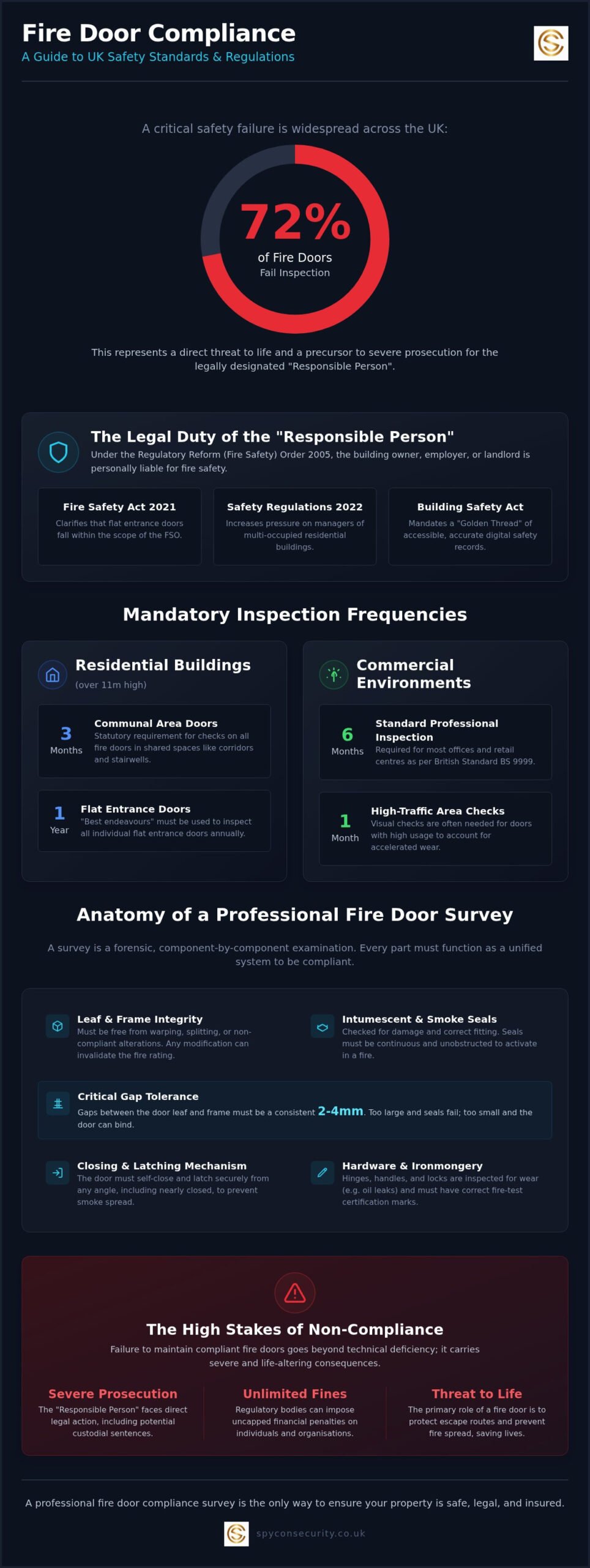
Over 72% of fire doors inspected in the UK currently fail to meet mandatory safety standards. For the “Responsible Person,” this data represents more than a technical deficiency; it’s a direct threat to life and a precursor to severe prosecution. You understand that fire safety demands absolute rigour, yet the introduction of the Fire Safety (England) Regulations 2022 and subsequent 2024 updates has left many building managers facing significant regulatory confusion. Commissioning a professional fire door compliance survey is the only way to ensure your property remains a safe, legal, and insured environment.
We’ll provide the expert guidance necessary to master these complexities and maintain an uncompromising standard of protection. This guide details the transition to the EN 1634-1 testing standard and the heightened enforcement powers of the independent Building Safety Regulator. You’ll learn how to establish a clear digital audit trail whilst securing the long-term safety of your inhabitants. We move beyond theory to provide a methodical framework for total compliance and operational peace of mind.
Key Takeaways
- Master the legal obligations of the “Responsible Person” to mitigate personal liability and ensure adherence to the latest UK fire safety standards.
- Identify the critical components of a fire door compliance survey, focusing on the rigorous verification of door leaves, frames, and intumescent seals.
- Recognise the risks associated with common compliance failures, such as non-compliant alterations and the compromise of compartmentation strategies.
- Establish a methodical maintenance regime that uses risk-based asset categorisation to maintain safety standards across multiple UK sites.
- Understand the necessity of professional remedial installation following a survey to secure a complete digital audit trail and achieve full legal certification.
Understanding Fire Door Compliance Surveys and UK Legal Requirements
A fire door compliance survey is not a cursory visual check. It is a forensic, component-by-component examination of a doorset’s ability to resist the passage of fire and smoke for a specified duration. Every element matters. The frame, the leaf, the hardware, and the intumescent seals must function as a unified system. Professional documentation provides the only verifiable proof that your building meets the rigorous standards required in 2026. Without a detailed report, compliance is impossible to demonstrate during a regulatory audit.
The Legal Framework: FSO 2005 to the Present
The Regulatory Reform (Fire Safety) Order 2005 remains the bedrock of UK fire legislation. It places the burden of safety on the “Responsible Person,” typically the building owner, employer, or landlord. This individual must ensure that all fire safety provisions are fit for purpose and maintained in efficient working order. Recent legislative shifts have tightened this focus significantly. The Fire Safety Act 2021 clarified that flat entrance doors and external walls are within the scope of the FSO, removing any ambiguity regarding a landlord’s liability.
The Fire Safety (England) Regulations 2022 increased the pressure on managers of multi-occupied residential buildings. Understanding Fire door components and function is now a technical necessity for those managing high-risk assets. Documentation is your primary defence. In the event of a legal audit or a post-incident investigation, a physical report is the only evidence that can withstand scrutiny. Digital record keeping is no longer optional. The Building Safety Act mandates a “Golden Thread” of information to ensure safety-critical data is accessible and accurate throughout the building’s lifecycle.
Mandatory Inspection Frequencies for 2026
Compliance requires a disciplined and documented schedule. For residential buildings in England over 11 metres in height, the law is explicit. Responsible Persons must carry out checks of fire doors in communal areas at least every three months. Additionally, they must use best endeavours to inspect all flat entrance doors on an annual basis. These are statutory requirements designed to preserve compartmentation and protect escape routes. Failure to meet these intervals can lead to unlimited fines or custodial sentences.
Commercial environments operate under different protocols. Most offices and retail centres require professional inspections every six months, as outlined in British Standard BS 9999. High-traffic areas often necessitate monthly visual checks to account for accelerated wear and tear. A competent person is someone with the specific training and accreditation to identify subtle defects that compromise integrity. Relying on unqualified staff to conduct a fire door compliance survey is a high-stakes gamble that risks both safety and legal standing.
The Technical Anatomy of a Professional Fire Door Inspection
A professional fire door compliance survey treats the doorset as a singular, high-performance unit. Precision is the baseline. The door leaf and frame must be free from warping, splitting, or non-compliant alterations that compromise structural integrity during a thermal event. Even a minor modification, such as an uncertified letterbox or a poorly fitted viewer, can invalidate the entire fire rating. Intumescent and smoke seals are checked for physical damage and correct fitting within the rebate. They must be continuous and unobstructed to function correctly.
Gaps represent a critical failure point in many buildings. A consistent tolerance of 2–4mm must be maintained between the leaf and the frame. If the gap is too large, the intumescent seals cannot bridge the void during a fire; if it’s too small, the door may bind. Closing mechanisms are tested with absolute rigour. A door that fails to latch from any angle, including from a nearly closed position, is a breach of UK Legal Standards. Reliability isn’t optional. It’s a life-saving requirement.
Hardware and Glazing Integrity
Hinges are often overlooked but are vital for operational readiness. Inspectors look for “darkening” or leaking oil. This indicates metal-on-metal friction and imminent mechanical failure. All ironmongery, including handles and locks, must bear the correct fire-test certification marks to ensure they can withstand extreme temperatures. Glazing requires equal scrutiny. The inspector verifies the presence of fire-rated glass and ensures the glazing beads are secure. If you identify systemic hardware issues, a professional fire door installation can restore full compliance and safety.
Signage and Thresholds
Clear communication prevents human error. Mandatory signage, such as “Fire Door Keep Shut” or “Fire Door Keep Locked,” must be visible on both sides of the door. Threshold gaps are measured with precision. These gaps must not exceed 10mm, particularly where smoke control is a priority. Intumescent seals play a dual role; they expand under heat to seal the door whilst the smoke seal component prevents the transfer of lethal cold smoke during the early stages of a fire. Every detail matters in a fire door compliance survey. Meticulous verification is the only path to safety.
Common Compliance Failures and the Risks of Neglect
High-traffic environments, such as London offices or Birmingham retail centres, subject fire doors to extreme operational stress. Constant use leads to accelerated wear and tear that often goes unnoticed until a professional fire door compliance survey is conducted. Mechanical components like door closers and hinges bear the brunt of this activity. When these elements fail, the door ceases to be a life-safety device and becomes a liability. Vigilance is the only way to prevent gradual degradation from turning into a systemic failure.
Human behaviour remains a significant risk factor in building management. Propping fire doors open with wedges or fire extinguishers is a common but catastrophic practice. It completely destroys the building’s compartmentation strategy, allowing smoke and flames to traverse escape routes unhindered. Unauthorised hardware changes are also rising in frequency. Fitting a non-fire-rated smart lock might seem like a modern security upgrade, but it often requires drilling through the core, which compromises the door’s integrity and invalidates its certification.
Improper remedial work is another frequent finding during inspections. Using standard wood filler or household sealants on fire-rated frames is a dangerous shortcut. These materials have no fire-resisting properties and will fail instantly under thermal pressure. A robust Fire Door Maintenance and Inspection Regime ensures that only certified materials and methods are used to maintain the doorset’s protective capabilities.
The Consequences of Non-Compliance
Neglect carries severe legal and financial penalties. In 2026, the Building Safety Regulator operates with enhanced enforcement powers. Prosecution for fire safety breaches can result in unlimited fines and custodial sentences for the Responsible Person. Beyond the courtroom, insurance invalidation is a critical risk. Insurers frequently refuse to settle claims if fire doors are found to be faulty or poorly maintained. This lack of cover can lead to the enforced closure of a business. Reputational damage following a formal fire safety notice is often permanent, eroding the trust of tenants and stakeholders alike.
Identifying “Hidden” Defects
Some failures are invisible to the untrained eye. Non-compliant fire stopping around the door frame can allow fire to bypass the doorset entirely, even if the door itself is in perfect condition. This highlights why doors must be evaluated as part of broader fire risk assessment services to ensure a holistic safety strategy. Painted-over intumescent seals are another systemic issue. Layers of gloss or emulsion prevent the chemical reaction required for the seal to expand during a fire. A professional fire door compliance survey identifies these technical nuances that a standard visual check would miss.
Establishing a Robust Fire Door Maintenance and Inspection Regime
Building safety isn’t a static state; it’s an ongoing operational commitment. A reactive approach to maintenance is a primary cause of legal failure and heightened risk. You must implement a structured regime that transforms fire safety from a burden into a disciplined routine. This systematic approach ensures that every doorset remains capable of performing its life-saving function throughout its service life.
Execution begins with a four-step framework designed for total oversight:
- Step 1: Baseline Verification. Begin with a comprehensive fire door compliance survey to audit every asset. This establishes a “state of the nation” report, identifying each doorset’s current condition and certification status.
- Step 2: Risk Categorisation. Not all doors face the same stress. Categorise assets by usage frequency and risk level. A main stairwell door in a busy London office requires more frequent scrutiny than a plant room door that’s rarely accessed.
- Step 3: Formalised Scheduling. Move beyond “best endeavours” by setting a hard calendar for competent person inspections. This ensures communal and high-traffic doors are checked at the legally mandated intervals without fail.
- Step 4: Occupant Engagement. Establish a clear reporting line. Building inhabitants are your first line of defence; they must have a simple way to flag damaged closers or loose seals immediately.
Training and Competency
There’s a critical distinction between a basic visual check and a technical survey. Whilst on-site staff can perform daily inspections, they must be equipped with the right knowledge. Investing in professional fire safety training empowers your team to spot early warning signs before they escalate into major breaches. For high-risk buildings, accredited third-party certification is a non-negotiable requirement to prove competence to the Building Safety Regulator. Relying on unverified expertise is a risk you don’t need to take.
Documentation and Digital Records
The “Golden Thread” of information is now a legal necessity. You must maintain a live fire door register that tracks every inspection, repair, and replacement. Photographic evidence is vital. It provides an indisputable record for compliance audits and insurance reviews. In cities like Manchester or Glasgow, where managers handle large portfolios, digital tagging and cloud-based reporting streamline this process. This level of meticulousness ensures that your safety-critical data is accessible and accurate at all times. To secure your building’s long-term safety, ensure your regime starts with a professional fire door compliance survey and a robust risk management plan.
Professional Fire Door Surveys and Remedial Solutions from Spycon Security
Spycon Security provides a definitive response to the complexities of UK fire safety. Our approach to a fire door compliance survey is rooted in rigorous verification and professional gravity. We don’t just identify defects; we provide the technical roadmap required to resolve them. This transition from audit to action is what sets us apart. Where a survey identifies a critical failure, our team facilitates a seamless move to professional fire door installation. This ensures that the “Golden Thread” of compliance remains unbroken from the first inspection to the final certification.
Our expertise isn’t confined to a single region. We maintain a strong local presence in hubs such as Coventry, Nottingham, and Edinburgh, delivering nationwide coverage with the precision of a local specialist. Beyond physical doorsets, we provide fire strategy reports that are approved for building control. This holistic view ensures that your compartmentation strategy aligns perfectly with your broader fire safety obligations. We bridge the gap between technical surveying and operational reality.
Why Choose Spycon for Your Compliance Journey?
We deliver detailed, declarative reports that eliminate ambiguity. Every finding is prioritised by risk level, allowing building managers to allocate remedial budgets where they’re needed most. For sites facing immediate regulatory pressure or technical failures, we offer integrated safety solutions. This includes manned guarding for properties requiring fire marshal or walking watch services. Our dual expertise in both security and fire safety provides a level of vigilant protection that traditional consultancy firms cannot match. We operate with uncompromising standards and a commitment to professional integrity that leaves no room for shortcuts.
Get Started with a Compliance Audit
Securing your property begins with a structured consultation. Our process is methodical. We assess your portfolio, conduct the on-site fire door compliance survey, and deliver a comprehensive digital report. This isn’t a mere “tick-box” exercise. It’s a high-stakes verification process conducted by seasoned experts. You’ll gain the peace of mind that comes from SIA-aligned professionalism and deep fire safety expertise. Don’t leave your legal standing to chance. Contact Spycon Security for your Fire Door Compliance Survey today and ensure your building remains fully compliant and protected.
Securing Your Property Through Rigorous Compliance
Maintaining fire safety in 2026 requires an uncompromising commitment to technical precision and legal accountability. The “Responsible Person” carries a significant burden of proof; documentation is your only defence against prosecution or insurance failure. A robust regime transforms your building from a potential liability into a verified safe environment. By establishing a digital audit trail and addressing defects with certified remedial works, you protect both your inhabitants and your legal standing.
A professional fire door compliance survey provides the forensic detail necessary to achieve this standard. Our team of SIA licensed and fire safety experts delivers nationwide coverage for UK property portfolios, ensuring consistency across every site. Beyond reporting, we offer full remedial installation services to close the loop on compliance. Precision is our baseline; your peace of mind is the result.
Secure your building with a professional fire door survey from Spycon Security. Take the proactive step today to ensure your property remains a beacon of safety and integrity.
Frequently Asked Questions
Is a fire door survey a legal requirement for all commercial buildings?
Yes, the Regulatory Reform (Fire Safety) Order 2005 mandates that fire safety provisions are maintained in efficient working order. Whilst the term “survey” isn’t explicitly named in a single clause, the Responsible Person must prove compliance through robust documentation. A professional survey is the only method to establish a legal audit trail. Failure to provide such evidence during a Building Safety Regulator audit can lead to severe legal penalties and unlimited fines.
How often should I have a professional fire door survey conducted?
Professional inspections for commercial premises should occur every six months according to BS 9999 standards. High-traffic environments often require monthly visual checks to manage accelerated wear. For residential buildings exceeding 11 metres, communal doors need quarterly inspections, whilst flat entrance doors require annual verification. A disciplined fire door compliance survey schedule ensures that your compartmentation strategy remains intact and your insurance cover stays valid throughout the year.
Who is qualified to perform a fire door compliance survey?
Inspections must be conducted by a “competent person” who possesses the necessary training, skills, and experience. This usually involves third-party accreditation from recognised bodies such as the Fire Door Inspection Scheme (FDIS). The surveyor must have the technical expertise to evaluate the entire doorset as a unified system. Relying on unverified staff for these high-stakes assessments is a significant risk that compromises both inhabitant safety and your legal standing.
What is the difference between a fire door check and a full survey?
A check is a routine visual inspection typically focused on obvious damage or obstructions. In contrast, a fire door compliance survey is an exhaustive technical audit of every component. This includes measuring gap tolerances with precision, verifying the certification of ironmongery, and assessing the condition of hidden intumescent seals. The survey produces a detailed asset register and a prioritised report of remedial works, providing the forensic evidence required for total compliance.
Can I repair a fire door myself, or do I need a specialist?
You must use a specialist for all fire door repairs to ensure the doorset’s integrity isn’t compromised. Standard DIY materials, such as domestic wood filler or unrated screws, don’t possess fire-resisting properties. A specialist uses certified components that match the door’s original fire-test evidence. This level of precision is essential because any uncertified modification can invalidate the entire fire rating, leaving the building vulnerable and the owner legally exposed.
What happens if my building fails a fire door inspection?
If a building fails, the Responsible Person must prioritise and complete remedial works immediately. A failed inspection isn’t just a technicality; it’s a breach of fire safety law. The Building Safety Regulator can issue enforcement notices, which often lead to unlimited fines or custodial sentences if ignored. Additionally, your insurance provider might refuse to pay out for any fire-related claims if they discover the doors were non-compliant at the time of the incident.
Do fire door regulations apply to flat entrance doors in residential blocks?
Yes, current legislation is very clear on this point. The Fire Safety Act 2021 confirms that flat entrance doors in multi-occupied residential buildings fall under the scope of the Fire Safety Order. For blocks over 11 metres, the law requires the Responsible Person to inspect these doors at least once every 12 months. This ensures that the compartmentation strategy protects escape routes for all residents, maintaining the critical “stay put” policy where applicable.
How long does a typical fire door survey take to complete?
The time required varies based on the size of the property and the complexity of the doorsets. An individual door typically takes between 15 and 30 minutes for a forensic examination. A large office complex or a high-rise residential block with hundreds of doors can take several days to audit fully. The surveyor needs sufficient time to document each asset, capture photographic evidence, and verify the certification marks on all hardware components.