

Fire Alarm Certification & Fire Safety Certificate Services Across Greater London
Before booking, send the existing certificate or service report and the request from your landlord, managing agent, council or insurer. We establish whether you need periodic inspection and servicing, fault investigation, or records for new or altered work. Design, installation, commissioning and periodic maintenance records have different purposes. Servicing does not retrospectively certify concealed installation work that has not been verified.
Whether you are a landlord, HMO owner, managing agent, facilities manager, business owner or Responsible Person, keeping your fire alarm system properly tested and maintained is an important part of looking after a property. At Spycon Security, we inspect, test and service existing fire alarm systems across London and provide clear documentation showing what was checked, what was tested and whether any faults or recommendations were identified.
Our existing-system services include:
• Fire Alarm Certificate London
• Fire Alarm Testing London
• Fire Alarm Servicing London
• Fire Alarm Service Certificate London
• Fire Alarm Inspection London
• Annual Fire Alarm Servicing London
• HMO Fire Alarm Certificate London
• Commercial Fire Alarm Testing London
• Fire Alarm Maintenance London
We confirm the inspection and certification your existing system needs, with a competent engineer responsible for the agreed work. London Fire Brigade recommends that fire alarm systems are appropriate for the premises and occupancy, properly maintained and managed by competent persons.
For houses, flats and HMOs in London, systems are graded under BS 5839-6.
A full fire alarm system with control panel, detectors and sounders.
Typically required in larger HMOs or buildings with complex layouts
Mains-powered, interlinked smoke alarms with battery backup.
Common in smaller residential properties.
London borough councils frequently specify Grade A systems in licensed HMOs where risk profile is higher.
Our team includes AM2-qualified electrical engineers or supervisors and personnel with relevant fire alarm training and system experience. AM2 demonstrates practical electrotechnical competence; the engineer must also understand the particular alarm system and work being undertaken. The testing engineer records the results, and the competent person responsible for the relevant certification reviews and signs
the documents. Any supervisor’s sign-off follows appropriate oversight and checks, rather than approval of work they have not verified.
Send us the property address, building type and any information you have about the existing fire alarm system. We can then discuss the appropriate inspection, testing or servicing
requirement.
Call 020 4600 4703
Our insurance is arranged through NAPIT, subject to the relevant
policies, activities, limits and exclusions. NAPIT training, insurance arrangements and contractor scheme registration are separate matters. Where a scheme-specific certificate or electrical notification is required, we identify the responsible registered contractor and applicable scope. Insurance alone does not confer scheme registration.
Provide panel details, the approximate device count, zone plan,
logbook, access information and known faults. Tell us about monitored connections, access control, door releases and other cause-and-effect interfaces. We agree occupant notification, any contact with the alarm receiving centre, isolation precautions and restoration after testing. Devices or areas that cannot be tested are identified in the record.
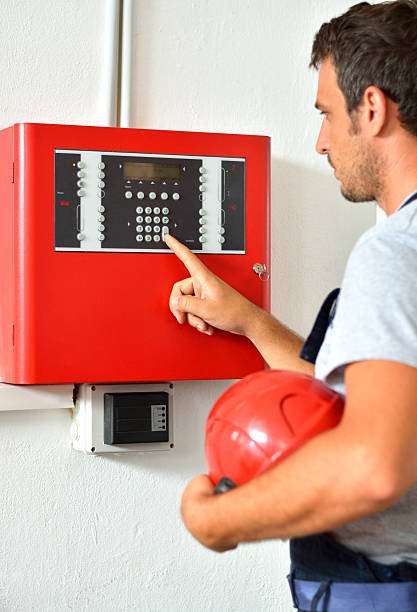
The quotation confirms the system and devices included, expected attendance, report delivery, VAT and agreed access charges. Replacement parts, repairs, design reviews, access equipment and return testing are separately agreed unless included. Failed items remain identified as faults until appropriate work and verification have been completed; a service record is not a blanket declaration that the whole building complies.
Keep routine user tests and logbook entries up to date between specialist visits. The appropriate maintenance programme depends on the system and risk. Category M describes a manual non-domestic alarm system. Domestic Grade F1 and F2 distinguish tamper-resistant and replaceable primary battery arrangements. Grades, detection categories and the building’s requirements
must be considered together.
Our certificate service is designed primarily around existing fire alarm systems.
You may need an inspection because:
• Your fire alarm service is due
• Your previous certificate has expired
• Your landlord records need updating
• An HMO licence requires current documentation
• A managing agent needs an up-to-date maintenance record
• Your business is preparing for a fire-safety review
• A Fire Risk Assessment has identified an issue
• The property has changed management
• The system has developed faults
• You have inherited a building without complete records
• An insurer has requested evidence of maintenance
• You have carried out changes to the building or alarm system
The inspection looks at the system that is actually there today. If historic documents are missing, we record what can be established from the existing installation instead of pretending to recreate paperwork that cannot be verified.
The phrase fire alarm certificate can mean different things depending on the work being carried out. For an existing fire alarm system, the certificate may relate to an inspection and servicing visit. Other certificates can relate to different stages of the system,
including:
• Design
• Installation
• Commissioning
• Acceptance
• Verification
• Modification
• Inspection and servicing
These documents are not interchangeable. For example, a Fire Alarm Installation Certificate records
installation work. A Fire Alarm Commissioning
Certificaterecords commissioning of a completed system. An Inspection and Servicing Certificate records the testing and
servicing of an existing system. That distinction is important when a landlord, property manager, insurer, licensing authority or other interested party asks for a
“fire alarm certificate”. We document the work that has actually been carried out rather than issuing a generic certificate that claims more than the inspection can establish.
A fire alarm panel showing “normal” does not, by itself, mean the whole system has been properly tested. Depending on the system and the agreed scope, our fire alarm
testing can include:
Control Panel
Checking the control and indicating equipment, indicators, faults and relevant functions.
Smoke and Heat Detectors
Testing relevant automatic detectors and checking their condition.
Manual Call Points
Testing manual activation points and checking for visible damage or obstruction.
Sounders
Checking audible alarm devices within the agreed testing arrangements.
Visual Alarm Devices
Testing visual alarm indicators where these are installed.
Batteries and Power Supply
Checking mains supply arrangements and standby batteries where accessible and applicable.
Faults and Indications
Reviewing fault indications and issues identified during testing.
Interfaces
Checking relevant interfaces where these form part of the system and are included within the inspection scope.
Fire Alarm Logbook
Reviewing available records, previous service entries and relevant system information.
The exact scope always depends on the system, premises,
documentation, accessibility and the work agreed.
Many customers search for annual fire alarm servicing London because that is the terminology they have been given by a previous contractor, managing agent or landlord. The correct maintenance frequency, however, depends on the system and premises. For relevant non-domestic systems, BS 5839-1:2025 recommends inspection and servicing at approximately sixmonth intervals. The maintenance programme must reflect the system, risk and applicable requirements; routine user tests continue between specialist visits. So an “annual fire alarm service” should not automatically be treated as enough for every commercial system. Government guidance also states that fire safety measures must be regularly inspected, tested and serviced, kept in efficient working order and good repair, and that people carrying out testing and maintenance must be competent. We can review your existing system and explain the appropriate maintenance arrangement.
A fire alarm system can deteriorate even when there is no obvious fault on the panel. During normal use, detectors can become contaminated, batteries can deteriorate, equipment can be damaged and the building itself can change. Common findings include:
• Dirty or contaminated detectors
• Detector faults
• Failed batteries
• Panel faults
• Sounder faults
• Damaged manual call points
• Faulty visual alarm devices
• Circuit faults
• Damaged equipment
• Missing or altered devices
• Incorrect labels
• Outdated records
• Historic faults that were never resolved
• Building changes affecting the system
Regular servicing is therefore about more than producing a piece of paper. It is about keeping the system in a condition where it can perform its intended function.
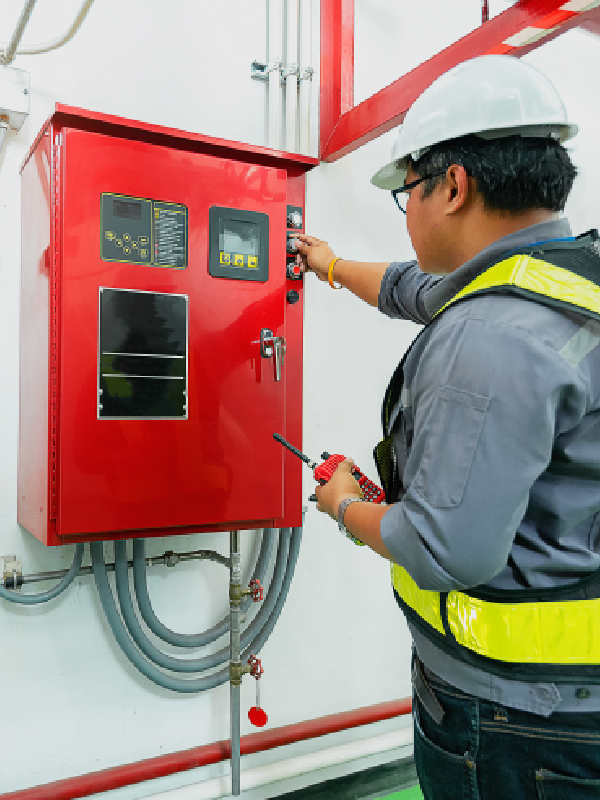
False alarms deserve more attention than they sometimes receive. Repeated unwanted fire alarm signals can disrupt a building and reduce confidence in the alarm. Reviewing false alarms and their causes is therefore an important part of managing an existing system. Repeated unwanted alarms can make people less likely to react quickly when a genuine fire occurs. LFB recommends investigating the reason for false alarms and taking steps to reduce repeat occurrences. Possible causes include cooking, steam, aerosols, smoking, hot works, environmental conditions, human error and maintenance issues. A good servicing programme should therefore look not only at whether the alarm operates, but also whether the system is being affected by recurring unwanted alarms.
Choosing someone to inspect a fire alarm system should not come down to price alone. London Fire Brigade advises Responsible Persons to use a competent person to design, install, maintain and manage fire alarm systems and recommends considering third-party accreditation when checking competency. At Spycon Security, our engineering team includes appropriately qualified electrical and fire-safety personnel, with qualifications and experience matched to the work being undertaken. Our competence profile can include the following
Our team includes relevant NAPIT-trained personnel. Qualifications, insurance arrangements and scheme registration are distinct.
Our team includes engineers with elevant Level 3 electrical and fire/security systems qualifications.
The Electrotechnical Certification Scheme has moved towards the Fire, Emergency and Security Systems (FESS)framework. The current FESS Systems Technician Gold Card is aimed at people who have achieved an industry-recognised Level 3
qualification or equivalent and can undertake relevant FESS installation and maintenance work without supervision.
Our team includes AM2-qualified electrical engineers or supervisors. Relevant system competence and responsible signoff are also required.
For certain fire alarm systems, panel-specific or manufacturer training can also be important. Addressable systems, networked panels and programmable cause-and-effect functions can require knowledge beyond general electrical qualifications.
Depending on the work, our engineers may also work with appropriate:
• Risk assessments
• Method statements
• RAMS
• Safe isolation procedures
• Site access procedures
• Working-at-height controls
• Asbestos-awareness requirements
• Building-specific health and safety arrangements
Qualifications alone do not make someone competent to work on every fire alarm system.
Competence has to match the system, the work and the circumstances of the premises.
Fire alarm terminology can become confusing because grades and categories are not the same thing. For domestic premises, BS 5839-6 uses grades such as Grade A, Grade C, Grade D and Grade F. For non-domestic premises, BS 5839-1 uses categories M, L1, L2, L3, L4, L5, P1 and P2. The appropriate classification depends on the building and its fire-safety requirements.
Grade A Fire Alarm
A Grade A domestic system is a comprehensive fire detection and
alarm arrangement incorporating a control and indicating panel,
automatic detection, alarm devices and standby power.
The exact installation and maintenance requirements depend on
the particular system and property.
A Grade A system should not automatically be assumed to be
required simply because a property is an HMO.
Grade C Fire Alarm
Grade C uses detectors and sounders with a common normal
and standby supply and central control equipment.
Its suitability depends on the property and the recommendations
applying to that particular premises.
Grade D Fire Alarm
A Grade D system uses mains-powered smoke and/or heat
alarms with integral standby power.
This includes:
Grade D1 — sealed, tamper-resistant standby battery.
Grade D2 — replaceable standby battery.
Grade D systems are commonly found in domestic premises, but
the appropriate grade depends on the building and applicable
requirements.
Grade F Fire Alarm
A Grade F system uses battery-powered fire detection without a
mains supply.
Grade F1 uses a tamper-resistant primary battery; Grade F2 uses
a replaceable primary battery. Suitability depends on the
premises.
The appropriate alarm arrangement depends on the applicable
legislation, property use, risk and relevant guidance.
The domestic LD categories describe the extent of automatic detection.
LD1 covers the areas specified throughout the premises, subject to the standard’s permitted exclusions.
LD2 covers escape-route circulation spaces and specified higherrisk rooms or areas.
LD3 covers circulation spaces forming the escape routes. The correct category depends on the building and fire-safety objectives.
For non-domestic premises, the classification is different.
Automatic detection throughout the protected premises, subject
to the detailed provisions of the applicable standard.
L2 adds detection in specified higher-risk areas to the protection
provided by L3.
L3 covers escape routes and rooms opening onto those routes, subject to the standard’s detailed provisions.
Detection principally within escape routes.
A system designed around a specific fire-safety objective or identified risk.
Commercial systems may also be designed for property protection.
Automatic detection throughout the protected premises, subject
to the detailed requirements.
Automatic detection in defined areas where property protection
is required.
A system can also have a combined life-protection and propertyprotection strategy.
HMOs need particular attention because the fire alarm arrangements can depend on the individual property. Factors may include:
This is why we do not publish a simplistic statement such as
“every three-storey HMO needs Grade A”.The appropriate arrangement has to be considered for the actual
building.
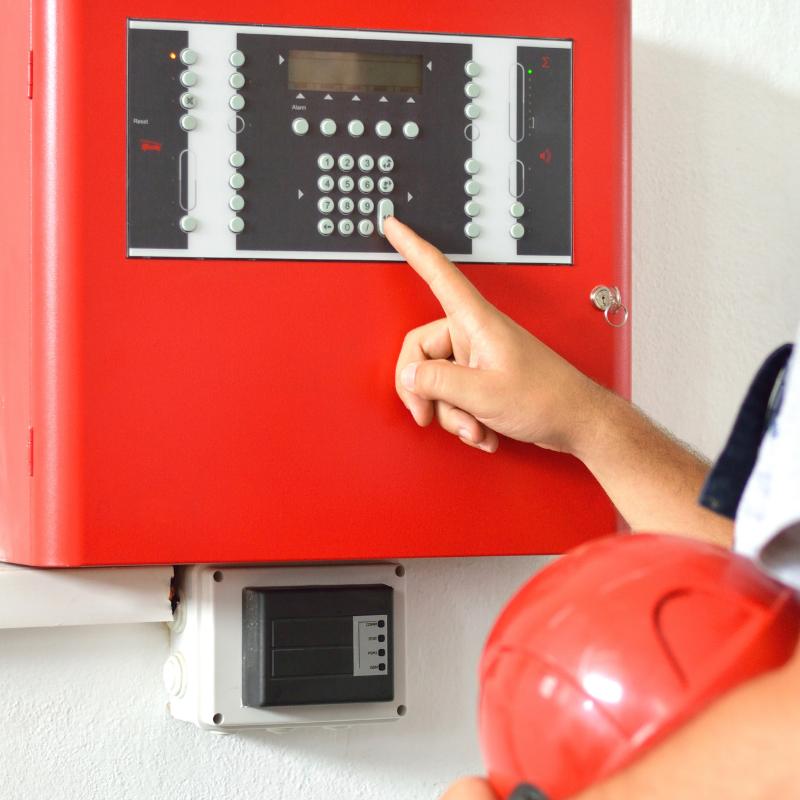
LACORS Housing – Fire Safety is widely referenced when considering fire precautions in certain types of existing housing, including HMOs. It considers factors such as the property’s:
LACORS is guidance, not legislation. A property’s fire alarm requirements should also be considered against the current fire-risk assessment, licensing requirements, building circumstances and relevant standards. This is particularly important in London because the local authority licensing requirements can differ between boroughs.
A basic domestic smoke alarm arrangement is not automatically
equivalent to a more comprehensive HMO fire detection system.
Depending on the property, an HMO system may involve:
The appropriate arrangement should be established from the
property and its fire-safety requirements rather than selecting
equipment first and trying to justify it afterwards.
Landlords often need to keep evidence that alarms have been inspected, tested or maintained. For private rented properties in England, government rules require smoke alarms on each storey containing a room used wholly or partly as living accommodation, along with carbon monoxide alarms in relevant rooms containing fixed combustion appliances, subject to the legislation. Landlords must repair or replace faulty alarms when they are informed and the fault is confirmed. These minimum requirements should not be confused with the more comprehensive fire alarm arrangements that may be needed for an HMO or other higher-risk property. A fire alarm service certificate can form part of the property’s wider maintenance records.
For offices, shops, warehouses, restaurants, industrial premises and other non-domestic buildings, the fire alarm system forms part of the building’s wider fire-safety arrangements. Under the Fire Safety Order, the Responsible Person has duties relating to fire safety at the premises. GOV.UK identifies employers, owners, landlords, occupiers and people such as facilities managers and managing agents as examples of people who may be a Responsible Person depending on the circumstances. Fire safety measures must be maintained regularly and kept in efficient working order and good repair.
The Regulatory Reform (Fire Safety) Order 2005, as amended, remains a central part of the fire-safety framework for relevant non-domestic premises and relevant common parts. The Responsible Person has a duty to manage fire safety. Fire alarm maintenance is one part of that responsibility. GOV.UK guidance explains that fire safety measures should be regularly inspected, tested and serviced and that defects should be repaired as soon as practicable. This is why keeping your fire alarm logbook and service documentation up to date matters.
The Fire Safety Act 2021 clarified the application of the Fire Safety
Order to important elements of multi-occupied residential
buildings, including:
• Structure
• External walls
• Cladding
• Balconies
• Flat entrance doors between domestic premises and
common parts. These matters form part of the wider fire-risk assessment and are
not replaced by a fire alarm certificate.

The Fire Safety (England) Regulations 2022 introduced additional
requirements for relevant multi-occupied residential buildings.
Depending on the building, requirements can include:
• Resident fire-safety information
• Fire door information
• Checks of communal fire doors
• Checks of flat entrance doors
• Fire and Rescue Service information
• Secure information boxes
• Wayfinding signage
• Firefighting equipment and lift checks in applicable high-rise
buildings
A fire alarm certificate is therefore only one part of a building’s
overall fire-safety record.
Changes made through Section 156 of the Building Safety Act 2022 strengthened requirements around recording fire-risk assessments, fire-safety arrangements, Responsible Person information and cooperation between Responsible Persons. For relevant premises, good fire-safety records are increasingly important. Your fire alarm service documentation should therefore be retained with the property’s wider fire-safety information.
An EICR and a fire alarm certificate are not the same document. An EICR relates to the condition of an electrical installation. A fire alarm certificate relates specifically to the fire detection and alarm system and the work carried out on that system. The two may both be required for a property, but one does not replace the other.
A block of flats can contain several different fire alarm arrangements. For example:
• Individual dwelling alarms
• Communal-area detection
• Protected escape routes
• Plant room detection
• Bin store detection
• Commercial-area systems
• Mixed-use systems
The right arrangement depends on the building’s fire strategy and applicable requirements. We inspect and document existing fire alarm arrangements without assuming that every residential block uses the same system.
A properly maintained fire alarm logbook can provide a useful
record of how the system has been managed. Records may include:
• Routine tests
• Alarm activations
• False alarms
• Faults
• Repairs
• Servicing
• Modifications
• Maintenance visits
• Outstanding issues
• System information
LFB recommends being organised and keeping appropriate
records, and its guidance stresses the importance of a detailed
log of system events and trends.
Do not assume that missing paperwork means the fire alarm needs replacing. You may simply have lost the original:
• Design certificate
• Installation certificate
• Commissioning certificate
• Acceptance certificate
• Verification certificate
• Modification certificate
Where historical information cannot be verified, it should not be recreated as though it were the original document. Instead, the existing system can be inspected and its current condition and operation documented. That gives you a genuine record rather than a reconstructed history.
One of the frustrating things about fire alarm servicing is being told:
“Your system has failed. Find someone else to repair it.”
Our Assess & Fix approach is designed to make the process simpler. Where the fault and required work are within our scope, we can investigate the issue, explain the repair needed and provide a quotation or carry out remedial work where appropriate.
That can mean fewer visits and less time spent coordinating separate contractors.
We do not believe in hiding problems simply to produce a certificate. If testing identifies a defect, it should be explained clearly. Typical issues include:
The detector may require cleaning, investigation or replacement.
Standby batteries may have reached the end of their useful life.
The control panel may display or record an issue.
One or more alarm devices may not operate correctly.
A fault may be identified on a circuit or loop.
The current system may no longer match its documentation.
Labels, zone information or records may require updating. The appropriate response depends on the actual defect.
The condition of the equipment is only part of effective fire alarm management. LFB advises property managers to:
• Keep the system appropriate for the building
• Use competent people
• Maintain the system effectively
• Investigate false alarms
• Reduce unnecessary alarm transmissions
• Keep the Fire Risk Assessment current
• Keep suitable records
• Make sure the emergency plan works alongside the alarm
strategy
LFB’s guidance also points out that recurring false alarms can lead to complacency and put people and firefighters at unnecessary risk. A good servicing contractor should therefore understand the difference between simply resetting a panel and finding out why the alarm keeps activating.
Spycon Security provides fire alarm testing, inspection and certification across Greater London, covering all 32 London boroughs and the City of London.
City of London
Fire alarm testing and certification for offices, commercial properties and managed buildings.
Westminster
Fire alarm inspection and servicing for commercial and residential premises.
Camden
Fire alarm certificates for landlords, HMOs, businesses and residential properties.
Islington
Testing and servicing for HMOs, rental properties and commercial premises.
Kensington and Chelsea
Fire alarm inspection and certification for residential and commercial properties.
Barnet
HMO, landlord, residential and commercial fire alarm certification.
Enfield
Fire alarm testing and maintenance for existing systems.
Haringey
Inspection and servicing for HMOs and managed properties.
Harrow
Fire alarm certificates for residential and commercial premises.
Hillingdon
Testing, servicing and certification for landlords and businesses.
Barking and Dagenham
Fire alarm certification for HMOs, rented properties and commercial premises.
Hackney
Fire alarm testing and servicing for landlords, HMOs and businesses.
Havering
Inspection and certification for residential and commercial buildings.
Newham
Fire alarm testing for HMOs, landlords and commercial properties.
Redbridge
HMO, landlord, residential and commercial fire alarm services.
Tower Hamlets
Fire alarm certification for residential blocks, HMOs and commercial premises.
Waltham Forest
Testing and servicing for rental properties, HMOs and businesses.
Brent
Fire alarm inspection for HMOs, landlords and commercial premises.
Ealing
Testing and servicing for offices, HMOs and residential properties.
Hammersmith and Fulham
Fire alarm certificates for commercial, HMO and residential properties.
Hounslow
Inspection and certification for landlords and businesses.
Richmond upon Thames
Testing and servicing for residential and commercial premises.
Bexley
Fire alarm testing and certification for landlords and businesses.
Bromley
Inspection and servicing for HMOs and residential premises.
Croydon
Fire alarm certificates for HMOs, landlords and commercial properties.
Greenwich
Testing and servicing for residential and commercial premises.
Kingston upon Thames
Fire alarm inspection for HMOs, landlords and businesses.
Lambeth
Fire alarm testing and certification for HMOs and commercial
premises.
Lewisham
Inspection and servicing for landlords, HMOs and businesses.
Merton
Fire alarm certificates for residential and commercial properties.
Southwark
Testing and certification for HMOs, mixed-use and commercial buildings.
Sutton
Fire alarm inspection and servicing for landlords and businesses.
Wandsworth
Fire alarm certification for residential, HMO and commercial premises.
The fire alarm requirements are not necessarily identical between properties or boroughs. Local licensing conditions, the building’s fire risk and the system already installed all need to be considered.
Choosing a fire alarm contractor is about more than finding the cheapest certificate.
Our engineering team includes appropriately qualified personnel, with experience and credentials relevant to the work being carried out.
AM2-qualified engineers or supervisors support the electrical scope. The competent person responsible signs the relevant work records.
Our competence profile includes relevant Level 3 and ECS/FESS pathways, depending on the individual engineer and scope of work. The current ECS FESS Gold standard is based around Level 3 competence in Fire, Emergency and Security Systems.
We understand the distinction between British Standards, legislation, Fire Risk Assessments and local authority licensing requirements.
Our certificate service is designed to inspect and maintain the system already installed rather than automatically recommending replacement.
Where appropriate, we can help move from identifying a fault to getting the problem resolved.
We cover all 32 London boroughs and the City of London.
Our documentation is designed to tell you what was inspected, what was tested and what needs attention.
Whether you need a Fire Alarm Certificate London, fire alarm testing, fire alarm servicing, an inspection certificate or an ongoing maintenance programme, we can help assess your existing system. We work with:
The process starts with understanding the property and the fire alarm system already in place.
The scope of inspection, testing, servicing and certification depends on the system, property, accessibility, available information and agreed work. A fire alarm certificate records the work undertaken and is not a substitute for a Fire Risk Assessment or wider fire-safety management.
The answer depends on the system and premises. For non-domestic systems following BS 5839-1:2025, successive inspection and servicing visits are recommended at approximately six-month intervals.
Not automatically.
“Annual fire alarm servicing” is a common search term, but a
non-domestic system may require more frequent inspection and
servicing.
It is documentation recording specific work carried out on a fire detection and alarm system.
No. A Fire Risk Assessment considers the wider fire risks of the
premises. A fire alarm certificate relates specifically to the fire
alarm work documented.
The exact documentation depends on the property, system and
licensing requirements. HMO fire-safety requirements should be
considered alongside the Fire Risk Assessment and local
authority conditions.
LACORS is guidance, not legislation. The correct alarm
arrangement depends on the property and applicable
requirements.
Grade A is a comprehensive domestic fire detection and alarm
system incorporating central control and indication, automatic
detection, alarm devices and standby power.
Grade D is a domestic arrangement using mains-powered smoke
and/or heat alarms with integral standby power.
Grade F is a battery-powered domestic fire detection
arrangement without mains power.
LD1 describes the broadest extent of automatic detection within
a domestic fire alarm category.
L2 is a non-domestic life-protection category providing detection
on escape routes plus additional areas presenting specified risks.
P1 is principally a property-protection category involving
automatic fire detection throughout the protected premises,
subject to the applicable requirements.
Yes, subject to the system, condition, access and agreed scope.
We can inspect the existing system and document its current
condition and the work carried out. We do not recreate historic
documents that cannot be verified.
Where the issue falls within our scope, we can investigate and
quote for or undertake remedial work.
No. It documents the work undertaken. Overall fire-safety
compliance depends on the wider circumstances of the property,
including the Fire Risk Assessment, fire precautions,
management arrangements and applicable requirements.