

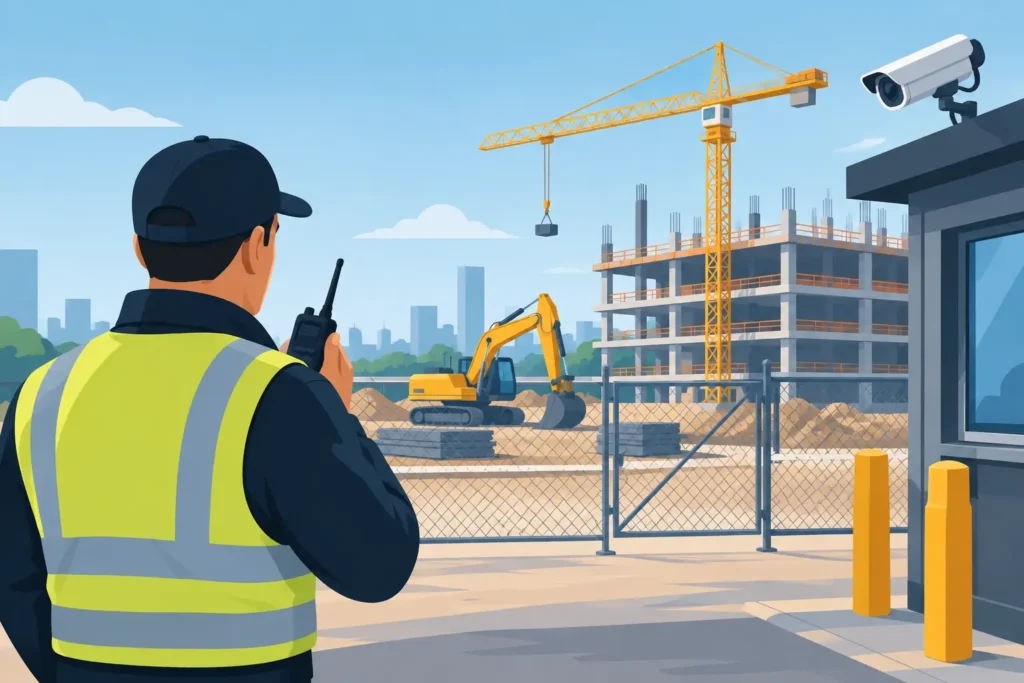
A missing generator, an open perimeter gate, or an undocumented after-hours delivery can create more than an immediate loss. Each can delay critical work, expose workers and visitors to danger, complicate an insurance claim, and leave the project team answering difficult questions. Effective construction site security is not a single guard at a gate or a camera mounted on a pole. It is a controlled operation that protects the site, the schedule, and the evidence needed when an incident is challenged.
Construction projects are especially exposed because conditions change constantly. Perimeters move, subcontractors rotate, materials arrive in stages, and partially completed structures can create new access points overnight. The security plan must adapt at the same pace.
What Construction Site Security Must Control
A construction site has several risks operating at once. Theft is often the most visible concern, particularly for fuel, power tools, plant equipment, copper, and high-value materials. However, unauthorized entry, vandalism, arson, unsafe access, trespass, and fraudulent activity can be just as disruptive. A security arrangement that only responds after property disappears is already too late.
The first control is the perimeter. Fencing, gates, lighting, warning signage, and locked storage areas establish a physical boundary, but their value depends on consistent use. A gate left unsecured for a delivery, damaged fencing that is not reported, or a blind area behind temporary accommodation can defeat an otherwise sound setup. Routine checks should confirm that the boundary remains intact as site layouts and work phases change.
The second control is access. Every person entering a site should have a legitimate reason to be there, whether they are a worker, contractor, visitor, courier, inspector, or emergency responder. Sign-in procedures, credential checks, visitor escorts, vehicle records, and delivery verification create accountability. The right approach depends on site size and activity, but the principle does not change: access should be authorized, recorded, and proportionate to the risk.
The third is visible, capable presence. Trained security officers deter opportunistic crime, challenge unauthorized individuals, conduct patrols, monitor vulnerable areas, and respond to issues before they develop. Their role is not limited to standing at an entrance. On an active project, officers need clear post orders, escalation routes, communication tools, and an understanding of site rules, emergency arrangements, and contractor activity.
Build Protection Around the Real Site Risk
Security should begin with a site-specific assessment rather than a standard package. A city-center redevelopment with frequent public foot traffic has different exposures than an isolated infrastructure project or a residential development nearing handover. The risk profile may also shift between daytime work, weekend shutdowns, and overnight periods.
Start by identifying what would cause the greatest operational damage. For some projects, it is the loss of excavators or specialist tools. For others, it is unauthorized access to unfinished floors, theft of installed fixtures, deliberate fire-setting, or disruption to deliveries. Consider the surrounding area, visibility from public roads, previous incidents, material storage, power supply, access routes, and the value of equipment left on site.
This assessment should lead to practical decisions. A low-activity site with limited entry points may be well served by monitored cameras, intrusion detection, scheduled patrols, and controlled keyholding. A high-risk or high-value project may require a permanent security presence, vehicle checks, a staffed gatehouse, regular internal patrols, and canine support during vulnerable hours. There is no value in paying for a high-profile presence where technical monitoring is sufficient, and no value in relying on cameras alone when a live intervention is needed.
A layered arrangement is usually the most dependable. Physical barriers delay entry. Cameras provide visibility. Monitoring identifies activity. Officers intervene, preserve the scene, and communicate with site management or emergency services. Each measure covers a limitation in another, reducing the gaps that criminals and unsafe visitors exploit.
Cameras Need Monitoring and a Response Plan
Temporary CCTV is a valuable construction tool because it can cover changing perimeters, storage compounds, access gates, and elevated viewpoints. It also provides an evidential record of suspicious activity, damage, deliveries, and site movements. Yet footage only has value if someone can see what matters, act on it, and retrieve it when required.
Round-the-clock CCTV monitoring gives the site an active layer of oversight outside working hours. A control room can assess alerts, identify whether an intrusion is genuine, issue audio warnings where appropriate, dispatch response personnel, and contact emergency services under an agreed escalation plan. This reduces false callouts while ensuring genuine incidents are not left unattended.
Camera placement matters as much as camera quality. Coverage should account for entry points, likely climbing routes, blind spots created by stacked materials, parking areas, fuel tanks, plant compounds, and changing building elevations. As construction advances, a camera plan that worked during groundworks may no longer protect upper floors, newly installed equipment, or temporary openings.
A documented response protocol should answer basic operational questions before an incident happens: who receives an alert, who has authority to make decisions, who holds keys, where officers should attend, and how evidence is retained. Without this clarity, delays can turn a manageable event into a serious loss.
Security Officers Must Be Part of Site Operations
Manned guarding is most effective when security personnel are integrated into the project’s daily operating rhythm. Officers should know the authorized work hours, the names and roles of key contacts, approved delivery processes, emergency assembly points, restricted zones, and the procedure for reporting hazards. They must also understand the limits of their authority and when to involve management or law enforcement.
Clear post orders make this possible. They should cover gate control, patrol frequency, visitor management, vehicle inspections where applicable, incident reporting, welfare checks, lock-up procedures, and escalation arrangements. Orders must be reviewed as the site develops. A guard working from instructions written at mobilization may miss new risks introduced by structural changes, new subcontractors, or shifting material storage.
Professional reporting is central to accountability. Daily occurrence logs, visitor records, patrol reports, photographs, incident reports, and handover notes give project leaders a clear view of what has happened on site. These records support investigations, insurer discussions, contractor management, and compliance reviews. They also reveal patterns, such as repeated perimeter breaches or delivery issues, that require corrective action.
Canine security can add a strong deterrent on large, remote, or high-risk sites, particularly during night hours and shutdown periods. It is not appropriate for every project. The deployment must be managed by properly trained handlers, with attention to site conditions, public proximity, welfare requirements, and the need to avoid interfering with legitimate operations. Used correctly, it can extend patrol capability and make unauthorized entry significantly less attractive.
Fire Risk Cannot Sit Outside the Security Plan
An unattended construction site faces more than intrusion risk. Temporary electrics, combustible materials, hot works, waste accumulation, arson exposure, and changing escape routes can all create serious fire concerns. Security and fire safety are often managed separately, but on a live project they intersect every day.
Security officers conducting patrols are often among the first people to identify unsecured fuel, blocked access routes, damaged fire points, evidence of smoking, or unauthorized activity around vulnerable areas. Their observations should feed directly into the site’s fire-safety process rather than remain isolated in a security log.
The project team should ensure that lock-up routines support fire precautions. This may include checking that access for emergency vehicles is not obstructed, fire exits and routes remain usable, flammable materials are stored appropriately, and concerns found during patrols are reported to the responsible person without delay. Security staff are not a substitute for a fire risk assessment or required fire-safety controls, but a coordinated operation makes those controls more reliable in practice.
Measure Performance, Then Adjust
Security that remains unchanged while a project evolves will eventually leave a gap. Review the arrangement after incidents, major deliveries, phase changes, holidays, increased material values, or alterations to the perimeter. Ask whether the controls prevented loss, whether response times were acceptable, and whether reports provide enough evidence to support management decisions.
The strongest providers do more than supply personnel or equipment. They maintain trained and vetted staff, continuous monitoring capability, defined operating procedures, and records that stand up to scrutiny. They can coordinate physical protection, technical systems, incident response, and fire-safety awareness through one accountable structure.
Construction is a moving environment, and its protection must move with it. When the next gate changes position, the next floor is opened, or the site closes for a long weekend, the right question is not whether security is present. It is whether the controls, people, and evidence are ready to hold up when they are needed most.