

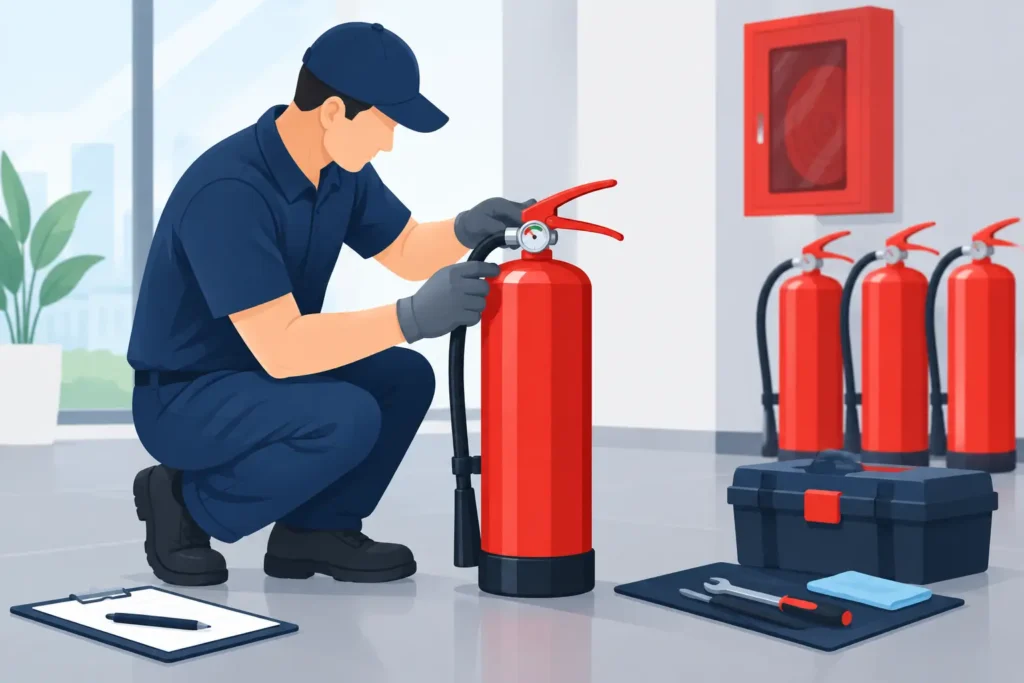
A fire extinguisher can look ready while being incapable of controlling a fire. A damaged hose, depleted pressure, blocked access point, missing pin, or overdue internal examination may only become visible when someone needs the unit most. Commercial fire extinguisher servicing turns those hidden failures into documented, correctable actions before an incident puts people, operations, and property at risk.
For facilities managers, landlords, site managers, and operations leaders, this is not a box-checking exercise. Extinguisher servicing is part of a wider life-safety control system. It supports the fire risk assessment, helps staff respond during the first critical moments of a small fire, and provides evidence that the premises has been managed with proper care.
What Commercial Fire Extinguisher Servicing Covers
Servicing confirms that extinguishers are present, suitable, accessible, and capable of operating as intended. The precise work depends on the extinguisher type, its age, manufacturer guidance, local fire code requirements, and the service history. A competent technician should assess the condition of the equipment rather than simply attach a new inspection label.
A routine service commonly includes an external condition check, verification of pressure or weight where applicable, examination of the safety pin and tamper seal, inspection of the hose and horn, and confirmation that operating instructions remain legible. The technician should also check the extinguisher’s location, visibility, signage, and access. An extinguisher behind stored materials or a locked door may be technically serviceable but operationally unavailable.
The service record matters as much as the physical inspection. Decision-makers need clear evidence of what was checked, what failed, what was replaced, and what still requires action. A vague certificate that cannot be matched to individual assets creates avoidable uncertainty during an inspection, claim, or post-incident review.
Service intervals are not all the same
Portable extinguishers do not all follow one identical timetable. Many require periodic visual inspections and annual maintenance, while certain models need more extensive internal examinations or pressure testing at longer intervals. The applicable schedule can vary by extinguisher type and local requirements.
This is where a generic approach creates risk. A site may have water, foam, carbon dioxide, dry chemical, wet chemical, or clean-agent extinguishers, each with different uses and maintenance needs. Kitchen suppression risks, electrical equipment, flammable liquids, warehouses, and public-facing areas all influence what equipment is appropriate and how it should be maintained.
A qualified provider should maintain an asset register that identifies each unit, its type, location, serial number, service status, and next due date. That register gives facilities teams control over multi-floor offices, residential buildings, retail portfolios, construction projects, and dispersed sites without relying on memory or incomplete paper tags.
Why Extinguisher Servicing Is a Compliance Control
Fire safety duties are judged by more than whether an extinguisher hangs on a wall. Authorities having jurisdiction, insurers, auditors, clients, and investigators may ask whether equipment was selected for the hazards present, maintained by competent personnel, and supported by records. If a fire occurs, the question becomes practical and direct: could staff access suitable equipment that had been properly maintained?
Commercial fire extinguisher servicing helps answer that question with evidence. It demonstrates that equipment has been inspected on schedule, defects have been identified, and remedial work has been tracked. It also exposes wider compliance gaps, such as missing signage, unsuitable mounting heights, obsolete extinguishers, or changes in site use that have altered the fire risk.
Consider a warehouse that has added battery-charging equipment, expanded storage racking, or introduced new packaging materials. The original extinguisher layout may no longer reflect the hazards or travel distances within the building. Servicing provides an opportunity to spot the change, but a fire risk assessment determines whether the overall provision remains suitable. These controls work together. Neither should be treated as a substitute for the other.
The Operational Failures That Cause Problems
Most extinguisher shortcomings are routine, not dramatic. They arise when site changes outpace safety controls, when several contractors assume someone else is responsible, or when service records are stored without being reviewed.
Common issues include:
- extinguishers blocked by stock, furniture, or construction materials;
- equipment relocated without updating plans or asset records;
- the wrong extinguisher type placed near a specific hazard;
- units discharged, damaged, or missing after an incident or act of vandalism;
- inspection dates missed because responsibility is unclear; and
- service reports filed without completing the corrective actions they identify.
The final point deserves particular attention. A technician may identify defective equipment, but the premises remains exposed if replacement approval, purchasing, access arrangements, or installation are delayed. Strong compliance management assigns an owner, a deadline, and proof of completion to every remedial action.
For occupied residential properties, event venues, hospitals, schools, and sites with vulnerable occupants, delays carry added consequence. Evacuation may take longer, staff may be managing the public, and the consequences of a small fire escalating can be severe. Extinguisher readiness must be treated as an operational control, not an administrative task.
Selecting the Right Service Provider
Price matters, but the lowest quote can conceal a narrow scope. Before appointing a provider, establish whether the service includes a full asset audit, defect reporting, replacement recommendations, labeling, certification, and support for corrective actions. Ask how they manage emergency replacements, out-of-hours access, and sites with complex security procedures.
Competence is central. The person inspecting the equipment should understand extinguisher types, common failure modes, relevant standards, and the hazards within commercial premises. They also need to work safely around live operations, controlled areas, tenant spaces, and sensitive environments. A technician who cannot obtain access to every required location cannot certify a complete inspection.
There is also value in coordinating fire servicing with the wider protection program. Fire doors, alarm systems, emergency lighting, evacuation arrangements, staff training, and site security all affect readiness. A single accountable provider can reduce handoff failures, particularly where access control, 24/7 monitoring, building management, and fire compliance overlap. Spycon Security Ltd. supports this joined-up approach by connecting practical fire-safety delivery with documented compliance and operational site protection.
Keeping Extinguishers Ready Between Visits
A professional service visit does not remove the need for site-level checks. Facilities teams should assign a responsible person to carry out brief, regular visual inspections between scheduled maintenance visits. The objective is not to dismantle equipment. It is to confirm that units remain in place, visible, unobstructed, undamaged, and within their service date.
This check is especially valuable after building works, tenant moves, events, deliveries, flooding, vandalism, or any incident involving smoke or fire. It should also be built into opening procedures for high-traffic premises and handover processes for construction sites. If an extinguisher is used, even briefly, it should be removed from service and assessed immediately. Returning it to the wall without inspection creates an unacceptable assumption of readiness.
Staff training should match the fire strategy. Employees may need to know where extinguishers are located and when it is safe to use one, but no one should be encouraged to fight a fire that is spreading, producing heavy smoke, or blocking escape. The priority remains raising the alarm, calling emergency services, and evacuating in line with the site plan.
Documentation That Holds Up Under Scrutiny
Reliable records should make it easy to establish what equipment exists, where it is located, when it was serviced, and what action was taken. Keep service certificates, asset registers, defect reports, replacement records, and relevant staff-check logs together with other fire-safety documentation.
Digital records can improve oversight across multiple locations, but only if they are accurate and actively managed. A dashboard showing every extinguisher as compliant is not useful if a damaged unit has not been replaced on the ground. The evidence must reflect the actual condition of the premises.
When commercial fire extinguisher servicing is planned, documented, and tied to prompt corrective action, it gives your people a better chance of controlling an early-stage incident without compromising evacuation or safety. The practical next step is simple: verify that every extinguisher on your site can be accounted for, accessed, and supported by a current service record before you are asked to prove it.