

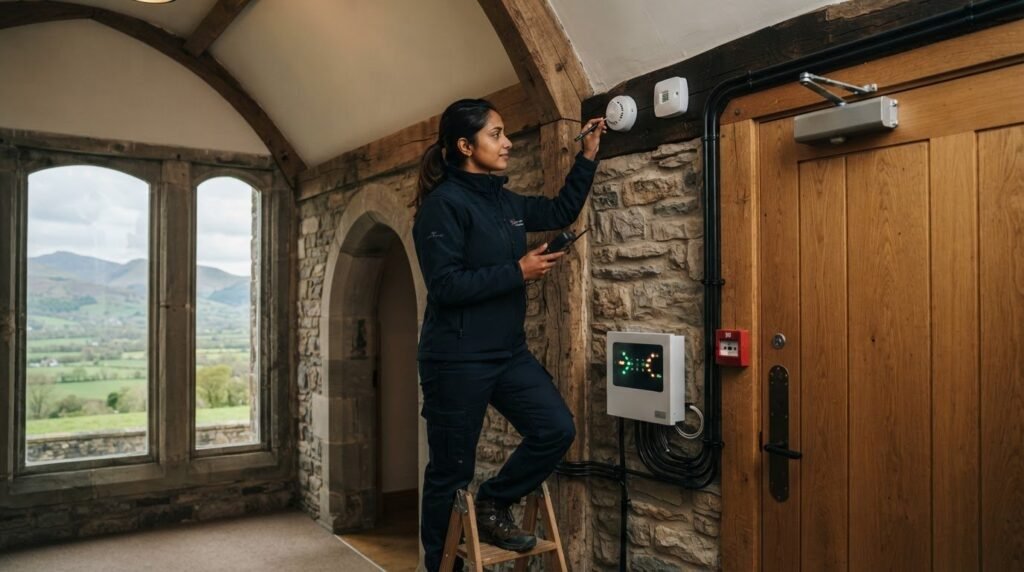
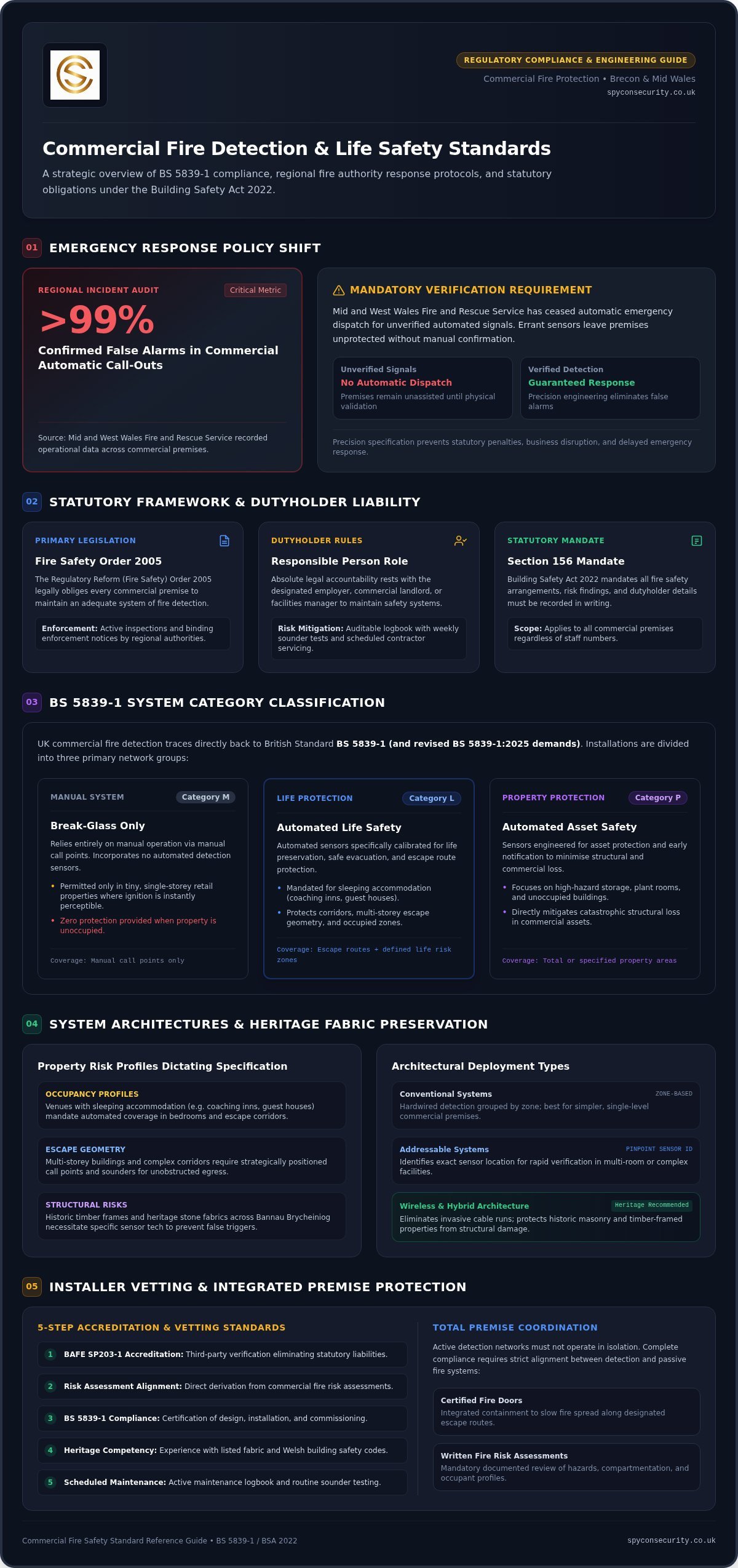
Over 99% of commercial automatic fire alarm call-outs attended across the region were confirmed false alarms, prompting Mid and West Wales Fire and Rescue Service to cease responding to unverified automated signals. For commercial decision-makers seeking reliable fire alarms Brecon premises demand, this shift makes precision engineering non-negotiable. An errant sensor no longer just disrupts trade; it leaves your building unprotected by emergency services without a verified manual confirmation.
You already recognise the immense friction of safeguarding a business here. Operating within historic masonry or timber-framed properties across Bannau Brycheiniog means balancing strict heritage preservation with the revised demands of BS 5839-1:2025 and Welsh building safety enforcement. Cutting into listed fabric or selecting the wrong hardware risks statutory penalties and operational paralysis. Navigating these overlapping legal liabilities should never rely on guesswork.
This comprehensive commercial guide resolves that uncertainty. You will discover how to match BS 5839 system categories directly to your premises, avoid disruptive false alarms, and evaluate accredited installers who can seamlessly integrate detection with your mandatory fire risk assessment.
Key Takeaways
- Understand the vital operational implications of regional fire authority response policies to guarantee your emergency verification procedures remain compliant.
- Learn how to select the precise BS 5839 category for commercial fire alarms Brecon enterprises require, matching sensor coverage directly to life-safety risk.
- Discover how wireless and hybrid system architectures protect historic properties across Bannau Brycheiniog without causing structural damage or invasive cable runs.
- Apply a rigorous 5-step installer vetting framework focused on third-party accreditations such as BAFE SP203-1 to eliminate statutory liabilities.
- Coordinate active detection networks with certified fire doors and mandatory written fire risk assessments to achieve complete premises protection.
Understanding Fire Alarms in Brecon: Legal Obligations for Commercial Premises
Operating a business in Powys carries strict statutory life-safety responsibilities. Under the Regulatory Reform (Fire Safety) Order 2005, every commercial property must maintain an adequate system of fire detection. Compliance isn’t a box-ticking administrative exercise; it’s an operational imperative designed to ensure business continuity and protect human life. Mid and West Wales Fire and Rescue Service actively enforces these codes across commercial properties. They inspect sites, review safety measures, and take swift enforcement action against premises that fail to meet modern benchmarks for commercial fire alarm systems.
The Role of the Responsible Person Under UK Fire Safety Law
The law assigns absolute accountability to the designated “Responsible Person”. Whether you’re an employer, commercial landlord, or facilities manager, the statutory burden rests squarely on your shoulders. Section 156 of the Building Safety Act 2022 mandates that all fire safety arrangements, risk findings, and dutyholder details must be recorded in writing, regardless of staff numbers.
Failure to comply triggers severe legal repercussions. Fire authorities issue binding enforcement notices, financial penalties, or immediate prohibition notices that halt trading instantly. Mitigating this personal liability requires maintaining an active, auditable fire safety logbook on site, documenting weekly sounder tests, staff training, and scheduled contractor servicing without exception.
Connecting Fire Risk Assessments to Alarm System Design
A compliant system cannot be procured off the shelf. System architecture must derive directly from an up-to-date commercial fire risk assessment. This foundational audit examines specific building hazards, internal compartmentation, and occupant profiles to specify the required protection category under BS 5839-1.
Property layout directly influences equipment selection for fire alarms Brecon enterprises commission:
- Occupancy profiles: Venues with sleeping accommodation, such as coaching inns or guest houses, mandate automated coverage within bedrooms and escape routes.
- Escape geometry: Multi-storey buildings and complex corridors require strategically placed call points and sounders to guarantee clear, unobstructed egress.
- Structural risks: Historic timber frames and heritage stone fabrics necessitate specific sensor technologies to avoid false triggers while ensuring rapid detection.
Commissioning fire alarms Brecon contractors quote without a prior risk assessment guarantees specification error. You risk under-protecting high-hazard areas or spending capital on redundant hardware. Aligning procurement directly with identified property risks preserves regulatory compliance and protects capital investment.
Commercial Fire Alarm Categories: Matching Systems to Brecon Properties
Every commercial fire detection strategy in the UK traces back to BS 5839-1. This British Standard governs system design, installation, commissioning, and maintenance across non-domestic buildings. The code categorises installations into three defined network groups: Category M, Category L, and Category P. Selecting the wrong classification compromises statutory life safety and exposes operators to severe regulatory penalties. Understanding these categories is critical to meeting your legal workplace fire safety responsibilities.
Category M relies entirely on manual operation via break-glass call points. It includes no automated detection whatsoever. While permitted in tiny, single-storey retail premises where an ignition is instantly perceptible by all occupants, it offers zero protection once a property is unoccupied. Conversely, Category L (Life Protection) and Category P (Property Protection) introduce automated sensors calibrated to life preservation or asset protection. When evaluating options for fire alarms Brecon commercial operators must match coverage strictly to building complexity.
| Category | Coverage Level | Typical Commercial Fit |
|---|---|---|
| Category M | Manual break-glass units and sounders only | Single-room workshops, small kiosks |
| Category L3 / L4 | Circulation corridors, stairs, and escape routes | Professional offices, small high-street retailers |
| Category L1 / L2 | Full premises or defined high-risk zones and sleeping areas | Hotels, coaching inns, care facilities |
| Category P1 / P2 | Comprehensive or targeted plant/asset protection | Agricultural storage, distribution depots, server facilities |
Premises operators can review our technical guide on commercial fire alarm system regulations to understand specific deployment standards in commercial real estate.
Category L Systems: Life Protection for High-Occupancy Buildings
Life protection tiers range from L5 down to L1. Category L5 addresses specific hazards identified within an engineering strategy. Category L4 covers escape corridors exclusively. Moving up, Category L3 introduces detection in rooms opening onto those corridors. Category L2 adds protection to dedicated high-risk areas such as commercial kitchens and boiler rooms, alongside all sleeping accommodation. Category L1 provides comprehensive detection throughout all rooms and roof spaces. Historic inns, rural retreats, and hotels across Powys require Category L1 or L2 networks to give occupants sufficient escape time.
Category P Systems: Asset and Property Protection for Rural Enterprises
Category P systems safeguard unoccupied spaces, fabric, and equipment against destruction. Category P1 provides total detection throughout the premises, while Category P2 isolates high-hazard zones, such as processing floors, chemical stores, or electrical switchgear rooms. Rural logistics hubs, timber mills, and agricultural distributors across Mid Wales rely heavily on Category P installations. These networks satisfy commercial insurer underwriting mandates, ensuring early asset preservation even during unstaffed hours.
Working alongside an accredited engineering team helps you specify the exact detection grade your insurer and local fire inspectors require. You can contact our fire protection specialists to review your building specifications and confirm the right standard of coverage.
System Architecture: Conventional, Addressable, and Wireless Detection
Selecting the mechanical architecture of your detection infrastructure dictates long-term operating costs, testing overheads, and site safety. Under the Regulatory Reform (Fire Safety) Order 2005, premises managers must ensure their equipment remains fit for purpose throughout its operating lifespan. Choosing between conventional, addressable, or radio-linked networks directly affects how rapidly your team responds to an incident.
Conventional systems divide a building into broad geographic zones. When a detector triggers, the control panel identifies the active circuit, such as “Ground Floor Retail”, but cannot name the specific sensor. This technology suits small footprints, single-room units, and compact workshops across Powys. However, locating an activated device in a multi-room property requires manual searching along corridors. That latency increases evacuation risks and complicates ongoing fault-finding.
Addressable Systems for Multi-Room Commercial Facilities
Complex operations require addressable panels. Each connected device carries a unique electronic identifier, transmitting continuous diagnostic health data back to the central console. When a sensor actuates, the panel instantly renders the exact location, such as “First Floor Room 104 Optical Sensor”. This pinpoints threats immediately. Evacuation coordination accelerates, and attending emergency crews avoid wasting critical minutes searching sprawling layouts.
Commercial addressable units also curb nuisance disruptions. Advanced multi-sensor heads combine optical chambers with thermal elements, dynamically filtering transient culinary vapour, dust, or steam. For venues operating complex commercial fire alarm systems, this smart algorithmic screening prevents the operational chaos and business downtime caused by false activations.
Wireless Fire Alarms for Historic and Listed Brecon Buildings
Commercial properties across Brecon town centre and the surrounding Bannau Brycheiniog National Park frequently occupy Grade II listed stone or timber-framed buildings. Drilling through solid rubble masonry, chasing conduits across historic plaster, or penetrating ornamental ceilings triggers severe planning friction. Wireless and hybrid architectures bypass these structural disruptions entirely.
Modern radio-linked units offer reliable operational parity with hardwired loops:
- Hybrid deployment: Hardwire base loops within modern service risers, then branch out using secure radio clusters inside historic, sensitive chambers.
- Architectural integrity: Surface-mounted radio heads require no structural penetrations, protecting sensitive lime plaster and exposed historic timber framing.
- Stringent compliance: Systems must meet EN 54-25 standards, featuring dual-frequency signalling and automated panel alerts whenever sensor battery levels fall below safe operational thresholds.
When selecting fire alarms Brecon commercial owners must evaluate building fabric alongside sensor hardware. Wireless engineering guarantees life-safety compliance while preserving irreplaceable architectural heritage.
Evaluating Fire Alarm Installers in Brecon: Selection Checklist
Procuring life-safety infrastructure demands strict due diligence. Handing your installation to an unverified contractor jeopardises building safety and leaves you legally exposed under Welsh fire enforcement. You need absolute confidence that your chosen partner designs, installs, and commissions equipment strictly in accordance with current British Standards.
When tendering contracts for fire alarms Brecon businesses should apply this 5-step vetting framework:
- Third-party scheme registration: Insist on dedicated fire accreditations rather than general commercial trade memberships.
- End-to-end competency: Verify certified capabilities covering design, cabling installation, final commissioning, and scheduled maintenance.
- Manufacturer approvals: Demand verified manufacturer training credentials for the specific control panels being installed.
- Operational support: Ensure formal service level agreements exist for emergency technical call-outs and fault rectifications.
- Regional commercial track record: Inspect verified references from comparable commercial and hospitality sites across Mid Wales.
Third-Party Certification and Technical Competence
General electrical qualifications prove basic wiring competency, but they do not demonstrate fire safety design expertise. Dedicated third-party frameworks, such as BAFE Scheme SP203-1 certified through bodies like NSI or SSAIB, independently audit an installer’s engineering management systems, staff training, and design compliance. Choosing an independently assessed contractor provides the Responsible Person with vital legal evidence of due diligence if Mid and West Wales Fire and Rescue Service ever investigates your premises.
Commissioning Handover and Statutory Documentation
A physical installation is legally incomplete without statutory handover documentation. When commissioning fire alarms Brecon operators must never sign off or release final payments without receiving a comprehensive technical package.
- Modular BS 5839-1 certificates: Formal paperwork confirming verified compliance across design, installation, and commissioning stages.
- Auditable building schematics: Accurate “as-fitted” wiring drawings and an unambiguous, framed zone plan mounted adjacent to the primary control console.
- Operational training manuals: Complete system operation handbooks detailing emergency procedures, daily user checks, and fault interpretation.
- Statutory logbook and service schedule: A dedicated register to record weekly call-point testing and formal six-monthly maintenance visits conducted by competent engineers.
Ensuring complete documentation from day one safeguards your business against sudden licensing disputes and insurance claim repudiations. To discuss a compliant installation plan tailored to your commercial footprint, speak with our authoritative safety team today.
Integrated Protection: Aligning Alarms with Wider Fire and Site Security
Active detection provides early warning, but an alarm panel is only as effective as the physical containment barriers supporting it. Sounders alert building occupants; robust structural barriers protect escape routes from smoke and toxic fumes. True life safety relies on uniting active electronic detection with passive physical containment. For commercial fire alarms Brecon enterprises deploy, this coordinated engineering delivers an uncompromising shield against property loss and statutory failure.
Passive Fire Protection: The Critical Role of Fire Doors
When optical or thermal sensors detect a threat, the central panel must interface with magnetic door retainers throughout the building. Dropping power to these electromagnetic holders allows heavy fire doors to swing shut instantly. This action seals escape corridors, limits oxygen supply, and compartmentalises heat. Without intact compartmentation, early detection cannot guarantee a safe escape route.
Even the most advanced alarm system cannot compensate for a damaged door. Excessive perimeter gaps, defective intumescent strips, or faulty self-closing mechanisms permit smoke migration across escape stairs within minutes. Responsible Persons must pair detection systems with routine fire door surveys. Maintaining physical door integrity guarantees that passive barriers perform exactly as engineered when the alarm actuates.
Unified Security and Fire Monitoring Strategies
Unattended premises remain vulnerable outside standard operating hours. Connecting detection panels to an accredited Alarm Receiving Centre ensures signals receive immediate human evaluation. Monitoring personnel review alarm signals, filter anomalies, and contact designated dutyholders without delay. This professional screening satisfies local emergency response requirements by confirming live incidents before escalating attendance.
Pairing active detection with trained manned security or live CCTV monitoring creates a unified site defence. On-site guarding teams investigate alerts directly, verify the emergency, and assist evacuation procedures seamlessly. This approach minimises business disruption, protects capital infrastructure, and guarantees total operational oversight. To align your premises detection with comprehensive physical protection, consult our dedicated security specialists today.
Securing Total Fire Compliance for Your Commercial Premises
Protecting non-domestic property across Powys requires absolute alignment between statutory regulations and architectural reality. Selecting the proper BS 5839 category ensures your business satisfies regional enforcement directives while safeguarding staff and visitors. Whether preserving historic stone fabric with wireless technology or pinpointing emergencies through addressable panels, dependable life safety demands precision. When upgrading or installing commercial fire alarms Brecon operators must never treat compliance as an afterthought; it is the cornerstone of long-term operational resilience.
Achieving true peace of mind means uniting active detection networks with rigorous fire risk assessments and certified passive fire door barriers. Spycon Security Ltd. delivers uncompromising protection, providing bespoke commercial system planning alongside comprehensive documentation that keeps the Responsible Person legally secure under UK fire legislation. You do not have to navigate complex statutory safety frameworks alone. Partner with Spycon Security Ltd. for compliant commercial fire safety solutions and safeguard your enterprise with absolute operational confidence.
Frequently Asked Questions
What is the British Standard governing commercial fire alarm installations in Brecon?
BS 5839-1:2025 is the governing technical code of practice across Wales and the UK, officially superseding the 2017 edition in April 2025. It establishes strict engineering rules for the design, installation, commissioning, and maintenance of fire detection systems in non-domestic buildings. The active standard enforces updated benchmarks for sleeping risks, expanded Category L2 system coverage, and formalised competency requirements for design engineers.
How frequently must commercial fire alarms in Wales undergo professional servicing?
Commercial fire detection systems require professional inspection and servicing at intervals not exceeding six months under BS 5839-1. These periodic audits verify detector sensitivity, standby battery health, and panel circuitry. Alongside biannual specialist visits, the premises Responsible Person must ensure weekly operational tests of manual call points take place, recording every test in the site logbook to satisfy Mid and West Wales Fire and Rescue Service.
Can a standard electrician install and certify a commercial fire alarm system?
Standard electrical contractors can run cabling, but they rarely hold dedicated fire safety design credentials. Under clause 3.13 of BS 5839-1:2025, engineers must prove specific competency through verified knowledge and continuing professional development. When procuring fire alarms Brecon businesses shouldn’t risk uncertified sign-offs. Insist on third-party UKAS-accredited providers, such as BAFE SP203-1 certified firms, to ensure full statutory compliance and legal protection.
Which fire alarm category is mandatory for guest accommodation and hotels in Brecon?
Hospitality venues typically require Category L1 or expanded Category L2 systems. Technical revisions under BS 5839-1:2025 strictly prohibit heat detectors as primary sensors in sleeping areas. Hotels, inns, and guest houses across Bannau Brycheiniog must install optical smoke or multi-sensor detectors in all guest bedrooms, corridors, and stairway lobbies. Multisensor units provide early warning while actively filtering out false triggers caused by bathroom steam.
What is the difference between an addressable and a conventional fire alarm system?
Conventional systems wire detectors into broad zones, signalling an incident within a general area without identifying the specific room. Addressable systems assign a unique digital identity to every sensor and call point on the loop. When triggered, the console pinpoints the exact device location instantly. This granular visibility speeds up emergency evacuations, simplifies fault diagnosis, and prevents costly operational downtime across complex commercial properties.
Do historic or listed buildings in Powys require special wireless fire alarm installations?
While wireless systems aren’t legally mandated, radio-linked architecture provides the best protection for historic stone properties. Drilling through rubble masonry or chasing cables into lime plaster often breaches listed building consents. EN 54-25 compliant wireless devices eliminate disruptive physical containment routes, preserving delicate architectural fabric. Modern wireless arrays deliver identical life-safety performance and reliability to hardwired networks while dramatically reducing installation labour on site.
What documentation must the installer supply upon commissioning a commercial system?
Your installer must hand over a comprehensive handover pack before final sign-off. This includes modular BS 5839-1 certificates covering design, installation, and commissioning. You must also receive “as-fitted” wiring schematics, a framed zone plan positioned beside the control panel, manufacturer operating manuals, and a formal logbook. When commissioning fire alarms Brecon dutyholders must retain these records on site to prove compliance during routine fire authority audits.