


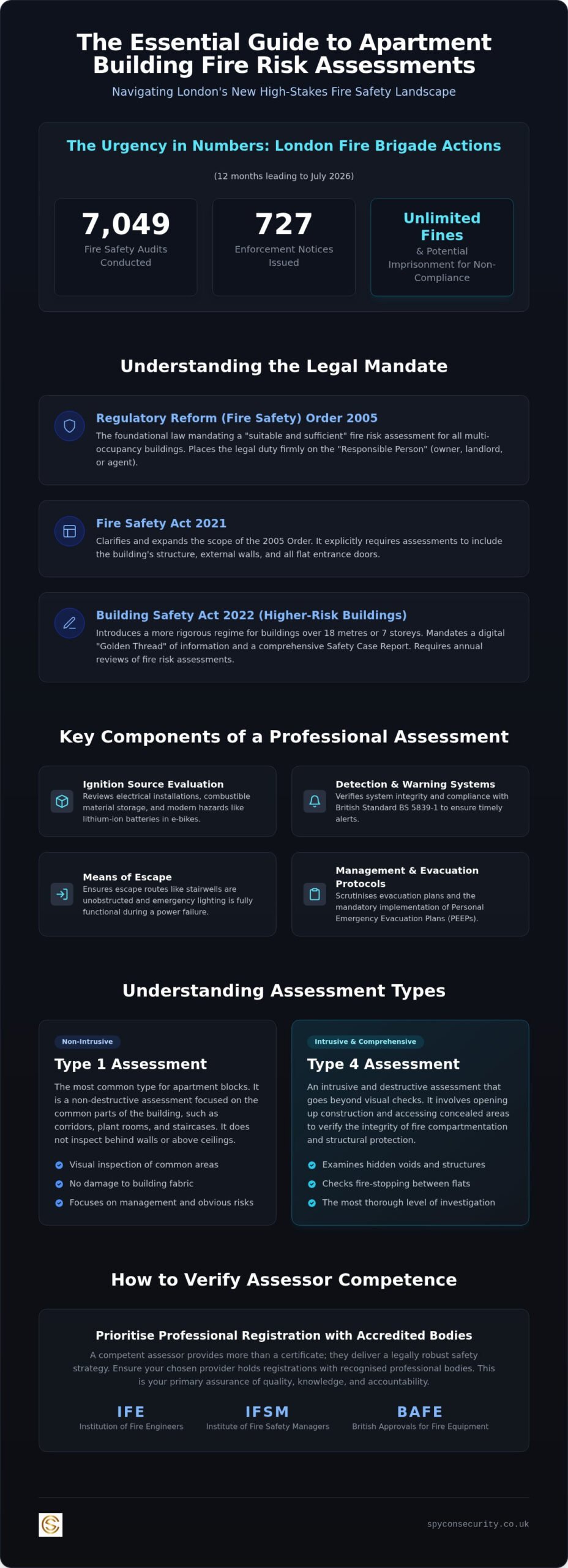
The legal landscape for residential safety in the capital has reached a critical turning point. With the introduction of mandatory Personal Emergency Evacuation Plans and the expansion of Awaab’s Law in 2026, an apartment building fire risk assessment London is no longer a periodic formality; it’s a continuous, high-stakes requirement for every Responsible Person. Failure to adapt to these rigorous standards carries the risk of unlimited fines and potential imprisonment. In the 12 months leading up to July 2026, the London Fire Brigade conducted 7,049 fire safety audits and issued 727 enforcement notices. The margin for error has vanished.
We understand that the complexity of the Building Safety Act 2022 and the search for a competent assessor can be overwhelming. You need more than a certificate; you require a legally robust strategy that protects your residents and your professional reputation. This guide provides the definitive roadmap to achieving absolute compliance and securing your property against evolving risks. We’ll detail the latest 2026 regulatory updates, explain how to prioritise remedial works, and show you how to establish a long-term partnership with a safety expert who prioritises precision over shortcuts.
Key Takeaways
- Understand the critical legal requirements mandated by the Fire Safety Act 2021, specifically regarding the inclusion of external walls and flat entrance doors.
- Identify the essential components of a professional apartment building fire risk assessment London, from ignition source evaluation to block-wide detection system verification.
- Learn how to verify assessor competence by prioritising professional registrations with accredited bodies such as the IFE, IFSM, or BAFE.
- Determine the appropriate level of investigation for your property by understanding the functional differences between Type 1 non-intrusive and Type 4 intrusive assessments.
- Recognise the operational advantages of a single-provider approach that manages both the initial fire strategy and the technical installation of remedial works.
The Legal Mandate for Fire Risk Assessments in London Apartments
The safety of residential structures in London is governed by a strict hierarchy of legislation. At the core of this framework is the Regulatory Reform (Fire Safety) Order 2005, which mandates that every multi-occupancy building must have a suitable and sufficient assessment of fire risks. This is not a voluntary exercise; it’s a statutory obligation designed to identify hazards and protect life. An apartment building fire risk assessment London must now account for the entire building envelope, including the structure and external walls, following the clarifications provided by the Fire Safety Act 2021. This act explicitly requires that flat entrance doors and external wall systems are included in the assessment scope.
The “Responsible Person” (RP), typically the building owner, landlord, or managing agent, carries the legal burden of this duty. In London’s complex block management environment, the RP must ensure that fire safety measures are not only present but functional and documented. Negligence is met with severe penalties. Under the current enforcement climate, non-compliance can lead to unlimited fines or up to two years in prison for those found criminally liable. Beyond legal action, a lapsed or inadequate assessment often invalidates building insurance, leaving the RP financially exposed in the event of an incident.
The Building Safety Act 2022 and High-Rise Compliance
For buildings exceeding 18 metres or seven storeys, the Building Safety Act 2022 introduces a more rigorous regime. These structures are classified as “higher-risk buildings” and require a Digital Safety Case Report. This involves maintaining a “Golden Thread” of information; a live record of fire safety data that remains accessible throughout the building’s lifecycle. Spycon Security supports the Principal Accountable Person by providing the technical fire strategy report data necessary to populate this digital record, ensuring that every safety decision is evidence-based and verifiable.
Annual Reviews vs. New Assessments
A fire risk assessment is a live document. Whilst a simple review may suffice for minor updates, a full new assessment is required if there are significant structural alterations, changes in occupancy type, or after a near-miss incident. For high-rise residential buildings in 2026, fire risk assessments must be reviewed at a minimum of once every year to maintain legal compliance. This regular cadence ensures that new risks, such as the rise in lithium-ion battery incidents, are addressed before they compromise resident safety. Precision in these reviews prevents the gradual erosion of safety standards over time.
What a Professional London Apartment Fire Risk Assessment Must Include
Precision is the hallmark of a professional audit. An effective apartment building fire risk assessment London must go beyond surface-level observations. It begins with a meticulous evaluation of ignition sources. This includes a review of electrical installations and the storage of combustible materials amongst residents. It must specifically address modern hazards, such as lithium-ion batteries in e-bikes. The London Fire Brigade identified these in February 2026 as the city’s fastest-growing fire risk. A vague assessment that ignores these evolving threats is insufficient.
The process also verifies the integrity of detection and warning systems. These systems must align with government guidance on fire safety and British Standard BS 5839-1. Inspectors examine every facet of the means of escape. They ensure stairwells remain unobstructed and emergency lighting functions during a total power failure. Finally, the assessment reviews management protocols. This involves scrutinising evacuation plans and, as of April 2026, the implementation of Personal Emergency Evacuation Plans (PEEPs) for vulnerable residents. Documentation must be clear, actionable, and ready for regulatory inspection.
Fire Door Surveys and Compartmentation
Flat entrance doors are no longer secondary considerations. Under the Fire Safety Act 2021, they are critical components of the assessment process. Effective fire door surveys verify that each unit can contain a fire for its rated duration. This compartmentation is the bedrock of a “Stay Put” strategy. If a door fails, the entire evacuation logic of the block collapses. Professional surveys identify defects in self-closing devices and intumescent seals before they become life-safety issues. For block managers, this level of detail is non-negotiable.
External Wall Systems and Cladding Risks
The assessment must account for the building’s exterior. This involves evaluating cladding, insulation, and balcony materials for potential fire spread. Professional assessors use the PAS 9980 methodology to provide a proportionate approach to external wall risks. This data feeds directly into the broader Fire Risk Appraisal of External Walls (FRAEW). Ensuring these elements are documented correctly is vital for maintaining the “Golden Thread” of safety information. If your current detection systems require modernisation to meet these standards, our team can assist with specialist fire alarm installation to ensure full-block coverage.
How to Evaluate Fire Risk Assessment Companies in London
Identifying a competent provider is the most critical decision a Responsible Person makes. It’s a statutory necessity. For an apartment building fire risk assessment London, the assessor must demonstrate verified technical proficiency through formal accreditation. You should prioritise assessors registered with recognised professional bodies:
- The Institution of Fire Engineers (IFE)
- The Institute of Fire Safety Managers (IFSM)
- BAFE Fire Safety Register
These certifications ensure the assessor has undergone rigorous peer review and maintains up-to-date knowledge of the Building Safety Act. This level of scrutiny aligns with official government fire safety guidance, which emphasises the need for specialised expertise in buildings with sleeping accommodation.
Beyond credentials, verify that the company carries adequate Professional Indemnity (PI) insurance specifically for fire safety consultancy. PI insurance is essential. Many standard policies exclude high-risk fire advice. A provider without this coverage leaves you legally and financially exposed if their advice is found wanting. Additionally, evaluate the clarity of their reporting. A professional document doesn’t just list failures; it provides actionable, prioritised remedial reports. These reports must clearly distinguish between immediate life-safety issues and long-term maintenance improvements, enabling block managers to manage budgets with precision.
Local Expertise: Why London Experience Matters
London’s architecture presents unique challenges that a generic provider might overlook. An apartment building fire risk assessment London must account for these structural variations. An assessor must understand the structural nuances of converted Victorian blocks, where timber-framed voids and shared chimneys are common, whilst also being fluent in the complex mechanical smoke ventilation systems of modern high-rises. This local knowledge extends to regulatory relationships. The London Fire Brigade (LFB) maintains specific enforcement priorities, conducting thousands of audits annually. A provider familiar with London Building Control requirements ensures that your assessment stands up to official scrutiny and aligns with the city’s evolving safety landscape.
The Spycon Advantage: Beyond the Report
We offer more than a static document. Our approach integrates authoritative consultancy with practical, technical execution. We understand that identifying a risk is only the first step in a broader safety strategy. By combining fire safety expertise with disciplined physical security insights, we provide a vigilant, all-encompassing protection strategy for your residents. If your assessment identifies a need for upgraded detection or warning systems, we facilitate a seamless transition to professional fire alarm installation. This full-circle service eliminates the risk of communication gaps between consultants and installers, ensuring every technical fix meets our uncompromising safety standards.
From Type 1 to Type 4: Understanding Residential Assessment Types
Selecting the correct level of inspection is vital for compliance and safety. Not every apartment building fire risk assessment London follows the same methodology. The industry recognises four distinct types of assessment, ranging from basic visual inspections to intrusive structural sampling. Understanding these categories allows block managers to commission the specific level of rigor required for their property’s unique risk profile.
- Type 1: This is the standard non-intrusive assessment of common parts. It’s the most frequent requirement for purpose-built blocks. It doesn’t involve entering individual flats or damaging the building fabric.
- Type 2: This involves an intrusive inspection of the common parts. It requires sampling structural elements, such as opening up ceilings or walls, to verify fire-stopping integrity. It’s typically recommended if serious structural defects are suspected.
- Type 3: This expands the Type 1 scope to include the interior of individual flats. It remains non-intrusive but evaluates the fire detection and compartmentation within the living spaces.
- Type 4: The most comprehensive level. It involves intrusive sampling in both the common areas and a representative number of individual flats. This is a destructive process used only when there are significant concerns about the building’s original construction.
When to Upgrade to a Type 4 Assessment
Older London properties often hide legacy construction issues that a visual check cannot detect. If you manage a Victorian conversion or a post-war block with a history of poor remedial work, a Type 4 assessment provides the necessary evidence of safety. This level of investigation is often required for major refurbishments or when developing a robust building safety case for the regulator. Whilst more costly and disruptive, it eliminates the guesswork associated with hidden voids and inadequate fire-stopping. If you’re unsure which level your building requires, book a professional fire risk assessment to determine the appropriate scope.
Integrating Fire Strategy Reports
It’s essential to distinguish between the periodic risk assessment and a fire strategy report. A strategy report is a design-based document that outlines how the building’s safety systems were intended to work. In contrast, the apartment building fire risk assessment London is an operational audit that checks if those systems are still functioning and compliant today. Complex London buildings often require a bespoke fire strategy plan to satisfy Building Control during structural changes. The fire risk assessment acts as the live verification of the fire strategy, providing the essential evidence required for the building safety case’s ongoing validation.
Spycon Security: Expert Fire Safety Solutions for London Block Managers
Spycon Security operates with a single objective: the absolute protection of your residents and your legal standing. When you commission an apartment building fire risk assessment London from our team, you’re engaging a partner that understands the gravity of 2026 compliance. Our consultants possess deep knowledge of the latest legislative shifts, including the complex requirements for high-rise residential buildings and the new mandate for Personal Emergency Evacuation Plans. We don’t just provide a checklist; we deliver a comprehensive safety strategy rooted in professional integrity.
Our approach is holistic and technically precise. We bridge the gap between consultancy and execution. By integrating fire door surveys and alarm maintenance into our service, we ensure that every vulnerability identified in the assessment is met with a definitive technical solution. This eliminates the need for multiple contractors and provides freeholders with a single, authoritative point of contact. Our reports are designed for clarity, prioritising remedial works so you can manage your building’s safety budget with precision and confidence.
Total Safety Integration
Effective fire safety often requires more than hardware. For high-risk blocks or buildings undergoing remedial works, we combine fire safety expertise with manned guarding to provide 24/7 site protection. Our walking watch fire marshal services act as a vigilant, human layer of protection when technical systems are compromised or during cladding replacement projects. This integrated model ensures that your site remains safe and compliant, regardless of the building’s current structural status. We maintain constant readiness to protect your assets.
Next Steps for Compliance
Securing your property begins with a professional site survey. Our London-based consultants will conduct a meticulous inspection of your premises, evaluating everything from compartmentation integrity to evacuation protocols. Following the site visit, we deliver a prioritised report that serves as your definitive roadmap for compliance. This document is legally robust, ensuring your apartment building fire risk assessment London stands up to the most rigorous official scrutiny. Don’t leave your regulatory standing to chance. Contact our team to schedule your assessment and ensure your building remains a safe, compliant environment for every resident.
Securing Your Property Portfolio for 2026 and Beyond
The safety landscape for London residential blocks has fundamentally shifted. Compliance is no longer a periodic task; it’s a continuous commitment to vigilant protection. From understanding the nuances of the Building Safety Act to selecting the appropriate assessment type, the responsibilities of a Responsible Person are significant. A professional apartment building fire risk assessment London serves as the cornerstone of this strategy. It provides the technical precision required to identify hidden vulnerabilities and prioritise remedial works effectively. It’s the only way to ensure your building remains legally robust whilst protecting the lives within it.
Whilst the regulatory environment grows more complex, Spycon Security stands as an elite partner for those who refuse to compromise on safety. Our SIA licensed and fire safety accredited consultants deliver comprehensive fire strategy reports approved for London Building Control. We offer 24/7 support for London property managers, ensuring your buildings remain compliant and your residents remain protected. Secure your building with a professional fire risk assessment from Spycon Security. Take the definitive step toward absolute regulatory compliance today. Your property’s integrity is our primary mission.
Frequently Asked Questions
How often is an apartment building fire risk assessment required in London?
For high-rise residential buildings over 18 metres, a review must occur at a minimum of once every year. Smaller blocks require annual reviews to account for occupancy changes or wear to safety systems. You must commission a new apartment building fire risk assessment London immediately if structural alterations are made or if the building’s purpose changes. Regular reviews ensure your safety strategy adapts to new risks, such as lithium-ion battery hazards.
Who is legally responsible for the fire risk assessment in a block of flats?
The “Responsible Person” carries the legal burden for safety. This role is typically held by the freeholder, the resident management company, or a designated managing agent. Under the Building Safety Act 2022, high-rise buildings also have an “Accountable Person” who manages structural and fire risks. Failure to appoint a competent assessor can lead to criminal prosecution. This includes potential unlimited fines or imprisonment for those in these defined roles.
Does a fire risk assessment for London apartments cover individual flats?
A standard Type 1 assessment focuses on common areas but now legally includes flat entrance doors under the Fire Safety Act 2021. Whilst the interior of a private dwelling is typically exempt from the Regulatory Reform Order, an apartment building fire risk assessment London may require a Type 3 or Type 4 approach. These more intrusive audits examine internal compartmentation and detection to ensure the building’s overall safety strategy remains viable and compliant.
What happens if a London building fails its fire risk assessment?
If an assessment identifies significant hazards, the Responsible Person must implement the recommended remedial works within the specified timeframe. The London Fire Brigade issued 727 enforcement notices in the year leading up to July 2026. Failure to rectify “emergency hazards,” such as faulty fire doors, within 15 days can result in legal action. Additionally, a failed assessment often invalidates your insurance coverage, leaving the property and its owners financially vulnerable.
How much does a professional residential fire risk assessment cost in London?
Fees are determined by the building’s height, structural complexity, and the number of communal areas requiring inspection. A multi-storey block requiring an intrusive Type 2 or Type 4 assessment involves more technical resources than a standard visual check. You should prioritise the competence and professional accreditation of the assessor over the initial quote. This ensures the resulting report is legally robust and provides the necessary protection for your residents and assets.
What is the difference between a fire risk assessment and a fire door survey?
Distinguishing between these two services is essential for block managers. A fire risk assessment is a comprehensive audit of the entire building’s safety strategy, including ignition sources and escape routes. A fire door survey is a specialised, technical inspection focused exclusively on the integrity of fire doors. These surveys verify that frames, seals, and self-closing devices meet current standards. Whilst an assessment identifies the need for functional doors, a survey provides the detailed data required for installation.
Can I carry out a fire risk assessment for my own building?
Legislation requires the assessment to be completed by a “competent person” with the necessary training and experience. Whilst a landlord might attempt a self-assessment for a very simple structure, London’s complex residential blocks demand professional expertise. Without formal accreditation from bodies like the IFE or BAFE, you risk overlooking critical hazards. This negligence can lead to personal liability and the failure of your building safety case during mandatory regulatory audits.
How long does it take to complete a fire risk assessment for a large London block?
A thorough site inspection for a large London block typically takes between three to six hours, depending on the number of floors and communal facilities. Following the site visit, the technical report is usually compiled and delivered within five to ten working days. Complex buildings requiring intrusive sampling or the review of sophisticated smoke ventilation systems may require additional time. This ensures the final strategy is both accurate and provides a clear roadmap for remedial action.