


Compliance is not a suggestion; it’s the foundation of your operational integrity. For property managers in the capital, the weight of the Regulatory Reform (Fire Safety) Order 2005 creates a constant pressure to ensure every sensor and sounder meets rigorous standards. You understand that a single oversight in your fire alarm system installation London project could lead to severe legal repercussions or, worse, compromised safety. The confusion surrounding categories like L, P, and LD often leads to paralysis, whilst the fear of disruptive false alarms remains a persistent concern.
This article provides the definitive 2026 compliance checklist to master these complexities with absolute precision. You’ll gain a clear roadmap for professional installation that satisfies both insurers and local authorities. We will detail the exact steps required to confirm your legal standing and establish a regime for meticulous ongoing maintenance. By the end of this guide, you’ll possess the knowledge to transform your fire safety strategy from a source of anxiety into a verified shield of protection.
Key Takeaways
- Define your legal obligations under the Regulatory Reform (Fire Safety) Order 2005 to maintain absolute compliance through 2026.
- Identify the specific requirements of Category L, P, and LD systems to ensure your installation provides the necessary level of protection.
- Follow a disciplined roadmap for fire alarm system installation London, beginning with a professional site survey and a building-control approved fire strategy report.
- Establish a rigorous maintenance regime that satisfies the legal requirement for six-monthly professional verification and weekly readiness checks.
- Learn how to integrate technical fire detection with elite fire marshal units to achieve a state of constant, vigilant protection for your assets.
The Legal Framework for Fire Alarm System Installation in London
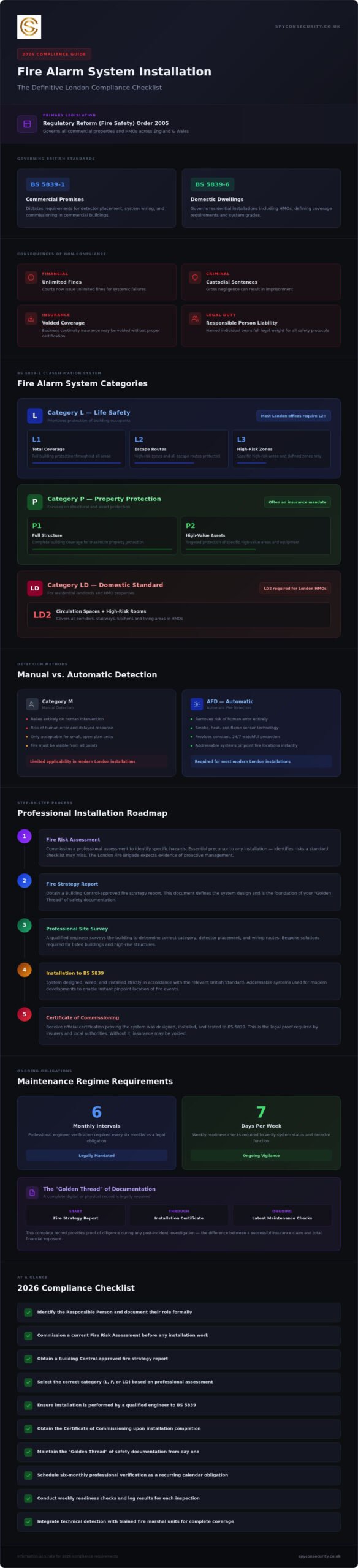
The Regulatory Reform (Fire Safety) Order 2005 remains the primary legislation governing fire safety in England and Wales. By 2026, enforcement has reached a peak of technical scrutiny. Every commercial property and House in Multiple Occupation (HMO) must identify a “Responsible Person”. This individual carries the legal weight for all safety protocols. Their duty is absolute. They must ensure that any fire alarm system installation London meets the highest possible standards. Failure is not an option. Compliance rests on two non-negotiable British Standards. BS 5839-1 dictates requirements for commercial premises, whilst BS 5839-6 governs domestic dwellings. These frameworks define everything from detector placement to system wiring.
The consequences of negligence are severe. Courts now frequently issue unlimited fines for systemic failures. In cases of gross negligence, custodial sentences are a reality. Protecting your assets requires more than a functional alarm; it requires a verified legal shield. This begins with understanding the specific demands of the capital’s unique building stock.
Understanding the 2026 London Fire Safety Landscape
London’s diverse architectural heritage presents unique challenges. The London Fire Brigade (LFB) conducts rigorous audits across the capital to ensure life safety protocols are active. They look for evidence of proactive management rather than reactive fixes. A current Fire Risk Assessment is the essential precursor to any installation. It identifies specific hazards within high-rise or multi-occupancy structures that a standard checklist might miss. Modern London developments require sophisticated, addressable systems that pinpoint fire locations instantly. Older, listed buildings in the City or Westminster require bespoke solutions that respect the structure whilst maintaining uncompromising safety standards.
Insurance Requirements and Certification
Insurers view fire safety through the lens of risk mitigation. A professional fire alarm system installation London is only valid if accompanied by a Certificate of Commissioning. This document proves the system was designed, installed, and tested according to BS 5839. Without it, business continuity insurance may be voided after an incident. You must maintain a “Golden Thread” of safety documentation. This digital or physical record tracks the system’s history from the initial fire strategy report to the latest maintenance check. It provides the proof of diligence required during any post-incident investigation. It’s the difference between a successful claim and total financial exposure.
Decoding Fire Alarm Categories: L, P, and LD Systems
BS 5839-1 provides a rigorous framework for system classification. Selecting the wrong category is a costly failure. Precision is mandatory. These categories define the level of protection required based on the building’s use and risk profile. For any fire alarm system installation London, the category must be determined by a professional risk assessment to ensure both life safety and legal compliance.
Category L systems prioritise life safety. L1 offers total coverage throughout the building. L2 and L3 protect escape routes and high-risk zones. Most London offices require at least an L2 system to satisfy the London Fire Brigade’s expectations. Category P systems focus on property protection. P1 covers the entire structure; P2 targets specific high-value assets. This is often an insurance mandate designed to mitigate structural damage and ensure business continuity. For residential landlords, Category LD is the domestic standard. LD2 is typically required for London HMOs, covering all circulation spaces and high-risk rooms such as kitchens and living areas.
To determine your specific requirements with absolute certainty, commissioning a professional Fire Risk Assessment is the first step toward a compliant installation.
Manual vs. Automatic Detection
Manual systems, known as Category M, rely entirely on human intervention. They’re only acceptable for small, open-plan London units where a fire would be immediately visible from all points. Most modern fire alarm system installation London projects demand Automatic Fire Detection (AFD). AFD removes the risk of human error. It uses sophisticated smoke, heat, and flame sensors to provide constant, watchful protection. Hybrid systems offer a balanced approach for complex sites, ensuring manual call points are supported by a network of vigilant sensors.
Addressable vs. Conventional Systems
Conventional systems are basic. They indicate a general zone but cannot pinpoint a specific location. They’re generally unfit for large or multi-storey London complexes. Analogue addressable systems are the professional choice for high-stakes environments. They assign a unique identity to every detector. If a sensor activates, the panel identifies the exact room or corridor, saving vital seconds for emergency responders. In London’s heritage and listed buildings, wireless technology is the elite solution. It provides a non-invasive installation that respects historical architecture whilst ensuring full, uncompromising compliance.
The Ultimate Fire Alarm Installation Checklist
The installation of a life-safety system is a high-stakes operation. It demands a disciplined approach. This checklist serves as your roadmap to a verified, compliant installation. Every stage requires professional verification to ensure the final system is fit for purpose and legally sound. Precision during the design and execution phases prevents the failure of critical components when they are needed most.
Phase 1: Survey and Specification
A successful fire alarm system installation London begins with a meticulous site survey. This process identifies “dead air” spaces. These are areas where air circulation is restricted; smoke may not reach a detector in time to save lives. Your system design must be rooted in a comprehensive Fire Strategy Report. This document dictates the necessary coverage levels based on your building’s specific architecture. The design must also align with the findings of your London Fire Risk Assessment. Choosing the right detectors is a matter of technical rigour. Optical detectors excel at sensing smouldering fires in corridors. Heat detectors are mandatory in kitchens to prevent false alarms. Multi-sensor detectors provide the most robust protection for complex environments.
Phase 2: Execution and Compliance
Installation must be performed with operational precision. All cabling must be fire-resistant. It must be secured using metal clips to prevent premature collapse during a fire. We then enforce the “Decibel Rule”. The alarm must achieve a minimum of 65dB in all areas of the premises. In rooms where occupants sleep, the volume must reach 75dB at the bedhead. This is a non-negotiable standard for any fire alarm system installation London. Integration is the final technical hurdle. Your system must interact seamlessly with other safety hardware. This includes triggering emergency lighting and releasing magnetic door holders. These integrated actions ensure a clear, unobstructed escape route for all occupants.
Commissioning is the definitive act of verification. It is a formal testing process that proves the system performs exactly as the design specified. Once commissioning is complete, the handover process begins. This includes comprehensive staff training and the initiation of a fire logbook. This logbook is a legal record. It must be maintained with absolute accuracy to prove your ongoing commitment to fire safety standards. Professional commissioning provides the peace of mind that your building is a fortress against fire hazards.
Readiness is a state of constant vigilance. A compliant fire alarm system installation London is the first step, but its efficacy depends on rigorous, ongoing maintenance. Compliance is not a static achievement; it is a continuous responsibility. Neglected systems fail. In a crisis, that failure is catastrophic. You must ensure your hardware is always in a state of operational precision to protect lives and assets.
The Professional Maintenance Schedule
Professional servicing is a legal mandate under BS 5839-1. This requires a specialist engineer to visit your premises at least every six months. During this inspection, every component undergoes verification. Engineers test battery standby capacity to ensure the system operates during power outages. They conduct detector sensitivity tests to prevent both failure and false activation. If your building layout changes, you must update your Fire Policy and Plan. This ensures your detection network still provides comprehensive coverage for the new environment.
Internal Testing Protocols
Weekly user testing is the foundation of site safety. The Responsible Person must activate at least one manual call-point every week during normal working hours. This confirms the control panel receives the signal and the sounders activate. Rotate the test points. This methodical approach ensures that every device in the circuit is eventually verified. Staff must be trained to interpret the fire alarm panel with absolute clarity. They must know how to identify a genuine fire signal versus a technical fault. Precision in these internal protocols prevents panic and ensures a disciplined response to real emergencies.
Managing false alarms is a critical operational priority. Unnecessary activations drain London Fire Brigade resources and breed complacency amongst occupants. Persistent issues can result in financial penalties from the LFB. Your fire logbook is your primary legal defence. It must contain a meticulous record of every test, fault, and professional service. During a fire safety audit, this logbook proves your unwavering commitment to the law. It transforms your safety regime from a verbal claim into a verified, documented fact.
To ensure your premises remain fully protected, schedule your next professional inspection with our elite team. Secure your maintenance contract today.
Why Spycon Security is London’s Authority for Fire Safety
Spycon Security Ltd. operates with a singular focus on professional gravity. We are not merely contractors. We are vigilant guardians of your assets and people. Our approach to fire alarm system installation London transcends basic hardware fitting. We provide a holistic safety ecosystem where technical precision meets operational discipline. This level of rigour is mandatory for navigating the complexities of the capital’s regulatory landscape. We don’t accept shortcuts. We don’t compromise on standards.
Our expertise covers the entire spectrum of fire protection. We understand that a compliant system is only effective if it is part of a broader, well-managed safety strategy. We bring years of experience in both technical fire systems and physical site protection to every project. This dual perspective allows us to design systems that are robust, reliable, and perfectly suited to your specific operational environment.
The Spycon Advantage: Integrated Protection
We bridge the gap between technical detection and human response. In high-risk London environments, a standalone alarm is often insufficient. We integrate fire alarm monitoring with 24/7 CCTV surveillance to ensure immediate verification of any incident. This synergy reduces the impact of false alarms and ensures a rapid, coordinated response. Our strategy frequently involves the deployment of expert personnel as part of a manned guarding safety strategy.
Our “watchful guardian” philosophy means we provide a constant, reassuring presence. This is vital for buildings with complex layouts or those undergoing significant structural changes. In these scenarios, our walking watch and fire marshal services work in tandem with your fire alarm system. This dual-layered approach provides the ultimate peace of mind. It ensures that every corner of your property remains under professional observation at all times.
Getting Started with Your London Installation
Safety begins with a definitive understanding of risk. We handle the full lifecycle of your fire alarm system installation London. This starts with a comprehensive site survey and a fire strategy report designed to satisfy building control and insurers alike. We don’t believe in generic solutions. Every design is bespoke, tailored to London’s unique architectural challenges and your specific needs.
Our London-based experts manage everything from the initial design phase to final commissioning and staff training. We ensure your system is not only compliant but also fully functional for your team. This meticulous process guarantees that your “Golden Thread” of safety documentation is complete and verified. Contact the Spycon Security Ltd. team today for an authoritative consultation. We’ll help you secure your premises with the precision and integrity that your business demands.
Establish Uncompromising Fire Safety Standards Today
Achieving absolute compliance in 2026 requires more than just functional hardware; it demands a disciplined approach to risk management. The path to a legal and effective fire alarm system installation London involves meticulous planning. This journey moves from initial fire strategy reports to rigorous six-monthly maintenance cycles. By adhering to BS 5839 standards and supporting your “Responsible Person” with documented proof, you mitigate both physical and legal risks. Precision is your greatest asset in protecting your property and its occupants.
Our team provides the expert oversight needed to navigate these complexities. As professional fire strategy consultants and SIA licensed security experts, we deliver 24/7 vigilant protection tailored to the unique architectural needs of the capital. We don’t accept shortcuts. We don’t compromise on your safety. It’s time to transform your compliance obligations into a verified shield of protection for your business and its future.
Secure your London premises with a compliant fire alarm installation from Spycon Security. Take the first step toward total peace of mind with an authoritative partner who values your safety as much as you do.
Frequently Asked Questions
How often do fire alarms need to be serviced in a London office?
Professional servicing must occur at least every six months to comply with BS 5839-1 standards. This bi-annual inspection is a legal requirement that ensures all sensors, sounders, and backup batteries are fully operational. You must also conduct weekly internal tests of manual call points. These combined efforts guarantee that your fire alarm system installation London remains in a state of constant readiness.
Do I need a fire alarm system if I have a small shop in London?
Yes, all commercial premises must provide adequate fire detection under the Regulatory Reform (Fire Safety) Order 2005. The specific type of system depends on your Fire Risk Assessment. Whilst a small shop might only require a manual Category M system, you still have a legal duty to ensure that fire can be detected and occupants warned. Compliance is mandatory regardless of floor space.
What is the difference between a Grade A and Grade D fire alarm?
Grade A systems are more complex, featuring a central control panel, detectors, and sounders connected by fire-resistant cabling. These are standard for most commercial fire alarm system installation London projects. Grade D systems consist of one or more mains-powered detectors with internal battery backups. These are typically reserved for smaller domestic properties or certain Houses in Multiple Occupation (HMOs).
Can I install my own fire alarm system to meet UK regulations?
You cannot install your own system if you wish to satisfy legal and insurance requirements. Regulations demand that a “competent person” with specialised technical training handles the design, installation, and commissioning. A professional must issue a Certificate of Commissioning upon completion. Attempting a DIY installation often leads to insurance rejection and leaves the Responsible Person liable for any system failures.
What should I do if my fire alarm system keeps triggering false alerts?
You should immediately commission a professional technical audit to identify the root cause of the activations. False alerts are often caused by incorrect detector types, such as using ionisation sensors near kitchens, or simple dust accumulation. Resolving these issues is vital. Excessive false alarms drain emergency resources and can lead to the London Fire Brigade charging for attendance at persistent nuisance calls.
How much does fire alarm system installation typically cost in London?
The total investment for a fire alarm system installation London depends on the building’s architecture, the required safety category, and system complexity. Every property presents unique challenges that influence the final cost. Because each installation is bespoke, you should request a comprehensive site survey. This professional assessment provides an accurate, verified quote based on the specific hardware and labour required for your premises.
Are wireless fire alarm systems as reliable as hardwired ones?
Modern wireless systems are fully reliable and compliant with BS 5839 standards. They use secure, dual-frequency radio links to ensure the control panel stays in constant contact with every device. These systems are an elite choice for London’s heritage and listed buildings. They allow for a non-invasive installation that provides uncompromising protection without the need for extensive structural cabling or decorative disruption.
What documentation must I keep after a new fire alarm installation?
You must maintain a comprehensive Fire Safety Logbook alongside your Certificate of Commissioning and system design specifications. These records are essential for proving your diligence during a fire safety audit. You should also keep records of all weekly tests and six-monthly professional services. This documentation creates a “Golden Thread” of safety evidence that is vital for both legal compliance and insurance verification.