


A single violent incident in 2026 is no longer just a local headline; it is a direct threat to your venue’s existence under London’s increasingly stringent borough rules. For operators managing bar and nightclub security London, the margin for error has vanished. You face a landscape where rising SIA licence fees and the full implementation of Martyn’s Law demand more than just a physical presence at the door. Precision in protection is now the only standard that guarantees survival.
You already understand that maintaining a vibrant, profitable atmosphere whilst navigating complex fire safety and counter-terrorism regulations is a relentless challenge. It’s a delicate balance between welcoming guests and enforcing absolute safety. This guide delivers the strategy to protect your licence and your patrons through a model that fuses elite door supervision with rigorous fire safety protocols. We will examine the 2026 regulatory shifts, including the new ACS registration requirements and the tiered mandates of the Terrorism (Protection of Premises) Act. You will discover how an integrated approach to physical security and fire risk assessments reduces overheads whilst ensuring total compliance with the Licensing Act 2003.
Key Takeaways
- Protect your establishment from licence revocation by implementing door supervision that strictly adheres to the Licensing Act 2003 and local London borough mandates.
- Enhance your front-of-house operations with advanced behavioural detection techniques designed to neutralise potential conflict before it escalates.
- Optimise your operational efficiency by adopting an integrated approach to bar and nightclub security London that fuses manned guarding with professional fire safety consultancy.
- Ensure total compliance with the 2026 legal framework, including the tiered requirements of Martyn’s Law and updated SIA registration protocols.
- Streamline venue safety by synchronising mandatory fire risk assessments with physical security measures to create a unified, watchful presence.
The Critical Importance of Elite Security for London’s Nightlife Venues
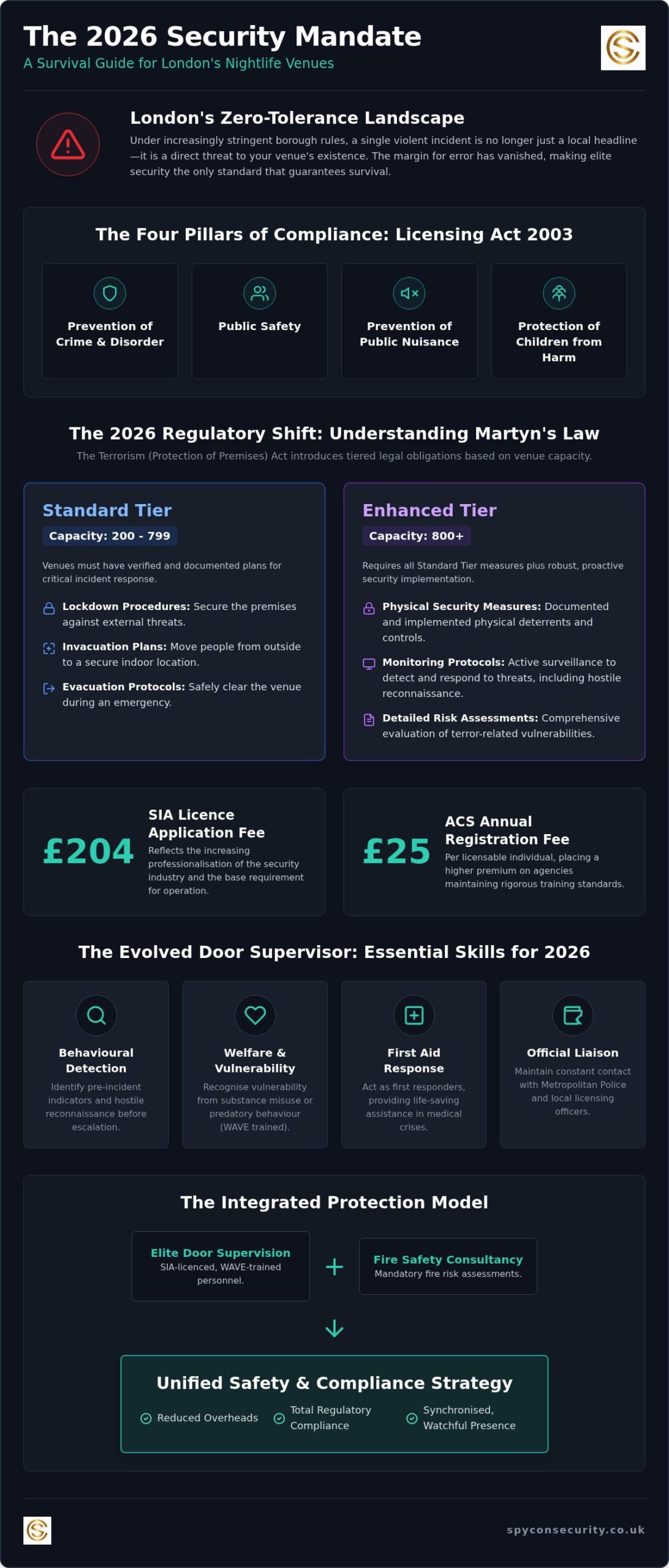
The London nightlife sector remains one of the most heavily regulated environments in the United Kingdom. Operating a venue under the Licensing Act 2003 requires a commitment to four core objectives: the prevention of crime and disorder, public safety, the prevention of public nuisance, and the protection of children from harm. Failure to uphold these standards through inadequate bar and nightclub security London often results in immediate summary reviews. A single lapse in door control can lead to restrictive conditions being added to your licence or, in severe cases, total revocation. Professional security is the shield that protects your commercial interests and your reputation amongst a discerning clientele.
Licensing Compliance and the Role of the Door Supervisor
Every London borough, from the strict streets of Westminster to the vibrant hubs of Hackney, imposes unique conditions on premises licences. Elite manned guarding ensures these conditions are met with absolute precision. This includes the fundamental duties of a door supervisor, such as maintaining meticulous incident logs and operating ID scanning technology to exclude known offenders. Constant liaison with the Metropolitan Police and local licensing officers is not optional; it is a requirement for a sustainable operation. When your security team operates with professional gravity, they transform from mere gatekeepers into compliance officers who safeguard your legal right to trade.
The 2026 Security Landscape: Beyond Physical Defence
Modern threats are increasingly sophisticated and require a more nuanced response than traditional physical intervention. Venues must now account for predatory behaviour and drink spiking as part of their standard risk assessment and staff training. Implementing the “Ask for Angela” initiative ensures security personnel are trained to intervene discreetly when a patron feels unsafe, preserving the venue’s status as a safe environment.
The 2026 landscape is also defined by the Terrorism (Protection of Premises) Act, commonly known as Martyn’s Law. Your venue’s capacity now dictates specific legal obligations. Standard tier venues, with a capacity between 200 and 799, must have verified plans for lockdown, invacuation, and evacuation. Enhanced tier venues, housing 800 people or more, are required to document and implement robust physical security measures and monitoring protocols. In 2026, highly trained security personnel serve as the primary intelligence gatherers and first responders capable of identifying and disrupting hostile reconnaissance before a terror threat manifests. This level of vigilance is essential for bar and nightclub security London to meet the rigorous standards expected by both the Home Office and the public.
Essential Standards for London Door Supervisors: More Than Just Entry Control
In 2026, the cost of an SIA licence application stands at £204. This financial commitment reflects the professionalisation of the industry. Meeting the basic SIA licence requirements is merely the starting point for effective bar and nightclub security London. Elite door supervisors must now master behavioural detection. This involves identifying pre-incident indicators, such as hostile reconnaissance or erratic movements, before a queue even forms. Early detection is the most effective tool for preventing escalation.
Beyond entry control, the Welfare and Vulnerability Engagement (WAVE) programme is vital for 2026. It equips staff to recognise vulnerability, whether from substance misuse or predatory behaviour. Our teams prioritise these standards to ensure every patron remains safe. This shift towards welfare-centric security is not just a trend; it’s a legal expectation. As of June 1, 2026, the ACS annual registration fee has increased to £25 per licensable individual, placing a higher premium on agencies that maintain these rigorous training standards.
First aid and emergency response capabilities are equally non-negotiable. Security staff are often the first responders in medical crises. They must provide life-saving assistance whilst emergency services navigate London’s traffic. This requires constant readiness and meticulousness. If you require a team that embodies this watchful guardian personality, consider how our SIA-licensed personnel can fortify your venue.
Conflict De-escalation and Professional Conduct
A “firm but fair” approach is essential for entry refusal. Removals must be handled with professional gravity to maintain the venue’s status as a local favourite. Politeness and composure prevent escalation. This level of discipline is a hallmark of professional manned guarding. Our guards are trained to use communication as their primary tool, reserving physical intervention as a final, controlled resort.
Vulnerability Management and Patron Care
Identifying intoxicated or vulnerable individuals at the point of entry prevents internal incidents. We manage “safe space” areas within nightclubs to support those who become overwhelmed or separated from their groups. Coordination with local schemes like London’s “Street Pastors” or “Night Owls” ensures a seamless transition of care once a patron leaves the premises. This integrated approach to patron care is essential for maintaining your bar and nightclub security London standards and protecting your licence.
Integrated Protection: Comparing Security Models for Nightclubs
London venue owners often mistake mere presence for operational security. In the high-stakes environment of 2026, the difference between “man-power” and a “security strategy” is the difference between a licence review and a thriving business. A basic guarding model is often reactive. It relies on personnel to respond after an incident occurs. Conversely, a comprehensive bar and nightclub security London strategy is proactive. It integrates risk analysis, intelligence gathering, and meticulous deployment to prevent incidents before they manifest. This strategic approach ensures every guard is not just a body in a uniform, but a trained professional executing a specific safety mandate.
Consolidating your safety requirements under a single provider offers significant operational advantages. When you combine manned guarding with expert fire safety consultancy, you eliminate communication gaps. This integrated model ensures that your security personnel are intimately familiar with your fire risk assessment findings. They understand the specific vulnerabilities of your building’s layout and the exact location of every fire exit. This cohesion reduces overheads and simplifies the compliance burden for busy venue managers who no longer need to coordinate between multiple contractors.
Physical Guarding vs. Canine Support
Specialist canine units provide a level of detection that human senses cannot match. For large-scale London club nights, K9 units serve as a formidable deterrent against drug-related crime. Their presence is a clear signal of uncompromising standards. Whilst human patrols focus on crowd behaviour and entry control, detection dogs identify concealed substances with absolute precision. This creates a safer environment without the need for intrusive manual searches of every patron. Balancing this visibility with a welcoming atmosphere requires disciplined handlers who maintain professional gravity at all times. They ensure the dogs remain a controlled, reassuring presence for legitimate guests whilst acting as a severe warning to those carrying contraband.
Technical Surveillance and 24/7 Monitoring
Technical surveillance acts as the overarching eye of a venue’s safety infrastructure. Integrating CCTV monitoring with on-site door staff allows for real-time intelligence sharing. Remote operators can identify external threats, such as approaching groups of interest or hostile reconnaissance, well before they reach the front of the queue. This early warning system enables door teams to prepare or adjust their posture accordingly. Meticulous monitoring also assists in managing queue flow and identifying bottleneck points that could lead to crowd pressure incidents. In 2026, the synergy between human vigilance and technical precision is the hallmark of an elite security operation. It provides the peace of mind that every corner of the premises is under constant, professional observation.
Organising Your Venue’s Security and Fire Compliance Strategy
Compliance in 2026 is an active operational framework, not a static document. Managing bar and nightclub security London requires the precise fusion of physical door supervision and technical fire safety. A disjointed approach creates dangerous vulnerabilities. It’s essential that your security personnel understand the specific fire risks of your building. This cohesion prevents confusion during high-stress incidents. When guards and fire marshals work from the same strategy, the venue operates with a unified, watchful presence.
A comprehensive fire risk assessment is the mandatory foundation for any licensed premises. It dictates your maximum occupancy and identifies critical egress routes. For London venues, a fire strategy report that satisfies Building Control is often required for capacity amendments or structural changes. Synchronising your fire exit door installation with crowd control barriers is a logistical necessity. Barriers must never impede an emergency exit pathway. This requires meticulous planning during the setup phase of every event to ensure that entry queues don’t compromise life safety.
Unified training is the final pillar of a robust strategy. Bar staff and security must participate in joint emergency drills. When an incident occurs, fragmented teams fail. A unified response ensures that every member of staff knows the protocol for evacuation, invacuation, or lockdown. This level of preparation is what separates elite venues from those at risk of licence reviews.
Fire Safety: The Often Overlooked Nightclub Risk
Fire door surveys are critical for venues with high occupancy levels. Constant use and high-volume crowds often lead to hardware failure that compromises a door’s fire-rating. Additionally, your fire alarm systems must be integrated with your sound system. In a nightclub environment, the alarm must trigger an automatic music cut-off. If the warning is not heard over the music, the safety of every patron is at risk. Protect your business by requesting a professional fire risk assessment today.
The Step-by-Step Security Audit
- Step 1: Review the specific conditions of your London premises licence to ensure every mandate is met.
- Step 2: Assess physical vulnerabilities, including dark corners, blind spots in CCTV coverage, and fire exit pathways.
- Step 3: Define the “Rules of Engagement” for your door team to ensure consistent, professional conduct.
This structured approach removes guesswork from your safety operations and ensures that your venue remains a safe, vibrant environment for all guests. Secure your venue’s future by investing in a professional fire strategy report that guarantees compliance with London Building Control.
Why Spycon Security is the Authoritative Choice for London Venues
Spycon Security operates with a level of professional gravity that exceeds industry norms. We don’t just provide staff; we deploy a strategic safety layer designed for the complexities of the capital. For operators seeking bar and nightclub security London, our “Watchful Guardian” approach offers more than mere deterrence. It is a commitment to meticulous preparation and constant readiness. We understand that a venue’s reputation is built over years but can be destroyed in a single night. Our mission is to ensure that never happens. Unwavering reliability. Professional gravity. These are the standards we bring to every shift.
Our integrated model is our greatest strength. We provide a single point of accountability for your security, fire doors, and mandatory risk assessments. This removes the friction of managing multiple contractors. It ensures that the person standing at your door is intimately familiar with the fire strategy report governing the building. This level of cohesion is rare in the London market. It provides a steady, grounded presence that instills confidence in both patrons and licensing authorities. We don’t allow for shortcuts. Every protocol is verified; every guard is prepared.
Elite Training and Operational Precision
Our selection process for staff is uncompromising. We only recruit individuals who demonstrate discipline and the ability to operate under high-pressure conditions. Every member of our team undergoes continuous professional development. This includes advanced training in counter-terrorism to meet the 2026 requirements of Martyn’s Law and comprehensive first aid certification. As one of the leading event security companies UK, we apply the same rigorous standards to nightclub environments as we do to large-scale public gatherings. Meticulousness is our baseline.
Securing Your Venue’s Future
Licence reviews are often the result of avoidable incidents and poor documentation. Spycon Security mitigates this risk through strict adherence to protocols and accurate incident logging. We provide the calm, controlled, and highly capable presence required to manage London’s diverse nightlife crowds. When you choose Spycon for your bar and nightclub security London, you’re investing in a partnership rooted in professional integrity and a commitment to excellence. Our partnership is built on unwavering duty and a shared goal: the long-term success of your venue. Don’t leave your compliance to chance. Contact Spycon Security for a London venue audit to ensure your operation meets the elite standards of 2026.
Secure Your Venue’s Reputation through Strategic Protection
The 2026 landscape for London venues demands a shift from reactive guarding to proactive, integrated safety management. Protecting your licence requires more than just a presence at the door; it necessitates a deep understanding of the Licensing Act 2003 and the evolving mandates of Martyn’s Law. By synchronising elite door supervision with professional fire safety protocols, you eliminate operational gaps that lead to costly reviews. Uncompromising safety is now the only standard for survival.
Effective bar and nightclub security London is built on the foundation of discipline and meticulousness. It’s about identifying vulnerabilities before they become incidents. Spycon Security provides the authoritative partnership needed to navigate these complexities with absolute precision. Our model combines SIA licensed professionals with comprehensive fire safety integration and London-specific licensing expertise. We ensure your establishment remains a safe, vibrant, and compliant environment for every patron.
Don’t leave your venue’s future to chance in an increasingly regulated market. Secure your London venue with Spycon Security’s elite door supervision and gain the peace of mind that comes from professional excellence.
Frequently Asked Questions
What are the SIA requirements for bar and nightclub security in London?
All personnel performing bar and nightclub security London must hold a valid SIA Door Supervisor licence. This requires completing an accredited training course covering conflict management, physical intervention, and first aid. As of 2026, the licence application fee is £204. Guards must display their licence at all times whilst on duty. Failure to comply with these regulations can lead to immediate prosecution for both the individual and the venue operator.
How many door supervisors do I legally need for my London nightclub?
There is no single legal number. Your specific requirement is dictated by the conditions of your premises licence and your venue’s capacity. A common industry baseline is two supervisors for the first 100 patrons and one for every 100 thereafter. However, London boroughs like Westminster or Camden often impose stricter ratios based on local crime statistics. Always consult your local licensing officer to ensure total compliance with your specific borough rules.
Can a security guard also act as a fire marshal in a London venue?
A security guard can perform fire marshal duties if they have received specific, accredited fire safety training. However, their primary focus must remain on life safety. The venue’s fire risk assessment must explicitly state how these dual roles are managed during an emergency. It’s critical that fire marshal duties don’t distract a guard from essential crowd control or entry management. Integrated providers often train staff in both disciplines to ensure a seamless response.
What is the “Ask for Angela” scheme and is it mandatory for London bars?
The “Ask for Angela” scheme is a safety initiative designed to protect patrons from predatory behaviour or uncomfortable situations. Whilst not a statutory requirement under national law, many London licensing authorities strongly encourage its adoption as a best practice. Some boroughs may even include it as a specific condition for late-night licences. Implementing this programme demonstrates a commitment to patron welfare and helps maintain a safe, reputable environment for your clientele.
How does Martyn’s Law affect nightclub security and fire safety in 2026?
In 2026, Martyn’s Law creates specific obligations based on venue capacity. Standard tier venues, holding 200 to 799 people, must implement procedural measures like evacuation and lockdown plans. Enhanced tier venues, with a capacity of 800 or more, must adopt robust physical security measures and document their protocols for SIA inspection. This legislation bridges the gap between traditional security and counter-terrorism, requiring meticulous preparation and regular staff training to mitigate hostile threats.
What should I look for when hiring a security company for a London bar?
Look for a provider with Approved Contractor Scheme (ACS) status and specific experience in the London nightlife sector. Verification of insurance and a proven track record with the Metropolitan Police are essential. Prioritise companies that offer integrated services, such as fire door surveys and risk assessments, alongside manned guarding. This ensures a cohesive safety strategy. A disciplined, professional presence is more valuable than low-cost alternatives that might compromise your premises licence.
Are canine units effective for drug detection in London nightclubs?
Canine units are exceptionally effective for both drug detection and as a visual deterrent for bar and nightclub security London. Specialist K9 teams can identify concealed substances with a level of precision that human guards cannot achieve. Their presence often prevents individuals from attempting to bring contraband into the venue. For large-scale events or high-profile club nights, deploying drug detection dogs is an authoritative way to signal that your venue maintains uncompromising safety standards.
How often should a London nightclub conduct a fire risk assessment?
The law requires fire risk assessments to be reviewed “regularly,” but the industry standard for high-occupancy London nightclubs is an annual review. You must also conduct a new assessment if there are significant structural changes to the building or a change in the type of events hosted. Meticulous record-keeping is vital for demonstrating compliance to the London Fire Brigade. Regular reviews ensure that your fire alarm systems and exit routes remain fit for purpose.