


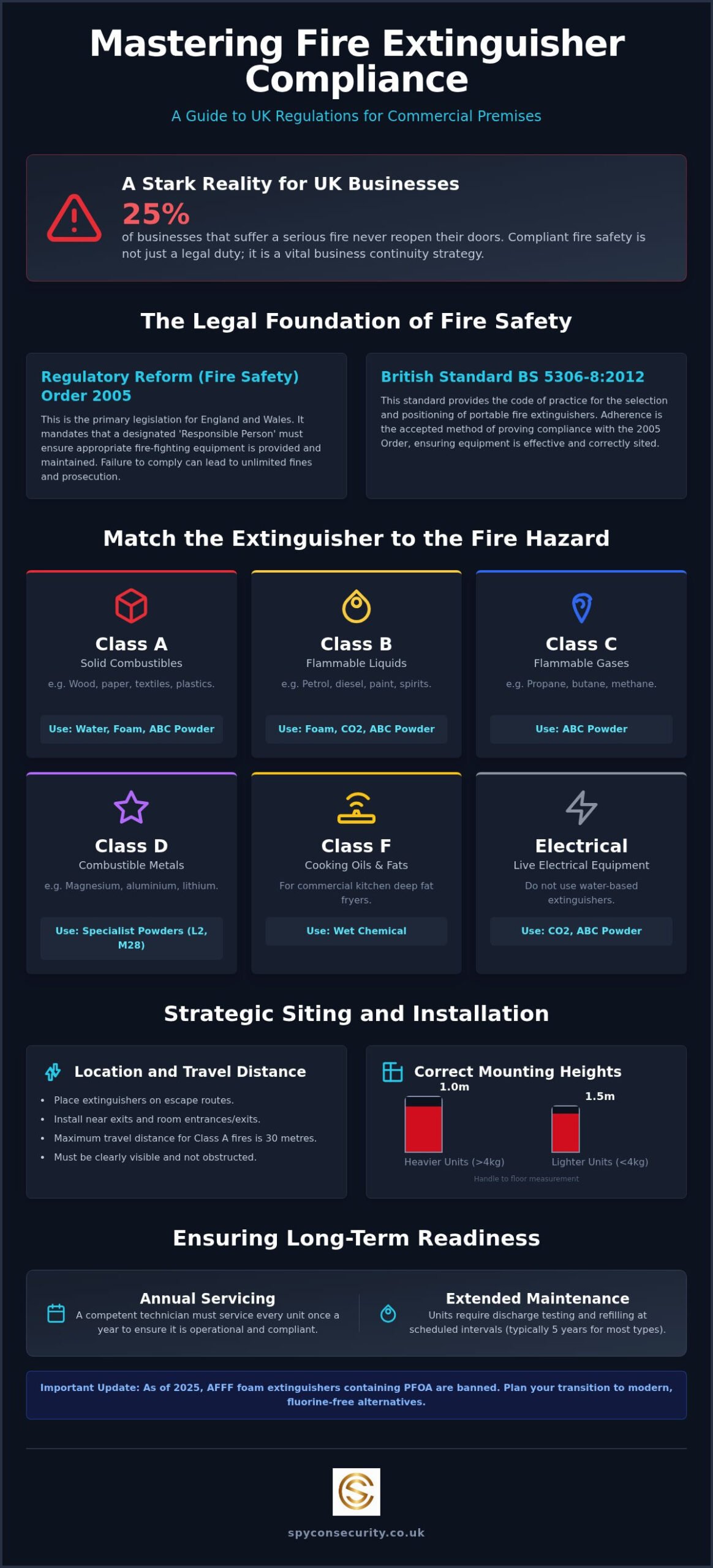
Twenty-five per cent of UK businesses that suffer a serious fire never reopen their doors. This statistic isn’t a mere warning; it’s a call for operational precision in your safety protocols. Relying on off-the-shelf hardware without a strategy leaves your premises vulnerable and your legal standing in jeopardy. Professional fire extinguisher installation services ensure that your equipment is more than just a wall decoration. Every unit must be a commissioned, compliant, and strategically placed asset that meets the rigorous standards of BS 5306-8:2012.
You likely feel the weight of adhering to the Regulatory Reform (Fire Safety) Order 2005, especially with the 2025 ban on PFOA-based AFFF foams now in full effect. It’s difficult to manage mounting heights and extinguisher classes whilst avoiding the threat of heavy non-compliance fines. This guide provides the clarity you need to master UK fire safety regulations through meticulous installation and maintenance. We’ll examine the latest British Standards, the shift towards fluorine-free alternatives, and the exact positioning requirements for every unit in your facility to ensure total protection and peace of mind.
Key Takeaways
- Define your legal obligations under the Regulatory Reform (Fire Safety) Order 2005 and the critical duties of the designated Responsible Person.
- Utilise professional fire extinguisher installation services to ensure every unit is correctly commissioned and mounted according to BS 5306-8:2012 standards.
- Master the travel distance rule and identify strategic fire points near exits to ensure equipment is accessible during an emergency.
- Learn how to select the correct extinguisher classes and calculate the mandatory Class A Rating required for your specific building layout.
- Establish a long-term compliance strategy through rigorous annual servicing and scheduled extended maintenance to maintain operational readiness.
Understanding Your Legal Obligations for Fire Extinguisher Installation
Compliance isn’t optional. It’s a statutory mandate. The Regulatory Reform (Fire Safety) Order 2005 dictates that every non-domestic premises in England and Wales must be equipped with appropriate fire-fighting equipment. This legal framework places the burden of safety squarely on the “Responsible Person.” Whether you’re a business owner, landlord, or facilities manager, you’re legally accountable for the readiness and suitability of your equipment. Professional fire extinguisher installation services bridge the gap between merely owning a canister and maintaining a life-saving system.
Failure to comply leads to more than just administrative friction. It results in criminal prosecution, unlimited fines, or even imprisonment in cases of extreme negligence. British Standard 5306-8:2012 provides the definitive blueprint for selecting and positioning extinguishers. It ensures that your response to a fire is immediate and effective. Following this standard isn’t just about avoiding penalties; it’s about operational integrity.
The Regulatory Reform (Fire Safety) Order 2005
Every compliant safety strategy begins with a professional fire risk assessment. You shouldn’t install equipment based on guesswork. An assessment identifies the specific combustible materials present in your workspace. This data informs your choice of suppressants according to recognised fire classification standards. It’s a precise calculation of risk versus response.
The Order requires that equipment is “appropriate” for the environment. A commercial kitchen requires different protection than a server room or a high-ceilinged warehouse. Professional fire extinguisher installation services ensure each unit is commissioned on-site. This vital process verifies that the extinguisher hasn’t been damaged in transit and is fully pressurised. It’s the final check in a chain of safety protocols.
Insurance Requirements and Compliance
Your insurance policy is a contract based on the assumption of reasonable care. If a fire occurs and your equipment is found to be non-compliant, your claim is at risk. Statistics show that 25% of businesses that suffer a serious fire never reopen. The average cost of such an incident is roughly £657,074. These aren’t risks worth taking. You need a partner who understands the high stakes of commercial protection.
Professional installation provides a robust paper trail of verification. Certificates of commissioning prove to insurers that you’ve adhered to BS 5306. DIY installation often fails because it ignores subtle but vital requirements. These include specific wall-mounting heights and the visibility of mandatory signage. A professional partner ensures your business remains resilient, insured, and legally protected. We provide the meticulousness that modern compliance demands.
Deciphering British Standards: Choosing the Correct Extinguisher Types
Precision in equipment selection is the foundation of site safety. You cannot afford to guess which suppressant is appropriate for your specific environment. Using the wrong medium, such as water on a fat fire, leads to catastrophic results. Our fire extinguisher installation services prioritise a rigorous match between the hazard and the hardware. This selection process is governed by UK fire safety regulations, ensuring every unit is fit for its intended purpose.
The industry is currently undergoing a significant transition. As of July 2025, AFFF extinguishers containing PFOA have been banned from use and testing. While newer C6 chemistry remains legal for now, a formal restriction is anticipated in 2027. We now specify fluorine-free alternatives for modern installations. These eco-friendly suppressants provide high-performance protection without the environmental liability of “forever chemicals.”
Matching Extinguishers to Specific Hazards
Fires are categorised into five main classes. Class A involves organic solids like wood and paper. Class B covers flammable liquids, whilst Class C involves flammable gases. Class D is reserved for combustible metals, and Class F handles cooking oils and fats. Electrical risks, though not a separate class, require non-conductive agents to prevent operator electrocution.
- CO2 Extinguishers: These are essential for server rooms and electrical hubs. They leave no residue and won’t damage sensitive circuitry.
- Wet Chemical: This is the only compliant solution for Class F risks in commercial kitchens.
- Water and Foam: These remain the standard for general combustible materials. Modern fluorine-free foam is now the preferred choice for versatile Class A and B protection.
The Class A Rating Calculation
British Standard 5306-8 provides a strict formula to determine the quantity of extinguishers needed for general risks. You calculate the required total Class A rating by multiplying the floor area in square metres by 0.065. This ensures the volume of suppressant matches the potential fire load of the building.
Consider a 400sqm office space. Multiplying 400 by 0.065 gives a requirement of 26A. A standard 6-litre foam extinguisher typically carries a 13A rating. In this scenario, you would need a minimum of two 13A units to meet the 26A total. Regardless of the calculation results, BS 5306-8 dictates that every floor must have a minimum of two extinguishers unless the floor area is exceptionally small. This redundancy ensures that equipment is always within reach if one unit is obstructed.
Determining these specific ratings requires technical expertise. You may find it beneficial to commission a fire strategy report to map these requirements across complex or multi-storey sites accurately.
Strategic Placement: Where to Install Fire Extinguishers in Your Building
Strategic placement is a discipline of spatial logic. It ensures that when a fire occurs, the response is immediate and instinctive. Our fire extinguisher installation services focus on creating “fire points” that align with your building’s natural exit routes. This methodical approach guarantees that suppressants are always located between the user and the exit, preventing anyone from becoming trapped whilst attempting to tackle a blaze.
Visibility is non-negotiable. You must ensure that equipment remains unobstructed by furniture, doors, or stock. Whilst building aesthetics are important, they must never compromise life safety. Every unit should be clearly visible from a distance, or its location must be indicated by specific directional signage. This level of readiness is what defines professional compliance.
Travel Distances and Accessibility
The “travel distance” rule is a cornerstone of BS 5306-8:2012. For general Class A risks, such as wood or paper, a person should not have to travel more than 30 metres to reach an extinguisher. This distance is not a suggestion; it is an absolute maximum. In environments with higher risks, such as those involving flammable liquids (Class B) or gases (Class C), the travel distance is reduced to just 10 or 15 metres.
These distances must be measured as the actual path a person walks, not as the crow flies. Obstacles like walls and machinery must be accounted for in your fire strategy report. We ensure that your layout accounts for these physical realities, placing protection exactly where the risk is highest.
Mounting Heights and Signage Standards
Correct mounting is essential for accessibility. Extinguishers are heavy, and their height must allow for safe removal by any occupant. Units with a total weight exceeding 4kg should be mounted so the handle is 1 metre from the floor. Smaller, lighter units can be mounted slightly higher, with the handle at 1.5 metres. This precision prevents injury during deployment and ensures the equipment is within reach for all users.
Every installation must be accompanied by a Fire Extinguisher ID sign. These signs serve two purposes. They identify the type of suppressant and explain which fire classes it can safely be used on. In high-risk areas or along escape routes, we recommend photoluminescent (glow-in-the-dark) signage. This ensures that even in a power failure or smoke-filled corridor, the location of life-saving equipment remains clear. Whether using wall brackets or floor stands, the goal remains the same: absolute readiness and unwavering compliance.
The Installation Process: How to Correctly Mount and Commission Units
Professional fire extinguisher installation services are defined by technical precision. The process begins with a final site survey. This on-site verification ensures that the physical environment matches the specifications in your fire strategy report. It’s a vital step because building layouts often shift during renovations or furniture installations. Once the location is confirmed, the technician proceeds through a rigorous five-step protocol to ensure operational readiness.
The transition from a boxed product to a life-saving asset requires official verification. We don’t just hang units on walls. We integrate them into your broader safety infrastructure. This involves secure mounting, meticulous commissioning, and detailed record-keeping. The final stage is a client handover, where we provide a basic demonstration of the equipment’s operation to ensure your team is prepared for an emergency.
What is Commissioning?
A fire extinguisher is not legally “installed” until it is commissioned on-site by a competent person. Commissioning is a meticulous verification process. We inspect each unit for transit damage that might not be visible to the untrained eye. We verify that the safety pin is secure and the tamper seal is intact. The pressure gauge is tested to ensure it hasn’t lost charge since leaving the factory.
Only after these checks are complete do we apply a service label. This label provides a traceable record of the technician’s verification. We then enter these details into your fire log book, providing the evidence needed for a fire officer’s audit. Without this commissioning process, your business isn’t compliant with BS 5306-3.
Mounting Best Practices
Secure mounting prevents accidental discharge or injury. We choose fixings based on structural integrity. Plasterboard walls require specialised anchors to support the weight of a 9kg unit, whilst masonry requires heavy-duty expansion plugs. The goal is a “snag-free” installation where the unit won’t fall due to vibration or accidental knocks.
In environments where wall mounting is impractical, such as glass-fronted offices or heritage buildings, we utilise heavy-duty floor stands. These provide a stable, visible platform for the equipment without damaging the building’s fabric. Every mounting solution must ensure that the extinguisher is easy to remove in a hurry but remains firmly in place during day-to-day operations.
For integrated protection that meets every regulatory hurdle, contact us for professional fire extinguisher installation services.
Beyond Installation: Long-term Maintenance and Compliance Strategy
Installation is the start of a lifecycle, not the end of a project. Once your fire extinguisher installation services are complete, the focus shifts to sustained operational readiness. British Standard 5306-3:2017 dictates that all extinguishers must undergo a thorough professional service at least once every 12 months. This is a legal requirement under the Regulatory Reform (Fire Safety) Order 2005. A technician must verify the internal suppressant levels, the condition of the hose, and the integrity of the firing mechanism during this visit.
Maintenance also involves deeper cyclical overhauls. Most units require an “Extended Service” every five years. This involves discharging the unit, inspecting the internal lining for corrosion, and refilling it with fresh suppressant. CO2 extinguishers are the exception, requiring a factory overhaul and hydrostatic pressure test every ten years. These rigorous schedules ensure that your equipment won’t fail during the seconds it’s needed most. Professional maintenance is the only way to guarantee the reliability that your insurance and legal standing demand.
Monthly Visual Inspections
The designated Responsible Person must perform a visual inspection of all units every 30 days. This isn’t a technical service but a verification of constant readiness. You’re checking that the unit is in its assigned position, the pressure gauge is in the “green” zone, and the safety pin hasn’t been tampered with. Any sign of corrosion, leaking, or accidental damage requires immediate professional attention.
Record these monthly checks in your fire logbook. Fire inspectors will prioritise these records during an audit to verify that you’re actively managing your site’s safety. Meticulous documentation is your primary defence against claims of negligence. It proves a culture of vigilant protection rather than mere box-ticking. If you find a unit has been moved or obstructed, it must be rectified immediately to maintain the travel distance compliance established during the initial fire extinguisher installation services.
Integrated Fire Safety Systems
Fire extinguishers are a reactive tool. They’re most effective when integrated into a comprehensive fire policy plan. This strategy should include a professional fire alarm system installation to ensure early detection and rapid response. Whilst extinguishers tackle small fires, fire door surveys are essential for containment, preventing the spread of smoke and flame whilst occupants evacuate.
Equipment is only as effective as the person operating it. We recommend regular fire safety training to ensure your staff can use the hardware with confidence and poise. A coordinated approach, combining high-specification hardware, containment strategies, and staff training, creates a truly resilient environment. Don’t leave your compliance to chance. Contact Spycon Security for a professional fire extinguisher installation survey to secure your premises today.
Securing Your Future Through Strategic Compliance
Compliance isn’t a static achievement. It’s a continuous commitment to operational safety. You now understand that meeting the Regulatory Reform (Fire Safety) Order 2005 requires a meticulous alignment of risk assessments, correct suppressant selection, and precise travel distance calculations. Every unit must be commissioned on-site to ensure it’s ready for immediate deployment. This rigorous approach prevents equipment failure and ensures your premises remain legally protected.
Professional fire extinguisher installation services provide the technical verification and rigorous documentation that satisfy both fire inspectors and insurers. By integrating these units with robust detection systems and regular staff training, you build a resilient environment that protects both lives and business continuity. Meticulous record-keeping and annual servicing are the final components of a truly professional safety strategy.
As SIA Licensed Fire Safety Specialists, we provide comprehensive fire risk assessments and installations with national UK coverage and 24/7 support. Secure your premises with professional fire extinguisher installation from Spycon Security. You don’t have to navigate these legal complexities alone. We’re here to ensure your business remains safe, compliant, and ready for any challenge. Your peace of mind is our priority.
Frequently Asked Questions
How many fire extinguishers do I need for my office?
You need a minimum of two Class A extinguishers per floor unless the floor area is exceptionally small. The exact quantity is determined by multiplying your floor area in square metres by 0.065 to calculate the required Class A rating. For example, a 400sqm office requires a total rating of 26A, which is typically met by two 6-litre foam units. Additional units are required for specific hazards like server rooms or kitchens.
Can I install my own fire extinguishers in a commercial building?
You cannot legally install your own extinguishers if you lack the specific training required by the Regulatory Reform (Fire Safety) Order 2005. Equipment must be commissioned on-site by a competent person to verify its operational integrity. Professional fire extinguisher installation services ensure that brackets are secure and units are properly pressurised. Attempting a DIY installation puts your insurance validity at risk and may lead to non-compliance fines during a fire officer audit.
What is the legal mounting height for a fire extinguisher in the UK?
The mounting height depends on the total weight of the unit. Extinguishers weighing more than 4kg must be mounted so the handle sits 1 metre from the floor. Lighter units should have their handles positioned at 1.5 metres. This standard ensures that the equipment is accessible and safe to remove for all building occupants. Maintaining these specific heights prevents injury during deployment and complies with the accessibility requirements established in BS 5306-8.
How often do fire extinguishers need to be serviced after installation?
Fire extinguishers require a basic professional service every 12 months according to BS 5306-3. This annual check verifies the suppressant levels and mechanical components. Every five years, most units must undergo an extended service, which involves a full discharge and refill. CO2 extinguishers are the exception, requiring a factory overhaul and hydrostatic test every ten years. You must also conduct your own visual inspections every 30 days to check for pressure loss.
Do I need different types of fire extinguishers on every floor?
You must provide protection based on the specific risks present on each level of your building. Every floor requires a minimum of two Class A extinguishers to tackle organic solids. If a floor contains electrical equipment or a kitchenette, you must install additional CO2 or Wet Chemical units. A professional fire risk assessment identifies these hazards, ensuring your fire extinguisher installation services cover the unique requirements of every floor to maintain total site compliance.
What is a fire extinguisher commissioning certificate?
A commissioning certificate is a legal document proving that your extinguishers were inspected and verified on-site by a qualified technician. This process happens after the units are delivered but before they are mounted. The certificate confirms that each unit is fully pressurised, undamaged, and fit for purpose. It serves as essential evidence for fire safety audits and insurance providers, demonstrating that you have fulfilled your duties as the designated Responsible Person.
Are fire extinguisher signs a legal requirement?
Fire extinguisher ID signs are a mandatory requirement under UK safety legislation. These signs must be placed above every unit to identify the type of suppressant and the fire classes it can tackle. They ensure that users don’t use dangerous agents, such as water on an electrical fire. In areas with low light or complex layouts, photoluminescent signs are recommended. These glow-in-the-dark markers remain visible during power failures, guiding occupants to life-saving equipment.
How long do fire extinguishers last before they need replacing?
Most fire extinguishers have a functional lifespan of 10 to 20 years if they are maintained correctly. However, they must be replaced immediately if they show signs of significant corrosion or fail a pressure test. Every five years, or ten for CO2, the cost of an extended service often approaches the price of a new unit. Many businesses choose to replace equipment at these intervals to ensure they have the latest safety technology and maximum reliability.