


A camera that only records isn’t a security solution; it’s a digital witness to your loss. Professional 24/7 CCTV monitoring services transform passive hardware into an active, offensive barrier against intrusion. You likely feel the pressure of rising manned guarding costs and the futility of slow police responses to unverified alarms. These are critical vulnerabilities. They demand a disciplined response that prioritises immediate intervention over historical review.
We agree that your security shouldn’t be a gamble. This definitive 2026 guide demonstrates how professional remote surveillance secures your UK assets with unwavering precision and rapid response. You’ll learn how to reduce overheads whilst maintaining total vigilance across your estate. We will examine the operational protocols of elite monitoring centres, the impact of the Data (Use and Access) Act 2025, and the specific methods used to provide verified evidence for police liaison. It’s time to replace uncertainty with a seasoned expert presence that never blinks.
Key Takeaways
- Transition from passive recording to active remote surveillance to prevent site loss rather than merely documenting incidents after they occur.
- Understand the critical role of UK-based Alarm Response Centres (ARCs) in managing the operational journey from initial trigger to professional intervention.
- Evaluate the cost-efficiency of 24/7 CCTV monitoring services as a tactical alternative or force multiplier for traditional manned guarding.
- Leverage visual verification and two-way audio to eliminate the burden of false alarms and ensure rapid response through verified evidence for police liaison.
- Align your surveillance strategy with wider UK compliance, integrating CCTV with mandatory fire strategy reports and sector-specific protocols.
The Evolution of Surveillance: Why 24/7 CCTV Monitoring Services are Essential
Surveillance is no longer a passive exercise in historical documentation. It has evolved into a proactive operational discipline. To define 24/7 CCTV monitoring services correctly, one must view them as active, real-time oversight conducted by off-site professionals. This isn’t a system that waits for a request to view footage. It’s a system that identifies, analyses, and reacts to threats as they occur.
Many UK businesses fall into the ‘reactive trap’. They invest in high-definition hardware that records site loss or damage without preventing it. Passive recording is a post-mortem tool. It provides evidence but fails to protect assets. Proactive monitoring acts as a deterrent before the first lock is even cut. It transitions security from a simple cost centre to a comprehensive layer of operational oversight.
The Limitations of Unmonitored Systems
In high-stakes environments, recording-only systems suffer from a significant failure rate regarding actual crime prevention. An intruder’s behaviour changes when they realise they are being watched in real time. Without live intervention, a camera is merely a witness. The psychological impact of a visible, unmonitored camera is negligible to a determined criminal. The result is post-event frustration. You possess clear footage of the incident, yet the assets are gone and the damage is done. Relying on footage alone ignores the primary objective of security: prevention.
The Core Benefits of Professional Vigilance
Professional monitoring delivers immediate intervention. Through two-way audio challenges, operators can speak directly to intruders, often stopping a crime in progress before physical damage occurs. This level of vigilance is critical for police liaison. Unverified alarms are a low priority for emergency services. However, visual confirmation from a professional operator ensures your incident receives the necessary priority.
Beyond security, this vigilance supports operational continuity. Operators monitor for environmental risks such as fires or leaks. Whilst this does not replace the legal requirement for a Fire Risk Assessment, it provides an additional layer of protection. This integration ensures that your site remains safe, compliant, and operational around the clock. Professional vigilance means your assets are never truly left unattended.
The Architecture of Protection: How Remote Surveillance Operates
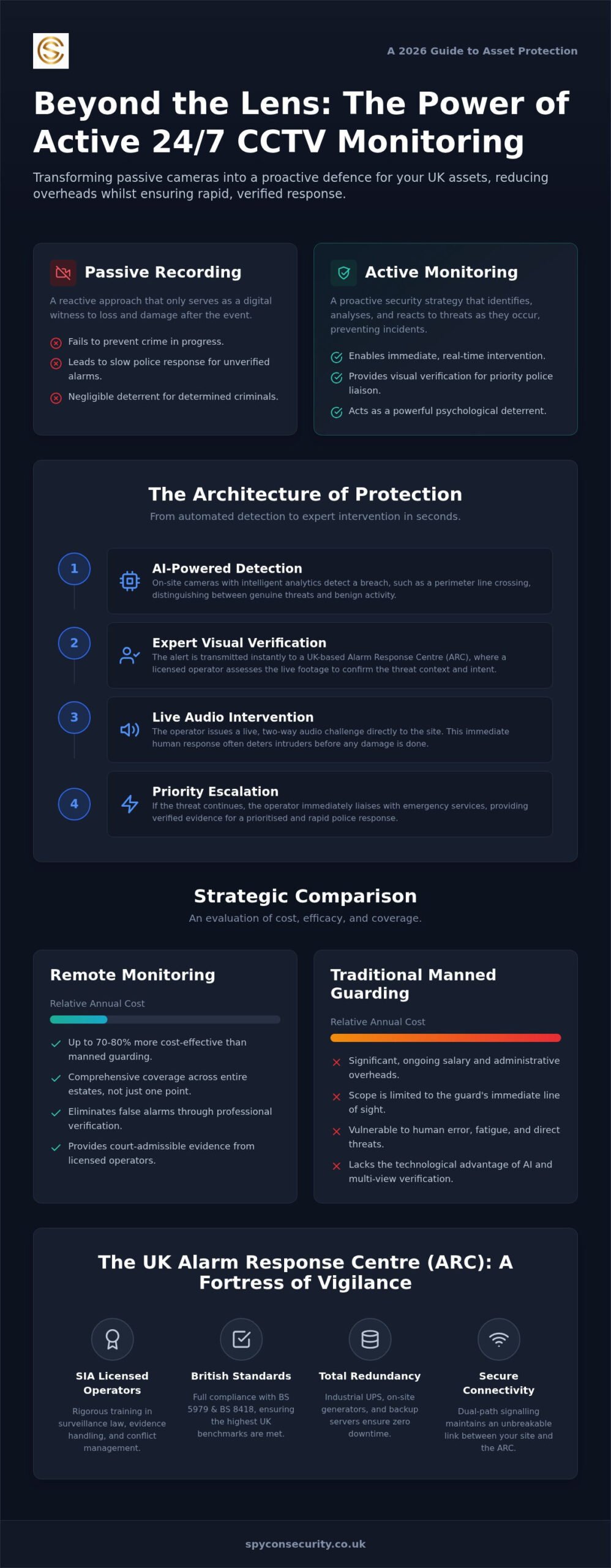
Effective 24/7 CCTV monitoring services rely on a seamless chain of technology and human expertise. It begins at the edge. A camera equipped with AI analytics detects a breach, such as a perimeter line crossing or unusual movement. This trigger initiates an immediate data transmission to a remote hub. The journey from detection to intervention happens in seconds, ensuring that threats are addressed before they escalate into incidents.
AI handles the initial filtration. It distinguishes between a stray animal and a human intruder with high precision. However, human logic remains the final arbiter. A professional operator assesses the context, intent, and level of threat. This synergy is why CCTV remains a primary deterrent. A 40-Year Systematic Review with Meta-Analysis confirms that such structured surveillance is fundamental to modern crime prevention. It provides the verified intelligence needed for a rapid response.
Inside the Alarm Response Centre
A professional Alarm Response Centre (ARC) is a fortress of data. These facilities operate under strict environmental controls with multiple layers of redundancy. If the national grid fails, industrial UPS systems and on-site generators maintain operations. Connectivity is similarly protected through dual-path signalling, ensuring the link between your site and the operator never breaks. The ARC is the tactical heart of remote security.
SIA Licensing and Professional Standards
In Great Britain, SIA licensing is a legal and operational mandate. Licensed operators undergo rigorous background checks and specific training in surveillance law, evidence handling, and conflict management. Adherence to British Standards, such as BS 5979 or BS 8418, ensures that the facility and its staff meet the highest UK benchmarks. This professional conduct isn’t just about security; it’s about legal compliance. Footage captured by a licensed professional is far more likely to stand up as verified evidence in court. It guarantees that every action taken is documented and defensible.
This high-tech architecture often works best when integrated with physical assets. For sites requiring an immediate physical presence alongside remote oversight, manned guarding provides the necessary boots on the ground to secure a breached perimeter.
Strategic Comparison: Remote Monitoring vs. Manned Guarding
A 24/7 physical presence on a large site involves substantial overheads. Wages, national insurance, and welfare facilities for multiple shifts create a high financial barrier. 24/7 CCTV monitoring services provide a scalable solution. They deliver unwavering vigilance across the entire perimeter at a significantly lower operational cost. This transition doesn’t necessarily eliminate the need for personnel. Instead, it allows for a more strategic allocation of resources. It ensures that your security budget is spent on intervention rather than idle observation.
Tactical strengths vary between the two approaches. Manned guarding excels in immediate physical intervention and public-facing roles. Remote monitoring offers superior sensory coverage and data accuracy. It doesn’t suffer from ‘guard fatigue’ or the natural limitations of human sight in low-light conditions. For most UK sectors, the choice isn’t between one or the other. It’s about finding the balance that ensures total site protection without unnecessary expenditure.
Cost-Efficiency and Resource Allocation
Maintaining a single 24/7 guard post requires a team of four or five personnel to cover 168 hours per week. Monitoring eliminates these headcount pressures. It allows businesses to maintain a smaller, more elite physical response team that only deploys when a threat is verified. The ROI of professional monitoring is most evident during a breach. Preventing a single major arson or theft incident justifies the investment many times over. It protects your assets, your reputation, and your insurance premiums from the fallout of a total site loss.
Hybrid Security: The Ultimate Protection Model
The most robust UK security strategies utilise a hybrid model. Remote monitoring acts as the ‘eyes in the sky’, directing manned guarding units or canine security to exact breach locations with surgical precision. This synergy removes the uncertainty from physical patrols. It transforms a standard security team into a high-precision response unit.
- Virtual Guard Tours: Operators conduct systematic visual sweeps of the site during high-risk hours, identifying vulnerabilities before they are exploited.
- Operational Oversight: Monitoring integrates with walking watch fire marshal services to provide an extra layer of detection for heat signatures or early-stage ignition.
- Enhanced Coverage: Cameras cover blind spots that physical patrols might miss, ensuring no part of your estate is left vulnerable.
This integrated approach ensures that every alarm is verified and every response is justified. It provides the constant vigilance required for modern UK asset protection whilst maintaining the capability for physical intervention when it matters most.
Advanced Features: Enhancing the Efficacy of Your CCTV System
Hardware alone is insufficient for modern asset protection. The true intelligence of 24/7 CCTV monitoring services lies in the advanced features that allow for immediate, real-time intervention. Visual verification is the cornerstone of this approach. It ensures that every alert transmitted to the hub is legitimate, removing the ‘false alarm’ burden that often delays emergency services. When an operator confirms a crime in progress, the incident is escalated with verified evidence, ensuring your site receives the priority response it requires.
The integration of AI-driven analytics has transformed how threats are identified. These systems don’t just detect motion; they analyse behaviour. By distinguishing between environmental noise and genuine forced entry, the system ensures that operators only focus on high-priority events. This precision is vital for maintaining operational continuity and complying with the Data (Use and Access) Act 2025, which mandates strict protocols for data handling and subject access.
Proactive Intervention via Audio
A live audio challenge is a powerful deterrent. Once a breach is detected, the operator uses on-site speakers to address the intruder directly. This isn’t a pre-recorded loop. It’s a live, authoritative command from a professional guardian. The psychological impact on a trespasser is immediate. Most vandalism and theft attempts are abandoned the moment the intruder realises they’ve been identified. The operator maintains a calm, controlled presence, gathering evidence whilst managing the situation to prevent escalation.
Smart Detection and False Alarm Reduction
False alarms are a significant drain on both time and financial resources. Professional systems utilise thermal imaging and line-crossing technology to differentiate between a stray animal and a human intruder. This filtering happens at the edge and is verified within the ARC centre. By ensuring only real threats are escalated, businesses avoid the ‘false alarm’ fines often issued by police for unverified incidents. This accuracy maintains your site’s credibility with emergency services and ensures that your security remains a reliable asset.
Operational efficiency is further enhanced through remote access control. Operators can manage gates, barriers, and turnstiles directly from the monitoring station, allowing for secure deliveries after hours without a physical keyholder. This control integrates with your wider safety infrastructure, including fire alarm installation, to ensure that exits remain clear and secure. To ensure your premises meet the highest standards of operational safety, consider how our monitoring integrates with a fire strategy report for your specific site requirements.
Implementing Professional Monitoring Across the UK
Deployment of 24/7 CCTV monitoring services requires a methodical approach to site-specific vulnerabilities. A generic surveillance setup often leaves critical gaps in perimeter integrity. Every professional installation begins with a rigorous site survey. This assessment identifies blind spots and evaluates connectivity requirements, ensuring that the link between your assets and the Alarm Response Centre is unbreakable. Whether your site relies on high-speed fibre or 5G redundancy, the architecture must support constant, high-definition data transmission.
Effective implementation also means aligning your security with wider safety protocols. By integrating surveillance with a fire strategy report, businesses gain a comprehensive oversight of their estate. Whilst CCTV does not replace a mandatory Fire Risk Assessment, it provides an essential detection layer for early-stage ignition. This integrated vigilance protects assets during high-risk hours when the site is unoccupied.
Tailored Security for Diverse Sectors
Security requirements differ vastly between a construction site in Manchester and a corporate headquarters in the City of London. For construction projects, the focus is on preventing the theft of high-value plant and materials. These sites often require mobile monitoring units and thermal detection to secure expansive, changing perimeters. Pairing remote surveillance with professional construction site security guards ensures that both human and environmental threats are addressed with a disciplined, layered approach. Conversely, corporate offices in Canary Wharf require a more discreet but equally rigorous approach. Here, monitoring integrates with internal access management to protect sensitive data and personnel.
Logistics hubs and vacant properties present another unique challenge. These environments require constant vigilance against both intrusion and environmental hazards. Professional monitoring ensures that vacant assets don’t become targets for squatting or vandalism. It provides a steady, grounded presence that maintains order across diverse UK sectors.
The Spycon Standard of Vigilance
Spycon Security delivers a disciplined and seasoned expert presence across the UK. Our approach is rooted in professional integrity and operational precision. We operate with absolute meticulousness, ensuring that every camera is positioned for maximum impact and every operator is trained to the highest SIA standards. This synergy between remote surveillance, manned guarding, and fire safety ensures a unified defensive front.
We provide national coverage, including major hubs like London, Manchester, and Birmingham. Our commitment to excellence doesn’t allow for shortcuts. Every monitored site is treated as a critical asset requiring unwavering protection. You deserve the peace of mind that comes from a partner who values order and compliance above all else. Contact Spycon Security today for a professional site surveillance assessment and secure your UK assets with unwavering precision.
Securing Your Assets with Professional Precision
Professional security requires a definitive shift from passive recording to active, real-time intervention. Unmonitored systems only document loss; they don’t prevent it. By implementing 24/7 CCTV monitoring services, you ensure a disciplined response that bridges the gap between detection and action. This strategic oversight reduces overheads whilst maintaining total vigilance across your UK estate. It transforms your cameras from simple observers into an offensive barrier.
Reliability is only as strong as the standards behind it. Our framework utilises SIA Licensed Experts and NSI Gold Accredited Monitoring Partners to provide a seamless, authoritative barrier against intrusion. This isn’t just about theft prevention. It’s about comprehensive fire and security integration that protects your operational continuity. Every second counts during a breach, and professional verification ensures that emergency services receive the priority intelligence they require.
It’s time to replace vulnerability with professional precision. Secure your site with Spycon’s 24/7 CCTV monitoring services and gain the peace of mind that comes from constant, elite protection. Your assets deserve a guardian that never blinks. We look forward to fortifying your premises with unwavering reliability and expert care.
Frequently Asked Questions
What is the difference between CCTV recording and CCTV monitoring?
Recording is a passive process that stores footage for historical review after an incident has occurred. It acts as a digital witness but does not prevent crime. In contrast, 24/7 CCTV monitoring services involve live, professional oversight. When a breach is detected, a remote operator intervenes immediately. This active approach allows for real-time audio challenges and rapid police escalation, stopping intruders before they can cause significant damage or loss.
Does remote CCTV monitoring reduce my insurance premiums in the UK?
Many UK insurers recognise professional remote monitoring as a superior risk mitigation strategy. By ensuring every alarm is verified and providing a proactive deterrent, you reduce the likelihood of successful theft or arson claims. This can lead to more favourable premium rates. You should consult your broker to confirm specific discounts, as most require monitoring centres to hold NSI Gold or SSAIB accreditation to qualify for these professional security incentives.
Can you monitor my existing CCTV cameras or do I need new hardware?
We can typically integrate most modern IP-based systems into our monitoring hub. If your current hardware supports standard communication protocols, new cameras may not be necessary. Older analog systems might require IP encoders to facilitate signal transmission to our centre. A professional site survey is the most reliable way to determine compatibility. This assessment ensures your existing equipment meets the technical standards required for unwavering, high-definition surveillance.
How quickly does an operator respond to a triggered alarm?
Response times are measured in seconds. The journey from an initial camera trigger to an operator’s workstation is nearly instantaneous. Once the alert is received, the professional guardian conducts an immediate visual assessment to confirm the threat. This speed is a critical component of operational precision. It ensures that intervention, such as a live audio challenge or police notification, occurs whilst the intruder is still on the perimeter of your estate.
Will the police respond to a CCTV monitoring alert?
UK police forces prioritise alarms that have been visually verified by a professional operator. Unverified alarms are often treated as low priority due to the high volume of false triggers. By using 24/7 CCTV monitoring services, you provide the police with confirmed evidence of a crime in progress. This verification significantly increases the likelihood of a rapid response, as emergency services can deploy resources with confidence that the incident is legitimate.
Is 24/7 CCTV monitoring compliant with GDPR and UK privacy laws?
Professional monitoring is fully compliant provided you follow established legal frameworks. This includes the Data Protection Act 2018 and the UK GDPR. You must display clear signage, conduct a Data Protection Impact Assessment (DPIA), and maintain strict data retention policies. Our centres operate under these rigorous standards, ensuring that all footage is gathered legally. This disciplined approach guarantees that any captured evidence remains admissible during police investigations or court proceedings.
What happens if the internet connection at my site fails?
Reliable systems utilise dual-path signalling to prevent protection gaps. If your primary broadband connection fails, the system automatically switches to a secondary 4G or 5G cellular link. This redundancy is essential for professional security. It protects against both technical faults and deliberate attempts to sabotage communication lines. Your site remains under constant vigilance, ensuring that the link to our Alarm Response Centre is never broken, regardless of local connectivity issues.
Can CCTV monitoring detect fires as well as intruders?
Monitoring can identify early signs of fire, such as smoke or unusual heat signatures, during unoccupied hours. However, this does not replace the legal requirement for a formal Fire Risk Assessment or a dedicated fire alarm system. CCTV acts as an additional layer of detection that supports your wider safety strategy. It allows operators to alert emergency services to a fire before it escalates, providing an essential safeguard for your assets and operational continuity.