

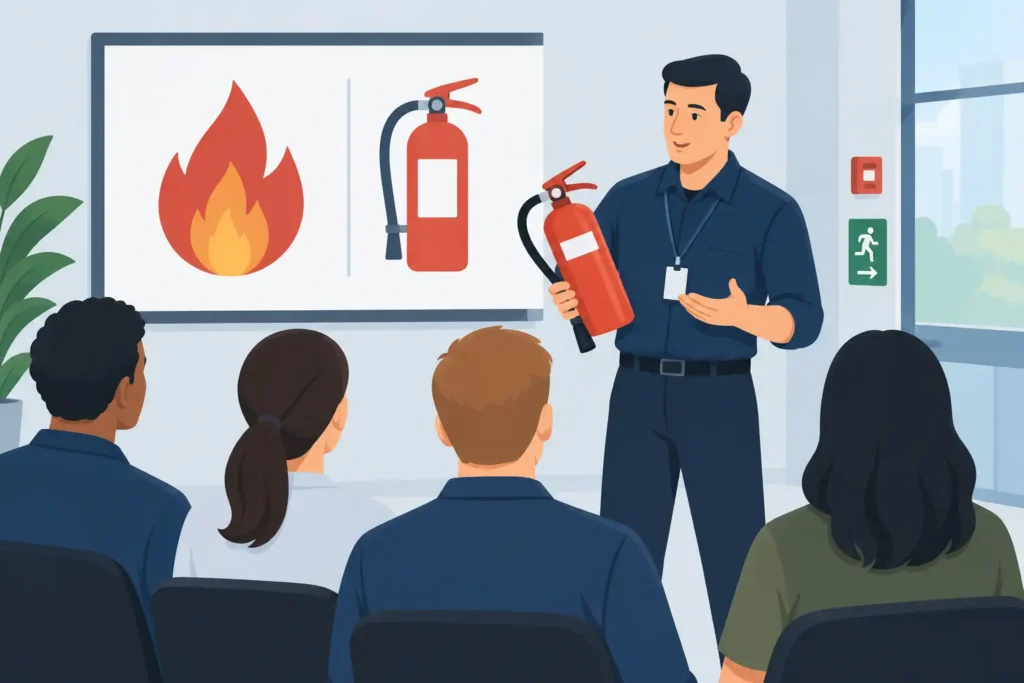
A fire alarm is not the time to discover whether people know who is responsible for checking a restroom, directing visitors, or reporting a blocked exit. Fire marshal training for staff gives an organization designated people who can act calmly, follow a defined procedure, and support safe evacuation when every minute matters.
For facilities managers, property teams, site leaders, and employers, the objective is bigger than issuing certificates. Training must translate the fire risk assessment into reliable action on the premises: the right people, in the right locations, carrying out duties they understand and can evidence. That is how fire preparedness stands up during an incident, an inspection, an insurance review, or a post-event investigation.
What Fire Marshal Training Must Achieve
A fire marshal, often called a fire warden, is not expected to replace the fire department or take unnecessary risks. Their purpose is to support the responsible person or management team by helping prevent fires, raising concerns, assisting an orderly evacuation, and reporting accurately after an alarm or incident.
Effective training should explain the legal and operational context without burying staff in theory. Participants need to understand the site-specific fire strategy, alarm arrangements, escape routes, assembly points, evacuation roles, and the limits of their authority. They must know when to intervene, when to report a hazard, and when to leave immediately.
The strongest programs also make clear that fire safety is continuous. A marshal may identify a wedged-open fire door during a routine walk-through, notice combustible materials accumulating in a service corridor, or find that a new layout has narrowed an escape route. Those observations are valuable only if there is a defined route for escalation, corrective action, and recorded follow-up.
Why Generic Courses Can Leave Gaps
A general fire marshal course can provide a useful foundation, particularly for new appointees. But a certificate alone does not prove that a member of staff understands a multi-tenant office tower, active construction site, warehouse, residential block, school, event venue, or industrial facility.
The risk profile changes with the building, its occupants, and its operations. A warehouse may require attention to charging areas, high-rack storage, vehicle movement, and large travel distances. A residential property may involve vulnerable residents, stay-put or simultaneous evacuation arrangements, and common-area controls. A construction project can change by the week as temporary power, hot works, incomplete compartmentation, and changing access routes alter the risk.
This is why site familiarization matters. Training should be connected to the current fire risk assessment and tested against the actual building. Marshals should be able to point out the relevant call points, fire exits, refuge areas where applicable, assembly locations, extinguishers, and emergency information. If they cannot apply the learning on site, the organization still has a readiness gap.
Core Duties Staff Need to Understand
The exact role should be written into the organization’s emergency arrangements, with enough marshals assigned to cover shifts, absences, remote areas, and periods of higher occupancy. One person appointed on paper is not adequate if they are routinely off site, working elsewhere, or unavailable during an evacuation.
Before an incident, a fire marshal’s work commonly includes routine visual checks, reporting defective equipment or obstructed routes, helping keep fire doors effective, and supporting scheduled drills. They should understand what they are checking and what requires immediate escalation. For example, a missing extinguisher, damaged emergency lighting, or blocked exit should not wait for the next monthly meeting.
During an alarm, duties often include encouraging prompt evacuation, sweeping only where it is safe and part of the agreed procedure, helping direct people to the correct exit, and reporting relevant information at the assembly point. Marshals must never place themselves in danger to complete a search. Smoke, heat, uncertainty about conditions, or a compromised route means withdrawing and communicating what is known.
Afterward, a marshal may help account for occupants, record observations, identify issues with behavior or building systems, and contribute to a debrief. Clear notes are particularly important where a drill exposes repeated delays, a door fails to close, visitors are not accounted for, or staff use the wrong assembly point.
Fire Marshal Training for Staff Should Be Site-Led
A practical training session begins with the realities of the premises, not a generic slide deck. The trainer should understand the type of building, occupancy patterns, working hours, existing alarm and detection systems, evacuation policy, and findings from the fire risk assessment.
For management, this means providing current information before training takes place. Plans, fire action notices, drill records, relevant maintenance issues, and known operational constraints all help create instruction that staff can use. If a building is being refurbished, has temporary access restrictions, or has occupants requiring personal emergency evacuation plans, those factors must be included.
Scenario discussion is especially useful. Ask what happens if an alarm sounds while a loading bay is busy, an elevator is unavailable, a client meeting includes visitors unfamiliar with the building, or a night shift has reduced staffing. The answers reveal whether the fire plan is workable under pressure. They also identify where additional coverage, signage, equipment checks, or procedural changes are needed.
Training Is Only Credible When It Is Tested
A drill is not a performance for a compliance file. It is a controlled test of whether people, procedures, and building measures work together.
Run drills at times that reflect real conditions where possible. A drill conducted only during a quiet mid-morning period may tell you little about response during shift change, a public event, or peak occupancy. There are trade-offs: operations, resident welfare, and business continuity must be considered, and some premises require carefully managed arrangements. But avoiding realistic testing entirely creates false confidence.
Record the date, scope, timing, attendance, issues found, and actions taken. A useful drill record does more than state that an evacuation occurred. It shows whether exits were available, marshals were present, visitors were managed, staff reached the right assembly point, and any failures were corrected. That evidence helps demonstrate active control of fire risk rather than passive reliance on paperwork.
Refreshers, Turnover, and Changing Risk
Fire marshal competence can fade if people do not use it. Refresher intervals should reflect the organization’s risk assessment, staff turnover, operational change, and the complexity of the site. A stable, low-risk office may need a different approach from a high-turnover logistics facility or an evolving construction project.
Retraining should also follow meaningful change. This may include a new floor plan, revised evacuation strategy, altered assembly point, installation of a new alarm system, changes to shift patterns, or an incident that exposes a weakness. New marshals need training before they are relied upon, while existing marshals need enough practice to remain confident in the current arrangements.
Management should maintain a simple, accessible record showing who has been trained, when training was completed, what it covered, which areas or shifts each marshal supports, and when review is due. This supports continuity when a trained employee leaves and provides a clear audit trail when compliance is questioned.
Choosing the Right Level of Support
Some organizations can coordinate their own training and drills if they have competent internal fire-safety leadership, stable premises, and current documentation. Others benefit from specialist support, particularly where buildings are complex, multiple locations must be managed, or risk assessments identify significant concerns.
The right provider should be able to connect training with the wider fire-safety system: risk assessments, emergency plans, fire-door checks, alarm testing, emergency lighting, extinguisher provision, and documented corrective actions. Fragmented services can create gaps when one contractor identifies an issue but no one owns the response.
Spycon Security Ltd. supports organizations that need fire-safety capability alongside operational protection, helping align trained personnel, site procedures, inspection evidence, and ongoing compliance responsibilities under accountable delivery.
Give Staff Authority to Act
The most effective fire marshals are not simply appointed. They are visible, trained, supported by management, and given a clear process for escalating concerns. When they report a wedged fire door, inadequate shift coverage, or repeated drill failures, the organization must respond and document what changed.
That approach protects more than a compliance position. It gives staff confidence that safety is taken seriously before an alarm sounds, and gives leaders evidence that their fire arrangements are designed to work when they are questioned.