

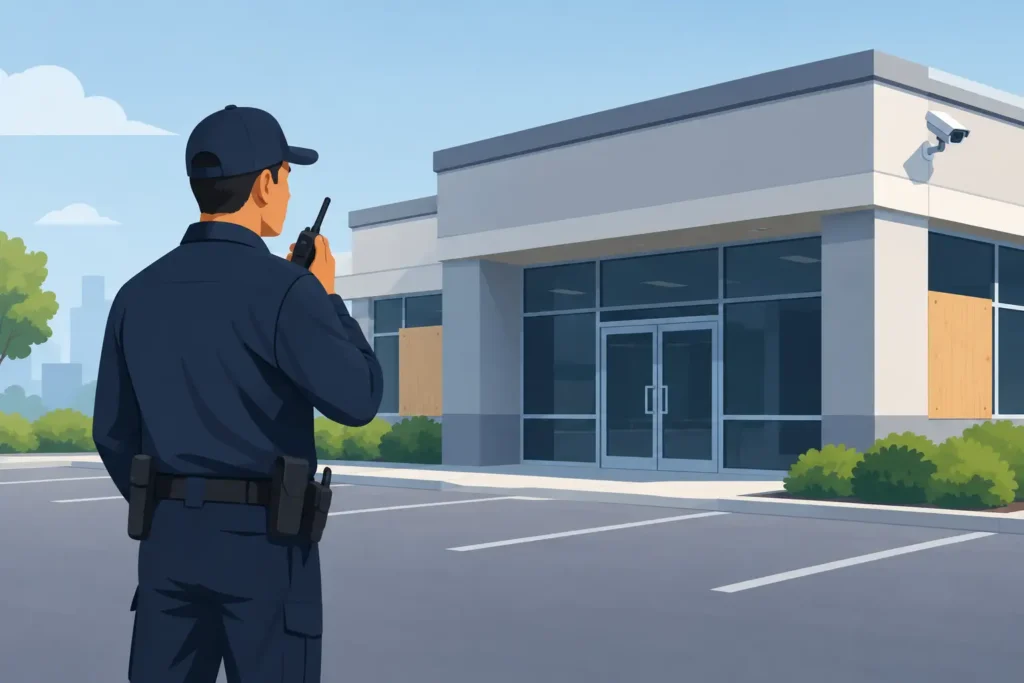
A vacant building can become a security exposure within days, not months. A broken fence panel, an unsecured delivery entrance, or a light left off at the rear of a site can signal opportunity to trespassers, vandals, thieves, and arsonists. Security guards for vacant properties provide a visible, accountable presence when there is no day-to-day workforce to notice what has changed.
For property managers, landlords, developers, and facilities teams, the issue is not simply keeping people out. It is maintaining control of an asset that may be under insurer scrutiny, awaiting sale, undergoing redevelopment, or temporarily closed after a change in operations. The right guarding plan protects the premises, creates a clear incident record, and helps demonstrate that reasonable precautions remained in place throughout the vacancy.
Why vacant premises need active protection
An occupied site has natural oversight. Staff arrive, visitors sign in, deliveries are received, and abnormal activity is more likely to be reported quickly. Once a property is empty, those controls disappear. Even monitored alarms and cameras can have limits if there is no rapid, informed response when an activation occurs.
Vacant buildings can attract unauthorized entry for many reasons. Some intruders are looking for high-value materials, copper, tools, or equipment. Others may be seeking shelter, access to utilities, or a place to cause damage. Empty commercial and residential buildings can also become targets for illegal dumping, graffiti, squatting, and deliberate fire-setting. Each incident can create further risk, from water damage and hazardous conditions to delayed construction schedules and disputed insurance claims.
A professional guard does more than stand at a gate. They inspect access points, challenge unauthorized visitors, monitor vulnerable areas, identify signs of tampering, and escalate concerns through an agreed reporting chain. Their presence changes the risk calculation for anyone considering entering the site without permission.
What security guards for vacant properties should deliver
Effective vacant-property guarding starts with a site-specific assignment, not a generic patrol schedule. A former office building in a city center presents different threats from an isolated warehouse, a vacant retail unit, or a residential block awaiting refurbishment. Guarding coverage should reflect the property’s layout, surrounding activity, known vulnerabilities, asset value, and the duration of the vacancy.
Controlled access and visible deterrence
Guards can manage a defined entry point, verify contractor credentials, log visitors, and enforce authorization procedures. This is particularly valuable where surveyors, maintenance contractors, cleaning teams, or construction personnel still require periodic access.
At higher-risk locations, a clearly identifiable security presence can deter opportunistic intrusion before it begins. Patrol patterns should remain purposeful rather than predictable, covering boundary lines, doors, windows, plant rooms, roof access, utility areas, and any location where concealment or forced entry is likely.
Regular inspections that find problems early
Vacancy creates risks that are not always criminal. A guard conducting documented checks may spot a leaking pipe, damaged fire door, open window, alarm fault, storm damage, or signs of water ingress before the problem becomes expensive. Where safe and authorized to do so, personnel can take immediate protective action, such as securing an accessible opening or isolating an area pending specialist attendance.
The key is escalation. Guards need clear instructions on what to report, who to contact, and when an issue requires emergency services, a facilities representative, or a specialist contractor. A shift log without action behind it is not a control measure.
Incident response and evidence
When an alarm activates or an incident occurs, time matters. A trained guard can assess the situation, preserve the scene, liaise with police or emergency responders, and provide factual incident reports. Accurate records can support follow-up action with insurers, property owners, contractors, or authorities.
Reports should record times, locations, observations, actions taken, people contacted, and relevant photographs where permitted. This is not unnecessary administration. It creates accountability and shows that the site was being actively managed rather than left unattended.
Choosing the right coverage model
There is no single guarding arrangement that suits every empty property. The appropriate model depends on risk, budget, operational needs, and the consequences of a security failure.
For a lower-risk property with a strong perimeter and monitored alarm system, scheduled mobile patrols may provide proportionate coverage. For example, guards may conduct external and internal inspections at varying times, check access points, and respond to unusual activity. This can be cost-effective, but it does not provide a continuous on-site presence.
Static guarding is more appropriate where the property is vulnerable, valuable, frequently accessed by authorized personnel, or located in an area with repeated incidents. A dedicated guard can control entry, maintain constant observation, and respond immediately to developing concerns. It carries a higher cost, but that cost may be justified by the value of plant, materials, fixtures, or the potential disruption caused by a single serious event.
Some sites need a combined approach: on-site guarding during high-risk hours, supported by CCTV monitoring, alarm response, and mobile patrols at other times. Layered protection can provide better coverage than relying on one measure alone, provided the responsibilities are clear and the systems are tested.
Fire safety cannot be treated separately
Security and fire safety often intersect at vacant premises. Unauthorized entry can introduce ignition sources. Arson is a serious concern at empty buildings, while reduced occupancy can mean faults, combustible waste, or compromised fire compartments go unnoticed for longer.
A vacant-property plan should consider whether fire detection, emergency lighting, extinguishers, fire doors, and escape routes remain suitable for the building’s condition and any authorized visitors. It should also establish how fire risks will be inspected, how alarms will be monitored, and who will respond to an activation. Requirements vary by building type, occupancy status, local rules, insurer conditions, and planned works.
This is where a single accountable provider can reduce gaps between guarding operations and life-safety responsibilities. Spycon Security Ltd. can align trained personnel, monitoring, site inspections, and fire-safety support so that concerns identified on the ground are not lost between separate vendors.
Questions to ask before appointing a guarding provider
The most useful proposal will explain how the provider intends to protect your specific property, not merely state an hourly rate. Ask how guards are selected, trained, supervised, and briefed for vacant-site duties. Confirm whether there is 24/7 control-room support and how incidents are escalated outside normal business hours.
You should also establish what evidence you will receive. Shift reports, patrol records, incident reports, access logs, and photographs can all provide assurance that coverage has been delivered. For sensitive or high-value sites, ask whether digital patrol verification, welfare checks, and supervisor inspections are included.
Insurance requirements deserve early attention. Some policies specify minimum protections for unoccupied buildings, including frequency of inspections, alarm maintenance, heating controls, water isolation, and security measures. Guarding should support those conditions, but it cannot replace them. The property owner or responsible manager should confirm requirements directly with the insurer and ensure the security plan is documented accordingly.
Make the handover disciplined
The first shift is often where vacant-site security succeeds or fails. Before guards are deployed, complete a structured handover covering keys, access codes, alarm procedures, known hazards, restricted areas, contractor schedules, emergency contacts, utility information, and reporting expectations. Walk the site with the guarding team wherever possible. A written assignment instruction should translate that information into clear operational duties.
Review the plan after the first week and whenever conditions change. A property becomes more exposed when scaffolding goes up, a tenant moves out, construction materials arrive, a perimeter is altered, or repeated trespass occurs. Security that remains fixed while the risk changes is not dependable security.
A vacant property does not have to become an unmanaged liability. With trained guards, clear instructions, tested escalation, and documented oversight, it can remain protected, controlled, and ready for its next operational use.