

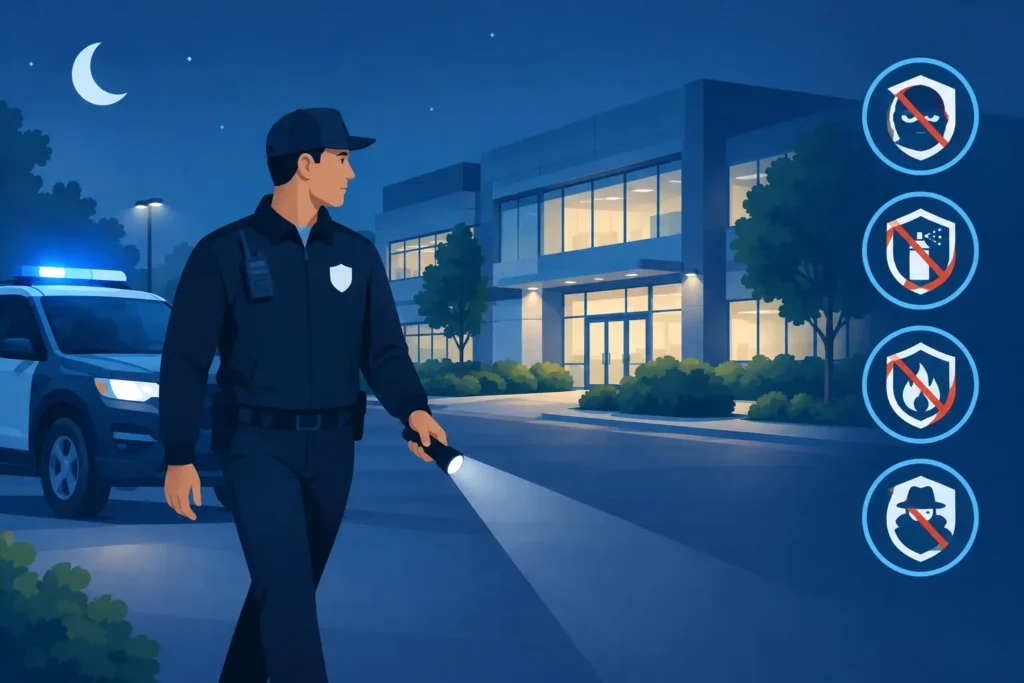
A locked gate, a camera on the wall, and an empty site are not the same as active protection. A 24 hour security patrol service puts trained personnel into the places where risk develops: perimeter lines, loading areas, vacant floors, parking lots, access points, and plant rooms. For facilities, property, and operations leaders, that presence delivers more than reassurance. It creates an accountable process for preventing loss, identifying hazards, and responding before a minor issue becomes an operational incident.
The strongest patrol programs are not based on random walks around a property. They are built around the site’s actual exposure, business hours, asset value, occupancy pattern, and incident history. That distinction matters when protection must stand up to insurer questions, internal reviews, tenant concerns, or an investigation after an event.
What a 24 Hour Security Patrol Service Actually Does
Continuous patrol coverage means there is a security presence throughout the day and night, not simply a guard posted at a front desk. Officers conduct scheduled and variable checks, verify that access points are secure, observe activity around the premises, and act on signs that conditions have changed.
On a construction site, this may involve checking temporary fencing, fuel stores, machinery, material deliveries, and unauthorized vehicle access. At a commercial property, the priority may be visitor management, loading dock oversight, out-of-hours access, or protecting sensitive areas after staff leave. For residential developments, patrols can focus on communal entrances, parking facilities, vacant units, anti-social behavior, and escalation routes for residents.
A patrol officer also provides human judgment that technology alone cannot supply. Cameras can record a door left open. A trained officer can determine whether it was caused by a failed closer, a contractor, forced entry, or an employee error, then secure the area and report the issue through the agreed process.
Visible Deterrence Is Only the First Layer
A marked and professional security presence can discourage opportunistic trespass, theft, vandalism, and unauthorized access. That deterrent value is real, particularly at sites that become vulnerable after business hours. But deterrence by itself is not a security plan.
The operational value comes from repeatable checks and prompt intervention. A patrol may find a damaged fence panel before intruders use it, identify a fire door that has been wedged open, notice water entering a plant room, or challenge an individual attempting to gain access without authorization. Each finding should be handled, logged, and communicated to the responsible client contact.
This documented trail is essential. If a property manager needs to show that vacant premises were inspected, if a site manager needs evidence of perimeter checks, or if an insurer requests records following a loss, verbal assurance is not enough. Time-stamped reporting, incident details, observations, and escalation records establish that control was in place.
Patrol Design Should Follow Risk, Not Habit
There is no single patrol frequency that suits every location. A distribution facility with high-value stock, multiple vehicle movements, and overnight operations has very different risks from an office building occupied only during weekday hours. The right level of coverage depends on what can happen, when it can happen, and how quickly an issue must be addressed.
A professional assessment should consider the site layout, entry and exit points, nearby public access, lighting, alarm and CCTV coverage, lone-worker exposure, valuable assets, fire risks, and previous incidents. It should also consider the gaps between other controls. If a camera system has blind spots or a gate is regularly opened for deliveries, patrol activity should be designed to address those weaknesses.
Patrol routes should not become entirely predictable. Consistent standards are necessary, but a routine that is obvious to anyone watching can be exploited. Varying the timing and sequence of certain inspections, while maintaining required checks at critical points, helps preserve deterrence and detection capability.
The difference between mobile patrols and dedicated officers
A mobile patrol service can be a cost-effective option for sites that need scheduled visits, lock and unlock support, alarm response, or periodic perimeter checks. An officer attends at agreed intervals or in response to an incident. This can work well for lower-occupancy offices, retail units, vacant buildings, and smaller compounds.
A dedicated officer is generally more appropriate where the risk is continuous or the site needs immediate intervention. Examples include busy construction projects, high-value industrial premises, residential developments with recurring issues, major events, and properties with complex access control. The officer remains on site, becoming familiar with routines, authorized personnel, and emerging concerns.
The choice is not simply about budget. It is about the consequence of delay. If an alarm activation, safety hazard, or access breach needs a response within minutes, scheduled visits may not provide sufficient control.
Security and Fire Safety Must Not Operate in Separate Silos
Patrol officers are not a substitute for specialist fire inspections, maintenance, or fire risk assessments. However, they can support day-to-day fire safety by identifying visible concerns and reporting them quickly. Obstructed escape routes, damaged emergency lighting, unsecured fire doors, unsafe storage, and suspicious odors should never be treated as routine observations.
For occupied buildings, construction sites, and higher-risk properties, clear escalation procedures are critical. The patrol team must know who to contact, when to isolate an area, when to call emergency services, and how to preserve a safe scene. Security staff should work within defined instructions and never exceed their authority or training.
This is where a single accountable provider can reduce avoidable gaps. When physical guarding, CCTV monitoring, access control awareness, and fire-safety support are coordinated, issues can be routed to the right people with less delay and less confusion. Spycon Security Ltd. approaches protection as an operational responsibility, not a collection of disconnected services.
What Good Patrol Reporting Looks Like
A useful report does not merely state that an officer attended. It records what was inspected, the condition found, any action taken, and whether further follow-up is required. Reports should be clear enough for a facilities manager to make a decision without chasing basic details.
For routine activity, that may include perimeter integrity, access point status, visitor or vehicle observations, lighting defects, and alarm panel checks where authorized. For incidents, reports should capture the time, location, persons involved where appropriate, facts observed, actions taken, notifications made, and supporting photographs where permitted.
Reporting also creates pattern recognition over time. Repeated loitering near one entrance, recurring damage to a gate, frequent false alarms, or a specific area left unsecured after a contractor visit may each appear minor in isolation. Properly recorded, they reveal where site procedures or physical controls need improvement.
Questions to Ask Before Appointing a Provider
Before procuring patrol coverage, decision-makers should be clear about who is responsible for the site at every hour and what happens when something goes wrong. Ask how officers are selected, trained, supervised, and briefed for your environment. Confirm how incidents are escalated outside normal business hours and whether reports are available promptly.
It is also sensible to ask how the provider handles relief coverage, sickness, emergency deployment, and control-room oversight. A service promise has little value if it depends on one individual being available. The provider should be able to explain its operating model, not just its staffing rate.
Finally, define the boundary between observation, intervention, and emergency response. Security officers can deter, challenge, secure, report, and escalate within their instructions. They should not be expected to take unnecessary risks or perform tasks outside their qualifications. Clear expectations protect both the client and the officers on the ground.
A well-managed patrol service gives your site a set of trained eyes, a visible standard of control, and evidence that risk is being actively managed around the clock. When people, property, and continuity are on the line, that accountability should be present long before an incident forces the question.