

If you are submitting a property for HMO licensing, planning approval or Building Control review in London, you may be asked to provide clear and compliant fire safety drawings.
A Fire Drawing Plan is more than a floor plan with symbols. It is a structured, scaled drawing that shows how escape routes, fire protection measures and safety systems are arranged within the building.
At Spycon Security, we prepare professional Fire Drawing Plans and Fire Safety CAD drawings for residential, commercial and mixed-use premises across Greater London. Each drawing reflects the actual layout and fire safety arrangements of the property — not a generic template.
If you require a professionally prepared Fire Drawing Plan, Fire Safety CAD drawing or HMO Fire Layout Plan in London, we can review your floor plans and provide a structured quotation.
Email: info@spyconsecurity.co.uk
Telephone: 020 4600 4703
A free quote can be provided following review of your building layout and compliance requirements.
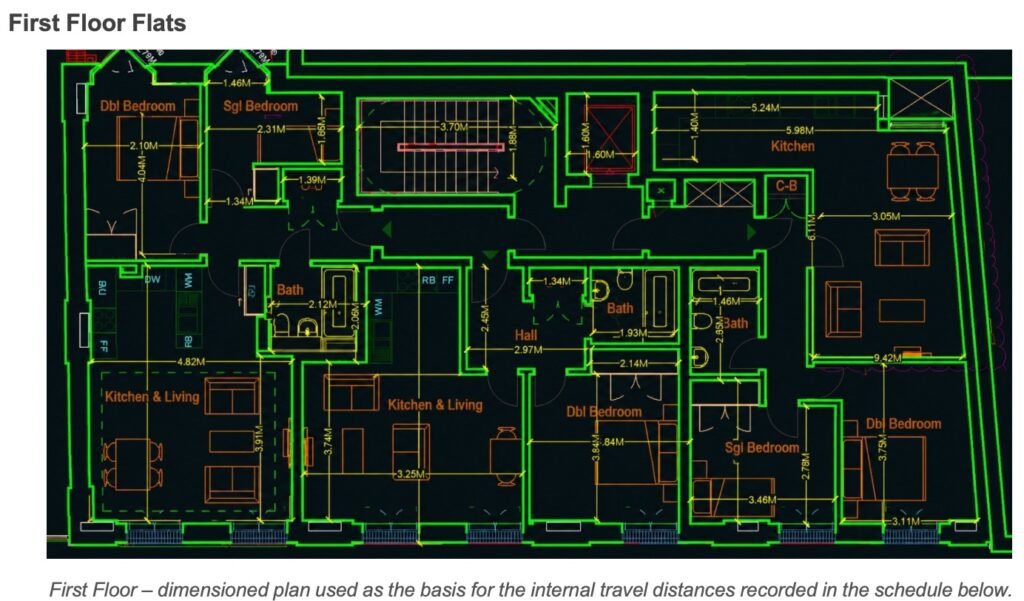
A Fire Drawing Plan — sometimes referred to as a Fire Safety Plan, Fire Escape Plan Drawing or Emergency Evacuation Layout Plan — is a scaled visual representation of a building’s fire safety features.
It typically identifies:
In London, these drawings are frequently required for:
The drawing must be accurate, legible and reflective of the building as it currently exists.
Many London borough councils require a fire safety layout drawing as part of HMO licensing applications.
An HMO Fire Plan Drawing should clearly show:
In practice, poorly prepared drawings are one of the most common causes of delays in HMO applications. Licensing officers expect clarity, consistency and alignment with the Fire Risk Assessment.
We prepare HMO Fire Safety Plans that are suitable for submission and professional review.
We provide Fire Drawing Plan services across Greater London, including:
Westminster
Camden
Islington
Hackney
Tower Hamlets
Newham
Croydon
Brent
Barnet
Hammersmith & Fulham
Kensington & Chelsea
Canary Wharf and Docklands
London remains our primary operational focus.
Where structural alterations, extensions or internal reconfigurations are undertaken, Building Control may request fire safety drawings to demonstrate compliance with Approved Document B.
A Fire Drawing Plan can assist in explaining:
Clear drawings often reduce queries during review.
Where architectural drawings are available, we produce fire safety CAD drawings using scaled plans.
Where accurate drawings are not available, we can work with updated layouts to ensure the final fire safety floor plan reflects:
All drawings are delivered digitally in clear, professional PDF format for ease of submission and display.
Generic downloadable fire plan templates rarely meet London authority expectations.
Common issues include:
In multi-occupancy London properties, these inaccuracies are quickly identified.
A properly prepared Fire Drawing Plan demonstrates that fire safety has been considered carefully and documented clearly.
Fire Drawing Plans work alongside:
The risk assessment identifies hazards and control measures.
The fire drawing visually represents where those measures are located.
Together, they strengthen compliance documentation.
We regularly prepare Fire Drawing Plans for:
London properties often involve complex layouts and shared access arrangements, which require careful representation on drawings.
In many London boroughs, yes. HMO licence applications often require a clear fire safety layout drawing showing escape routes, fire doors, alarm systems and separation between units. Requirements vary slightly between boroughs, but accurate fire plan drawings are commonly requested.
A Fire Risk Assessment identifies hazards and evaluates fire risk within a building.A Fire Drawing Plan visually shows where fire safety features and escape routes are located.The drawing supports the findings of the risk assessment but does not replace it.
While not always mandatory, scaled CAD-based drawings are preferred for clarity and accuracy, especially for Building Control submissions or commercial developments. Clear scaling and legibility are important for compliance purposes.
Only if it accurately reflects the current layout and includes correct fire safety markings. Outdated plans that do not match the building configuration can cause delays in licensing or compliance reviews.
In many cases, yes — particularly where alterations affect means of escape, compartmentation or fire safety systems. Building Control may request clear drawings to demonstrate compliance with Approved Document B.
Typically, a compliant fire plan should show:
The exact requirements depend on the building type.
No. While core fire safety principles remain consistent, borough-specific licensing departments may request additional detail, particularly for HMOs or mixed-use buildings.
Fire Drawing Plans should be updated whenever:
Regular review ensures drawings remain accurate and defensible.
Yes, in many cases simplified evacuation drawings are displayed on-site to guide occupants. However, submission drawings used for compliance may contain additional technical detail.
A Fire Strategy Report explains how a building achieves compliance through design and construction.
Fire Safety Drawings visually show the layout and positioning of fire safety features within the building.
They serve different but complementary purposes.
Smaller premises may still require a fire plan drawing, particularly if undergoing alteration, change of use or licensing. Requirements depend on building complexity and regulatory context.
Yes. Clear, accurate drawings reduce queries from licensing officers and help demonstrate that fire safety has been considered properly. Incomplete or unclear plans are a common reason for application delays.