


Compliance is not a checkbox exercise; it’s a continuous cycle of risk assessment, professional engineering, and disciplined maintenance. For many business owners, understanding the commercial fire alarm system requirements UK mandates can feel like a moving target, especially with the transition to BS 5839-1:2025 standards. You likely feel the weight of responsibility for your staff and assets, yet the technical jargon regarding L and P categories often obscures the path to legal certainty. It’s a common frustration to find yourself caught between complex British Standards and the rigid expectations of the law whilst managing daily operations.
This guide provides the clarity you require to secure your premises and satisfy regulatory inspectors. You’ll master the latest legislative updates and learn how to implement a system that offers genuine, 24/7 protection. We’ll examine the specific requirements for 2026, clarify the distinction between life protection and property protection categories, and establish a clear roadmap for your ongoing maintenance obligations. Reliable safety starts with professional strategy.
Key Takeaways
- Identify your statutory obligations under the Regulatory Reform (Fire Safety) Order 2005 to ensure your premises remain legally sound.
- Master the commercial fire alarm system requirements UK professionals must follow, including the critical distinctions between Category L and Category P systems.
- Evaluate the technical advantages of addressable versus conventional systems to select the most efficient protection for your specific site layout.
- Implement a rigorous maintenance schedule that combines internal weekly checks with mandatory six-monthly professional servicing.
- Understand how professional installation secures your business by integrating alarms with fire doors and comprehensive strategy reports.
Statutory Framework: The Regulatory Reform (Fire Safety) Order 2005
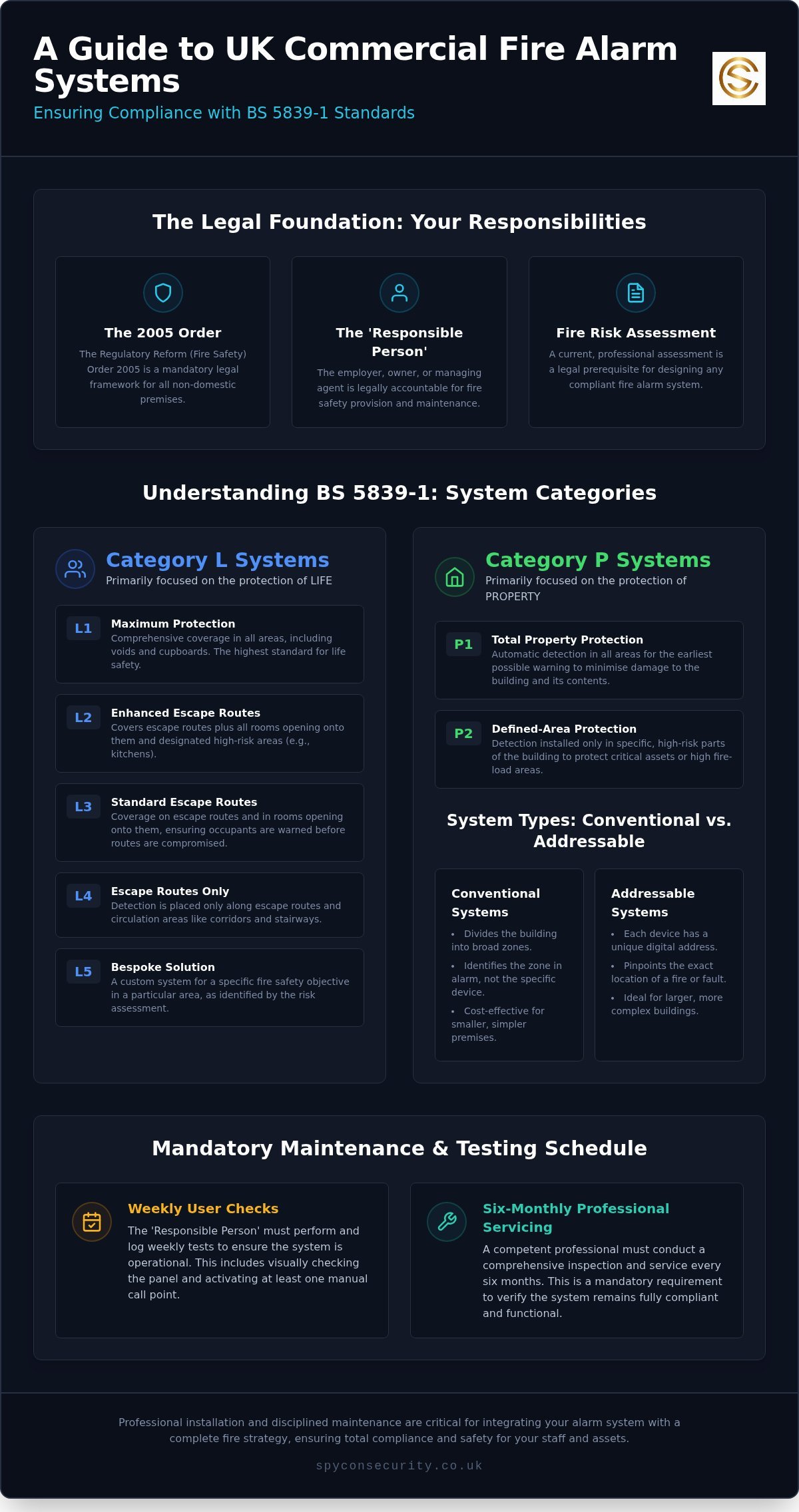
The Regulatory Reform (Fire Safety) Order 2005 remains the primary piece of legislation governing non-domestic premises across England and Wales. It is not a set of suggestions. It’s a mandatory framework that places the burden of safety squarely on the shoulders of those who operate commercial buildings. Central to this order is the requirement for “appropriate” fire detection and warning systems. This means your system must be fit for purpose, scaled to your specific risks, and maintained with absolute precision.
Compliance in 2026 has moved beyond reactive measures. The legal expectation is now rooted in proactive risk management. You must demonstrate that you’ve identified potential hazards and implemented technical solutions to mitigate them before a crisis occurs. The consequences of failing to meet commercial fire alarm system requirements UK standards are severe. Authorities have the power to levy unlimited fines. For the most serious breaches, custodial sentences are a distinct possibility. Professional vigilance is the only path to total legal security.
The Role of the Responsible Person
The law defines a “Responsible Person” as the individual or entity held legally accountable for fire safety. This role usually falls to the employer, building owner, or managing agent. Your duties are extensive. You’re responsible for the provision, testing, and upkeep of all fire detection equipment. Given the technical complexity of modern standards, many organisations choose to delegate these responsibilities to a professional consultancy. This is a critical risk-mitigation step. It ensures that your safety protocols are handled by experts who understand the nuances of the law, providing you with documented proof of due diligence.
Fire Risk Assessments as a Legal Prerequisite
A professional fire alarm system cannot be designed or installed without a current fire risk assessment. This document is the foundation of your entire fire strategy. It identifies the specific hazards within your building that dictate the required alarm category, whether you’re protecting life or property. Without this prerequisite, any system installed is based on guesswork rather than verified data. You must review these assessments regularly. Any change in building occupancy, internal layout, or business activity necessitates a fresh evaluation to ensure your detection coverage remains adequate and legally compliant.
Understanding BS 5839-1:2025 Categories and Grades
BS 5839-1:2025 serves as the definitive code of practice for fire detection and alarm systems in UK non-domestic premises. It translates broad legal duties into technical specifications. Adhering to these standards is essential for meeting commercial fire alarm system requirements UK mandates. The 2025/2026 updates have introduced more rigorous criteria for wireless signal verification. They also refined sensor placement to reduce false alarms whilst maintaining rapid detection speeds. Operational precision is the core objective. Every sensor must be positioned to provide an uncompromising shield against fire threats.
High-risk commercial environments often demand Grade A systems to meet the most stringent commercial fire alarm system requirements UK inspectors look for. These systems feature central control and indicating equipment with a dedicated, monitored power supply. This ensures constant readiness. It prevents system failure when it’s needed most. Relying on inferior grades in a complex commercial setting is a risk that disciplined operators don’t take.
Category L: Systems Designed for Life Safety
Category L systems prioritise the protection of building occupants. The level of coverage depends on building complexity and user vulnerability. These categories are not interchangeable; they are selected based on meticulous risk profiling.
- L1: Provides comprehensive coverage throughout all areas, including cupboards and roof spaces. This is the highest level of life safety protection available.
- L2 and L3: These focus on escape routes. L2 adds detection in high-risk rooms like kitchens or plant rooms. L3 ensures occupants are alerted before escape routes become impassable.
- L4 and L5: L4 covers escape routes only. L5 is a bespoke category designed for specific fire safety objectives identified in a professional audit.
Category P: Protecting Assets and Continuity
Category P systems focus on safeguarding the building structure and contents. The goal is early detection to minimise fire damage and business interruption. This level of protection is often a prerequisite for comprehensive insurance coverage.
- P1: Detection is installed across the entire premises for the fastest possible emergency response. It offers the maximum protection for your physical assets.
- P2: Detection is limited to specific areas of high risk or high value. This protects critical infrastructure without the cost of full-building coverage.
Determining the correct category often involves consultation with your insurance provider. A robust fire strategy report will define these requirements clearly. This ensures your technical investment aligns with both legal and financial risk profiles, providing the peace of mind that comes from total compliance.
Selecting the Appropriate System Type for Your Business
The architecture of your fire safety infrastructure determines how effectively you can manage an emergency. Selecting the correct technology is a pivotal step in meeting commercial fire alarm system requirements UK standards. For simple, single-storey premises, conventional systems offer a robust and cost-effective solution. Larger, multi-level, or complex sites require the precision of addressable or wireless technology. Each choice involves a balance between initial installation complexity and long-term operational efficiency. Precision is the ultimate goal. You must choose a system that matches the physical demands of your building whilst ensuring total reliability.
Conventional vs Addressable Architectures
Conventional systems operate on radial circuits. They divide a building into broad zones. If a detector activates, the control panel identifies the zone but not the specific room. This is often sufficient for small retail units or simple warehouses where the source of a fire is easily visible. Addressable systems, however, utilise loop configurations. These loops allow for superior fault tolerance; if a wire breaks, signal integrity is maintained from the other direction. The primary advantage is the text display on the control panel. It provides the exact location of the incident, allowing for an immediate and targeted response. Whilst addressable hardware carries a higher initial cost, the reduction in cabling requirements often offsets this in larger installations. It’s a calculated investment in operational speed.
The Rise of Wireless Fire Detection
Wireless technology has evolved into a highly reliable alternative to traditional wired systems. Modern radio-linked components must comply with strict EN54-25 standards to be considered legally compliant under commercial fire alarm system requirements UK frameworks. This technology is particularly valuable for heritage buildings or high-end offices where aesthetic preservation is paramount. There’s no need for invasive cabling or trunking. Hybrid solutions are also gaining prominence. These combine wired loops for main areas with wireless extensions for difficult-to-reach spaces or temporary structures. You must account for battery life in your maintenance roadmap. Whilst installation is faster and less disruptive, regular verification of signal strength and battery health is a non-negotiable requirement for operational readiness. A disciplined approach to these technical choices ensures your system remains a watchful guardian.
Maintenance, Testing, and Operational Compliance
Maintenance represents the operational heartbeat of your fire safety strategy. It’s the mechanism that ensures your initial investment remains functional and legally sound. Under commercial fire alarm system requirements UK regulations, the Responsible Person must maintain a rigorous testing schedule to verify system integrity. This is not a matter of choice. It is a statutory duty. Failure to document these actions in a Fire Safety Logbook leaves your organisation vulnerable during a fire service inspection. A meticulous record is your primary defence against claims of negligence.
One of the most significant challenges in high-stakes environments is managing false alarms. Unwanted signals lead to alarm fatigue, where staff begin to ignore warnings, creating a lethal delay in evacuation. Additionally, many fire services now levy substantial charges for persistent false call-outs. A disciplined maintenance programme identifies the technical faults or environmental factors causing these triggers, ensuring your system remains a trusted guardian rather than a nuisance. Precision in maintenance prevents these operational failures.
Weekly Testing Best Practices
Your internal team must conduct a functional test every week. This involves activating a manual call point during normal working hours to ensure the sounders operate correctly. You should rotate the call points used for these tests, ensuring every trigger device is verified over a specific cycle. If your system is monitored, you must verify that the signal successfully reaches the alarm receiving centre (ARC). Training staff to recognise the difference between a scheduled test and a genuine emergency signal is vital for maintaining order amongst your workforce whilst ensuring everyone remains vigilant.
Professional Servicing and Certification
Whilst weekly tests are essential, they don’t replace the need for professional expertise. BS 5839-1 mandates that a qualified engineer must service your system at least every six months. During this periodic inspection, the engineer performs a deep-level verification of battery health, sensor sensitivity, and signal strength. You must receive a formal Certificate of Compliance following these visits. This document differs from a standard service report; it serves as official proof that your system meets all commercial fire alarm system requirements UK standards. If you require technical support to achieve this level of rigor, you can book a professional fire alarm installation and maintenance review to secure your premises.
Professional Installation and Integrated Fire Strategy
Professional fire alarm installation represents the final, critical step in achieving full legal compliance. You cannot rely on a fragmented approach. Hardware must be configured to work in perfect unison with your building’s architecture. Meeting the commercial fire alarm system requirements UK inspectors demand requires more than just functional sensors. It demands a system that’s correctly commissioned and certified. This process ensures that every component, from the control panel to the furthest heat detector, operates with absolute precision during a crisis. Unaccredited work is a liability you can’t afford.
A fire strategy report serves as the essential blueprint for this installation. It bridges the gap between the initial risk assessment and the final technical deployment. This report provides the engineering logic required for Building Control approval, ensuring your system is architecturally sound. Without this strategic foundation, your system remains a collection of parts rather than a cohesive shield. It’s the difference between reactive equipment and a proactive safety infrastructure.
Beyond the Alarm: Comprehensive Fire Safety
A modern fire system doesn’t operate in isolation. It must be integrated with other life-safety systems to create an effective escape environment. This includes linking your detection loops to automatic fire door closers and emergency lighting. When an alarm triggers, fire doors must release immediately to compartmentalise the threat. There’s also a vital synergy between technical systems and physical guarding. Integrating your alarm with 24/7 CCTV monitoring allows for immediate signal verification, significantly reducing the risk of false deployments. Your fire strategy plan must account for these interactions to ensure your escape routes remain clear and protected at all times.
Choosing a Disciplined Partner
Selecting an installation partner requires careful verification of their professional integrity and technical rigor. Spycon Security Ltd. provides authoritative fire safety consultancy and technical solutions across the UK. Our SIA licensed expertise ensures that your security and fire safety protocols are handled with the same level of meticulousness. We operate as a watchful guardian, providing end-to-end excellence from the initial assessment to the final commissioning. We value order and compliance above all else. Moving from a state of uncertainty to full compliance is a structured process. It begins with a professional strategy and ends with a system that offers uncompromising protection for your staff and assets.
Securing Your Future Through Technical Precision
Compliance is not a static destination; it’s a disciplined cycle of assessment, engineering, and maintenance. Navigating the commercial fire alarm system requirements UK mandates requires a commitment to the latest BS 5839-1:2025 standards. You’ve seen how a robust fire strategy report and a correctly categorised detection system form the bedrock of your legal defence. These elements ensure your premises are not just compliant but genuinely safe for every occupant. Total protection is achieved only through meticulous attention to detail and unwavering operational standards.
As SIA Licensed Security Experts, Spycon Security Ltd. provides Building Control approved strategy reports and technical solutions across the country. Our comprehensive UK coverage ensures that your business remains resilient against fire risks and regulatory scrutiny. Don’t leave your assets to chance. You can secure your premises with professional fire alarm installation from Spycon Security today. Establishing a rigorous safety roadmap now provides the peace of mind you require to focus on your core operations. Your commitment to excellence starts with a single, professional step toward total compliance.
Frequently Asked Questions
Do all UK businesses need a fire alarm system by law?
Most UK businesses are legally required to install a fire alarm system under the Regulatory Reform (Fire Safety) Order 2005. Whether you operate in London or Birmingham, your premises must have a functional means of detecting fire and alerting occupants. A professional fire risk assessment determines the specific type of system needed. Small, simple buildings might rely on manual detection, but almost all commercial entities require an electronic system to ensure total compliance.
What is the difference between a Grade A and Grade D fire alarm?
Grade A systems are the standard for high-risk commercial environments in the UK. They feature a central control panel and multiple detectors with a monitored power supply. In contrast, Grade D systems consist of one or more mains-powered smoke alarms with battery backups, typically used in residential or very low-risk settings. For businesses in Luton or Coventry, meeting commercial fire alarm system requirements UK standards usually necessitates the robust infrastructure of a Grade A system.
How often must a commercial fire alarm be professionally serviced?
You must have your commercial fire alarm professionally serviced at least every six months to comply with BS 5839-1. This periodic inspection by a qualified engineer is a mandatory requirement for businesses from Nottingham to Edinburgh. These inspections verify battery health, sensor functionality, and signal integrity. Failing to adhere to this six-monthly schedule can invalidate your insurance and lead to significant legal penalties if a fire occurs on your premises.
Can I install my own commercial fire alarm system?
You shouldn’t attempt to install a commercial fire alarm yourself. The law requires a competent person with the necessary training and experience to handle the installation. Professional installers in Wales or Glasgow ensure the system is correctly commissioned and certified according to British Standards. Incorrect installation poses a severe risk to life and property. It also leaves the Responsible Person legally liable for any system failures during an emergency incident.
What should I do if my business fire alarm has a fault light?
You must take immediate action if a fault light appears on your fire alarm control panel. First, check the display for a description of the error and record it in your Fire Safety Logbook. You should then contact a qualified engineer to rectify the issue without delay. A fault light indicates that a portion of your system may be compromised, leaving your staff in Manchester or Derby at risk until the repair is completed.
Are wireless fire alarm systems legal for commercial use in the UK?
Wireless fire alarm systems are fully legal for commercial use in the UK, provided they comply with EN54-25 standards. These systems are an excellent solution for heritage buildings or high-end offices in London where invasive cabling is prohibited. They offer the same level of reliability as wired systems when installed by professionals. You must ensure regular signal strength verification is part of your maintenance routine to keep the system in a state of constant readiness.
What is an “L1” category fire alarm system?
An L1 category system provides the highest level of life safety protection by featuring detectors in all areas of a building. This includes every room, cupboard, and roof space to ensure the earliest possible warning of a fire. Businesses in Northampton or Canterbury with high-risk profiles or complex layouts often require L1 coverage. This comprehensive approach ensures that occupants have the maximum time to evacuate safely before escape routes become compromised.
Who is responsible if a fire alarm fails during a fire?
The Responsible Person is held legally accountable if a fire alarm system fails during an emergency. This individual or entity must ensure the system meets all commercial fire alarm system requirements UK mandates through regular testing and professional servicing. Whether you are a business owner in Dover or a property manager in Glasgow, you cannot delegate this ultimate legal liability. Documenting your maintenance efforts in a logbook is your only proof of due diligence.