

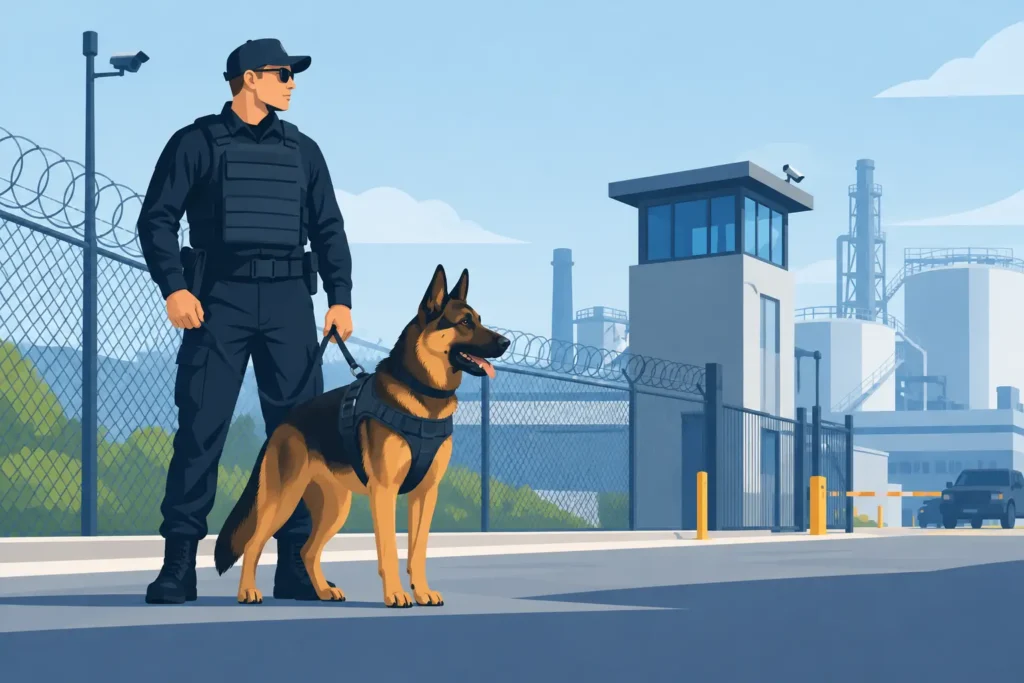
A fence, camera, or locked gate can delay an intruder. It cannot investigate a suspicious noise, track an unauthorized person across a large perimeter, or make a determined offender reconsider before damage is done. Canine security services add a trained handler-and-dog team to the point where physical protection needs to become active, visible, and accountable.
For facilities managers, site leaders, property managers, and event organizers, the value is not simply having a dog on patrol. It is a controlled security capability: a qualified handler, a suitably trained canine, clear patrol instructions, incident reporting, and a response presence that is difficult to ignore. Used correctly, this service protects people, property, operations, and the evidence trail needed to demonstrate reasonable control.
Where canine security services make the difference
Canine teams are most effective where risk is spread across a wide area, changes after normal hours, or cannot be managed by static guarding alone. Construction sites, vacant properties, industrial yards, logistics facilities, utilities infrastructure, vehicle compounds, and large outdoor events are common examples.
At a construction site, theft is only one concern. Unauthorized entry can expose people to incomplete structures, excavations, machinery, fuel stores, and electrical hazards. A canine patrol can cover vulnerable boundaries, challenge access breaches, and support a faster response while the handler records what was found and what action was taken.
For warehouses and distribution facilities, perimeter intrusion may lead to stock loss, disruption, and safety risks for night staff. A canine team provides a mobile, high-visibility patrol presence that complements gates, access control, alarms, and CCTV monitoring. The aim is not to replace those systems. It is to give alarms and camera observations a capable on-site response.
Events require a different approach. Crowd movement, temporary infrastructure, delivery access, and changing entry points call for disciplined deployment. Canine teams may support perimeter patrols, controlled entry areas, overnight asset protection, and targeted searches where appropriate. The deployment must be proportionate to the venue, audience, operating hours, and credible threats.
A canine unit is a security system, not a show of force
A visible patrol dog is a powerful deterrent, but deterrence alone is not a security plan. Effective canine security services are built around defined duties, escalation procedures, communications, welfare controls, and supervision.
The handler is central to that standard. They must be able to assess risk, communicate professionally with staff and the public, operate within assignment instructions, and control the dog at all times. The canine should be trained for the role it is assigned to perform, whether that is patrol support, detection, tracking, or another specialist task. Not every dog team is suitable for every environment.
This is particularly important in public-facing locations. A deployment near residents, visitors, or employees requires careful route planning, signage where necessary, secure rest arrangements, and a clear understanding of how the team will interact with people. A poorly planned deployment can create complaints, disruption, or avoidable risk. A professionally managed one strengthens control without interfering with legitimate activity.
Start with the site risk, not the dog
The strongest deployments begin with a risk assessment and operational survey. Security managers should identify what needs protecting, when it is most exposed, how intruders are likely to approach, and what response is required if a breach occurs.
That assessment should consider the perimeter condition, lighting, blind spots, access routes, neighboring land, valuable materials or equipment, previous incidents, lone-worker exposure, and the availability of police or emergency services. It should also account for fire and life-safety conditions. A patrol route must never obstruct emergency access, interfere with evacuation arrangements, or create a conflict with fire watch responsibilities.
Once the risks are understood, the provider can set patrol frequency, shift coverage, patrol zones, handover requirements, reporting standards, and escalation contacts. Some sites need overnight canine patrols every night. Others need temporary cover during shutdowns, high-value deliveries, civil works, or a period of increased trespass. The right model depends on exposure, not on a standard package.
Define what happens after an alert
A canine team is most valuable when it is connected to the rest of the operation. If CCTV identifies movement at the rear fence, who contacts the handler? If the handler finds forced entry, who secures the area, informs the client, preserves evidence, and coordinates with law enforcement?
These decisions should be documented before the first shift. Site instructions should establish contact numbers, radio protocols, incident thresholds, emergency procedures, prohibited areas, and authority limits. For higher-risk premises, a 24/7 control room can provide welfare checks, live escalation, audit support, and continuous coordination between guards, cameras, and management.
Compliance, welfare, and accountability cannot be secondary
Security decision-makers are rightly asked to show that their protective measures are competent and proportionate. Canine deployments should be supported by documented training, handler qualifications, insurance, welfare procedures, assignment instructions, patrol records, and incident reports.
Local requirements and licensing rules can vary, especially where security staff perform regulated duties or work in public environments. The provider should confirm that handlers are properly qualified for their role and that the deployment meets applicable site, insurance, and client requirements. If the service includes specialist detection work, verify the scope of training and how performance is maintained.
Canine welfare is also operationally relevant. A fatigued, poorly housed, or improperly handled dog is not a dependable security asset. Shift design should include suitable transport, rest, water, temperature management, secure kenneling arrangements where needed, and a realistic working pattern. These controls protect the animal, the handler, the public, and the reliability of the service.
Good records matter after an incident. Patrol logs, visitor challenges, alarm responses, photographs, time-stamped reports, and escalation notes can help clients investigate loss, support insurance notifications, respond to landlord or stakeholder questions, and improve future controls. Security that cannot be evidenced is harder to defend when it is questioned.
How canine teams work with guards, CCTV, and fire safety
Canine security is not automatically the best answer for every location. A small office with controlled daytime access may benefit more from access control, monitored alarms, or a concierge-style officer. A dense indoor environment may require discreet guarding rather than a canine presence. The decision should follow the risk assessment.
Where a canine team is appropriate, integrated coverage delivers better control. Manned guards can manage gates, visitor verification, and front-of-house duties while a canine team patrols vulnerable external areas. CCTV operators can direct patrols toward live concerns rather than relying on routine routes alone. Alarm systems provide immediate triggers, and the canine unit provides a trained physical response.
Fire safety must remain part of the operating picture. On construction projects and occupied buildings, security personnel may be first to identify blocked escape routes, unsafe storage, signs of arson, or damage to fire doors and emergency lighting. They should know how to report those issues, not attempt work outside their competence. A single provider that coordinates physical security and fire-safety support can reduce gaps between what is observed on site and what is formally addressed.
Choosing a provider that can stand up to scrutiny
Procurement should focus on evidence of operational control rather than promises of deterrence. Ask how handlers and dogs are selected, trained, supervised, and assessed. Review sample incident reports and assignment instructions. Confirm how the provider manages relief cover, welfare, complaints, emergency escalation, and quality checks.
It is also worth asking whether the provider can scale. A single dog unit may be enough for an isolated compound, but a major event, rail-adjacent project, or multi-building estate may need coordinated guards, patrols, control-room monitoring, and technical security systems. The provider should be able to explain how each element communicates and who owns the response when an incident crosses service lines.
Spycon Security approaches canine deployments as part of an accountable protection plan, combining trained personnel with clear operating procedures and continuous support where required. The objective is practical: reduce opportunity, detect threats early, respond with control, and leave a documented record of what happened.
When your site faces recurring intrusion, exposed assets, or a perimeter that cannot be left to cameras alone, start with an operational assessment. The right canine team should give your people confidence, make unauthorized access harder, and provide protection that holds up when it is questioned.