

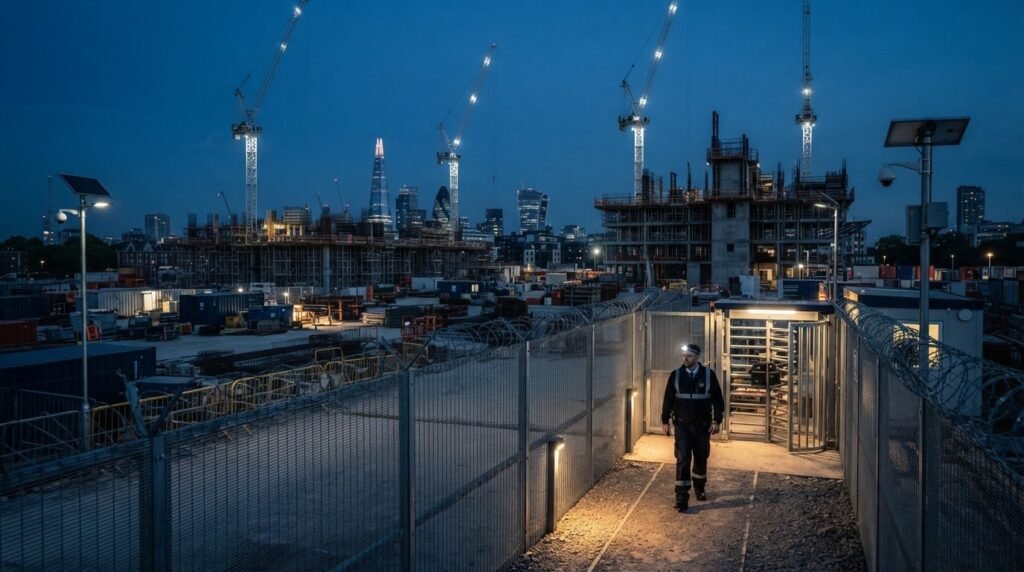
A locked gate can deter opportunistic theft, but it won’t protect every vulnerable area or valuable asset. Effective construction site theft prevention in London starts with identifying which tools, materials and equipment could be targeted, where they are kept and when oversight is reduced.
For project managers, security measures need to work around changing layouts, deliveries and working patterns. Choosing controls before assessing the risks can leave gaps or add measures that don’t fit the way the site operates. A proportionate, layered plan is a more practical starting point.
This guide explains how to assess site-specific risks and plan around procedures, physical measures, monitoring and oversight. It also covers when manned guarding, canine security or CCTV monitoring may support that plan, and what to review as the project changes. The aim is to help you make informed decisions for your London site, not to suggest that any single measure can eliminate theft.
Key Takeaways
- Shape construction site theft prevention London around the project’s location, layout, access points and current phase.
- Review how deliveries, temporary storage and site handovers may create new vulnerabilities as work progresses.
- Choose each control for a clear purpose, understand its limitations and review it when site conditions change.
- Build a practical plan by assessing risks, prioritising actions, assigning responsibilities and reviewing controls.
- When considering manned guarding, canine security or CCTV monitoring, clarify briefing, reporting and escalation arrangements.
Construction site theft prevention in London starts with a clear risk assessment
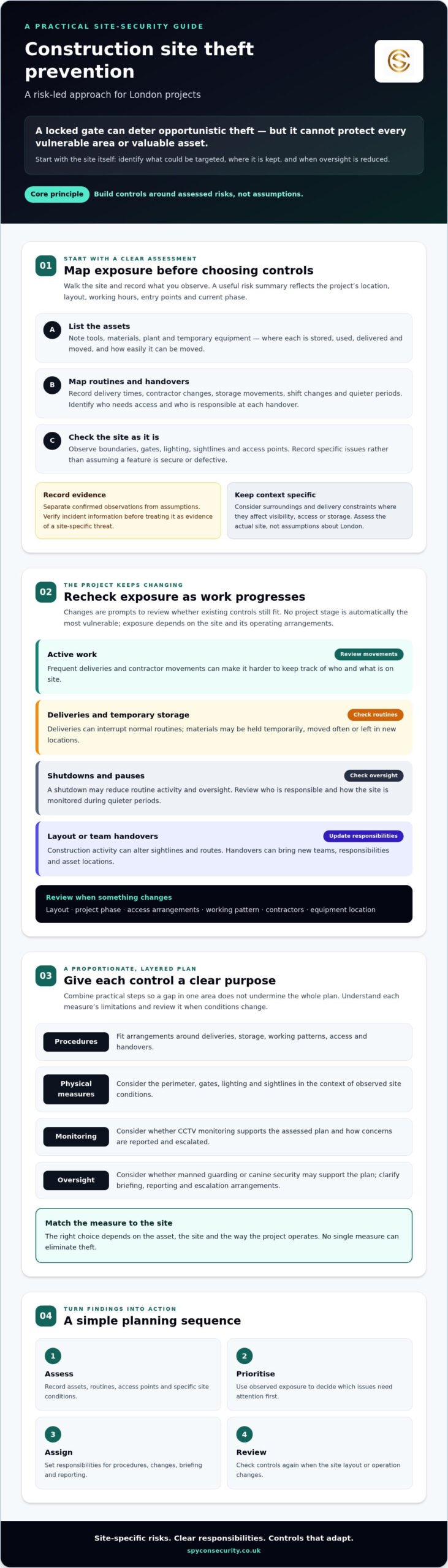
Effective theft prevention starts with evidence about the site, not a standard package of measures. Identify where exposure exists, which assets are most vulnerable and what controls are proportionate. Then combine practical steps so a gap in one area does not undermine the whole plan. A sound construction site theft prevention London plan reflects the project’s location, layout, working hours, entry points and current phase.
Walk the site and record where tools, materials, plant and temporary equipment are stored, used, delivered and moved. Note who needs access to each area and when oversight is reduced, such as during shift changes, deliveries or pauses in work. Check the perimeter, gates, lighting and sightlines as they are. Record specific issues rather than assuming a feature is secure or defective.
- List assets: Note what is on site, where it is kept and how easily it can be moved.
- Map routines: Record delivery times, contractor changes, storage movements and quieter periods.
- Check conditions: Observe boundaries, access points and sightlines, then note issues that need action.
Separate confirmed observations from assumptions. For example, record a recurring unstaffed delivery entrance only if the site schedule confirms it. Treat reports of local theft as unverified until checked. A concise risk summary helps the project team prioritise controls and identify what information it still needs.
Which construction site assets and routines need reviewing?
Look beyond high-value machinery. Hand tools, materials and temporary equipment can also be attractive targets, particularly if they are left near boundaries or moved frequently. Trace each asset’s journey from delivery to storage and use. Identify who is responsible at each handover, and check whether contractor changes or out-of-hours periods affect who can see or account for it. General approaches to anti-theft systems include different methods and technologies, but suitability depends on the asset and site.
How should London site conditions shape the assessment?
Assess the actual surroundings, not assumptions about London. Consider neighbouring premises, public-facing boundaries, nearby activity and delivery constraints where they affect visibility, access or storage. Record what you observed, when you observed it and any follow-up needed. Verify local incident information through appropriate sources before treating it as evidence of a site-specific threat. Keep distinct safety workstreams separate: fire risk assessment services in London address fire hazards, not theft exposure.
Revisit the assessment when the layout, project phase, access arrangements or working pattern changes. A risk summary is useful only while it reflects how the site operates.
How theft risks develop across a construction project
A site’s security needs change as the work changes. Deliveries can interrupt normal routines, materials may be held in temporary locations, and construction activity can alter sightlines or routes between the perimeter and storage areas. These changes are not automatically weaknesses. They are prompts to check whether existing controls still fit how the site is operating.
Base controls on assessed site risks, not assumptions. A consistent review process helps the team respond to real changes rather than rely on a fixed plan that may no longer reflect current conditions.
How do project stages change theft exposure?
During active work, frequent deliveries and contractor movements can make it harder to keep track of who and what is on site. A shutdown may reduce routine activity and oversight, while a handover can bring new teams, responsibilities and asset locations. None of these stages is automatically the most vulnerable. Exposure depends on the specific site and its operating arrangements.
Recheck the plan when the layout, contractors or working hours change, or equipment moves. Decide who is responsible for updating procedures and sharing changes with the people who need to act on them. Construction management resources, including those from the Chartered Institute of Building, can provide wider professional context, but the controls still need to reflect the project itself.
Can one security measure prevent construction site theft?
No single measure performs every security function. A physical barrier may deter unauthorised entry, but it cannot establish by itself whether an incident has occurred or what should happen next. Monitoring can support detection, while clear reporting and escalation arrangements help define the response. Procedures for deliveries, storage and handovers add another layer by reducing avoidable gaps in oversight.
Professional security can complement site arrangements. Depending on the assessed need, a project may consider manned guarding, canine security or CCTV monitoring. Agree each service’s role in advance, including how it fits with site procedures and who receives reports. Spycon Security Ltd.’s security team and company background may be useful context when assessing a provider, alongside practical questions about responsibilities and operating arrangements.
Layering measures can reduce exposure, but it cannot guarantee that theft will not occur. Review the plan after changes and incidents, and adjust it when evidence shows that responsibilities, coverage or procedures need attention. This keeps construction site theft prevention London focused on current conditions throughout the project.
Compare construction site theft prevention measures by purpose
Different controls address different parts of a theft risk. Site procedures can reduce avoidable gaps; physical measures can deter or restrict access; monitoring can support detection; and security personnel can provide a defined physical presence. A practical construction site theft prevention London plan combines measures only when their roles are clear.
Select each measure for a defined risk and operational role. Use this comparison to consider what a control can contribute, where it may fall short and what needs reviewing.
| Measure | Purpose | Suitable conditions | Limitations and review needs |
|---|---|---|---|
| Site procedures | Clarify responsibilities for deliveries, storage and handovers. | Useful across projects, especially when routines or teams change. | Procedures rely on being understood and followed. Review them when site activity changes. |
| Physical measures | Deter or restrict unwanted entry to areas or assets. | Consider where the site assessment identifies a specific boundary, storage or visibility concern. | They don’t identify every incident or provide a response by themselves. Check their condition and suitability as the layout changes. |
| Manned guarding | Provide a physical security presence with responsibilities agreed for the site. | Consider where identified risks or operating arrangements call for visible oversight. | Define duties, coverage and reporting arrangements. Review these as risks and site routines change. |
| Canine security | Offer a specialist physical security option. | Consider only where assessment supports its use and deployment can be planned appropriately. | Requires suitable deployment and professional handling. Confirm arrangements and review whether they remain appropriate. |
| CCTV monitoring | Support remote oversight and detection. | May suit sites where monitoring is part of the assessed security plan. | Verify camera coverage, operating arrangements and escalation procedures. Monitoring is not a substitute for every physical control. |
When might manned guarding or canine security be appropriate?
A site-specific assessment may point to a need for a visible physical presence, for example where site routines make oversight difficult or a particular area needs attention. Spycon provides manned guarding services and canine security. These are distinct options, not automatic additions. Before deciding whether either is suitable, agree the role, site briefing and reporting expectations.
What role can CCTV monitoring play?
Monitoring can support oversight, but its value depends on whether relevant areas are covered and what happens when activity needs attention. Ask who monitors the system, what the operating arrangements are and how concerns are escalated. Spycon provides CCTV monitoring; check the proposed arrangements against your site requirements. Spycon’s company background can also help you understand the provider before discussing suitability.
Spycon’s stated security services include manned guarding, canine security and CCTV monitoring. They do not include alarms, access control or perimeter installation. Treat those as separate requirements if your assessment identifies a need, and make sure each measure has a defined role in the overall plan.
Build a practical London construction site theft prevention plan
A usable plan turns the site assessment into actions with clear owners. For construction site theft prevention London projects, keep the process proportionate. Address straightforward procedural gaps promptly, and seek specialist assessment or procurement where a control needs technical input or a defined service arrangement.
- Assess: Record valuable assets, routines, access arrangements and observed vulnerabilities. Mark unverified concerns as assumptions.
- Prioritise: Rank actions by the exposure they address, the assets affected and the practical consequences of leaving the issue unresolved.
- Assign: Name an owner and review date for every agreed action. Make responsibilities clear across relevant site teams and contractors.
- Implement: Update procedures within the project team’s control. Refer physical security measures or professional support for appropriate assessment and procurement.
- Review: Check whether controls remain suitable, record any gaps and update the plan as the project changes.
What should a site security review record?
Keep a concise record of assets and storage locations, site routines, access arrangements, vulnerabilities and controls already in place. For each action, document its owner, status and review date. Separate confirmed observations from assumptions, and note what needs checking by a competent professional. This makes the plan easier to act on and less reliant on untested impressions.
How should a site manager assess professional security support?
Ask providers to explain how their recommendation addresses a documented risk. Clarify proposed duties, coverage, reporting and escalation arrangements before agreeing a service. Check the scope and operational details directly. Don’t assume availability, response arrangements or outcomes. The right option should complement site procedures and fit current project conditions.
Use this checklist during routine reviews:
- Have assets, storage locations or delivery routines changed?
- Are site access arrangements and responsibilities still clear?
- Have working hours, layout or contractor teams changed?
- Have any incidents or near misses been recorded and reviewed?
- Does each agreed action have an owner and review date?
- Do current controls still match the risks they were selected to address?
Repeat the review after a significant site change, new asset arrival, altered operating hours or recorded incident. A consistent record gives managers a sound basis for adjusting controls, rather than assuming the previous plan still fits.
To learn more about Spycon and its security services, review the company’s background as part of your provider assessment.
Choose professional construction site security in London with confidence
Professional security should address a defined risk, not add another layer without a clear purpose. Use the site assessment to identify where a physical presence, canine security or CCTV monitoring could support existing procedures. Then confirm the duties and coverage your project requires. Spycon provides manned guarding, canine security and 24/7 CCTV monitoring, which site managers can consider as part of a layered construction site theft prevention London plan.
What should you ask a construction security provider?
Ask the provider to explain how its proposal relates to your documented risks and operating requirements. Before agreeing arrangements, clarify:
- What duties will be carried out, and how will the site briefing reflect current risks?
- What coverage is proposed, and how are supervision and handovers organised?
- How will incidents or concerns be recorded, reported and escalated?
- How will the arrangements be reviewed if site conditions change?
- What relevant experience and service scope can the provider explain?
Request clear answers rather than relying on general assurances. Check that the proposed service fits alongside site procedures, and confirm operational details directly. Don’t assume a particular schedule, response arrangement or outcome unless it has been confirmed for your project.
When is it time to review or strengthen site security?
Revisit the arrangements when the site layout changes, assets move to new storage areas or operating hours are altered. Incidents, near misses and concerns raised by site personnel are also reasons to check whether responsibilities and controls remain suitable. A change does not automatically mean more security is needed. It means the current plan should be assessed against the new conditions.
For a focused review, compare each identified risk with the measure intended to address it. Confirm that responsibilities are understood, reporting routes remain clear and any proposed professional service still matches the site’s needs. If gaps remain, record what needs clarifying before making a decision.
If you’re considering professional support, discuss your site security requirements with Spycon’s team. Share the relevant site conditions and ask how manned guarding, canine security or CCTV monitoring could fit your assessed needs. A clear conversation can help establish whether a service is appropriate, without treating any measure as a guarantee against theft.
Put a risk-led site security plan into action
Effective construction site theft prevention London starts with the conditions on your project, not a one-size-fits-all solution. Assess which assets and routines are exposed, then select controls for clear purposes. Review the plan whenever site layouts, working hours, storage or project teams change.
Professional security can support those measures where the assessed risks call for it. Spycon’s primary service is manned guarding, with canine security and 24/7 CCTV monitoring also available to discuss. Consider how any proposed service would fit your site procedures, responsibilities and reporting arrangements. No single measure can remove every risk, but a considered, layered plan gives your team a clearer basis for decisions.
Discuss your construction site security requirements with Spycon to explore whether its security services may suit your project. Start with the site’s specific needs, ask clear questions and keep the plan under review.
Frequently Asked Questions
How can I prevent theft on a construction site in London?
Start by assessing what could be taken, where it is stored and how site routines affect oversight. Construction site theft prevention London works best as a layered plan: organise delivery and storage procedures, review physical site conditions, assign responsibilities and consider professional security where the assessment identifies a need. Recheck the plan after changes to the site layout, working hours, contractors or asset locations. No single measure can guarantee that theft will not occur.
Are security guards effective for construction site theft prevention?
Manned guarding can support theft prevention when the guard’s duties and coverage address risks identified in the site assessment. Agree the site briefing, responsibilities, reporting route and escalation process in advance. Guards can form one part of a broader plan, alongside site procedures and suitable physical measures. Their presence should not be treated as a guarantee against theft, and arrangements need review when site routines or conditions change.
Can CCTV monitoring help protect a construction site overnight?
CCTV monitoring can support oversight overnight if the proposed camera coverage and operating arrangements suit the site. Check which areas are visible, who monitors the system, how concerns are reported and what escalation process applies. It does not replace every physical control or site procedure. Spycon provides 24/7 CCTV monitoring, but confirm directly whether the proposed arrangements match your site’s requirements and operating conditions.
When should a construction site consider canine security?
Consider canine security when a site-specific assessment identifies a need for specialist physical security and deployment can be planned appropriately. Discuss the site layout, relevant duties, briefing and professional handling arrangements with the provider. Canine security is not a default solution for every project, nor does it remove the need for other suitable controls. Confirm that its role complements site procedures and addresses a defined risk.
What should a construction site security risk assessment include?
Record the site layout, access arrangements, working patterns and locations of tools, materials, plant and temporary equipment. Include delivery and storage routines, current controls, observed vulnerabilities and any known incident information that has been verified. Separate confirmed facts from assumptions that need checking. Assign an owner and review date to each agreed action, and identify where specialist assessment is needed before selecting or procuring a measure.
How often should construction site security arrangements be reviewed?
Review arrangements whenever a change could affect site exposure, rather than relying only on a fixed calendar. Triggers include layout changes, new assets, different storage locations, altered working hours, contractor changes, incidents or near misses. Routine checks can also confirm that agreed responsibilities and controls remain in place. Record what has changed, who will act and when the assessment should next be reviewed.
What should I ask before hiring construction site security in London?
Ask how the proposal reflects your documented site risks and operating requirements. Clarify duties, coverage, briefing, supervision, handovers, incident reporting, escalation and review arrangements. Request details of relevant experience and confirm exactly which services are included. Spycon provides manned guarding, canine security and 24/7 CCTV monitoring; check the proposed scope and availability for your site directly. Spycon lists locations including London, Luton, Birmingham, Wales, Slough, Nottingham, Edinburgh, Glasgow, Northampton, Derby, Manchester, Dover, Canterbury, Dartford, Enfield, Camden, Barking, Coventry, East London and West London.