

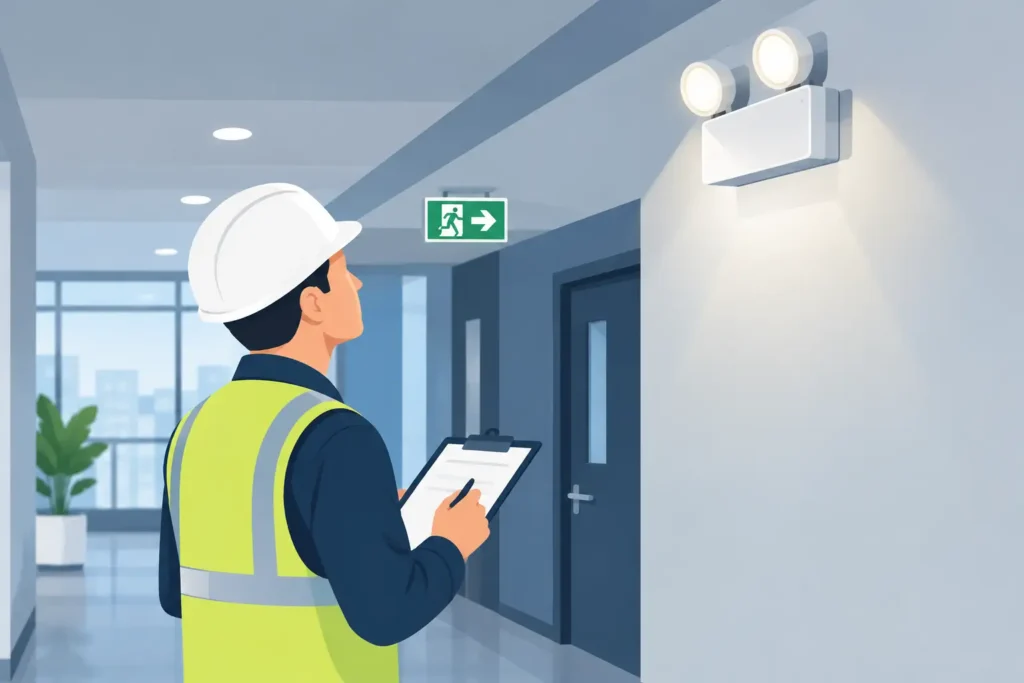
When normal power fails, an emergency lighting system has one job: provide a clear, usable route for people to leave safely. Emergency lighting testing requirements exist because a fitting that appears serviceable during routine operation may fail the moment its battery is needed. For facilities managers, landlords, site managers, and responsible persons, the standard is not simply having lights installed. It is being able to demonstrate that the system has been tested, defects were controlled, and people would not be left in darkness during an emergency.
For UK premises, emergency lighting is generally designed, installed, inspected, and maintained in line with BS 5266. The precise regime must reflect the building, fire risk assessment, occupancy, and any conditions imposed by the enforcing authority or insurer. A warehouse with long escape routes, a residential block, and a public venue do not present the same risks. The principle remains constant: testing must be planned, recorded, and followed through.
What emergency lighting testing requirements cover
Emergency lighting includes illuminated exit signs, escape-route luminaires, open-area or anti-panic lighting, and, where required, high-risk task-area lighting. It may be self-contained, with a battery inside each fitting, or supplied by a central battery system. Both arrangements need testing, but the method, duration, and fault response can differ.
A suitable maintenance program confirms that lights illuminate when the normal supply is interrupted, batteries support the required duration, indicator lamps show the expected status, and fittings remain clean, visible, and undamaged. It also confirms that changes to the building have not undermined coverage. A new partition, storage racking, altered stairwell, or revised escape route can turn a compliant installation into a weak point.
The responsible person should not treat the test schedule as a substitute for a fire risk assessment. The assessment determines whether the system is appropriate for the people and routes it is intended to protect. Testing then proves that the installed system remains dependable.
The normal testing schedule
Daily visual checks where a central system is installed
Central battery systems commonly require a daily visual inspection of indicators and controls. The purpose is to identify an obvious system fault, charger issue, supply failure, or alarm condition before it becomes a life-safety failure. The check should be completed by a competent person who understands what normal and fault indications look like and who can escalate defects without delay.
This daily requirement may not apply in the same way to self-contained fittings, which often rely on local charge indicators and periodic functional testing. The maintenance approach should always match the system type and the manufacturer’s instructions.
Monthly functional tests
A monthly test typically involves simulating a failure of the normal lighting supply for a short period. Every emergency luminaire and internally illuminated exit sign should operate correctly. The test does not need to run for the full rated duration, but it must be long enough to confirm that the fitting changes to emergency mode.
This is a practical check, not a box-ticking exercise. During the test, staff should look for dim lamps, failed fittings, damaged diffusers, obstructed signs, missing labels, and areas that remain poorly lit. If a fitting fails, the defect must be recorded and corrected promptly.
Timing matters. Avoid testing at a point when a genuine power interruption is more likely, and do not leave batteries depleted immediately before the building is occupied. For high-risk or continuously occupied premises, testing should be planned to avoid creating an unnecessary gap in protection.
Annual full-duration tests
The annual test is the most significant routine inspection. The emergency lighting system is operated on battery power for its full rated duration, commonly one, two, or three hours depending on the design and risk assessment. At the end of that period, every required fitting must still provide the necessary illumination.
A full-discharge test can temporarily reduce battery resilience while units recharge. That is why it should be carried out when the impact on occupants and operations can be properly managed. In some premises, this may mean scheduling work outside normal hours, notifying relevant personnel, providing temporary controls, or staging testing by zone where the system design allows it.
After the duration test, confirm that the normal supply has been restored and that the system is recharging correctly. Do not assume the work is complete when the lights switch on. The building must return to a protected condition.
Keep evidence that stands up to scrutiny
A test that cannot be evidenced is difficult to defend after an inspection or incident. Emergency lighting records should be retained in the fire-safety logbook or an equivalent controlled system. Digital records are acceptable where they are secure, accessible, and provide a clear audit trail.
For each test or inspection, record:
- the date and time of the check
- the identity of the person completing it
- the test type and duration
- faults found, including the location or fitting reference
- corrective work completed and the date protection was restored
This documentation matters to more than the fire authority. Insurers, managing agents, auditors, residents, clients, and investigating bodies may all ask whether a known fault was identified and resolved. Clear records demonstrate active control, not passive ownership of a life-safety system.
Faults need action, not just an entry in the logbook
Common faults include failed batteries, charging problems, damaged fittings, lamp or LED failure, obscured exit signs, missing test keys, and changes to room layouts that block light along an escape route. An automated self-test system can identify some failures, but it does not remove the need for periodic visual inspection. Technology can report a fault. A competent person still needs to assess whether that fault affects safe escape and how quickly it must be rectified.
The appropriate response depends on the extent of the defect. A single failed fitting in an area served by other effective units may be manageable for a short period if the risk assessment supports that decision. A failed exit sign at a confusing junction, multiple battery failures, or a dark stair enclosure demands faster action and may require interim measures.
Those measures can include restricting access, supplying temporary compliant lighting, increasing fire-watch controls where appropriate, or arranging urgent repair. The key is proportionality backed by evidence. Leaving a defect open because a contractor visit is scheduled next month is rarely a credible position where escape lighting is compromised.
Responsibilities across occupied and managed premises
In England and Wales, the responsible person under fire-safety law must take suitable measures to protect relevant persons. In Scotland, duty-holder arrangements differ, but the expectation to manage fire risk and maintain protective measures remains. For multi-occupied buildings, responsibilities can also be divided between landlords, managing agents, tenants, and facilities teams.
That division must be explicit. One party may arrange servicing, another may control access to units, and another may receive fault reports. Without defined ownership, failed fittings can remain unresolved between contractors, building management, and occupiers. A written maintenance plan should state who tests the system, who reviews records, who authorizes repairs, and who verifies closeout.
Construction sites and temporary events need particular care. Layouts change quickly, temporary supplies are vulnerable, and unfamiliar visitors may rely heavily on visible escape routes. Emergency lighting provision and testing should be reviewed whenever access routes, occupancy patterns, or work phases change.
When professional inspection is the right control
Routine checks can be completed in-house when staff are trained, competent, and supported by a clear procedure. Annual duration testing, system diagnosis, repairs, and certification often require specialist competence, particularly for larger sites, central battery systems, addressable monitoring, or premises with complex evacuation arrangements.
An experienced fire-safety provider can test the installation, identify deficiencies, replace or repair defective components, and provide documentation that aligns testing with wider fire-safety records. Spycon Security Ltd. supports businesses with emergency lighting inspection, maintenance, and compliance evidence alongside broader fire-safety controls, giving decision-makers one accountable route from fault identification to documented resolution.
The practical question is not whether a test can be completed on a calendar date. It is whether the building can support safe evacuation at the point normal lighting fails. A disciplined testing program, clear records, and prompt corrective action provide the answer when it is questioned.