

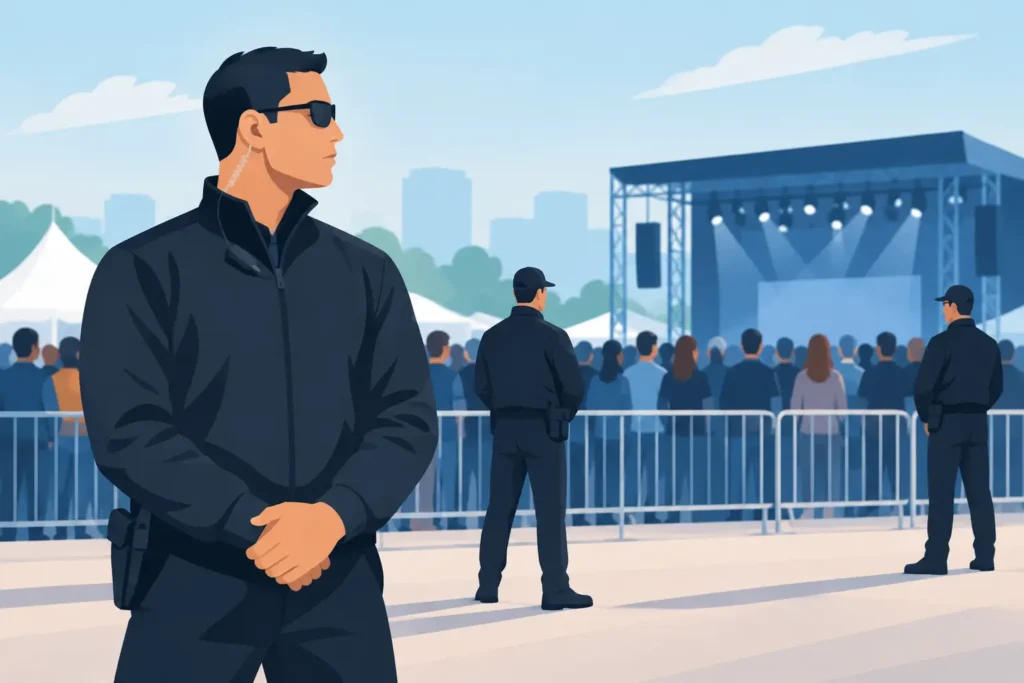
A crowded entrance, an unexpected VIP arrival, a medical emergency, or a dispute near the bar can change an event’s risk profile in seconds. Event security is not simply a visible guard presence at the door. It is the planned control of people, access, behavior, information, and emergency response from load-in through final departure.
For event organizers, venue managers, property teams, and corporate operations leaders, the standard is clear: protection must work when it is questioned. That means trained personnel, defined responsibilities, reliable communications, and records that demonstrate reasonable care before, during, and after the event.
Event Security Starts Before Guests Arrive
The most effective security decisions are made well before gates open. A generic staffing number based on expected attendance may look efficient on paper, but it can leave gaps at the points where incidents actually occur: vehicle access, credential collection, backstage areas, cash handling, crowd movement, and exit routes.
A proper pre-event assessment should examine the event format, guest profile, venue layout, timing, alcohol service, performers or speakers, public visibility, and likely pressure points. A daytime corporate conference calls for a different posture than a ticketed music event, a sporting fixture, a construction-industry open house, or a residential-community gathering.
The surrounding environment matters as much as the venue itself. Consider nearby transportation, public access routes, adjacent businesses, neighborhood concerns, parking capacity, protest risk, and the ability for emergency services to reach the site. Security planning should also account for weather, darkness, temporary structures, and any areas that may become congested during arrival or dispersal.
The output should be a practical operating plan, not a document that sits unread in a folder. It needs to define who is responsible for each control, how staff communicate, what triggers escalation, and who has authority to pause entry, close an area, or stop the event if safety is compromised.
Build the Right Event Security Coverage
Visible security personnel provide reassurance, deter misconduct, and give guests a clear point of contact. Their value, however, depends on positioning and purpose. Assigning guards only to the main entrance can create a strong first impression while leaving vulnerable areas unprotected.
A balanced coverage plan typically separates public-facing duties from protected operational areas. Entrance officers manage credentials, bag policies, guest flow, and refusals of entry. Roving personnel identify developing issues across the venue. Access-control officers protect staff-only rooms, production areas, loading docks, and equipment. Supervisors coordinate deployment, make operational decisions, and maintain contact with event leadership.
For larger or higher-risk events, security may also need to cover vehicle screening, perimeter patrols, canine support, control-room monitoring, VIP movement, overnight protection, and post-event egress. The correct combination depends on the risk assessment. More personnel are not automatically better if the team lacks clear zones, communication discipline, or a competent supervisor.
Every officer should understand the event’s rules of engagement. This includes the admissions policy, prohibited items, conduct expectations, reporting procedures, emergency exits, accessibility requirements, and the boundaries of their authority. Professional security is firm without becoming confrontational. A well-managed refusal or de-escalation can prevent a minor issue from becoming a removal, injury, or reputational incident.
Credentials and Access Must Be Controlled
Access control is often where an event either maintains order or loses it. Wristbands, passes, badges, guest lists, and digital credentials are useful only when they are checked consistently. Staff should know what each credential permits, where it applies, and what to do when it is missing, altered, or challenged.
Backstage, production, catering, and technical areas require particular care. These spaces may contain valuable equipment, personal property, electrical infrastructure, and people focused on time-sensitive work. Uncontrolled access can lead to theft, interference, accidental damage, or safeguarding concerns.
A clear access map helps. It should identify public areas, restricted areas, emergency routes, staff entrances, loading zones, and security posts. Temporary signage, barriers, and lighting are operational controls, not cosmetic details. They reduce confusion and make it easier for personnel to direct people without unnecessary confrontation.
Plan for Incidents, Not Just Prevention
No event plan can remove every risk. The objective is to identify foreseeable incidents, respond quickly, and keep disruption contained. Staff must know how to act if there is a medical issue, missing person, aggressive behavior, suspicious item, fire alarm, evacuation, severe weather alert, or loss of power.
The emergency plan should establish a simple chain of command. Event management, security supervision, venue operations, medical providers, and fire safety personnel need a shared understanding of who makes decisions and how those decisions are communicated. During an incident, conflicting instructions create delay and confusion.
Communications should be tested before doors open. Radios need assigned channels, working batteries, disciplined call signs, and agreed language for urgent incidents. Teams should avoid transmitting sensitive personal details over open channels where possible. A staff briefing should also confirm muster points, emergency access routes, first-aid locations, fire equipment, and the location of the event control point.
Fire safety cannot be treated as a separate issue from security. Exit routes must remain clear, capacity limits must be respected, and temporary layouts must not obstruct evacuation. Security personnel are often the first people asked to manage crowd movement during an alarm or evacuation, so their role must align with the venue’s fire and life-safety procedures.
De-escalation Protects People and Reputation
Security teams are regularly judged by the way they handle difficult moments. A loud disagreement, an intoxicated guest, or a person refusing instructions may require decisive intervention, but the response should remain proportionate and lawful. Staff should create space, use calm and direct communication, call for support early, and separate individuals where safe to do so.
Physical intervention is never a substitute for planning or communication. It should be a last resort, carried out only by appropriately trained personnel and in line with applicable law, policy, and immediate safety needs. Accurate reporting afterward is essential, particularly where force, injury, ejection, police involvement, or a significant complaint is involved.
Documentation Is Part of the Protection
Security documentation is often overlooked until an organizer faces an insurance query, complaint, incident investigation, or regulatory review. At that point, memory is not enough. Decision-makers need evidence of what was planned, who was assigned, what checks were completed, and how incidents were managed.
Useful records include risk assessments, staffing plans, briefing notes, attendance logs, access-control procedures, patrol records, incident reports, radio logs where appropriate, and post-event observations. The level of documentation should match the event’s scale and risk, but it should always be factual, timely, and secure.
Incident reports need more than a short statement that an issue was “dealt with.” They should record the time, location, people involved, observed behavior, actions taken, witnesses, escalation decisions, injuries, emergency-service involvement, and outcome. Objective language matters. Reports should distinguish between what was seen, what was reported by others, and what action staff took.
This recordkeeping also improves future delivery. Patterns may show that a particular entrance became congested, a guest policy was unclear, a lighting level was inadequate, or staff needed a better escalation route. Each event provides operational evidence that can strengthen the next one.
Choose a Provider That Can Be Accountable
Security procurement should not focus only on hourly rates or headcount. The real question is whether the provider can assess risk, supply properly trained and vetted personnel, supervise operations, communicate with venue leadership, and produce credible records when required.
Ask how supervisors are deployed, how absences are covered, what training is relevant to the event type, and how incidents are escalated outside normal hours. Confirm that the provider can coordinate security with access control, CCTV, fire safety procedures, and emergency planning where the event requires those capabilities. One accountable partner reduces the risk of gaps between separate contractors.
Event security should feel organized rather than intrusive. Guests may never see the planning behind clear entry routes, professional staff, controlled access, and calm incident management. That is the point: when protection is properly designed, the event can remain focused on its purpose while the people responsible for it have confidence that safety will hold under pressure.