

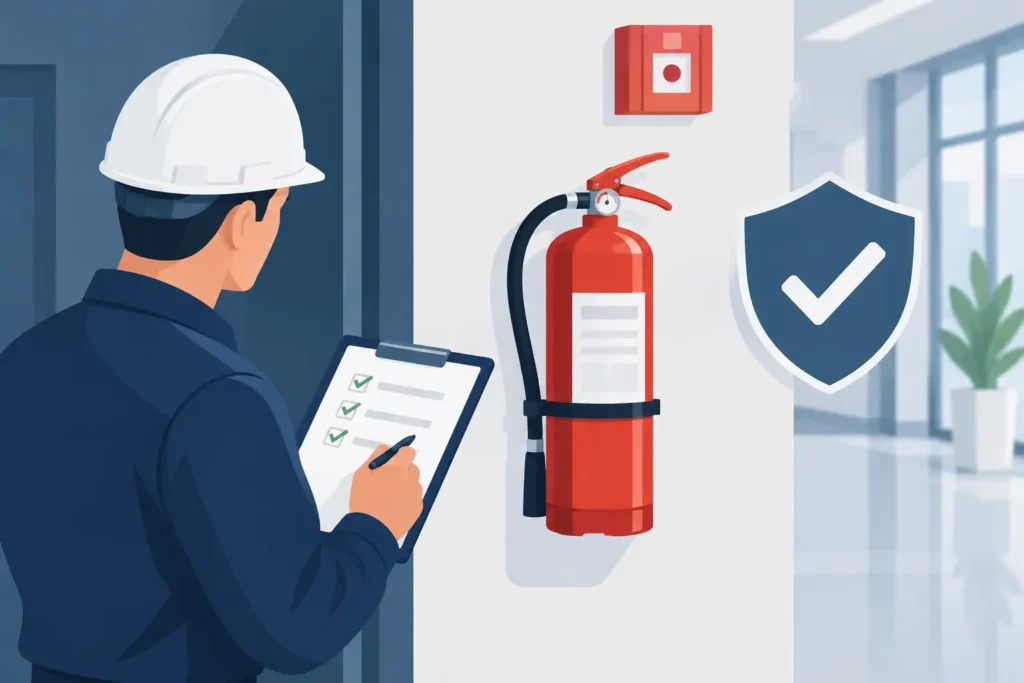
A fire extinguisher on the wall, an alarm panel in the lobby, and an inspection certificate in a shared drive do not, by themselves, equal fire compliance. When an incident, inspection, insurance query, or occupancy review takes place, the real question is whether the controls worked together, were maintained, and can be proven.
For facilities managers, property owners, construction leaders, and operations teams, fire safety is not a one-time project. It is a live operational responsibility. People change, layouts change, contractors enter site, equipment ages, and risks move. Effective compliance must keep pace without creating uncertainty over who owns the next action.
What Fire Compliance Actually Means
Fire compliance is the practical ability to meet the fire-safety duties, codes, standards, and local authority requirements that apply to a building and its use. The exact requirements depend on the jurisdiction, building type, occupancy, fire strategy, and risk profile. A warehouse, residential tower, school, event venue, and active construction site should never be managed as if they carry the same exposure.
In the United States, the authority having jurisdiction, or AHJ, has a central role in interpretation and enforcement. Local fire codes, adopted versions of NFPA standards, building code requirements, workplace rules, and insurance conditions can all affect what is required. A compliant position therefore cannot be based on assumptions or an old checklist copied from another site.
The strongest approach begins with a current risk assessment and develops into a managed control system. That system typically covers detection and warning, emergency lighting, means of escape, fire doors and compartmentation, extinguishing equipment, signage, training, inspections, testing, and records. It also defines responsibilities, escalation routes, and response arrangements.
The objective is not paperwork for its own sake. It is to ensure that people can identify danger, raise the alarm, evacuate or shelter as the plan requires, and that responders have reliable information when every second matters.
Fire Compliance Fails at the Gaps
Most serious weaknesses are not caused by the total absence of equipment. They arise in the spaces between systems, suppliers, shifts, and responsibilities.
A fire alarm may be technically sound, but its test results may not be reviewed. Emergency exits may have been adequate when the floor plan was approved, but stock, furniture, or construction materials may now restrict escape routes. Fire doors can be fitted correctly and then defeated by wedges, damaged closers, or unapproved alterations. These are operational failures with compliance consequences.
Documentation is another common gap. Records should show not only that an inspection was scheduled, but what was inspected, what defects were found, who received the finding, what corrective action was taken, and when it was verified as complete. A certificate without a clear asset record, scope, and follow-up trail can leave decision-makers exposed when the control is questioned.
This is where one accountable provider can reduce avoidable risk. Security staff, fire marshals, monitoring teams, technical contractors, and site management all see different parts of the picture. Coordinated delivery makes it easier to turn observations from the frontline into documented corrective actions rather than allowing them to disappear in handovers.
Start With the Building You Operate Now
Fire risk assessments should reflect the building as it is actually used, not as it was intended to be used years ago. Review changes in occupancy, hours of operation, vulnerable occupants, storage, ignition sources, charging areas, hot works, refurbishment, and contractor activity. A site undergoing change can move from a stable risk profile to a high-risk environment quickly.
The assessment should identify hazards and people at risk, evaluate the existing safeguards, record necessary actions, and establish a review date or trigger. Significant changes should prompt an earlier review. Waiting for the annual date while a building is being reconfigured, occupied differently, or refurbished is not a defensible strategy.
A clear action plan matters as much as the assessment itself. Each action needs an owner, priority, deadline, and evidence of completion. “Review fire doors” is not an action that can be closed confidently. “Inspect all fire-rated doors on floors two through five, record defects, complete approved repairs, and verify operation” is measurable and accountable.
Match controls to the risk
There is no benefit in over-specifying equipment that a site cannot maintain properly, and there is no acceptable case for under-specifying controls because a simpler option is cheaper. The right measure depends on the risk and the applicable code.
For example, a 24-hour residential property may require dependable out-of-hours oversight and clear resident communication, while a warehouse may need stronger controls around combustible storage, forklift operations, and battery charging. A construction site may need temporary alarm arrangements, hot-work permits, controlled access, and regular changes to escape routes as work progresses. The control plan must fit the operation.
Test, Inspect, and Record What Matters
Compliance is sustained through routine verification. Alarm systems, emergency lighting, extinguishers, fire doors, suppression systems, evacuation routes, and signage all require appropriate inspection and maintenance intervals. The exact schedule should follow applicable codes, manufacturer requirements, the adopted standard, and the building’s risk assessment.
Do not treat a test as a box-checking exercise. If an alarm test identifies a fault, a door inspection finds a failed closer, or an emergency light does not operate for the required duration, the finding must enter a corrective-action process. Temporary measures may be necessary while repair is arranged, especially where life safety is affected. Those measures should be recorded, communicated, and reviewed until the permanent fix is complete.
Digital records can improve control, but only if the underlying process is disciplined. A useful compliance record makes it easy to answer practical questions: What assets are on site? When were they last serviced? Which defects remain open? Who accepted the risk? When is the next test due? Can the building manager produce the relevant evidence without searching across multiple inboxes and contractors?
That visibility supports safer decisions and faster response to inspections, insurance requests, and incidents.
People Are Part of the Fire-Safety System
A technically compliant building can still fail people if the workforce does not understand the plan. Employees, contractors, security officers, reception teams, and designated fire marshals need instructions that match their role and the site’s actual arrangement.
Training should cover how to raise the alarm, escape routes, assembly arrangements, reporting procedures, and any specific responsibilities. Fire marshals need enough confidence to monitor conditions, identify hazards, support evacuation, and report deficiencies. They are not expected to replace emergency services or take unnecessary risks.
Evacuation drills are valuable because they test behavior, not just equipment. They can reveal blocked routes, unclear communications, poor visitor procedures, mobility support gaps, or delays in accounting for people. The outcome should be reviewed constructively. A drill that exposes a weakness has done its job if the weakness is corrected.
For sites with complex or elevated risk, trained on-site personnel and continuous monitoring can provide an additional layer of assurance. This may be appropriate where a building is occupied around the clock, under remediation, undergoing construction, or subject to a temporary risk-control arrangement. The level of staffing should be proportionate, clearly defined, and supported by documented procedures.
Make Accountability Visible
The fastest way to lose control of fire safety is to assume another party is handling it. Landlords, tenants, managing agents, contractors, facilities teams, and specialist vendors may all have duties. Those duties need to be translated into a working responsibility map for the property.
Set out who owns the fire risk assessment, testing calendar, defect management, staff training, contractor controls, emergency plan, and record retention. Then establish a regular review that looks beyond due dates. Ask whether recurring defects are being solved, whether changes to the building have been captured, and whether staff can carry out the plan under pressure.
Spycon Security Ltd. supports organizations that need security operations and fire-safety controls to work as one accountable protection plan. That matters where site teams need both physical presence and compliance evidence, rather than disconnected services with unclear ownership.
A Defensible Standard, Every Day
The best fire compliance program is not the one with the most documents. It is the one that remains credible when a fire inspector asks questions, when an insurer requests evidence, when a contractor changes the site, or when an alarm activates at 2 a.m.
Build controls around the risks you have now, verify them routinely, close defects decisively, and keep evidence organized. That discipline turns fire safety from a periodic obligation into dependable protection for people, property, and operational continuity.