


A fire risk assessment is not an administrative hurdle; it’s a live safety strategy that requires professional verification to be legally robust. You likely understand that keeping your tenants safe is your primary duty, yet the shifting landscape between the Fire Safety Act 2021 and subsequent updates has left many property owners feeling exposed. The fear of prosecution for non-compliance is a rational response to an increasingly complex regulatory environment. Securing a comprehensive fire risk assessment for landlords is the only way to transform that uncertainty into operational certainty.
We recognise the challenges of navigating these requirements, especially when seeking qualified assessors in major hubs like London or Birmingham. This guide will help you master the legal complexities of fire safety and ensure your rental properties are fully compliant with 2026 UK regulations. You’ll gain a clear understanding of the Responsible Person role and learn how to reduce fire-related liability through meticulous standards. We’ll examine the critical steps for total legal compliance, moving from initial strategy reports to the professional installation of fire alarm systems and fire doors.
Key Takeaways
- Identify the specific legal obligations under the Regulatory Reform (Fire Safety) Order 2005 to ensure properties meet 2026 standards.
- Execute a robust fire risk assessment for landlords by focusing on hazard identification and the protection of vulnerable occupants.
- Distinguish between the varying fire safety requirements for HMOs, purpose-built blocks, and single-let residential units.
- Recognise the critical necessity of fire door surveys and professional strategy reports in reducing long-term liability.
- Establish a reliable compliance framework through expert consultancy and technical installations verified by industry specialists.
Mandatory Fire Risk Assessments: Understanding the Legal Obligations for Landlords in 2026
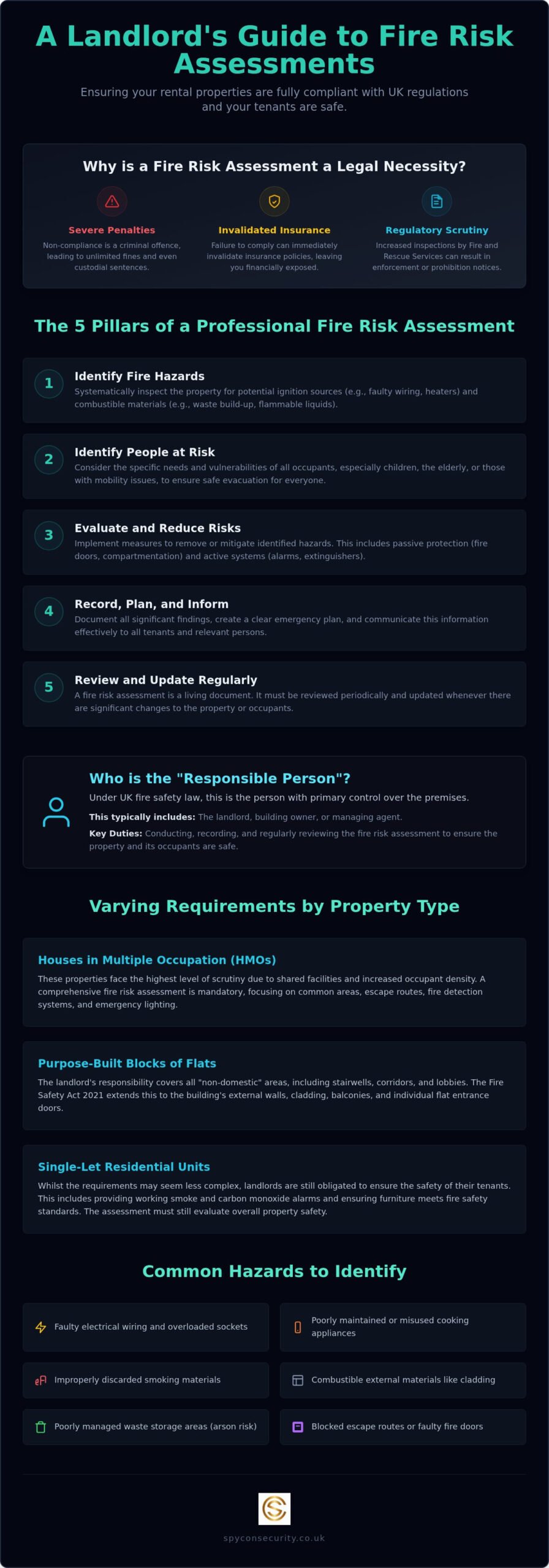
A fire risk assessment for landlords is a systematic evaluation of a property to identify fire hazards and ensure the safety of occupants. Under the Regulatory Reform (Fire Safety) Order 2005, this is not a recommendation; it is a statutory requirement for all commercial and multi-occupancy residential properties. The legislation dictates that fire safety must be managed proactively to prevent loss of life and property damage. Failure to maintain these standards is a criminal offence. Penalties are severe, ranging from unlimited fines to custodial sentences. Beyond legal prosecution, non-compliance often results in the immediate invalidation of insurance policies, leaving landlords financially exposed in the event of an incident.
The Legal Framework for Rented Properties
The 2026 regulatory environment is defined by the rigorous enforcement of the Fire Safety Act 2021. This legislation clarified that the fire safety order applies to a building’s external walls and flat entrance doors. Landlords of multi-occupied residential buildings must now account for cladding, balconies, and windows within their assessments. Local Fire and Rescue Services have increased their inspection frequency. They possess the authority to issue enforcement or prohibition notices if they deem a property unsafe. A clear distinction exists between “domestic” areas, meaning the space inside a flat, and “non-domestic” areas, such as common stairwells and lobbies. The latter falls strictly under the landlord’s jurisdiction for fire safety management.
Who is Classified as the Responsible Person?
The “Responsible Person” is the central figure in UK fire safety law. This role typically falls to the landlord, the managing agent, or the building owner. You hold the primary duty to ensure the premises are safe. This involves conducting, recording, and reviewing a fire risk assessment for landlords on a regular basis. Whilst the law allows you to carry out an assessment yourself if you are “competent”, the technical complexity of modern buildings often makes this impossible for laypeople. Appointing a professional fire safety consultant allows you to transfer the technical liability of the assessment. Expert surveyors provide the precision required to satisfy building control and regulatory bodies. Our fire risk assessment services provide the verification needed to ensure your portfolio remains fully compliant and your tenants remain protected.
The Five Pillars of a Professional Fire Risk Assessment (FRA)
A professional fire risk assessment for landlords is a rigorous, five-step methodology designed to eliminate oversight. Whilst some property owners attempt to conduct these surveys themselves, a “DIY” approach often fails to identify technical deficiencies in fire compartmentation or alarm coverage. This lack of precision creates a false sense of security. That illusion vanishes during a formal inspection or, worse, a fire incident. A professional assessment provides the verification required to satisfy both the law and your insurers. It transforms a legal obligation into a robust safety strategy.
Identifying Fire Hazards and People at Risk
The first pillar involves a meticulous sweep for ignition sources and combustible materials. Look for hazards first. In rental properties, faulty electrical wiring, poorly maintained cooking appliances, and smoking remain the primary causes of fire. Beyond internal hazards, you must evaluate external risks like combustible cladding or waste storage areas prone to arson. The second pillar focuses on the occupants. Not all tenants have the same evacuation needs. A generic plan is insufficient if your tenants include children, the elderly, or individuals with limited mobility. Your assessment must account for these specific vulnerabilities. Occupants matter most. You must ensure every person can reach safety without assistance.
Evaluating and Reducing Risk Factors
Once hazards are identified, the third pillar requires action to remove or reduce them. This involves a combination of passive and active measures. Passive fire protection, such as fire-rated partitions and ceilings, slows the spread of smoke and heat. Active protection is equally vital. A professional fire risk assessment for landlords ensures these technical details aren’t overlooked. Ensuring professional fire alarm system installation provides the early warning necessary for a safe evacuation. Clear, unobstructed escape routes and functional emergency lighting are non-negotiable requirements for any multi-occupancy building. If your property requires a more detailed technical overview, a professional fire strategy report can provide a definitive roadmap for compliance.
The fourth and fifth pillars transform findings into a live safety management system. You must record every significant finding. Prepare a detailed emergency plan. Ensure it’s accessible to all tenants. Providing clear instructions on fire behaviour and evacuation protocols is a statutory duty. Finally, establish a rigorous review schedule. An assessment is not a one-off event. It requires updating whenever the building’s layout changes, after a “near miss” incident, or when new regulations come into force. Constant readiness is the only way to maintain total legal compliance. Act on findings immediately to protect your investment and your tenants.
Differentiating Requirements: HMOs, Purpose-Built Flats, and Single-Let Properties
Regulatory scrutiny is not uniform across all rental sectors. The level of risk inherent in a property dictates the intensity of the fire risk assessment for landlords. Houses in Multiple Occupation (HMOs) face the most stringent requirements. This is due to the increased probability of fire when multiple households live independently under one roof. In contrast, purpose-built flats and single-let properties operate under different frameworks. Understanding these distinctions is vital for maintaining total legal compliance and protecting your investment. You must align your safety strategy with the specific architecture of your portfolio.
Strict Standards for HMO Landlords
HMOs are high-stakes environments. You must install fire-rated doors on every bedroom and communal exit to ensure effective compartmentation. These doors must be fitted with self-closing devices and intumescent strips. Detection systems must be hard-wired and interconnected, typically requiring both smoke and heat sensors. For properties with complex layouts or those undergoing significant conversion, a professional fire strategy report is essential. This document provides a definitive technical roadmap that satisfies both local authorities and building control. Precision is non-negotiable here. Errors in HMO fire safety often lead to immediate enforcement action.
Managing Common Parts in Residential Blocks
In purpose-built blocks of flats, your responsibility as a landlord or managing agent centres on the “common parts”. This includes hallways, stairwells, and plant rooms. The Regulatory Reform (Fire Safety) Order 2005 applies strictly to these non-domestic areas. You must ensure that fire doors in communal zones meet current UK standards and that escape routes remain completely unobstructed. In mixed-use buildings, you may need to co-ordinate with other Responsible Persons, such as commercial unit owners, to ensure a unified safety strategy. A fire risk assessment for landlords in this context must verify that fire-stopping measures between floors and units are intact. Neglecting these areas leaves the entire building vulnerable.
Single-let properties are often perceived as lower risk, yet they’re not exempt from safety obligations. Whilst the law is less prescriptive for single-family dwellings, conducting a formal assessment remains best practice for liability protection. It provides documented proof that you’ve exercised due diligence. If a fire occurs, having a professional record of your safety measures is your primary defence against claims of negligence. Whether you manage a single unit or a large portfolio in Manchester or Birmingham, professional verification is the only way to achieve peace of mind. Consistent standards across all property types reduce fire-related liability and ensure tenant safety remains uncompromising.
Beyond the Checklist: Common Hazards and Fire Safety Remedial Works
Identifying a hazard is meaningless without a corrective response. A fire risk assessment for landlords often uncovers structural or technical failings that require immediate engineering solutions. These are not optional upgrades. They are legal imperatives. Electrical safety is a primary concern. Faulty installations cause a significant portion of domestic fires. Your Electrical Installation Condition Report (EICR) must align with your fire safety strategy. If the wiring is compromised, the building is at risk. Constant vigilance is required to maintain the safety of the electrical infrastructure.
The Importance of Fire Door Surveys
Visual inspections are often deceptive. A door may look functional yet fail to provide the required 30 or 60 minutes of protection during a live incident. Meticulous fire door surveys are the only way to verify the integrity of intumescent seals, hinges, and self-closing mechanisms. These components must work in perfect unison. Even a 3mm gap can allow lethal smoke to bypass a fire door. Integrate these surveys into your annual maintenance programme. Do not leave compartmentation to chance. Professional verification ensures that every entrance and exit point remains a reliable barrier against fire spread.
Active systems require constant readiness. Regular testing of fire alarms and emergency lighting is a statutory duty. Signage must be clear. Tenants need to navigate to safety in zero-visibility conditions. If the power fails and smoke fills the corridors, your emergency lighting becomes the difference between a safe exit and a tragedy. Maintaining these systems is an ongoing commitment. It is the only way to ensure the building’s safety features operate as intended when they are needed most.
Implementing Technical Fire Solutions
Detection is your first line of defence. Upgrading your property with professional fire alarm installation ensures that every occupant receives the earliest possible warning. This is particularly critical in HMOs where fire can spread rapidly between units. Kitchens and communal areas should also be equipped with appropriate fire extinguishers and blankets. Remedial works are the essential corrective actions required to bring a property into legal compliance. These works must be carried out by qualified professionals to ensure they meet the rigorous standards expected by the Fire and Rescue Service.
Ensure your property meets every technical standard and remains fully compliant by booking a comprehensive fire risk assessment and door survey today.
Securing Compliance: How Spycon Security Delivers Professional Fire Safety Consultancy
Achieving total compliance requires more than a checklist; it demands the precision of a seasoned expert. Spycon Security provides the technical verification necessary to satisfy the most rigorous regulatory audits. Our fire risk assessment for landlords is conducted by industry specialists who understand the nuances of the 2026 safety landscape. We operate across major UK hubs, including London, Birmingham, and Manchester, bringing local expertise to every survey. Our reports do not just identify problems; they provide definitive solutions. From initial consultancy to the installation of fire doors and alarms, we offer a single-source solution for your safety requirements. Precision is our baseline. Reliability is our promise.
Our fire strategy reports are approved for building control and regulatory bodies. They provide the structural and technical evidence needed for complex developments or HMO conversions. We don’t just assess; we implement. Our engineers handle fire extinguisher and fire door installation with absolute precision. This end-to-end service eliminates the risk of fragmented safety management. One partner. Total accountability. We ensure that every remedial action aligns with the original assessment’s findings. This seamless transition from survey to installation guarantees that your property remains a fortified environment against fire hazards.
Expert Fire Risk Assessment Services
Detailed reports provide a clear, actionable roadmap for your property. We examine every vulnerability. Our team ensures your fire policy plan remains current and legally robust. This ongoing support is vital as regulations evolve. You gain peace of mind knowing your property meets the highest standards of the UK Fire Safety Order. We handle the technical complexity so you can focus on management. Our assessments are meticulous. We leave nothing to chance. Every exit, alarm, and partition is verified against the latest safety protocols to ensure absolute compliance. When selecting a partner for your portfolio, understanding how to evaluate credentials and technical expertise is essential; our 2026 buyer’s guide to choosing the best fire risk assessment company in London provides the methodical framework needed to make that critical decision with confidence.
Integrated Safety and Security Solutions
High-risk or vacant properties often require enhanced protection. We combine fire safety with manned guarding to mitigate risks during transition periods. If remedial works are underway, our fire marshals and “waking watch” services provide the constant vigilance required to maintain safety. This integrated approach ensures no gap in your defence. We are your watchful guardian. Order and compliance are our priorities. We provide the disciplined oversight necessary to protect both your tenants and your capital investment. Every operative is trained to the highest standards, ensuring your property is never left vulnerable.
Ensure your property is compliant today; book a professional fire risk assessment with Spycon Security.
Future-Proofing Your Portfolio: Achieving Uncompromising Fire Safety Standards
The 2026 regulatory landscape demands more than a passive approach to safety. Your legal obligations under the Fire Safety Act and the Regulatory Reform Order are absolute; you must ensure every property remains a fortified environment. Whether you manage complex HMOs or single-let units, the necessity of a professional fire risk assessment for landlords is the foundation of your compliance strategy. Hazard identification is just the beginning. Technical remedial works must follow, ensuring fire doors and alarm systems provide tangible protection for every occupant. Precision in these areas is non-negotiable for the responsible duty holder.
Spycon Security Ltd. provides the elite expertise required to navigate these high-stakes requirements. Our accredited consultants deliver end-to-end compliance, moving seamlessly from initial assessment to professional installation. We specialise in London and UK-wide fire safety regulations, ensuring your portfolio meets the highest industry standards. Secure your building with a professional fire risk assessment from Spycon Security Ltd. and gain the peace of mind that comes from absolute precision. Protecting your investment starts with an unwavering commitment to excellence.
Frequently Asked Questions
How often should a landlord review a fire risk assessment?
You should review your assessment at least once every 12 months to ensure continued compliance. A review is also mandatory whenever significant structural changes are made to the building, after a fire-related incident, or if the property’s use changes. Regular updates ensure your safety strategy remains effective against evolving risks and building wear.
Do I need a fire risk assessment for a single-let house?
Whilst the Regulatory Reform (Fire Safety) Order 2005 focuses on common parts and multi-occupancy properties, conducting a fire risk assessment for landlords of single-let houses is highly recommended. It serves as documented proof of due diligence. This protection is vital if a tenant pursues a liability claim following a fire incident within the dwelling.
Can I carry out my own fire risk assessment as a landlord?
You may legally conduct the assessment if you are deemed “competent,” meaning you possess sufficient training and experience. However, most landlords lack the technical knowledge to evaluate complex fire-stopping or alarm synchronisation. Appointing a professional consultant transfers this technical liability and ensures the report meets the rigorous standards expected by building control. If you are unsure how to verify the credentials of a qualified assessor, our guide to selecting a reputable fire risk assessment company in London outlines the critical verification steps you should follow.
What is the “Responsible Person” in fire safety law?
The “Responsible Person” is the individual or entity held legally accountable for fire safety within a property. This role typically falls to the landlord, building owner, or managing agent. You are statutorily required to take reasonable steps to reduce fire risk and ensure occupants can evacuate safely in an emergency without assistance.
Are fire doors a legal requirement for all rental properties?
Fire doors are a mandatory legal requirement for Houses in Multiple Occupation (HMOs) and the communal areas of residential blocks. They must meet specific fire-resistance ratings, typically FD30 or FD60, and include functional self-closing devices. For single-let properties, whilst not always a strict statutory requirement, they remain a critical component of a robust safety strategy.
What happens if a landlord fails to provide a fire risk assessment?
Failure to produce a valid assessment can lead to unlimited fines or custodial sentences of up to two years. Local Fire and Rescue Services possess the authority to issue enforcement notices that can halt property operations immediately. Most insurers will also refuse to pay out on claims if you haven’t met your statutory fire safety obligations.
Does a fire risk assessment cover external wall cladding?
Yes, following the Fire Safety Act 2021 and 2026 enforcement updates, assessments for multi-occupied buildings must include the structure and external walls. This includes cladding, balconies, and windows. It’s a critical area of focus for the fire risk assessment for landlords to prevent rapid external fire spread in high-rise or multi-unit environments.
How much does a professional fire risk assessment cost for a landlord?
Costs vary significantly based on the size, location, and architectural complexity of the property. A large HMO in London requires a more intensive survey than a small residential unit in Manchester or Birmingham. We recommend requesting a bespoke quote to ensure the assessment covers all technical requirements specific to your building’s unique layout and risk profile.