

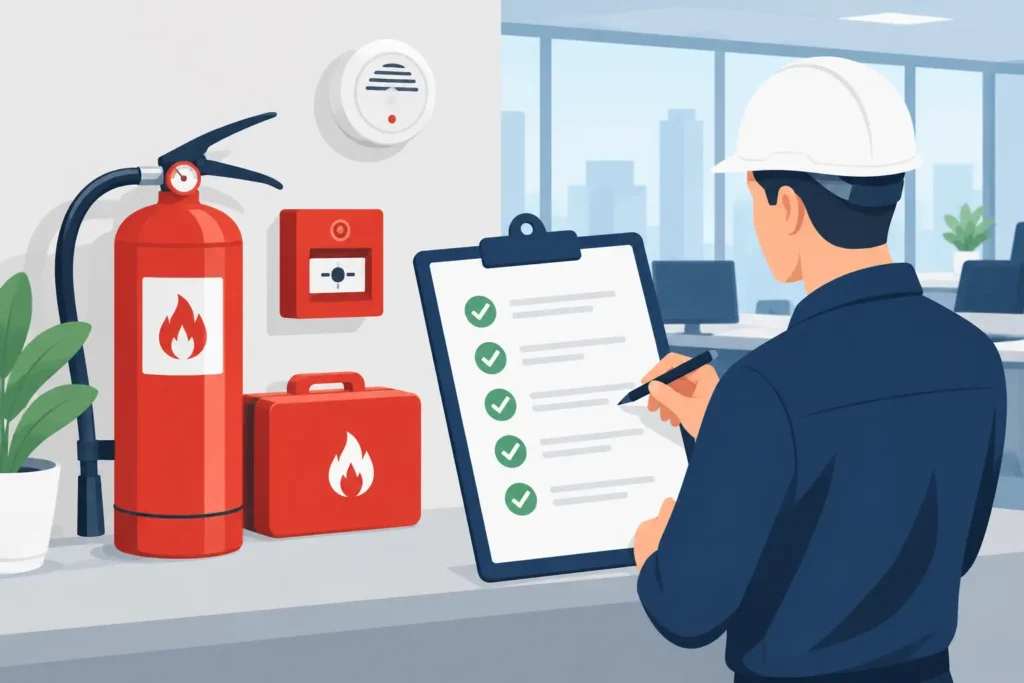
A fire safety compliance checklist for business is not a folder created for an inspection. It is the operating record that shows who is protecting occupants, what controls are in place, and whether those controls will work under pressure. When an alarm activates or an authority having jurisdiction asks for evidence, assumptions are not enough.
For facilities managers, property operators, landlords, site leaders, and employers, the objective is clear: prevent fire where possible, protect people when it cannot be prevented, and retain records that stand up to scrutiny. The exact requirements depend on your building, occupancy, local fire code, and insurer, but the control areas below form a practical baseline for most commercial premises.
Start With Clear Fire Safety Accountability
Compliance fails when responsibility is shared vaguely across maintenance, operations, tenants, and contractors. Appoint a named person with authority to act on fire safety findings, approve corrective work, and maintain the compliance record. On larger sites, that person may coordinate a fire safety committee, building engineer, security supervisor, and departmental fire wardens.
Define responsibilities in writing. The facilities team may manage alarm testing and contractor access; department leaders may keep exits clear; security personnel may control emergency access and support evacuation; fire wardens may sweep assigned zones. What matters is that every task has an owner, a due date, and evidence of completion.
A change in use, occupancy, construction, staffing pattern, or tenant arrangement can alter the fire risk. Make fire safety part of change control rather than treating it as an annual exercise. A warehouse adding lithium-ion charging, an office converting storage space into workstations, or a venue introducing temporary partitions all require the risk assessment to be reviewed.
Build the Fire Safety Compliance Checklist Around Risk
A documented fire risk assessment should drive the checklist. It identifies ignition sources, combustible materials, people at risk, existing safeguards, and actions needed to reduce exposure. For U.S. businesses, applicable requirements may include local and state fire codes, Occupational Safety and Health Administration rules, National Fire Protection Association standards, lease obligations, and insurance conditions. The local authority having jurisdiction has a decisive role, so do not rely on a generic checklist where site-specific requirements differ.
The assessment should consider more than obvious hazards. Look at contractor hot work, commercial cooking, electrical rooms, waste storage, flammable liquids, battery charging, unattended equipment, smoking controls, and poor housekeeping. It should also identify people who may need additional support, including visitors unfamiliar with the building, mobility-impaired occupants, lone workers, overnight staff, and people in high-noise or restricted-access areas.
Use the findings to create an action plan. Separate immediate life-safety issues, such as blocked exits or an impaired alarm panel, from planned improvements such as replacing doors, upgrading emergency lighting, or revising evacuation arrangements. Close every action with a date, responsible person, and proof.
Inspect the Systems That Protect Life
Life-safety systems need more than installation certificates. They require planned inspection, functional testing, preventive maintenance, and fault escalation. Keep service reports, deficiency notices, repair invoices, and test logs together so the history is easy to verify.
Your operational checklist should cover at least these core controls:
- Fire alarm and detection systems, including control panels, manual pull stations, detectors, audible and visual notification devices, monitoring connections, and documented tests.
- Emergency lighting, including functional checks, required duration testing, battery condition, illuminated exit signs, and prompt repair of failed units.
- Portable fire extinguishers and, where fitted, hose reels or suppression systems, with suitable types, accessible locations, current service labels, and staff awareness of their limited role.
- Automatic sprinklers, standpipes, fire pumps, kitchen suppression, smoke-control equipment, and other fixed systems, tested by competent providers at the required intervals.
- Fire doors, dampers, penetrations, stairwell enclosures, and other passive fire protections that stop smoke and flame from spreading.
- Means of egress, including corridors, stairways, final exits, exterior discharge routes, emergency release hardware, exit signs, and assembly areas.
The frequency of checks varies by system and jurisdiction. A daily visual walk-through may reveal a wedged fire door or blocked exit, while a qualified contractor may carry out scheduled alarm, sprinkler, extinguisher, or emergency-lighting service. Do not confuse a quick internal check with the inspection or certification work required from a competent professional.
Treat Impairments as an Active Risk
A disabled sprinkler valve, fire alarm fault, damaged fire door, or outage in an alarm monitoring connection is not simply a maintenance ticket. It is a temporary reduction in protection that requires control.
Record the impairment, assess the affected area, notify relevant parties, and establish compensating measures. Depending on the risk, these may include increased patrols, a trained fire watch, restricted work, removal of ignition sources, temporary detection, or moving people and operations away from the affected zone. Set a restoration deadline and verify that the system has returned to service.
Keep Escape Routes and Fire Doors Ready Every Day
Many serious failures are visible during a five-minute site walk. Exit routes become storage areas. Deliveries narrow hallways. Fire doors are propped open for convenience. Exterior exit gates are locked without a compliant means of release. These conditions can turn a manageable incident into a life-safety emergency.
Inspect escape routes at the start of each shift or operating day, especially in high-traffic properties, construction sites, warehouses, schools, hospitality venues, and multi-tenant buildings. Confirm that routes are clear to the public way or designated safe area, exit doors open as intended, signage is visible, and no one has compromised doors or stairwells.
Fire doors deserve specific attention. They should close and latch properly, have no unapproved holes or damaged seals, and must not be held open unless an approved device releases them on alarm. A door that looks intact but fails to close is not providing the compartmentation your building strategy depends on.
Train People for the First Minutes of an Emergency
Equipment does not evacuate a building. People do. Every employee should know how to raise the alarm, leave by the nearest safe route, report to the assembly point, and avoid re-entering until authorized. That instruction should be part of onboarding and refreshed whenever conditions change.
Designated fire wardens need additional training appropriate to the site. Their role can include directing occupants, checking assigned areas only when it is safe to do so, reporting missing persons, and communicating with emergency responders. They are not expected to enter smoke, fight a developing fire, or place themselves at risk.
Conduct evacuation drills on a schedule that reflects occupancy, turnover, shift patterns, and local requirements. Record the date, participants, evacuation time where relevant, issues observed, and corrective actions. A drill that reveals confusion over an assembly area is useful only if the plan is updated and the change is communicated.
Control Contractors, Hot Work, and Temporary Conditions
Contractor activity introduces a different level of risk because workers may not know your building, evacuation plan, or fire-protection arrangements. Require site induction, coordinate access, and verify that contractors understand emergency procedures before work begins.
Hot work such as welding, cutting, grinding, soldering, and torch-applied roofing should be controlled through a permit process. Confirm the work area has been inspected, combustible materials are protected or removed, suitable extinguishers are available, and a fire watch continues for the required period after work stops. The duration depends on the work, surrounding construction, and governing requirements.
Construction, renovation, and tenant fit-out can also obstruct exits, create dust that affects detectors, breach fire-rated walls, or leave temporary wiring exposed. Review these conditions daily. Do not allow project schedules to override life-safety controls.
Maintain Records That Can Be Produced Quickly
A compliance record should make it easy to answer basic questions: When was the alarm last tested? Which fire doors have defects? Who completed the last drill? What actions remain open? If the answer requires searching emails, loose certificates, and multiple contractor portals, the record is not under control.
Maintain a centralized file, digital or physical, containing the current risk assessment, floor plans, emergency procedures, inspection logs, maintenance certificates, training records, drill reports, impairment records, contractor permits, and corrective-action register. Set document owners and review dates. Retain prior records in line with applicable rules, contractual obligations, and insurance requirements.
This level of documentation also supports business continuity. After an incident, a credible record demonstrates that the organization identified risks, maintained safeguards, trained personnel, and acted on deficiencies rather than ignoring them.
When Outside Support Is the Right Decision
Internal teams can manage many routine checks, but specialist input is appropriate when systems are complex, findings are repeated, occupancy changes, construction affects fire protection, or formal testing and certification are required. A qualified provider can bring risk assessment, system inspection, fire-door review, emergency-lighting testing, fire marshal coverage, and compliance documentation into one accountable program.
The strongest fire safety program is the one that works on an ordinary Tuesday, not just when an inspector is expected. Assign ownership, test what you rely on, correct defects without delay, and keep evidence that proves your people and premises were protected.