


A fire safety report that identifies risks but leaves actions unassigned is not enough. Fire safety management reports should help UK businesses understand what needs attention, who is responsible and what evidence will show the work is complete. The challenge is knowing which records matter and how different reports fit together.
If you’re unsure whether you need a fire risk assessment, a fire strategy report or a focused survey, each document has a different purpose. None removes the Responsible Person’s duty to manage fire safety. Findings need to be considered in the context of the building, its occupants and how it is used.
This guide explains what these reports can and can’t tell you, how to prioritise findings, assign owners and keep a clear record of actions. It also covers when professional support may be appropriate, including fire risk assessments, fire strategy reports and fire door surveys. The aim is practical: turn documented findings into controlled, evidenced action.
Key Takeaways
- Use fire safety management reports to understand documented findings, while recognising that one report cannot confirm every ongoing responsibility is being met.
- Check that each report clearly identifies its scope, inspection date, evidence, limitations and recommendations.
- Distinguish between a fire risk assessment, a fire strategy report and a fire door survey before deciding what support your premises needs.
- Turn findings into controlled actions by assessing urgency, assigning owners and recording evidence when work is complete.
- Before appointing a provider, confirm their competence and agree the scope, deliverables, exclusions and follow-up arrangements.
What fire safety management reports tell a UK Responsible Person
A fire safety management report records specified fire-safety arrangements, conditions, findings or actions at a premises. Its value depends on what it covers, when it was prepared and the evidence available to the person who produced it.
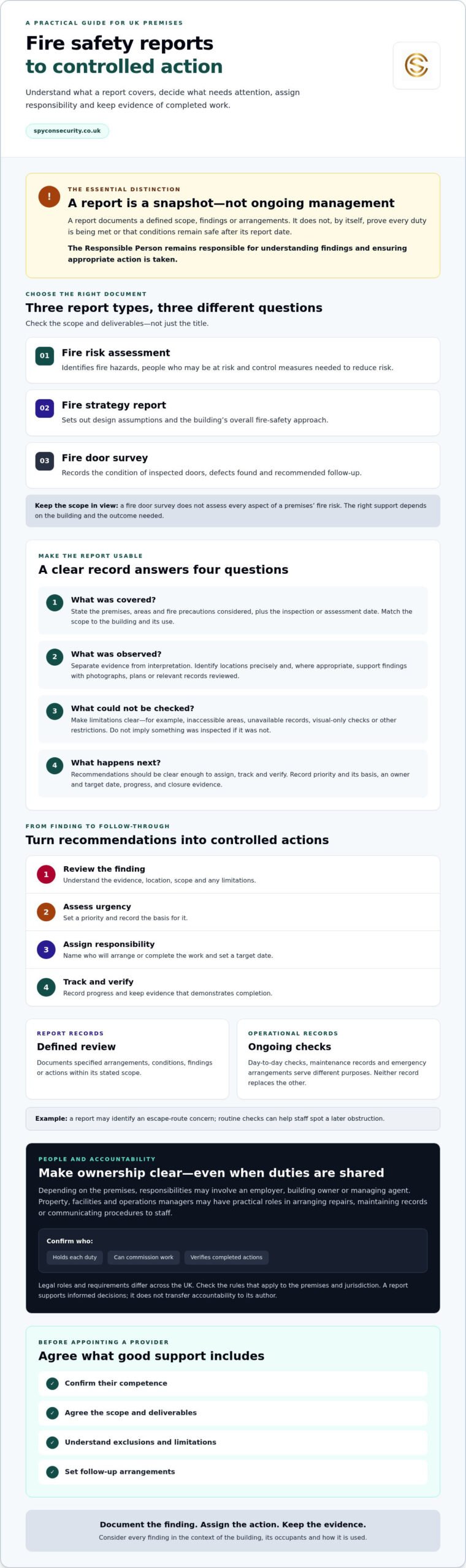
A fire safety management report documents a defined area of fire-safety management. It does not, by itself, prove that every duty is being met or that conditions remain safe after the report date. Treat it as a snapshot or review of its stated scope, not a substitute for active management. Fire precautions must continue to be checked and maintained, and identified actions need clear ownership and follow-up.
The general fire safety principles include prevention and protecting people if a fire occurs. The records needed to manage those principles depend on the premises, its use and the responsibilities in place.
Keep reports distinct from routine operational records. Day-to-day checks, maintenance records and emergency arrangements serve different purposes. For example, a report may identify a concern with an escape route, while routine checks help staff spot a later obstruction. Neither record replaces the other.
Which fire safety documents might a premises team call a report?
Report titles can be used differently, so check the scope and deliverables rather than relying on the name alone. A fire risk assessment identifies fire hazards, people who may be at risk and control measures needed to reduce risk. A fire strategy report sets out design assumptions and the building’s overall fire-safety approach. A fire door survey records the condition of inspected doors, defects found and recommended follow-up.
These documents answer different questions. A fire door survey, for instance, does not assess every aspect of a premises’ fire risk. Spycon Security Ltd. lists fire risk assessments, fire strategy reports and fire door surveys among its services. The right support depends on the building and the outcome you need.
Who should read and act on the report?
The Responsible Person should understand the findings and ensure appropriate action is taken. Depending on the premises, this may involve an employer, building owner or managing agent. Property, facilities and operations managers may also have practical roles, such as arranging repairs, maintaining records or communicating procedures to staff.
Responsibilities may be shared, but they should be clearly allocated. Confirm who holds each duty, who is authorised to commission work and who will verify completed actions. Legal roles and requirements differ across the UK, so check the rules that apply to the premises and jurisdiction. A report supports informed decisions; it does not transfer accountability to its author.
What a fire safety management report should record
A usable report lets someone identify what was assessed, what was found and what needs to happen next. Its scope should match the premises and its use, rather than rely on a generic template. For example, a report for a warehouse should make clear which areas and fire precautions were considered, and the date of the assessment or inspection.
Fire safety management reports should make technical information traceable. Name the building or site, identify relevant floors, rooms or equipment, and label plans or photographs clearly. A recommendation that refers only to “the corridor” may be difficult to action in a large or multi-occupancy building. A precise location makes it easier to find and verify the issue.
Evidence, findings and recommendations
Keep evidence distinct from interpretation. A report might state that a fire door did not close fully when checked, identify its location and include a photograph. The professional recommendation can then explain the action needed. This separation helps readers understand what was observed and what judgement or advice follows.
Supporting material could include relevant records reviewed, photographs, plans or documents, where appropriate. The fire risk assessment (FRA) can help guide a building’s fire-safety measures, but the report should still state what was assessed and what evidence informed its findings. Make limitations explicit: note inaccessible areas, unavailable records, visual-only checks or other restrictions. Don’t imply that an area or system was inspected if it wasn’t.
Recommendations should be practical to manage. For each action, record:
- Priority: how urgently it needs attention and the basis for that priority.
- Owner and target date: who will arrange or complete the work, and by when.
- Progress and closure evidence: the current status and what will demonstrate completion, such as a work record or follow-up inspection.
Building information and report control
Include the premises identifier, report date, scope, author and version where applicable. These details help the team confirm it has the right document and whether it reflects the current building. Link relevant plans, fire procedures and maintenance records so readers can consult supporting information. Don’t treat linked records as inspection evidence unless they were reviewed as part of the work.
Store the report and related records in a controlled location that the people responsible for actions can access. Keep a review trail when actions are completed or the building, its use or fire precautions change. If specialist input is needed to define the scope or interpret technical findings, Spycon Security Ltd. lists fire risk assessments, fire strategy reports and fire door surveys among its services. Check that the requested work matches the premises and required outcome.
How fire risk assessments, strategy reports and surveys differ
Choose the document that answers the question you need resolved. These report types have different scopes and purposes. None automatically replaces another or proves that every fire-safety duty is being met. The right scope depends on the premises, the appointment and the issue being investigated.
| Document | Purpose and typical questions | Likely user | Important limitation |
|---|---|---|---|
| Fire risk assessment | Identifies fire hazards, people at risk and existing or required precautions. What risks need controlling? | Responsible Person, employer, owner or managing agent | Its findings relate to the stated premises and assessment scope. It does not replace ongoing checks or maintenance. |
| Fire strategy report | Records the building’s fire-safety design approach and assumptions. How is the building intended to support fire precautions and evacuation? | Building owners, property managers, design or project teams | It may rely on particular design assumptions. Confirm that these remain relevant to the building as occupied and used. |
| Fire door survey | Provides focused evidence about inspected doors, their condition and identified defects. Which doors need attention? | Property or facilities managers and those arranging remedial work | It covers the doors and elements stated in its scope, not the premises’ complete fire risk or wider strategy. |
For a fire risk assessment, match the scope to the building’s use, occupants and relevant circumstances. If you need a broader introduction to assessment and its role in workplace responsibilities, consult this fire risk assessment guide. GOV.UK also sets out official government guidance on fire safety responsibilities. Check the requirements that apply to your premises and UK jurisdiction.
When might a strategy report or fire door survey be relevant?
A strategy report may help when teams need to understand the design basis for a building or assess whether planned changes affect its fire-safety approach. Spycon Security Ltd. lists fire strategy reports as a service. Confirm that the proposed scope addresses the building and question at hand.
A fire door survey is more specific. It can help identify defects in inspected doors so follow-up can be planned. For each finding, record the door’s location, assign an action owner, set a target date and retain completion evidence. This turns a technical observation into a trackable task without treating the survey as a substitute for a broader assessment.
Use fire safety management reports as a coordinated evidence set, not as interchangeable paperwork. Before commissioning work, state the decision you need the report to support and ask what it will include, exclude and rely on.
How to review findings and manage fire-safety actions
A report only improves fire safety when its recommendations are understood, assigned and followed through. Use a consistent review process so important findings don’t disappear into email threads or meeting notes.
- Confirm the scope. Check which building areas, systems or activities were covered, when the assessment took place and whether any limitations affect the findings.
- Understand each finding. Separate observed conditions from professional judgement and recommended action. If wording is unclear, conditional or outside your competence, ask the report author or another suitably competent person to clarify it before deciding how to proceed.
- Assess urgency. Consider the stated priority and the potential effect on people and fire precautions. Give urgent safety concerns prompt attention and obtain appropriate competent advice. Don’t downgrade a recommendation simply because it is difficult to arrange.
- Assign ownership. Name a person with the competence and authority to progress the action. Set a suitable target date and a route for escalating delays or unresolved decisions.
- Track closure. Record the action’s status and check that completion evidence addresses the original finding. Keep unresolved items visible until they are verified as complete.
Every accepted recommendation should have an owner, a status and an evidence trail. That simple control makes fire safety management reports useful beyond the review meeting.
Turn recommendations into a controlled action plan
Translate each recommendation into a defined task without changing its technical meaning. If a report identifies a fire door defect, for example, record the specified door and required follow-up rather than reducing the task to “check doors”. Where an action cannot be completed immediately, record any interim control, who authorised it and when it will be reviewed. An interim measure must not be treated as a replacement for the required permanent work.
Make responsibility and escalation clear. The action owner should know who can approve resources, arrange specialist work or decide what to do if the target date cannot be met. If the recommendation’s intent remains uncertain, return to the author for clarification rather than guessing.
Verify completion and keep records current
Close an action only when the evidence supports closure. Depending on the work, this might include an updated record, inspection note, photograph or commissioning documentation. Link the evidence to the relevant finding and location so another manager can verify what was done.
Review the action plan after alterations, changes in occupancy, incidents or relevant review findings. Update related procedures and records where the change affects them. If an action concerns staff training or fire drills, record what was completed and retain appropriate evidence. Review fire safety training and fire drill information when considering those records.
Choosing fire safety management report support in the UK
Choose a provider whose competence and proposed report scope match the building, its use and the decision you need to make. A report for a straightforward workplace may not address the same issues as one for a complex, multi-occupancy building. Ask how the provider will account for the premises’ particular features and present findings so your team can act on them.
Legislation and the responsibilities of relevant authorities vary across England, Wales, Scotland and Northern Ireland. Confirm which jurisdiction applies and check legal interpretations against current official guidance. Don’t assume that a report or a provider’s standard process automatically covers every duty attached to your premises.
Questions to ask before commissioning a report
Agree the appointment in writing before work begins. Clarify what the assessment or survey is intended to establish, who will carry it out and what relevant competence supports the appointment. Ask how that experience relates to your premises and the scope requested.
Confirm practical details, including access requirements, which areas and records will be reviewed, and whether systems or specific report types are included or excluded. Establish what you’ll receive: findings, supporting evidence, recommendations and any action-tracking format. Also agree how urgent concerns will be communicated, who can answer questions about recommendations and whether follow-up is included or needs a separate arrangement.
Good commissioning prevents mismatched expectations. A survey limited to selected areas, for example, should not be mistaken for an assessment of the whole premises. Check the proposed scope against the question you need answered and clarify any exclusions before relying on the findings.
When Spycon Security Ltd. may be relevant
Spycon Security Ltd. If you need assessment support in London, review its fire risk assessment service and confirm that the proposed scope suits your premises and requirements.
Spycon Security Ltd.’s stated locations include London, Luton, Birmingham, Wales, Slough, Nottingham, Edinburgh, Glasgow, Northampton, Derby, Manchester, Dover, Canterbury, Dartford, Enfield, Camden, Barking, Coventry, East London and West London. Confirm availability for your specific location and premises type directly. Ask about relevant experience, deliverables, exclusions and follow-up before making an appointment.
If you’re considering external support, discuss your fire safety requirements with Spycon Security Ltd. Outline the building, the report you need and the decision you want the work to inform.
Make your next fire-safety action clear
Effective fire safety management reports are more than records to file. They clarify what was assessed, what needs attention and what evidence will confirm that actions are complete. Choose the document for the question at hand, then make sure each recommendation has an owner, a status and a clear route to verified closure.
Keep the report’s scope and limitations in view. A fire risk assessment, strategy report and fire door survey each provide different information, and none replaces ongoing management of fire precautions. Clear records help your team maintain continuity when premises, responsibilities or conditions change.
Spycon Security lists fire risk assessments, fire strategy reports and fire door surveys among its services, with stated locations including London, Luton, Birmingham, Wales, Slough, Nottingham, Edinburgh, Glasgow, Northampton, Derby, Manchester, Dover, Canterbury, Dartford, Enfield, Camden, Barking, Coventry, East London and West London. Confirm availability for your premises and location. To discuss suitable support, contact Spycon Security about your fire safety requirements.
With a defined scope and disciplined follow-through, you can turn report findings into practical, evidenced progress.
Frequently Asked Questions
What is a fire safety management report?
A fire safety management report is a documented record of defined fire-safety arrangements, conditions, findings or actions at a premises. It helps relevant people understand what was examined and what needs attention. The title can describe different documents, so check the report’s scope, date, evidence and limitations. It supports active management, but doesn’t replace routine checks, maintenance records or emergency arrangements.
What should a fire safety management report include?
A useful report identifies the premises, its scope and the date of inspection or assessment. It should distinguish observed conditions from professional conclusions and recommendations, and record relevant evidence such as photographs or documents reviewed. Limitations, including inaccessible areas or unavailable records, should be clear. Recommendations are easier to manage when each has a priority, an owner, a target date, a progress status and evidence required for closure.
Is a fire risk assessment the same as a fire safety management report?
No. A fire risk assessment is a specific type of assessment that identifies fire hazards, people who may be at risk and precautions needed to reduce risk. Fire safety management reports is a broader description for documents covering different aspects of fire safety. A strategy report or fire door survey has a distinct purpose and scope. Check what question the document answers rather than treating report types as interchangeable.
How often should fire safety management reports be reviewed?
There isn’t one review interval that applies to every report or premises. Follow any review requirements relevant to the document and jurisdiction, and reconsider whether its findings remain current after changes to the building, its use, occupancy or fire precautions. Incidents, completed remedial work or new assessment findings may also prompt a review. Continue routine checks and maintenance between formal reviews, and record why and when a report was updated.
Who is responsible for acting on fire safety report findings?
The Responsible Person should ensure findings are considered and appropriate action is taken, with practical tasks allocated to people who have the authority and competence to complete them. Depending on the premises, employers, building owners or managing agents may hold responsibilities or support implementation. Confirm the legal role allocation for the building and applicable UK jurisdiction. Record an owner, target date and escalation route for each action, then retain evidence of completion.
Can a fire safety management report prove that a building is compliant?
No single report automatically proves that a building meets every applicable requirement or that fire precautions remain effective. A report documents its stated scope at a particular time and may identify limitations or outstanding actions. Use it alongside current checks, maintenance records, procedures and evidence that recommendations have been addressed. Confirm legal requirements for the premises and jurisdiction, and seek competent advice if findings or responsibilities are unclear.
When should I commission a fire strategy report instead of a fire risk assessment?
Consider a fire strategy report when you need to understand the building’s fire-safety design approach, assumptions or intended arrangements, particularly when assessing how proposed changes may affect that approach. A fire risk assessment instead examines hazards, people at risk and precautions at the premises. One isn’t a substitute for the other. Spycon lists both services, with stated locations including London, Luton, Birmingham, Wales, Slough, Nottingham, Edinburgh, Glasgow, Northampton, Derby, Manchester, Dover, Canterbury, Dartford, Enfield, Camden, Barking, Coventry, East London and West London. Confirm local availability and scope.