


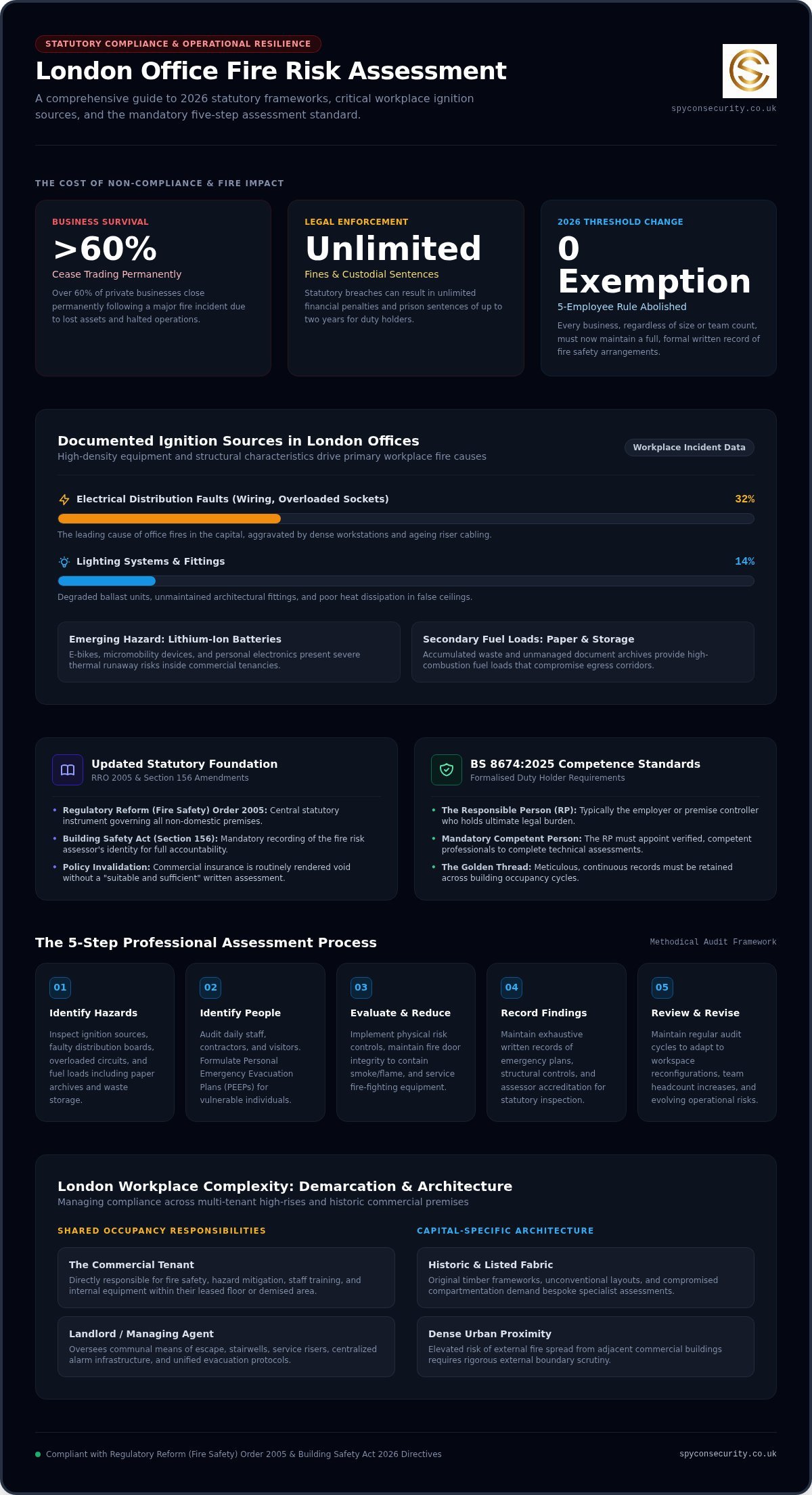
Over 60% of private businesses cease trading permanently following a major fire incident. In the high-stakes environment of the capital, a professional office fire risk assessment London is no longer just a tick-box exercise. It’s a critical pillar of operational resilience. You likely feel the pressure of navigating complex shared occupancy rules or the fear of unlimited fines under the latest enforcement protocols. It’s a heavy responsibility to protect both your people and your premises in historic or high-rise structures.
This guide provides the clarity you need to achieve full legal compliance and establish a safer environment for your employees. We’ll break down the 2026 statutory requirements, including the abolition of the five-employee threshold and the new BS 8674:2025 competence standards. You’ll gain a methodical understanding of the assessment process to ensure your London workforce remains secure and your business remains beyond reproach. We’ll also address emerging hazards like lithium-ion battery management to ensure your safety strategy is as modern as your workspace.
Key Takeaways
- Understand your mandatory legal obligations under the updated Regulatory Reform (Fire Safety) Order 2005 and the latest Section 156 amendments.
- Identify and manage high-risk modern hazards such as lithium-ion battery charging and electrical distribution faults within the workplace.
- Master the five-step methodology for a professional office fire risk assessment London to ensure absolute workforce protection and operational continuity.
- Navigate the complexities of shared-occupancy coordination and evacuation policies in high-rise London corporate environments.
- Implement a disciplined review cycle to maintain continuous compliance as your office layout and occupancy levels evolve.
Understanding the Legal Framework for London Office Fire Safety
An office fire risk assessment London is a mandatory, systematic evaluation of your workplace hazards. It identifies potential ignition sources, fuel loads, and the specific individuals at risk within your premises. The statutory foundation for this process is the Regulatory Reform (Fire Safety) Order 2005. As of 2026, compliance standards have tightened significantly. Every business, regardless of size or employee count, must now maintain a full, written record of their fire safety arrangements. There are no exemptions for small teams or start-ups. Failure to meet these standards carries severe penalties. Criminal prosecution can lead to unlimited fines and custodial sentences of up to two years. Your commercial insurance policy will likely be rendered void if a “suitable and sufficient” assessment is not in place during an incident.
The Role of the Responsible Person in 2026
The Responsible Person (RP) is typically the employer or the individual with primary control over the premises. In the complex corporate landscape of the capital, identifying the RP is a critical first step in your safety strategy. This role carries the ultimate legal burden for fire safety. In shared London office blocks, responsibilities are often divided. The tenant is responsible for their specific floor, whilst the landlord or managing agent oversees common areas like stairwells and risers. You must coordinate with these other duty holders to establish a unified evacuation strategy. The law now mandates that the RP must appoint a “competent person” to assist with the assessment. This ensures that technical complexities are managed with professional precision and verified expertise.
Why London Offices Require Specialist Assessments
London presents unique architectural challenges that standard safety checklists cannot address. Many firms operate out of historic buildings with complex layouts, original timber structures, and limited compartmentation. These premises require a high level of meticulousness to identify hidden risks. High-density urban environments also increase the risk of external fire spread from neighbouring properties. Generic assessments fail to account for these variables. Specialist fire risk assessment services in London provide the rigorous scrutiny required for such high-stakes environments. Professional verification ensures your fire strategy aligns with the specific risks of your London location, protecting both your workforce and your operational continuity.
Meticulous documentation is now a statutory requirement. Under Section 156 of the Building Safety Act, you must formally record the identity of your fire risk assessor. This transparency is designed to drive up standards across the industry. It ensures that only those with the necessary training and official recognition are tasked with protecting London’s workforce. By moving beyond basic compliance, you transform fire safety into a strategic asset that safeguards your firm’s future.
The Five Essential Steps of a Professional Fire Risk Assessment
A professional office fire risk assessment London follows a disciplined five-step methodology. This isn’t a cursory inspection; it’s a rigorous audit of your operational environment. Every assessment must begin with hazard identification. This involves scrutinising your premises for ignition sources like faulty wiring or overloaded sockets and fuel loads such as stored waste or paper archives. You then identify the people at risk. This includes your daily workforce, visitors, contractors, and individuals who may require Personal Emergency Evacuation Plans (PEEPs). Step three requires evaluating, removing, or reducing these risks through physical controls. The final stages involve recording your findings in full and establishing a regular review cycle to maintain the “Golden Thread” of safety information. Following the GOV.UK workplace fire safety guidance ensures your approach remains aligned with national standards.
Hazard Identification and Risk Reduction
Modern offices contain high-density ignition sources. Electrical distribution faults account for 32% of London office fires, while lighting contributes another 14%. You must evaluate the placement and service history of your fire-fighting equipment to ensure it’s fit for purpose. Effective hazard reduction relies on the uncompromising integrity of fire doors to prevent the spread of smoke and flame throughout the building. If your equipment is outdated or your layout has changed, immediate remedial action is necessary to protect your occupants. Our team at Spycon Security can help you understand the professional standards required to mitigate these specific workspace hazards.
Recording Findings and Emergency Planning
As of late 2023, the legal landscape shifted significantly. Under Section 156 of the Building Safety Act 2022, the previous exemption for businesses with fewer than five employees was abolished. Every Responsible Person must now record their assessment and fire safety arrangements in full, regardless of company size. This document forms the basis of your emergency plan. It must detail exactly how people will be alerted and evacuated during an incident. Developing bespoke fire policy plans ensures your procedures are tailored to your specific London premises rather than relying on generic templates. This level of detail is essential for complex high-rise or historic buildings where standard evacuation routes may be compromised. Your written record acts as your primary defence in the event of an audit or incident, proving you’ve taken every reasonable step to secure your workforce.
Identifying Common Fire Hazards in Modern London Workspaces
Modern workspace hazards have evolved beyond simple paper fires. An effective office fire risk assessment London must address the surge in lithium-ion battery incidents. In 2025, the London Fire Brigade attended a record 206 e-bike and e-scooter fires, with e-bikes accounting for 83% of those incidents. These devices, often brought into offices by commuting staff, represent a volatile ignition source that requires specific management. Beyond batteries, traditional electrical faults remain a leading cause of workplace incidents. Overloaded sockets and the dangerous practice of “daisy-chaining” extension leads create significant thermal stress on infrastructure. Referencing the London Fire Brigade guidance on fire risk assessments is vital to ensure your inspection criteria meet local enforcement standards.
Kitchenettes and breakout zones are high-risk environments that demand constant vigilance. Unattended toasters, microwave faults, and poorly maintained kettles are common triggers for office evacuations. These areas often lack the same level of daily scrutiny as main floor plates, yet they house significant ignition sources near flammable materials. Ensuring these zones are covered by rigorous fire alarm maintenance protocols is essential for early detection. A failing detector in a secluded kitchenette can lead to a catastrophic delay in the emergency response, putting the entire workforce at risk.
Electrical and Battery Safety Protocols
Your fire safety strategy must include explicit lithium-ion charging policies. Many London firms now ban the charging of personal e-mobility devices within tenanted floors to mitigate thermal runaway risks. Annual Portable Appliance Testing (PAT) remains a non-negotiable standard for all commercial electrical items. In server rooms, cooling systems must be monitored constantly. A failure in climate control leads to rapid overheating of high-density hardware, requiring dedicated fire suppression and specialised detection. Regular audits of these technical spaces prevent small faults from escalating into full-scale building fires.
Housekeeping and Combustible Materials
Open-plan offices often accumulate significant fuel loads through poorly managed paper storage and waste disposal. You must implement disciplined housekeeping to prevent rapid fire spread. Modern breakout furniture and decorative wall features often contain synthetic materials that produce toxic smoke when ignited. You must ensure that all escape routes remain entirely clear of obstructions whilst the office is occupied. Even temporary storage of deliveries in corridors can compromise a safe exit during an emergency. Meticulous order is the foundation of a resilient workspace.
Managing Compliance in Shared Occupancy and High-Rise Offices
High-rise and shared occupancy London offices present a unique layer of complexity. An office fire risk assessment London must account for the interplay between individual tenancies and the building’s core safety systems. Under Section 156 of the Building Safety Act, Responsible Persons (RPs) in multi-tenant buildings are legally mandated to identify themselves to other RPs and share contact information. Coordination is not optional; it’s a statutory requirement. You must ensure your internal safety protocols do not conflict with the wider building’s fire strategy.
The distinction between “Stay Put” and “Simultaneous Evacuation” policies is critical. A “Stay Put” strategy relies on high-integrity compartmentation to contain a fire within its room of origin. Conversely, “Simultaneous Evacuation” requires all occupants to exit immediately upon alarm activation. In high-risk scenarios or where compartmentation is compromised, the deployment of fire marshals and waking watches provides a vital human layer of protection. These professionals ensure constant vigilance and rapid response, bridging gaps in automated systems whilst maintaining the safety of the entire floor plate.
Evacuation Strategies for Multi-Storey Buildings
Vertical evacuation requires meticulous planning. You must manage Personal Emergency Evacuation Plans (PEEPs) for any staff members with mobility issues or disabilities. These plans must be tested and shared with the building’s central security team. Fire lifts and protected stairwells are your primary life-safety assets. They must remain clear of all storage and equipment. Under the latest 2026 compliance standards, high-rise office tenants must participate in coordinated building-wide fire drills to ensure the integrity of shared evacuation routes and communication protocols. This ensures that in a crisis, the transition from the office floor to the street is seamless and controlled.
Liaising with Building Owners and FM Teams
Clear boundaries are essential for legal protection. You must define exactly where your office responsibility ends and the communal areas begin. This is typically outlined in your tenancy agreement, but it must be reflected in your risk assessment. You require regular access to shared fire alarm testing data to confirm that your office remains protected by the building-wide system. Your internal plan should be a direct extension of the building fire strategy report. This alignment ensures that your physical security measures, such as access control, do not impede emergency exits. To ensure your high-rise office meets every Building Control standard, contact our expert consultancy team for a professional review.
Securing Your Office: Professional Assessments and Remedial Action
An office fire risk assessment London is an active document that requires regular maintenance to remain valid. You must trigger a formal review at least annually to ensure continuous compliance with the Regulatory Reform (Fire Safety) Order 2005. Significant layout changes, such as installing acoustic pods or reconfiguring open-plan desks, also necessitate an immediate update. New staff arrivals or shifts in occupancy patterns require a fresh evaluation of your evacuation capacity. Remedial works are the logical result of a thorough assessment. This often includes upgrading fire alarm systems or conducting detailed fire door surveys to ensure compartmentation remains intact. Professional consultancy provides the meticulous oversight needed to manage these technical upgrades without disrupting your daily operations.
Integrating Fire Safety with Physical Security
Physical security measures must never compromise life safety protocols. You must ensure that high-security shutters and electronic locks are integrated with your fire alarm system for automatic release during an emergency. Conflict between access control and fire exit routes is a common point of failure in corporate environments. Manned guarding plays a critical role in this integration by providing human verification of fire risks during out-of-hours periods. Security personnel can use CCTV to verify alarm triggers immediately, preventing unnecessary building evacuations and assisting emergency services with real-time intelligence. This unified approach creates a robust protective shield for your premises whilst maintaining strict adherence to safety laws.
Choosing a Specialist Fire Safety Partner
Selecting the right fire risk assessment company in London is a decision rooted in professional integrity. You should look for assessors who hold UKAS-accredited professional register listings, such as the IFSM or IFE. A generic checklist is insufficient for the capital’s complex building stock. You require detailed fire strategy reports that align with Building Control standards and provide clear, actionable remedial steps. Elite partners operate with absolute precision, ensuring that no shortcut is taken in the protection of your workforce. Long-term peace of mind is only achieved through rigorous verification and a commitment to excellence. Protect your London office with an expert assessment from Spycon Security to ensure your firm meets every statutory duty with unwavering reliability.
Strategic Protection for Your London Workforce
Statutory compliance in the capital’s commercial sector is a matter of professional integrity and operational survival. You’ve seen that the abolition of the five-employee threshold makes a full written record mandatory for every firm. Navigating the unique architectural challenges of high-rise and shared occupancy spaces requires more than a generic checklist. It demands an integrated approach where fire safety and physical security operate in total unison. An office fire risk assessment London is your primary tool for establishing this baseline of safety.
Securing your premises is a continuous duty. From managing volatile lithium-ion battery risks to ensuring fire strategy reports meet Building Control standards, the stakes remain high. Our team provides elite consultancy as SIA licensed security experts. We deliver Building Control approved fire strategy planning and a comprehensive integration of fire safety and manned guarding. This level of meticulousness ensures your firm remains a safe, compliant, and resilient environment. We stand ready to serve as your watchful guardian.
Contact Spycon Security Ltd. for a Professional London Office Fire Risk Assessment to secure your workforce with absolute precision.
Frequently Asked Questions
How often should an office fire risk assessment be reviewed in London?
You should review your assessment at least once every 12 months to ensure continuous compliance. Immediate reviews are also necessary after significant layout changes, staff increases, or near-miss incidents. For London offices, high occupancy levels and evolving hazards like lithium-ion batteries demand constant vigilance. Regular updates maintain the “Golden Thread” of safety information required by enforcement authorities. This disciplined approach prevents your safety strategy from becoming obsolete as your business grows.
Who is legally responsible for fire safety in a shared London office building?
The legal burden falls on the “Responsible Person,” which usually means the employer for their specific office space. In shared London buildings, the landlord or building manager is the Responsible Person for common areas like stairwells and plant rooms. You have a statutory duty to cooperate and coordinate with other tenants. This ensures a unified evacuation strategy across the entire structure. Failing to identify your Responsible Person and align with building-wide protocols can lead to severe legal penalties.
What happens if my office fails a fire risk assessment?
If an assessment identifies deficiencies, you must implement the recommended remedial actions within the specified timeframe. Failure to address high-risk items can trigger enforcement notices from the London Fire Brigade. In extreme cases, prohibition notices may be issued to shut down unsafe premises immediately. Beyond legal risks, a failed assessment can invalidate your commercial insurance. Taking swift action on items like fire door repairs or alarm upgrades is essential for maintaining operational resilience and peace of mind.
Do I need a fire risk assessment if I only have a small office with three staff?
Yes, you are legally required to have a full written office fire risk assessment London regardless of your team size. The previous exemption for businesses with fewer than five employees was abolished under Section 156 of the Building Safety Act 2022. Every firm must now record its fire safety arrangements in full. This change ensures a baseline of protection for all workers in the capital, even in micro-offices or shared co-working spaces where risks were previously unrecorded.
Can I carry out my own office fire risk assessment?
The law allows you to carry out your own assessment if you are a “competent person” with the necessary training and experience. However, for complex London offices, this is rarely advisable. Professional assessors bring the technical meticulousness required to identify hidden structural risks and ensure compliance with the latest standards. Appointing an expert provides a layer of professional verification that protects you from liability and ensures your safety strategy is truly robust, sufficient, and legally defensible.
What are the specific fire door regulations for London offices in 2026?
In 2026, regulations demand rigorous verification of fire door integrity through documented surveys. You must ensure all fire doors are fit for purpose, including their frames, seals, and self-closing devices. For high-rise offices, quarterly inspections of fire doors in common parts are often required. Detailed records of these surveys must be kept as part of your digital fire log. This meticulous approach prevents smoke and flame spread, which is the primary cause of fatalities in multi-storey incidents.
How long does a professional office fire risk assessment take to complete?
A professional survey for a standard single-floor office typically takes between two and four hours on-site. Larger, multi-storey corporate headquarters or historic buildings may require several days of meticulous inspection. Following the site visit, a detailed report is produced, which can take an additional few days to finalise. The duration reflects the level of rigor required to evaluate complex layouts and technical fire safety systems to a professional standard that satisfies both insurers and regulators.
What is the difference between a fire risk assessment and a fire strategy report?
An office fire risk assessment London evaluates the current risks and hazards within an occupied space. In contrast, a fire strategy report is a more technical document, often required for Building Control approval during refurbishments or new builds. The strategy report outlines the fundamental design principles of the building, such as compartmentation and travel distances. Whilst the assessment manages daily hazards and occupancy risks, the strategy report provides the structural blueprint for long-term fire safety and building resilience.