


Hiring an unlicensed security guard isn’t just a lapse in judgement; it’s a legal liability that can lead to unlimited fines and a prison sentence. You already know that protecting your London commercial assets requires more than just a physical presence at the door. You need a standard of reliability that holds up under the strictest regulatory scrutiny. Deploying SIA licensed security guards is the only way to ensure your site remains compliant while mitigating the growing risks found in modern urban districts.
This article demonstrates why SIA licensing is the non-negotiable benchmark for protecting your property, people, and professional reputation in 2026. We’ll explore how the BS7858 vetting standard and mandatory top-up training create a foundation of trust. You’ll also discover how verified personnel can prevent insurance claim rejections and reduce your overall liability. From understanding the £204 licence fee requirements to preparing for the implementation of Martyn’s Law, we provide the clarity you need to secure your operations with absolute precision.
Key Takeaways
- Understand your legal obligations under the Private Security Industry Act 2001 to eliminate the risk of unlimited fines and potential criminal prosecution.
- Learn how SIA licensed security guards provide a verified layer of protection through mandatory DBS screening and rigorous identity verification.
- Discover the operational advantages of professional conflict management and emergency response training in high-stakes London commercial environments.
- Secure your insurance validity by ensuring your security personnel meet the strict professional benchmarks required to prevent costly claim rejections.
- Establish a comprehensive risk-mitigation framework that prioritises professional integrity and uncompromising site safety for your high-value assets.
The Legal Mandate: Understanding SIA Licensing in the UK
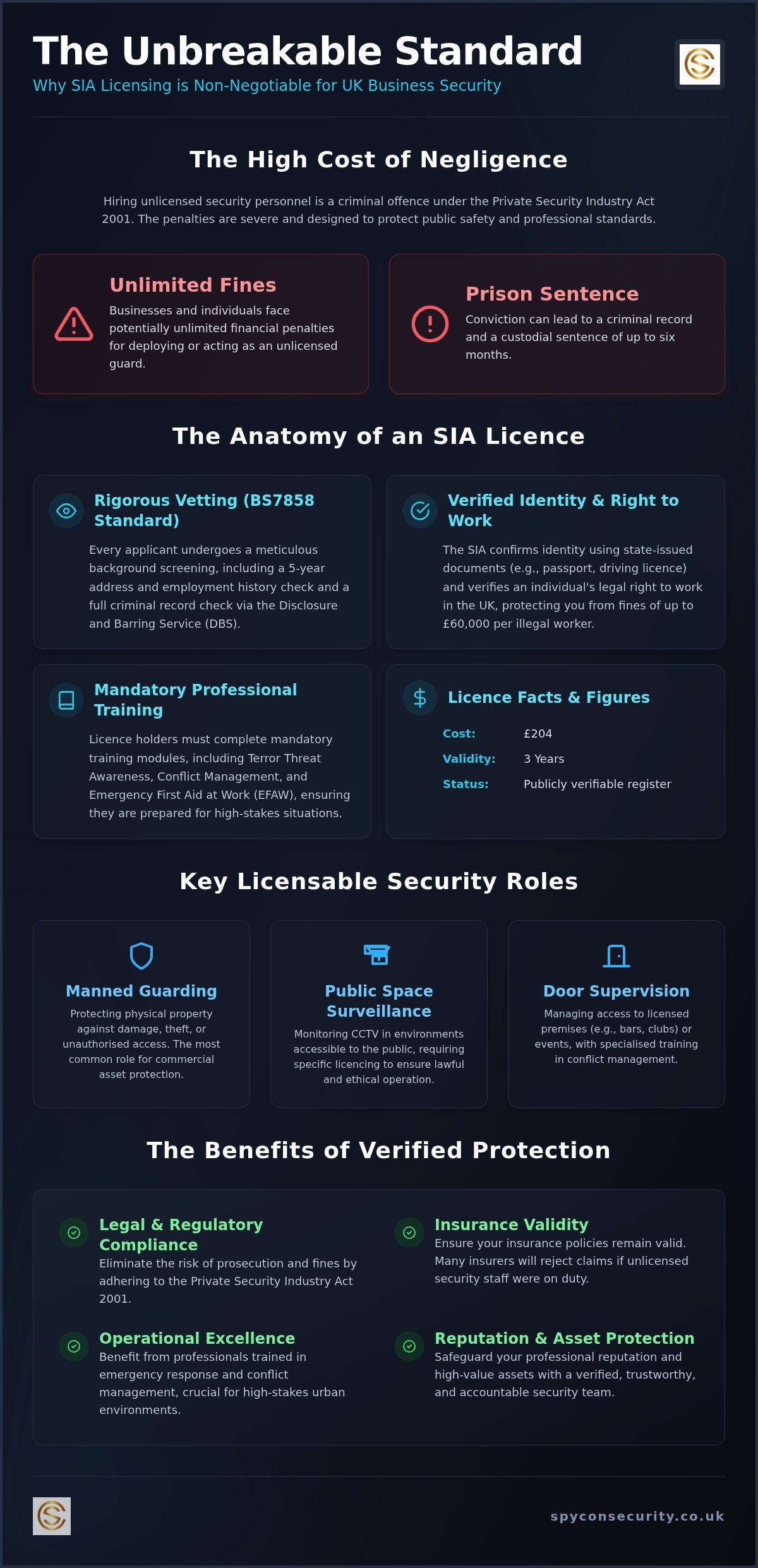
The regulatory framework governing private security in the United Kingdom is rigid and uncompromising. Established under the Private Security Industry Act 2001, the Security Industry Authority (SIA) serves as the statutory body responsible for licensing individuals and regulating the sector. This legislation was designed to eliminate rogue operators and ensure that only vetted, competent professionals handle the protection of people and property. For any business owner, understanding this mandate is a matter of legal survival. Engaging unlicensed personnel is a criminal offence that carries severe penalties, including unlimited fines and up to six months of imprisonment.
The Role of the Security Industry Authority
The SIA acts as the national guardian of professional standards. It ensures that every individual working in a security capacity has undergone rigorous background checks and achieved a standardised level of training. By maintaining the Register of Licensed Individuals, the authority allows for instant public verification of a guard’s status. As of April 2026, the cost for a new or renewed licence stands at £204, a fee that reflects the administrative rigor of the vetting process. This system provides a clear audit trail for compliance, ensuring that SIA licensed security guards on your site have met the national benchmark for professional integrity.
Licensable Activities for Commercial Sites
The law distinguishes between various roles based on the nature of the work performed. Manned guarding is the most common requirement for commercial assets, involving the protection of physical property against theft, damage, or unauthorised access. Public space surveillance is another critical category; it applies to any operative monitoring CCTV in environments accessible to the public. Door supervision remains a mandatory requirement for managing access to licensed premises or specific events. Each of these roles requires a front-line licence, which is only granted after the applicant completes mandatory modules, including terror threat awareness and Emergency First Aid at Work (EFAW).
A vital distinction exists between ‘in-house’ security and contracted services. If a business employs security staff directly on its own payroll for manned guarding, those employees are generally exempt from SIA licensing requirements. However, the legal landscape shifts the moment you engage a third-party security firm. Every operative provided by a contractor must be a front-line licence holder. Most London firms choose to hire contracted SIA licensed security guards because it shifts the burden of vetting and training to the provider. This ensures that the personnel on-site are not just employees, but verified professionals who have cleared the BS7858 security screening standard, covering five years of employment history and criminal background checks. Compliance is not optional. It is the baseline for professional reputation.
Rigorous Vetting: What an SIA Licence Actually Guarantees
The presence of a uniform does not equate to security. True protection is built on a foundation of verified character and legal eligibility. When you deploy SIA licensed security guards, you aren’t just hiring staff; you’re implementing a pre-vetted risk management solution. The SIA application process requires applicants to provide multiple forms of state-issued identification, such as a British passport or driving licence, to confirm their identity beyond any doubt. This ensures that the individual standing on your premises is exactly who they claim to be.
Legal compliance extends to the Right to Work. As of 2024, the civil penalty for employing an illegal worker has risen to £45,000 for a first offence and £60,000 for repeat violations. By using licensed personnel, you eliminate this catastrophic financial risk. The SIA also requires a mental health self-declaration and, where necessary, medical verification to ensure the operative is fit for the psychological demands of high-stakes environments. It is a process designed for absolute certainty.
Comprehensive DBS and Background Screening
Vetting is not a one-time event. Every applicant undergoes a mandatory Disclosure and Barring Service (DBS) check to identify relevant criminal convictions. This screening follows the BS7858 British Standard, which includes a meticulous five-year address and employment history check. If a guard is charged with a crime during their three-year licence term, the SIA has the authority to revoke their licence immediately. This continuous monitoring provides a level of integrity that unvetted, ‘cash-in-hand’ operatives can never match. It provides the peace of mind that your assets are in safe hands.
Standardised Professional Training
Competence is non-negotiable. To hold a licence, guards must achieve a Level 2 Award in Security Guarding. This isn’t merely a theoretical exercise. It covers practical emergency procedures, fire safety awareness, and mandatory Emergency First Aid at Work (EFAW) qualifications. The training ensures that guards can act decisively during a crisis, rather than becoming a liability.
The standards are constantly evolving. All SIA licensed security guards must complete mandatory top-up training every three years to renew their licence. This ensures they’re prepared for modern threats, including terror threat awareness and updated physical intervention protocols. For businesses that cannot afford a lapse in site safety, choosing a partner that prioritises rigorously vetted security personnel is the only logical step. Professionalism is not a choice; it is a requirement.
Operational Excellence: How Licensed Guards Mitigate Site Risks
Operational security is more than a deterrent. It is a series of controlled, professional actions designed to neutralise threats before they escalate. When you employ SIA licensed security guards, you are investing in a personnel tier trained to manage high-pressure environments with composure. These operatives don’t just stand watch. They execute specific, audited protocols that protect your staff and your professional standing. In a high-stakes environment, the difference between a minor incident and a total site shutdown often rests on the split-second decisions of your personnel.
De-escalation and Conflict Resolution
Modern security training prioritises the voice over the baton. SIA modules place heavy emphasis on verbal de-escalation techniques. This approach is vital for retail and corporate environments where the customer experience is paramount. By resolving disputes through communication, guards prevent physical altercations that could lead to costly civil litigation against your firm. It’s a calculated strategy to maintain order without damaging your brand’s reputation. Professionalism is maintained through restraint, not aggression.
When physical intervention becomes unavoidable, licensed guards understand the strict legal boundaries of “reasonable force”. They are trained to act within the law, ensuring that any necessary restraint is proportionate and defensible in court. This level of legal literacy is absent in unvetted personnel. It provides an essential layer of protection for the business owner, who might otherwise face vicarious liability for the reckless actions of an untrained guard. You cannot afford to leave your legal safety to chance.
Integration with Fire Safety Protocols
Vigilance extends beyond crime prevention. Professional guards are trained to identify environmental hazards whilst conducting site patrols. In London’s commercial districts, the risk of arson or electrical fires is a constant concern for property managers. A licensed guard acts as a first responder, identifying early warning signs that might be missed by automated systems. This proactive approach directly supports the findings of your Fire Risk Assessment, creating a unified safety strategy that protects the building’s infrastructure as well as its occupants.
Accountability is the backbone of operational excellence. Licensed personnel follow a disciplined reporting structure. Every incident, however minor, is documented in a formal log. Detailed incident reports and meticulous patrol records provide a transparent audit trail. This documentation is crucial for internal reviews and police investigations alike. It ensures that security is not just performed, but proven. In high-stakes environments, if an action isn’t recorded, it didn’t happen. Professional SIA licensed security guards ensure that every shift is a matter of record.
The High Cost of Non-Compliance: Insurance and Legal Pitfalls
The legal consequences of bypassing regulatory standards are severe. Under Section 5 of the Private Security Industry Act 2001, it is a criminal offence to engage unlicensed personnel for security duties. While much of the industry’s focus is on the individual operative, the business owner or property manager who hires them faces significant exposure. You aren’t just risking a fine; you’re inviting a level of scrutiny that can dismantle a professional reputation in days. Choosing SIA licensed security guards is the only way to insulate your organisation from these avoidable legal traps.
Vicarious liability is another critical risk. If an unlicensed guard causes injury or damage through negligence or excessive force, the legal burden often falls on the person who hired them. Without the framework of a licensed provider, you have no professional buffer. You become directly responsible for the actions of a person who has not been verified to national standards. It is an unnecessary gamble with your corporate assets. Professionalism requires a clear line of accountability that only a regulated workforce can provide.
Voiding Your Public Liability Insurance
Insurance policies are built on the principle of disclosed risk. Most public liability and professional indemnity providers in the UK mandate that security tasks must be performed by qualified professionals. If a major loss occurs, such as a large-scale theft or a fire, the insurer’s first action is an audit of your security protocols. They will demand to see the Register of Licensed Individuals entries for the staff on duty during the incident.
If it’s discovered that you used unlicensed personnel, the insurer may classify this as a ‘material non-disclosure’ of risk. This effectively voids the policy. For a high-value London asset, a rejected claim for a multi-million pound loss can be catastrophic. The perceived savings of hiring ‘cash-in-hand’ security are instantly erased by the total loss of financial protection. Compliance is the only way to ensure your cover remains valid when you need it most.
Reputational Damage and Brand Protection
London’s commercial districts operate on trust and professional integrity. News of a business being prosecuted for hiring illegal workers or unlicensed security spreads rapidly through tight-knit corporate circles. This ‘Security Cowboy’ stigma is difficult to shake. It suggests a lack of due diligence and a disregard for worker rights. It can lead to the loss of prestigious tenants and the withdrawal of investment.
By insisting on certified professionals, you demonstrate a commitment to ethical business practices. It signals to stakeholders, tenants, and partners that you value safety and compliance above short-term cost-cutting. To ensure your site remains fully compliant and protected, you should only partner with a firm that provides verified, SIA licensed security guards for every deployment. Protection is a professional obligation. It requires an uncompromising approach to site standards.
Spycon Security Ltd.: Elite Protection for London’s High-Value Assets
Spycon Security Ltd. operates with a singular focus on professional integrity. We recognise that in London’s high-stakes commercial landscape, a standard licence is merely the entry point. Our operational model is built on precision and an uncompromising commitment to site safety. We deploy exclusively SIA licensed security guards for all manned guarding and canine roles. This ensures that every operative on your premises has been verified to national standards and possesses the tactical knowledge required for elite asset protection.
Our internal protocols go beyond statutory requirements. While we adhere to all mandatory screening processes, Spycon Security Ltd. implements additional layers of performance assessment and situational training. We select personnel who demonstrate the discipline necessary for corporate environments and high-value construction sites. This meticulous approach provides our clients with a level of reliability that unvetted providers cannot replicate. We don’t just fill a rota; we provide a seasoned defensive layer.
Why Our London Clients Trust Spycon Security Ltd.
London’s diverse threats require specialist knowledge. Whether managing a corporate lobby or securing a large-scale event, our teams understand the nuances of urban risk mitigation. We combine physical presence with 24/7 CCTV monitoring to provide a comprehensive security solution. By integrating our manned guarding with our fire safety expertise, we offer a unified strategy that addresses both criminal threats and environmental hazards. It’s a holistic approach designed for absolute peace of mind.
- Exclusively SIA licensed personnel for all manned guarding and canine roles.
- Enhanced internal vetting that exceeds standard industry benchmarks.
- Specialist London-based expertise across corporate and industrial sectors.
- Integrated fire safety consultancy and physical security management.
Secure Your Premises Today
Effective security is a dynamic requirement. Our senior consultants are available to perform a detailed site audit to identify gaps in your current protection framework. Experience the impact of a professional, disciplined security presence that prioritises your reputation and your assets. Spycon Security Ltd. is your partner in maintaining an orderly and secure environment.
Take the necessary steps to fortify your operations against rising urban risks. Book a consultation with our SIA licensed security experts to ensure your site meets the uncompromising standards of modern asset protection.
Securing the Future of Your Commercial Assets
Asset protection in 2026 requires more than a passive presence; it demands a disciplined framework that withstands both legal and operational scrutiny. As explored, an SIA licence is not merely a badge but a comprehensive risk-mitigation tool that protects your insurance validity and legal standing. By prioritising verified standards, you insulate your organisation from the catastrophic financial and reputational fallout associated with non-compliance in London’s commercial districts.
Spycon Security Ltd. provides the professional gravity required to manage high-stakes environments with absolute precision. Our commitment to deploying only SIA licensed security guards ensures that your site is managed by personnel who have cleared rigorous DBS checks and possess specialist fire safety awareness. With our 24/7 operational support and integrated CCTV monitoring, we offer the vigilant protection necessary to safeguard your property and people.
Secure your London assets with Spycon Security Ltd.’s SIA licensed guards and establish a standard of excellence that leaves no room for compromise.
Frequently Asked Questions
Is it illegal to hire a security guard without an SIA licence in the UK?
Yes. Hiring an unlicensed individual to perform licensable security activities for a third-party contract is a criminal offence under the Private Security Industry Act 2001. Business owners found in breach of this law face severe penalties. These include unlimited fines and potential imprisonment for up to six months.
How can I verify if a security guard’s SIA licence is genuine and active?
You can verify a licence through the SIA’s online Register of Licensed Individuals. By entering the operative’s 16-digit licence number or their personal details, you can confirm their current status and expiry date. Professional providers of SIA licensed security guards will always facilitate this verification process to ensure transparency and trust.
What is the difference between a Door Supervisor and a Security Guard licence?
A Door Supervisor licence is more versatile. It allows an operative to work on premises where alcohol is sold for consumption, such as bars or event spaces, as well as standard commercial sites. A Security Guard licence is restricted to non-licensed premises. Both roles require mandatory Emergency First Aid at Work (EFAW) qualifications and rigorous background screening.
Do CCTV operators need an SIA licence for private business premises?
Yes, if the monitoring involves the use of cameras to identify individuals or track their activities under a third-party contract. This requirement applies to any operative performing public space surveillance. Maintaining a valid Public Space Surveillance (CCTV) licence ensures the operator understands the legalities of data protection and human rights whilst monitoring your assets.
Can a security guard work whilst their SIA licence application is being processed?
Only under very specific conditions. An operative can only work without a physical licence if they hold a Licence Dispensation Notice (LDN) and are employed by an SIA Approved Contractor. In all other scenarios, the individual must wait until their application is fully approved and the licence is issued. Working without these protections creates significant legal risk for your business.
Will my business insurance be valid if I use unlicensed security personnel?
Most likely not. Insurers generally require that all security personnel meet national regulatory standards. Using unvetted or unlicensed staff is often viewed as a material non-disclosure of risk. This breach can lead to the immediate invalidation of your public liability cover, leaving your business financially exposed in the event of a claim.
What should I do if I suspect a security company is using unlicensed guards?
You should report your concerns directly to the Security Industry Authority via their anonymous reporting tool. Alternatively, you can contact Crimestoppers. Reporting non-compliance protects the integrity of the industry and prevents rogue operators from undermining the safety of London’s commercial districts. Professionalism relies on collective accountability.
How often do SIA licensed guards need to undergo refresher training?
Refresher training is mandatory every three years. All SIA licensed security guards must complete specific top-up training modules before they can renew their licence. This ensures they remain current with the latest safety protocols, including terror threat awareness and updated physical intervention techniques. Continuous professional development is a requirement for maintaining an active licence.