

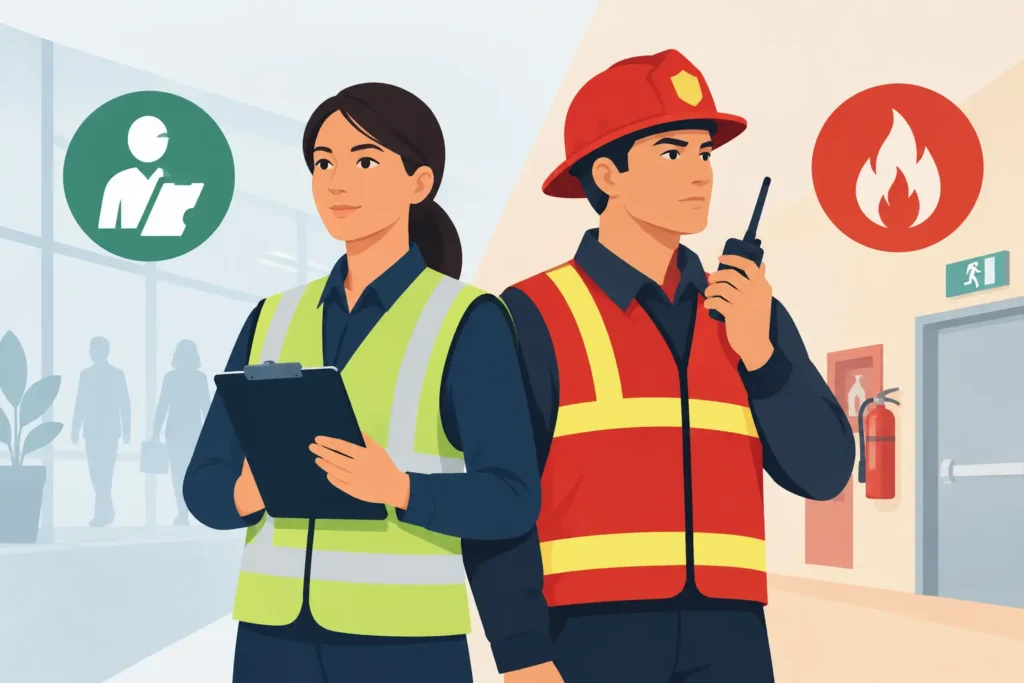
A fire alarm at a busy site creates a short window for disciplined decisions. People need clear instructions, routes must remain usable, visitors need accountability, and management needs to know that someone is coordinating the response. That is why the distinction between fire wardens versus marshals matters. The titles are often used loosely, but the authority, purpose, and expected actions behind them can be very different.
For facilities managers, landlords, site managers, and event operators, the priority is not selecting the most impressive job title. It is assigning competent people, defining their responsibilities in writing, and ensuring that the emergency plan works under pressure.
Fire wardens versus marshals: the practical difference
A fire warden is generally an appointed member of a workplace team who supports the employer’s fire-safety arrangements. Their role is preventive as well as responsive. They may check that escape routes are clear, report blocked fire doors, identify unsafe storage, raise concerns about extinguisher access, and help occupants evacuate when an alarm sounds.
A fire marshal can mean different things depending on the country, organization, or service specification. In many workplaces, it is simply another name for a fire warden. In other settings, particularly in the United States, a fire marshal may be a public official with enforcement or investigative powers. That is not the same as an employee appointed to assist an evacuation.
For a UK-based business operating under a fire-risk-assessment regime, the key issue is competence and documented duty rather than the label. A site may call its trained evacuation personnel fire marshals, fire wardens, floor wardens, or evacuation coordinators. What matters is that every person understands their limits, their assigned area, and the procedure they are expected to follow.
Where a provider offers fire marshal staffing, the service commonly refers to trained on-site personnel who help maintain fire-safety controls and support evacuation arrangements. It does not automatically mean that the individual has statutory enforcement authority.
What a workplace fire warden does
A properly appointed fire warden provides an active layer of protection between formal fire-safety documentation and day-to-day site conditions. Risk assessments can identify controls, but someone still needs to notice when a final exit is obstructed by deliveries, when a fire door is held open, or when a temporary layout has changed an escape route.
During normal operations, a warden’s duties may include routine checks of escape paths and assembly-point information, reporting faults in alarms, emergency lighting, signage, or fire doors, and reinforcing local fire procedures. They can also help brief new starters, contractors, and event staff on the action to take when an alarm is activated.
When an alarm sounds, the warden should follow the site emergency plan. This may involve encouraging people to leave promptly, directing them toward a safe exit, checking assigned areas only where it is safe to do so, and reporting relevant information to the evacuation coordinator or responding emergency services. They should never place themselves at risk to complete a search or attempt to fight a fire.
After evacuation, wardens often help account for staff, visitors, and contractors at the assembly point. This is one of the strongest reasons to appoint enough trained people across shifts, floors, and separate buildings. A single warden cannot reliably manage a multi-story office, warehouse, construction project, or occupied residential property alone.
When a fire marshal role may be broader
The term fire marshal is often used where a role has a stronger coordination, inspection, or dedicated-staffing element. At a construction site, high-risk industrial facility, temporary event, or building with known fire-safety issues, a marshal may be assigned to monitor controls continuously rather than carrying the role alongside another job.
For example, a fire marshal on a construction project may monitor hot works, combustible storage, temporary escape routes, changing access arrangements, and end-of-shift checks. In a large event venue, the role may focus on crowd movement, exit access, communication with security personnel, and rapid escalation of hazards. In a residential setting requiring enhanced precautions, dedicated personnel may conduct patrols and support immediate evacuation action under an agreed procedure.
The trade-off is straightforward. A dedicated marshal provides stronger on-site oversight, but the role must be matched to the actual risk, occupancy pattern, and management plan. Assigning a marshal title without providing defined responsibilities, training, authority to escalate issues, or adequate coverage creates a false sense of control.
Authority has limits
Neither a workplace fire warden nor a contracted fire marshal replaces the fire department, the responsible person, building management, or specialist fire-safety advice. They are part of the control framework, not the entire framework.
Their authority should be practical and explicit. They need permission to stop unsafe practices, report defects, challenge blocked exits, and require occupants to follow an evacuation instruction. Management must support that authority. If a warden reports that materials are repeatedly stored in a stairwell and nothing changes, the appointment has little operational value.
The limits are equally important. Fire wardens should not re-enter a building to search for people, investigate smoke, isolate hazardous systems unless trained and authorized, or delay evacuation to collect personal items. Any instruction to tackle an incipient fire must be based on suitable training, equipment, and a clear assessment that it is safe to do so. Evacuation remains the default priority.
Training should reflect the premises, not a generic checklist
Basic fire warden training can provide a sound foundation, but it must be applied to the building and its users. A warehouse with shift workers, forklifts, high storage, and visiting drivers has different needs from a corporate office. A care setting, apartment building, school, hotel, or live construction site may require specialist procedures, including phased evacuation, personal emergency evacuation plans, or temporary fire measures.
Training should cover alarm response, evacuation routes, assembly arrangements, communication, reporting, and the limitations of the role. It should also explain the site’s specific hazards, such as lithium-ion battery charging, hot works, kitchens, flammable liquids, electrical rooms, or vulnerable occupants.
Competence is not established by issuing a certificate and moving on. Personnel need refresher training, realistic drills, and changes communicated when layouts, occupancy, works, or fire procedures change. Shift patterns matter too. A fully trained daytime team does not protect a site at night, during weekends, or while key people are absent.
Build coverage into the fire plan
The right number of wardens or marshals depends on the premises. There is no useful one-size-fits-all ratio. Management should consider the size and complexity of the building, the number of floors, evacuation strategy, occupancy levels, hours of operation, visitors, lone workers, and the likelihood that appointed people will be unavailable.
Coverage should include deputies and clearly assigned zones. If an organization has multiple tenants, each tenant’s arrangements must work alongside the wider building plan. If the site includes security officers, reception staff, or control-room monitoring, their responsibilities should be coordinated rather than duplicated or left unclear.
Documentation makes that coordination defensible. Keep role descriptions, training records, drill outcomes, inspection findings, defect reports, and evidence that corrective actions were closed out. These records support compliance, but more importantly, they show whether the plan is functioning before an emergency exposes its weaknesses.
Choosing the right approach for your site
If your site has low complexity and stable occupancy, trained employee fire wardens may be the appropriate solution. If operations are high risk, temporary, continuously changing, or inadequately staffed, dedicated fire marshal coverage may offer greater assurance. Some premises need both: internal wardens who know the people and layout, supported by specialist personnel during construction, events, major works, or periods of elevated risk.
Spycon Security Ltd. approaches fire coverage as part of the wider protection picture. Fire-safety staffing, security presence, monitoring, inspections, and documentation should reinforce one another, so hazards are identified early and responsibility remains clear when a decision is questioned.
The most reliable arrangement is the one that people can carry out at 2 a.m., during a busy handover, or when the usual manager is not on site. Give your wardens or marshals clear boundaries, practical training, enough support, and the authority to act. That is how an emergency plan becomes credible protection rather than paperwork.