

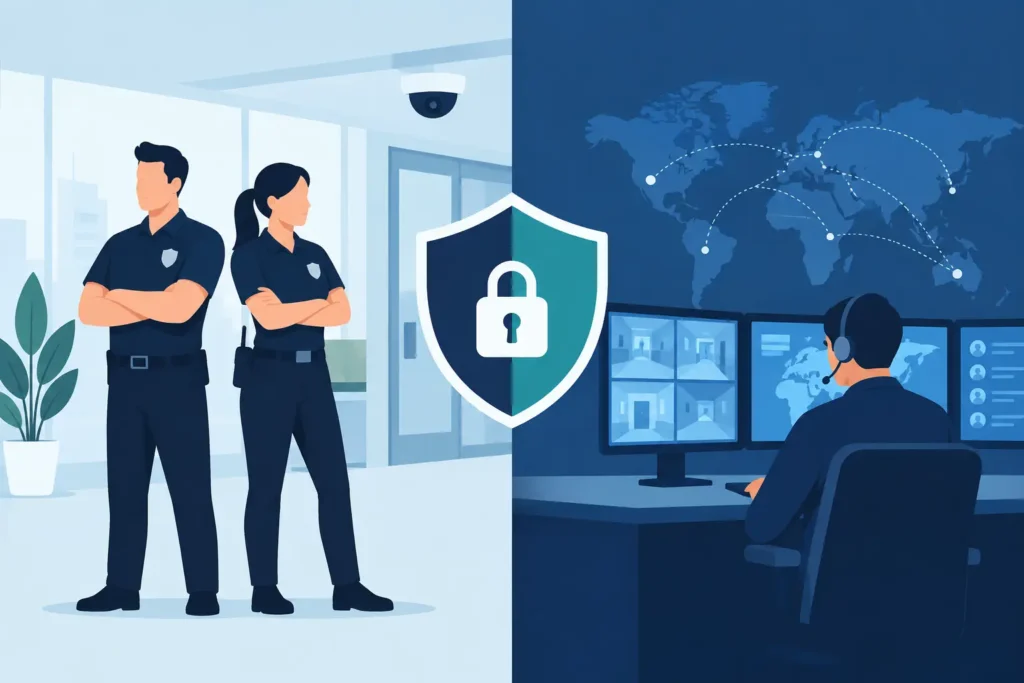
A vacant post at 2:00 a.m., an access-control challenge at a busy reception, or an incident that is not recorded correctly can quickly become more than a staffing problem. It can expose the organization to loss, disruption, liability, and difficult questions from insurers, regulators, tenants, or senior leadership. The decision between in house versus outsourced security should therefore be based on control, capability, and accountability – not simply the hourly cost of a guard.
For some organizations, an internal security team is the right long-term fit. For others, a specialist provider delivers more dependable coverage and clearer compliance evidence. The right answer depends on the site, the risk profile, the hours of operation, and the standard of response required when conditions change.
In House Versus Outsourced Security: What Is Actually Being Decided?
The choice is often described as hiring employees or hiring a security company. In practice, it is a decision about who owns the full security operation.
An in-house model means your organization recruits officers, carries the employment obligations, manages schedules, provides training, supervises performance, and arranges cover for sickness, vacations, and turnover. It can provide direct cultural alignment and close familiarity with the site, particularly where security staff are part of a large, stable operation.
An outsourced model transfers delivery of the guarding function to a specialist provider under an agreed scope of service. The provider supplies trained personnel, operational management, relief coverage, reporting structures, and often access to related services such as mobile patrols, K9 teams, event security, CCTV monitoring, fire marshals, and emergency support.
Neither model removes the client’s duty of care. A property manager, employer, or site operator remains responsible for ensuring that suitable arrangements are in place. The difference is whether the organization builds and controls each component itself or appoints one accountable partner to deliver it.
The Case for an In-House Security Team
An internal team can work well when the site has a consistent, high-volume need for security and the organization has the management capacity to support it. Officers may develop a deep understanding of employee routines, sensitive areas, visitor expectations, and internal culture. For a major corporate campus, a hospital network, or a critical facility with highly specific procedures, that familiarity can be valuable.
Direct employment can also give leadership more immediate control over recruitment decisions, uniforms, post instructions, and day-to-day priorities. When the workforce is stable and security leadership is experienced, internal teams can become an integrated part of operations rather than a separate service.
However, control only produces value when it is actively exercised. An in-house department requires more than officers on a roster. It needs a competent manager, documented procedures, induction and refresher training, vetting, performance reviews, incident escalation, payroll administration, insurance consideration, and reliable relief arrangements. If one experienced supervisor leaves or several officers are absent at once, the apparent control of an internal model can become a coverage risk.
Costs also need to be measured honestly. The wage rate is only one line. Recruitment, benefits, overtime, training, uniforms, equipment, supervisory time, absence cover, and turnover all affect the true cost of an internal operation. A lower visible hourly figure does not necessarily mean lower total cost.
Where Outsourced Security Adds Operational Strength
Outsourced security is often the stronger choice where coverage must be continuous, risks vary, or the organization needs specialist capability without building a full internal department. A qualified provider should be able to scale staffing for construction phases, events, vacant-property periods, seasonal peaks, tenant moves, and elevated threat conditions.
The principal advantage is managed continuity. If a scheduled officer becomes unavailable, the provider is responsible for finding suitable cover. If an incident occurs, the provider should have an escalation structure, supervisory support, and reporting process ready to operate. This matters on sites that cannot accept a missed shift, an unlocked gate, or an unmonitored alarm.
Outsourcing can also bring stronger operational depth. A single partner may coordinate manned guarding with 24/7 CCTV monitoring, access-control procedures, canine patrols, and fire-safety support. Instead of separate suppliers working from separate assumptions, the client has an opportunity to align site instructions, reporting, emergency response, and compliance records.
That said, outsourced security is not automatically effective. A poorly defined contract can lead to unclear duties, inconsistent officers, and reports that do not answer the questions a client needs to evidence control. The provider must be assessed on management quality, vetting, training, supervision, response capability, and documented performance – not just price.
Compare Accountability, Not Just Staffing Cost
When evaluating in-house versus outsourced security, decision-makers should test both models against the incidents that would cause the greatest harm. Consider unauthorized access, theft, aggression toward staff, a fire alarm activation, equipment failure, a missing key, a vulnerable resident, or a contractor working outside approved hours.
Ask who is responsible for each stage: prevention, immediate response, escalation, investigation, reporting, and corrective action. If the answer relies on an informal arrangement or the availability of one individual, the arrangement may not hold up under scrutiny.
An outsourced provider should make accountability visible through clear post orders, assignment instructions, supervisor checks, incident reports, shift handovers, and agreed service levels. In-house teams need the same discipline. Documentation is not an administrative extra; it is evidence that the organization identified risk, gave staff appropriate instructions, and monitored whether controls were working.
For many facilities and property teams, a combined security and fire-safety provider reduces the chance of gaps between physical protection and life-safety responsibilities. Security officers may be the first people to identify blocked escape routes, damaged fire doors, unsafe contractor behavior, or alarm-related issues. Defined procedures ensure those observations become recorded actions rather than forgotten concerns.
Questions That Reveal the Right Model
Before selecting either approach, establish what the site genuinely needs. The following questions tend to reveal whether internal management can support the requirement or whether a specialist partner is the more dependable option:
- Is coverage needed around the clock, across multiple locations, or at short notice?
- Can the organization recruit, vet, train, supervise, and replace suitable officers without weakening operations?
- Are there specialist needs such as CCTV monitoring, event security, K9 deployment, fire marshals, or vacant-property protection?
- What compliance records, incident reports, and inspection evidence must be available?
- How quickly must the operation adapt to construction changes, tenant demands, threats, or emergency conditions?
- Who takes responsibility when a shift is uncovered or a procedure fails?
A site with predictable daytime access control and a capable internal facilities department may reasonably retain its own team. A multi-occupancy building, construction project, public-facing venue, logistics operation, or high-risk property will often benefit from the operational bench strength of outsourced provision.
A Hybrid Model Can Be the Practical Answer
The decision does not have to be absolute. Some organizations retain a small internal security function to manage policy, stakeholder relationships, and sensitive access decisions while outsourcing frontline coverage, nighttime shifts, technical monitoring, or surge requirements.
This approach can preserve internal knowledge while removing the burden of maintaining a large relief pool and specialist infrastructure. It is particularly useful when a site’s risk profile changes throughout the year. The key is to avoid blurred ownership. The internal lead and external provider should agree on authority, escalation paths, reporting standards, and how performance will be reviewed.
Choose the Model That Holds Up Under Pressure
Security arrangements are judged most severely after something has gone wrong. At that point, decision-makers need to show that coverage was planned, personnel were suitable, risks were understood, and incidents were handled with control.
Choose the model that gives your organization dependable people, documented procedures, continuous coverage, and a clear line of responsibility. The strongest arrangement is not the one that appears cheapest on paper. It is the one that continues protecting people, property, and compliance when the site is under pressure.