


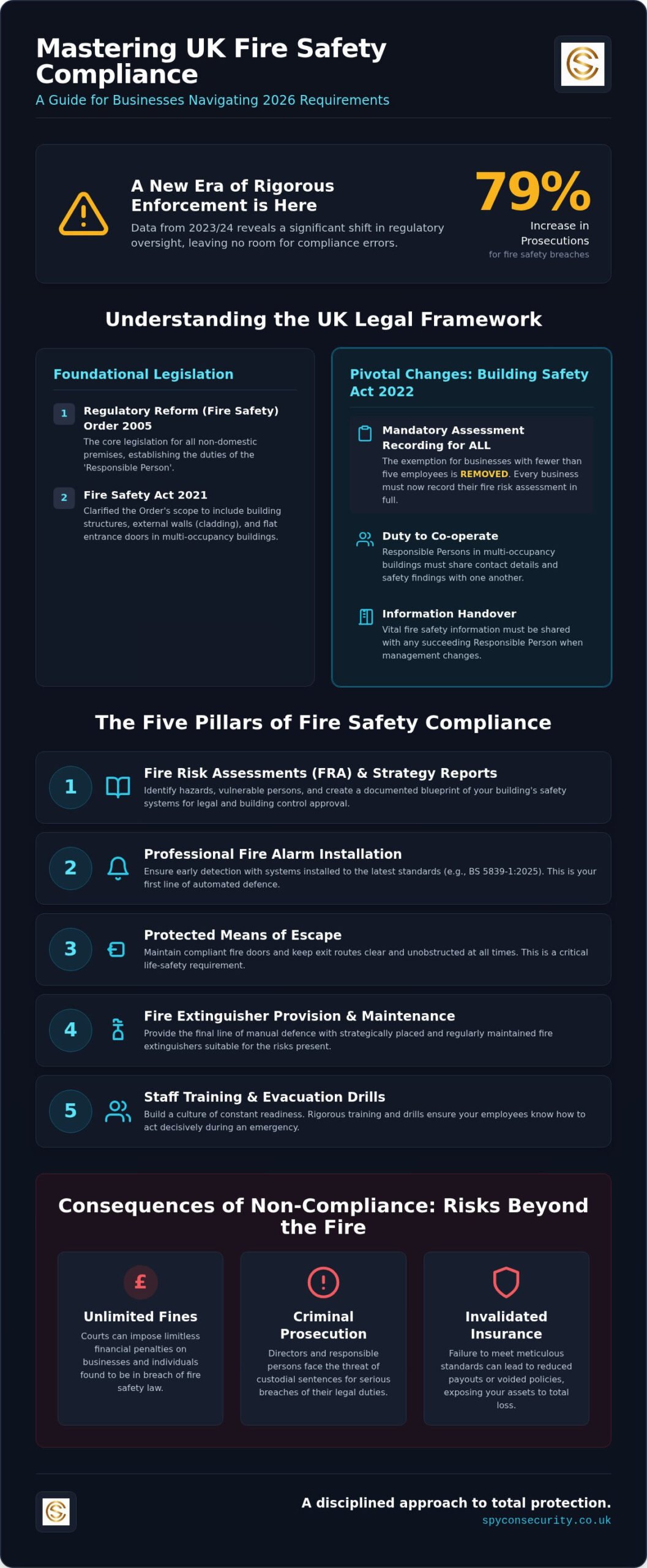
Prosecutions for fire safety breaches rose by 79% in the 2023/24 period. This data reflects a rigorous new era of enforcement that leaves no room for error. You likely find the interplay between the Fire Safety Order and the Building Safety Act 2022 complex and difficult to manage. The risk of unlimited fines or custodial sentences for non-compliance is a legitimate concern for any responsible person.
This guide ensures you master fire safety compliance for businesses UK to protect your assets and your people. We provide a clear roadmap to achieving full legal standing and reducing insurance premiums through meticulous standards. We will detail the 2026 requirements for Fire Risk Assessments, the latest BS 5839-1:2025 standards for alarm installations, and the necessity of professional fire door surveys. Expect a disciplined approach to total protection.
Key Takeaways
- Navigate the complexities of the Regulatory Reform (Fire Safety) Order 2005 and the Fire Safety Act 2021 to ensure your legal framework is current.
- Secure your premises by mastering fire safety compliance for businesses UK through mandatory Fire Risk Assessments and professional hardware installation.
- Identify the critical risks of non-compliance, including the threat of unlimited fines and criminal prosecution for business directors.
- Implement a disciplined maintenance programme for fire doors and alarm systems to guarantee constant readiness and protection.
- Leverage an integrated safety strategy that combines professional consultancy with the deployment of SIA-licensed Fire Marshals.
Understanding the UK Fire Safety Legal Framework in 2026
The UK legal landscape for fire safety is currently at its most stringent. The Regulatory Reform (Fire Safety) Order 2005 serves as the foundational pillar for all non-domestic premises. Since its inception, the Order has been strengthened by successive legislation to close safety gaps. The Fire Safety Act 2021 was a pivotal update. It clarified that for buildings containing two or more sets of domestic premises, the Order applies to the building’s structure, external walls, and flat entrance doors. This ensures that cladding and balconies are subject to rigorous inspection during the assessment process. Compliance is a legal mandate. It’s not a suggestion.
The Role of the Responsible Person
Identifying the Responsible Person (RP) is the first step toward legal adherence. The RP is the individual or entity that carries the legal weight of fire safety compliance for businesses UK. Under the FSO, their primary duty is to ensure the safety of employees and ‘relevant persons’ by mitigating fire risks. This isn’t a passive role. It requires active oversight of fire risk assessments and the maintenance of fire-fighting equipment. In multi-occupancy buildings, the Responsible Person is legally accountable for the fire safety of common parts and the structural integrity of flat entrance doors. If you’re a tenant or an employer in a shared block, your duties overlap with those of the landlord, requiring a unified approach to protection.
Significant Changes in the Building Safety Act 2022
The Building Safety Act 2022 introduced Section 156 to drive higher standards of accountability. One of the most significant changes for 2026 is the removal of the employee threshold for recording assessments. Previously, businesses with fewer than five employees were exempt from recording their fire risk assessments. This exemption no longer exists. Every business, regardless of size, must now record their fire risk assessment in its entirety. This creates a transparent audit trail for fire and rescue services.
There are also new obligations for co-operation. Multiple RPs in a single building must share their contact information and safety findings with one another. If you’re seeking Fire Risk Assessment Services in London, you must ensure your provider understands these granular documentation requirements. The Act also requires RPs to share all relevant fire safety information with any succeeding Responsible Person. This ensures that vital safety data isn’t lost when building management changes hands. Precision in record-keeping is now a statutory requirement.
The Five Pillars of Fire Safety Compliance for Businesses
Achieving total fire safety compliance for businesses UK requires a structured and disciplined approach. It isn’t enough to simply install equipment; you must integrate five distinct pillars of protection into your daily operations. These pillars ensure that your site remains defensible against both fire incidents and legal scrutiny. Start with a mandatory Fire Risk Assessment (FRA). This document identifies hazards and vulnerable persons. Follow this with professional fire alarm installation to ensure early detection. Your means of escape must be protected by compliant fire doors and clear exit routes that remain unobstructed at all times. Strategic placement and regular maintenance of fire extinguishers provide the final line of manual defence. Finally, rigorous staff training and evacuation drills build a culture of constant readiness amongst your employees.
Fire Risk Assessments and Strategy Reports
A generic assessment often fails to address the unique structural risks of complex commercial sites. For building control approval, a comprehensive Fire Strategy Report is frequently necessary. This report provides a detailed blueprint of how the building’s design and safety systems work in unison. It goes beyond a standard FRA by detailing fire spread prevention and smoke ventilation requirements. For a deeper dive into these requirements, consult The Definitive Guide to Fire Risk Assessments. Aligning your strategy with official UK government guidance ensures that your documentation stands up to inspection. Securing your premises starts with verified hardware; consider how a professional fire alarm installation can provide the early warning your staff needs.
Fire Door Compliance and Maintenance
Fire doors are critical life-safety assets. They are not merely standard doors with different labels. Statutory requirements mandate regular fire door surveys in commercial premises to verify their integrity. A certified fire door installation includes intumescent seals, fire-rated hinges, and self-closing devices that must function perfectly under pressure. Neglecting these surveys is a common failure in workplace safety audits. Our Office Fire Door Regulations: 2026 UK Compliance Guide explains these nuances in detail. Ensuring your hardware meets the BS 8214 standard is vital for maintaining a safe environment. Every door must be inspected for gaps, damage, and effective closure to remain legally compliant. Precision in these surveys prevents minor faults from becoming catastrophic failures during a fire event.
Consequences of Non-Compliance: Risks Beyond the Fire
The legal penalties for failing to maintain fire safety compliance for businesses UK are severe and uncompromising. Courts now routinely issue unlimited fines for major breaches of the Regulatory Reform (Fire Safety) Order 2005. For directors, the stakes are even higher. Professional negligence can lead to custodial sentences of up to two years. These aren’t theoretical risks. In the 2023/24 period, prosecutions for fire safety breaches rose by 79%. This surge in enforcement signals a zero-tolerance approach from authorities.
Beyond the courtroom, non-compliance threatens your financial stability through insurance invalidation. Most commercial policies require a valid Fire Risk Assessment (FRA) as a condition of coverage. If a fire occurs and you lack a documented assessment, your insurer may reject the claim entirely. This leaves your business liable for the full cost of damages. The average cost of a major workplace fire is £657,074. Such a loss is often terminal for an organisation. Precision in compliance is your only true safeguard against financial ruin.
The Cost of Negligence
Negligence often stems from minor oversights that carry heavy consequences. Recent enforcement actions across the UK highlight businesses fined heavily for blocked fire exits or faulty alarm systems. These incidents cause long-term damage to brand reputation and erode client trust. Maintaining a high standard of fire safety compliance directly reduces your annual insurance premiums by demonstrating a lower risk profile to underwriters. Failure to act doesn’t just risk lives; it risks the entire future of your business. A single lapse in oversight can erase years of hard-earned professional standing.
Enforcement and Prosecution
The Fire and Rescue Service acts as the primary enforcement body. They conduct unannounced fire safety audits to verify that premises are safe. In the 2024/25 period, 42% of fire safety audits identified failings. During an inspection, officers examine your FRA, maintenance logs, and physical hardware. If they identify failings, they may issue an Enforcement Notice, requiring repairs within a specific timeframe. They expect to see evidence of rigorous, ongoing verification of all safety systems.
For critical hazards, a Prohibition Notice is issued. This can immediately shut down all or part of your premises until the risk is rectified. This brings daily operations to a standstill, causing immediate revenue loss and operational chaos. For more information on your specific duties, consult the UK Government Fire Safety Guidance for Businesses. Adherence to these standards is the only way to ensure your business remains operational, protected, and beyond the reach of the courts.
Implementing a Robust Fire Safety Maintenance Programme
Fire safety is not a static state. It is a continuous operational discipline. Maintaining fire safety compliance for businesses UK requires a rigorous maintenance programme that functions with military precision. This programme serves as your primary defence against system failure and legal liability. Your Fire Safety Logbook is the central repository for this evidence. It must be kept up to date and remain on-site. It is the first document an inspector will request during an audit. If it’s missing or incomplete, your compliance is void.
A disciplined schedule ensures no component of your safety infrastructure is neglected. Follow these intervals for maximum protection:
- Weekly: Test fire alarms from different call points. Check that all fire exits are clear and functional. Verify that all fire doors are unobstructed.
- Monthly: Inspect fire extinguishers for pressure and placement. Test emergency lighting systems to ensure they activate upon power failure. Conduct a visual check of all fire doors for wear and tear.
- Annual: Engage a professional for a full system service. This includes alarm calibration, extinguisher maintenance, and fire door surveys.
Alarm and Detection Maintenance
Fire detection systems are your early warning line. Weekly testing protocols ensure that every zone of your fire alarm system functions correctly. You must rotate the call points used for testing to verify the entire circuit. Whilst internal checks are vital, they do not replace annual professional inspections. A certified technician must verify system integrity and issue a certificate of compliance. For expert support, consider our Fire Alarm Installation and Maintenance services. Precision in detection saves lives.
Staff Readiness and Fire Drills
Hardware is only effective if your people know how to use it. Statutory requirements dictate that all employees receive regular fire safety training. This training must cover evacuation procedures and the correct use of fire-fighting equipment. Organising effective fire drills that simulate real-world scenarios is essential for building muscle memory. You should conduct these drills at least twice a year. Record the results and any identified weaknesses in your logbook immediately. Our Fire Safety Training and Drill Services ensure your team is prepared for any emergency. A trained workforce is a resilient workforce.
Ensure your systems remain fully operational and legally defensible by scheduling a professional alarm service today.
Integrated Safety: How Spycon Security Ltd. Protects Your Business
Spycon Security Ltd. provides a unified response to the rigorous demands of fire safety compliance for businesses UK. We bridge the critical gap between technical consultancy and physical protection. Whilst many providers offer either assessments or hardware, we deliver a cohesive, end-to-end solution. This model ensures that the directives in your Fire Strategy Reports translate directly into professional alarm installation and manned protection. We operate with nationwide expertise, maintaining a strong presence across London, Birmingham, and Manchester. Our clients benefit from a single point of contact for all fire safety requirements. This reduces administrative burden and ensures no safety gap remains unaddressed.
Professional Fire Marshal and Walking Watch Services
A Walking Watch is legally required when a building’s fire safety systems are compromised. This is frequently the case for buildings with cladding defects or significant structural fire-stopping issues. In these high-stakes environments, the standard ‘stay put’ policy is often suspended in favour of a simultaneous evacuation strategy. Spycon provides SIA-licensed personnel to perform these critical duties with unwavering reliability. Our Walking Watch and Fire Marshal Services provide 24/7 vigilant oversight. These marshals are not passive observers. They are trained to identify potential ignition sources and manage complex evacuation procedures with absolute precision. By combining manned guarding with fire marshal duties, we create a dual layer of security and safety. This integrated approach is essential for high-risk residential and commercial premises.
Bespoke Fire Strategy and Consultancy
Generic safety plans often fail to account for the operational realities of unique business environments. A high-traffic retail centre requires a completely different evacuation logic than a high-bay warehouse or a multi-storey office block. We tailor every fire policy to the specific risks and layout of your site. This ensures that every hardware installation, from fire door surveys to alarm systems, meets the exact requirements of your Fire Risk Assessment. We eliminate the friction of managing multiple contractors for assessment, installation, and monitoring. This integrated approach guarantees that your business remains fully compliant, protected, and operational. Our commitment to professional integrity means we never take shortcuts with your safety. We act as your watchful guardian in an increasingly complex regulatory world.
Contact Spycon Security for a Comprehensive Fire Safety Audit to secure your premises and ensure total peace of mind.
Securing Your Operational Future
The 2026 regulatory landscape demands a higher standard of accountability and professional precision. Maintaining fire safety compliance for businesses UK is no longer a matter of simple annual checks; it requires a continuous cycle of rigorous assessment and proactive maintenance. You must ensure your documentation is meticulous and your hardware is certified to the latest British Standards. By integrating professional risk assessments with disciplined maintenance schedules, you protect both your personnel and your long-term commercial viability. Neglect is a risk you cannot afford to take.
Spycon Security Ltd. acts as your watchful guardian, providing a seamless bridge between strategic consultancy and physical protection. We offer expert Fire Safety Consultancy alongside the provision of SIA Licensed Personnel and comprehensive fire hardware installation. Our nationwide team ensures your site remains defensible against both fire incidents and legal scrutiny. We operate with a commitment to excellence that allows for no shortcuts. Precision in safety is the only path to genuine peace of mind and operational security.
Secure your business with a professional Fire Risk Assessment from Spycon Security Ltd. and ensure your organisation remains fully compliant and protected.
Frequently Asked Questions
What is the main fire safety legislation for UK businesses?
The primary legislation is the Regulatory Reform (Fire Safety) Order 2005. This framework applies to all non-domestic premises in England and Wales. It has been significantly bolstered by the Fire Safety Act 2021 and the Building Safety Act 2022. These updates ensure that external walls and flat entrance doors are included in safety assessments. Adhering to these statutes is the only way to guarantee fire safety compliance for businesses UK.
Who is responsible for fire safety in a commercial building?
Responsibility lies with the ‘Responsible Person’ (RP). In a workplace, this is typically the employer. For buildings with multiple tenants, the owner or managing agent also carries duties for common parts. If you have control over a premises, you are legally accountable for the safety of everyone on-site. This includes employees, visitors, and contractors. Failure to identify the RP can lead to significant legal gaps during an inspection.
How often must a business conduct a fire risk assessment?
The law requires you to review your Fire Risk Assessment regularly to ensure it remains valid. Whilst there is no fixed statutory interval, industry standards dictate an annual review for most commercial premises. You must conduct a new assessment immediately if there are significant changes to the building layout, occupancy type, or fire safety systems. Meticulous record-keeping of these reviews is essential for demonstrating ongoing legal compliance.
Are fire door surveys a legal requirement for my office?
Yes, regular fire door surveys are a statutory requirement under the Fire Safety Order. You must ensure that all fire doors are capable of performing their intended function during a fire. This requires periodic inspections of hinges, seals, and self-closing devices. Neglecting these surveys is a common point of failure in fire safety audits. Professional surveys provide the documented evidence required to prove that your hardware meets the necessary safety standards.
What are the penalties for non-compliance with fire safety regulations?
Penalties for non-compliance are severe and strictly enforced. Minor breaches can result in fines of up to £5,000 per instance. Major negligence can lead to unlimited fines and custodial sentences of up to two years for directors. Fire and rescue services also have the power to issue Prohibition Notices. These notices can immediately close your premises until you rectify the identified hazards, causing total operational and financial disruption.
Can I do my own fire risk assessment for my business?
You can legally conduct your own assessment if you are competent. This means you must have the necessary training, knowledge, and experience to identify fire risks accurately. For small, low-risk environments, a self-assessment may suffice. However, complex commercial buildings or high-rise structures typically require a professional assessor. Most business owners choose professional services to ensure they achieve total fire safety compliance for businesses UK without risking legal oversights.
What is a Fire Strategy Report and do I need one?
A Fire Strategy Report is a comprehensive technical document that outlines how a building’s fire safety systems work together. It is typically required for new developments, major refurbishments, or complex multi-use sites to secure building control approval. This report goes beyond a standard risk assessment by detailing structural fire protection and smoke ventilation designs. It provides a permanent blueprint for the building’s safety infrastructure that must be maintained throughout its lifespan.
What is a ‘Responsible Person’ in the context of fire safety?
The ‘Responsible Person’ is a specific legal designation defined in the Fire Safety Order. This individual or entity has the ultimate duty to take general fire precautions to ensure the safety of the premises. Their obligations include conducting fire risk assessments, maintaining safety equipment, and providing staff training. In complex organisations, several RPs may exist. They are legally required to co-operate and co-ordinate their safety efforts to ensure the entire building remains protected.