


An office fire door is not merely a piece of joinery. It’s an active life-safety system that requires the same rigorous oversight as your security personnel. Many facility managers feel unsettled by the 2022 regulatory updates and the weight of personal legal liability. Mastering office fire door regulations UK is the only way to ensure your workplace remains safe, compliant, and fully insured. This guide provides the technical clarity needed to manage these complexities with absolute precision. We don’t believe in shortcuts when lives and livelihoods are at stake.
You’ll gain a clear understanding of the performance differences between FD30 and FD60 ratings. We’ll also provide a structured checklist for your internal inspections and identify the exact indicators that signal a professional surveyor must intervene to maintain your safety protocols. Vigilance is your best defence against failure. By the end of this guide, you’ll have the knowledge required to verify every fire door in your building with confidence and professional integrity.
Key Takeaways
- Navigate the latest updates to office fire door regulations UK to mitigate legal liability and ensure your workplace adheres to the Regulatory Reform (Fire Safety) Order.
- Decipher technical specifications including FD30S and FD60S ratings to ensure every door provides the requisite level of fire and smoke containment.
- Implement a rigorous six-monthly inspection schedule using the 5-Point Check framework to maintain operational readiness and insurance compliance.
- Define the critical role of the ‘Responsible Person’ and establish a ‘Golden Thread’ of safety records to satisfy building control and audit requirements.
- Understand the necessity of professional installation and when to prioritise remedial repairs over full replacement to maintain the integrity of your fire strategy.
Understanding Office Fire Door Regulations in the UK (2026 Update)
Compliance is the foundation of workplace safety. The framework governing office fire door regulations UK ensures that every commercial building operates as a protected environment. The Regulatory Reform (Fire Safety) Order 2005 (RRO) remains the primary legislation. It mandates that the “Responsible Person” maintains fire doors to a functional standard. However, the legislative landscape has evolved with the Fire Safety Act 2021 and the 2022 Regulations. These updates closed previous loopholes regarding door maintenance and inspection frequency.
2026 represents a pivotal deadline for UKCA marking compliance. This transition from the old CE marking system requires meticulous verification of door certification. A fire door is legally defined as a “fire door set.” This distinction is critical. A door set includes the leaf, frame, hinges, and ironmongery. Replacing a single hinge with a non-certified alternative invalidates the entire system. Professional fire strategy reports are essential to document these configurations for building control approval.
The Fire Safety Order 2005 and Your Office
The RRO applies to all non-domestic premises. This includes shared office spaces and commercial hubs. It distinguishes between doors used for internal compartmentation and those on escape routes. Compartmentation doors prevent fire from spreading between zones. Escape doors ensure staff can exit the building safely. Failure to maintain these systems leads to severe legal penalties. Prosecution can result in unlimited fines or custodial sentences for those found negligent in their duties.
Recent Legislative Changes: What Office Managers Must Know
The Fire Safety (England) Regulations 2022 introduced rigorous standards for high-rise offices. Managers must now share clear safety information with all building occupants. This includes instructions on how to report a faulty door immediately. Regulation 38 information is also vital. This regulation requires the handover of fire safety information when a building is constructed or extended. Without this “Golden Thread” of data, maintaining fire door integrity becomes nearly impossible. You must ensure your fire risk assessment accounts for these recent statutory shifts to remain fully insured.
Technical Specifications: What Makes an Office Door ‘Fire Rated’?
Identifying a compliant fire door requires more than a visual inspection of the timber. Under office fire door regulations UK, a door is only as effective as its specific certification. You must look for mandatory identification markings. These are typically found on the top edge of the door leaf. They take the form of a colour-coded plastic ‘plug’ or a permanent label. Since the UK’s departure from the EU, the transition from CE to UKCA markings is critical. By 2026, all new installations must bear the UKCA mark to prove they meet British testing standards. If your office doors lack these identifiers, their fire-resisting capabilities are unverified and potentially void for insurance purposes.
The door leaf is merely one part of a certified fire door set. The frame, hinges, and ironmongery must all be tested together. Using a standard door frame with a fire-rated leaf is a common compliance failure. Every component must work in unison to maintain the fire barrier. If you are unsure of your current door specifications, conducting professional fire risk assessments is the most reliable way to verify your building’s technical compliance. Precision in these details is the difference between safety and catastrophe.
FD30 vs FD60: Choosing the Right Protection
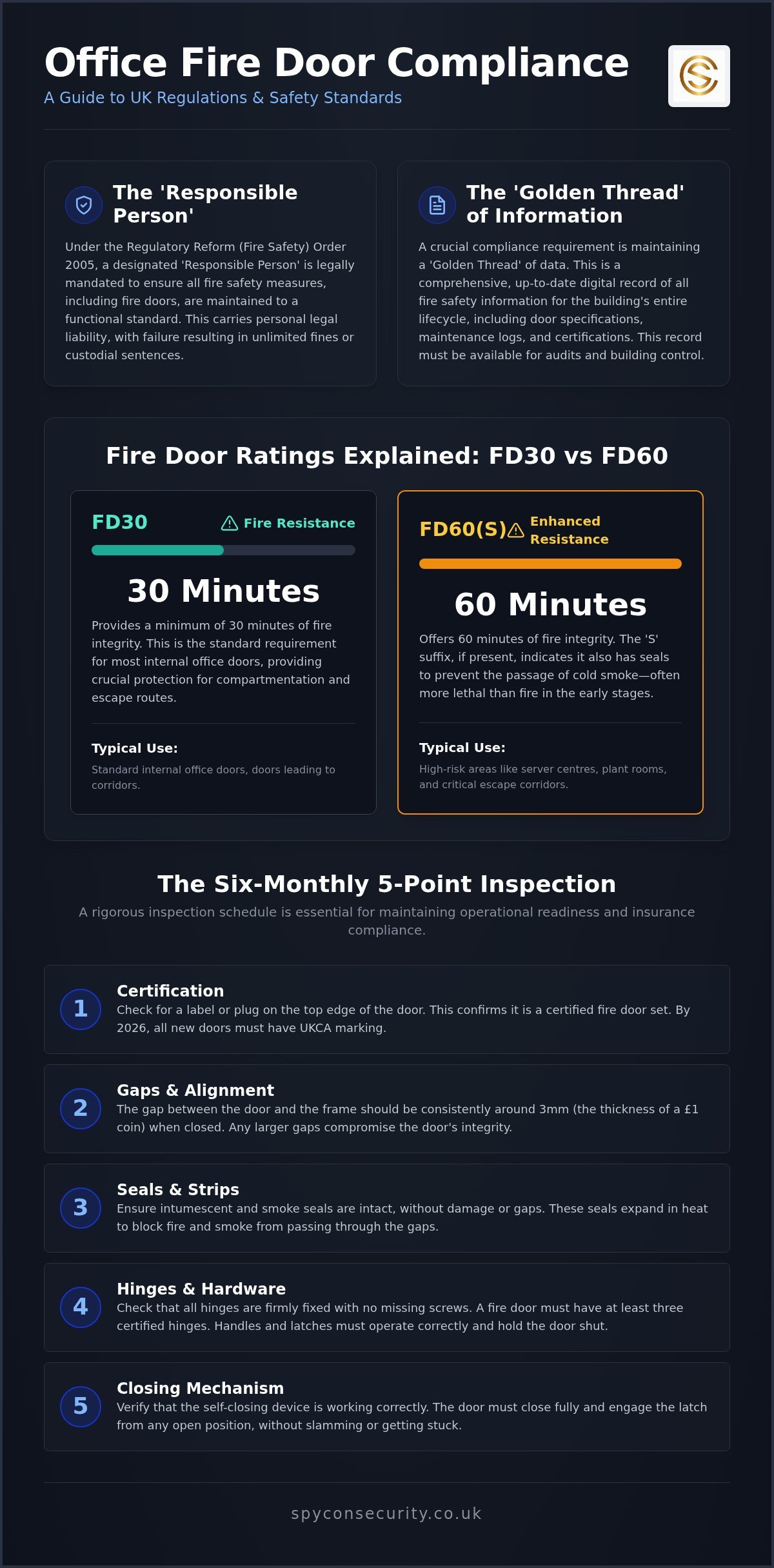
Your Fire Risk Assessment determines the level of resistance required for each opening. FD30 provides 30 minutes of fire resistance whilst maintaining integrity. This is the standard requirement for most internal office doors. High-risk areas, such as plant rooms or server centres, often require FD60S protection. The ‘S’ suffix indicates the presence of smoke seals. In office corridors, smoke is often more lethal than heat. Cold smoke seals are non-negotiable for protecting escape routes; they ensure toxic fumes cannot bypass the door before the intumescent strips activate.
Essential Components of a Compliant Door Set
Self-closing devices are the most frequent point of failure in office environments. A fire door that does not close fully into its rebate is useless. You must also verify that hinges are fire-rated and properly fitted. Three hinges are the industry standard to prevent the leaf from warping under intense heat. If your doors feature vision panels, the glass must be fire-resistant. Standard wired glass is often insufficient. Look for the etched marking on the corner of the glazing to confirm it meets BS EN 1363-1 standards. Meticulousness in component selection is essential for legal and physical protection. Understanding the full scope of professional fire door installation requirements, including the transition from BS 476-22 to EN 1634-1 standards, ensures every component you select contributes to a fully certified door set.
The Fire Door Inspection Process: Essential Surveys and Standards
Adherence to office fire door regulations UK requires more than occasional attention. Six-monthly inspections are the industry gold standard for commercial environments. This frequency ensures that wear and tear from high-traffic office use does not compromise the door’s integrity. While monthly checks are recommended for high-use doors, a formal inspection every six months is a legal necessity for the Responsible Person. Professional fire door surveys provide the documented evidence needed to satisfy insurance providers that your building remains a protected environment.
Precision is paramount during any assessment. The gap between the door leaf and the frame must consistently measure between 3mm and 4mm. If the gap is too wide, smoke and flames will bypass the seals before they have time to expand. If it’s too narrow, the door may fail to close or latch properly. This margin of error is slim. It requires a disciplined approach to maintenance. Documenting these measurements is a vital component of your fire risk assessment, ensuring that every entry point is verified against national safety standards.
How to Conduct a Preliminary 5-Point Check
Office managers can perform basic checks between professional surveys to maintain a state of constant readiness. First, verify certification by locating the label or colour-coded plug on the leaf. Second, check the gaps. A £1 coin is approximately 3mm thick; it serves as a useful rough guide for the top and sides. Third, inspect the seals. Intumescent and smoke seals must be continuous and free from damage or layers of paint. Fourth, examine the hinges. Ensure all screws are tight and there is no visible “black soot,” which indicates metal-on-metal wear. Finally, test the closing mechanism. The door must latch firmly from any angle without human assistance.
Common Faults Found During Office Surveys
Surveys often reveal systemic failures rooted in daily office habits. Propping doors open for convenience is a primary breach. It renders the fire barrier useless and places occupants at immediate risk. Damaged self-closing devices also feature heavily in non-compliance reports. If a door fails to latch from a small opening of 75mm, it is non-compliant. Another frequent issue is the use of incorrect hardware. Replacing a fire-rated lock with a standard office version during a refurbishment is a dangerous shortcut. Only fire-tested ironmongery maintains the safety of the door set. Vigilance in these details prevents minor faults from becoming fatal liabilities.
Legal Obligations for Office Managers and the ‘Responsible Person’
Under the Regulatory Reform (Fire Safety) Order 2005, every commercial premises must have a designated ‘Responsible Person’ (RP). In most corporate environments, this is the employer, the building owner, or the facility manager. The RP carries the ultimate burden of ensuring office fire door regulations UK are met with absolute precision. This is not a passive duty. It requires active, documented oversight of every fire door within the building’s footprint. Vigilance is the only way to maintain a safe and lawful workplace.
Legal liability is severe. If a fire door fails to perform during an incident because of poor maintenance or non-compliant hardware, the RP faces personal prosecution. The courts don’t accept ignorance of a door’s condition as a valid defence. To mitigate this risk, you must align your physical assets with professional Fire Strategy Reports. These documents map your compliance requirements and provide a definitive blueprint for your safety protocols. Precision in record-keeping is your primary protection against legal exposure. For London-based businesses, a thorough office fire risk assessment London specialists recommend is equally essential to identify site-specific hazards and satisfy the latest 2026 regulatory standards.
Shared Responsibility in Multi-Tenanted Buildings
Shared office spaces create complex layers of accountability. You must liaise with landlords to determine who is responsible for communal fire doors in lobbies and stairwells. Typically, your responsibility begins at the threshold of your leased space. However, the Fire Safety Order mandates co-operation and co-ordination between all parties. You can’t ignore a faulty corridor door simply because it sits outside your immediate office boundary. You’re legally required to report it and verify its repair to ensure the entire building’s compartmentation remains intact.
Record Keeping and Compliance Documentation
Maintaining a ‘Golden Thread’ of information is now a standard expectation for UK safety audits. This involves keeping a comprehensive fire door register that details the location, certification, and inspection history of every unit. By 2026, digital logs have become the benchmark for professional record-keeping. These logs should document every remedial work and maintenance schedule with meticulous detail. If you need to formalise your safety documentation, you should obtain a comprehensive fire strategy report to ensure your records are approved for building control and insurance audits.
Implementing a Fire Door Strategy: Installation and Maintenance
A comprehensive fire safety strategy extends beyond the physical door leaf. Under office fire door regulations UK, the installation phase is a critical point of failure. Professional fire door installation is vital because even a minor misalignment during fitting can void the manufacturer’s certification. A fire door is a precision-engineered safety device. It must be integrated seamlessly with your wider safety infrastructure, including fire alarm systems and electromagnetic hold-open devices. These components ensure that doors remain open for daily convenience but close instantly upon alarm activation.
Operational continuity requires a backup plan. During major remedial works or when a door is temporarily out of service, the risk level increases. This is where Walking Watch and Fire Marshals play a vital role. They provide a human safety net. They ensure escape routes remain clear and hazards are identified whilst the physical compartmentation is compromised. A proactive strategy prioritises this multi-layered approach to protection. It ensures no gap exists in your building’s vigilant defence.
Choosing a Professional Installation Partner
Expertise is non-negotiable. You must look for third-party accreditation such as BM TRADA or FIRAS when selecting an installer. Non-specialist joiners often lack the training to handle fire-rated materials with the required precision. Upon completion, your partner must provide a Certificate of Compliance. This document is your primary evidence for building control and insurance providers. It confirms the installation meets the rigorous standards of the original fire test. It’s your guarantee of professional integrity.
Ongoing Maintenance and Remedial Strategies
Maintenance prevents catastrophic failure. Scheduling routine checks allows you to address minor issues before they necessitate a full replacement. Common remedial tasks include replacing damaged smoke seals, adjusting self-closing speeds, and re-hanging dropped leaves. A door can often be repaired if the core remains intact and the ironmongery is replaced with like-for-like certified parts. However, if the door leaf is warped or the fire-rated glass is cracked, engaging a professional fire door replacement service is the only compliant option to ensure the new installation meets the latest BS 8214:2026 standards. A proactive maintenance culture reduces long-term commercial insurance premiums and reinforces your commitment to absolute safety.
Secure Your Compliance with Professional Oversight
Maintaining a compliant workplace requires constant, unyielding vigilance. The transition to UKCA marking and the mandatory requirement for a digital ‘Golden Thread’ of safety records have fundamentally changed how you must manage office fire door regulations UK. You’ve identified the technical requirements of FD30 systems and the substantial legal weight carried by the Responsible Person. Now, you must translate this knowledge into a disciplined maintenance regime that satisfies both building control and your insurance providers with absolute certainty.
Preliminary DIY checks are a vital starting point, but they cannot replace the technical rigour of a certified inspection. We provide expert Fire Door Surveys in London and Birmingham to ensure every component of your door set meets the highest safety standards. Our specialists deliver fully compliant fire strategy reports and professional installation to bridge the gap between regulatory theory and absolute protection. Book a Professional Fire Door Survey with Spycon Security Today to secure your premises and your peace of mind. Your commitment to professional excellence today ensures a safer, fully compliant tomorrow for every occupant.
Frequently Asked Questions
Do all office doors need to be fire doors in the UK?
Not every door in a commercial building is required to be fire-rated. Only those identified in your Fire Risk Assessment as part of a fire-resisting compartment or a protected escape route must meet these standards. Standard doors between individual offices often don’t require ratings unless they lead directly into a protected corridor. Precision in identifying these doors is essential to avoid unnecessary costs whilst maintaining absolute safety.
How often must fire doors be inspected in a commercial office?
Professional guidelines recommend that fire doors in commercial offices undergo a full inspection every six months. This frequency is considered the industry gold standard for ensuring continued reliability. High-traffic areas might require more frequent monthly visual checks to monitor for damage. Adhering to this schedule is a critical part of managing office fire door regulations UK and fulfilling your legal obligations as a Responsible Person.
What is the difference between an FD30 and an FD60 fire door?
The numerical suffix indicates the minimum number of minutes the door can withstand a fire test. An FD30 door provides 30 minutes of resistance, whilst an FD60 door provides a full hour. FD60 doors are typically thicker and used in higher-risk areas like server rooms or basements. Your building’s fire strategy report defines which rating is required for each specific location to ensure maximum protection and technical compliance.
Can I legally wedge a fire door open if I use a Dorgard device?
You can’t legally wedge a fire door open with a physical object like a chair or a wooden block. However, you can use certified hold-open devices like Dorgard. These units are battery-operated and release the door when they hear the fire alarm. They must be tested weekly during your fire drill. Using these devices is the only compliant way to keep fire doors open for ventilation or accessibility.
What are the gap requirements for a compliant office fire door?
The gap between the door leaf and the frame must remain between 2mm and 4mm. If the gap exceeds this, the intumescent strips may fail to bridge the opening during a fire. The threshold gap at the bottom should be no more than 10mm. If the door is designed to restrict smoke, this bottom gap must be reduced to 3mm or fitted with a drop seal for compliance.
Who is the ‘Responsible Person’ for fire safety in a shared UK office?
The Responsible Person is usually the employer or the building owner. In a multi-tenanted building, this role is shared. The employer is responsible for fire safety within their specific office, whilst the landlord manages the communal areas and escape routes. Both parties are legally required to co-ordinate their efforts. Failure to identify the Responsible Person can lead to significant legal complications during a safety audit.
Do fire exit doors have the same regulations as internal fire doors?
Fire exit doors and internal fire doors serve different primary functions. Internal fire doors focus on compartmentation and containing smoke. Fire exit doors are designed for rapid, unhindered egress to a place of ultimate safety. An exit door only needs a fire rating if it’s also required to prevent fire from spreading into an escape route. Both types require regular maintenance and clear, unobstructed paths at all times.
Is it a legal requirement to have ‘Fire Door Keep Shut’ signs on all doors?
Mandatory signage is a legal requirement for every fire door. You must display ‘Fire Door Keep Shut’ signs on both sides of the leaf. For doors that lead to cupboards or plant rooms, ‘Fire Door Keep Locked’ is the correct designation. These signs must be blue and white and comply with BS 5499. They ensure that staff and visitors understand the door’s role in the building’s fire strategy. For venues and large commercial premises where public access is managed, working with professional event security companies UK businesses trust can further reinforce fire safety compliance by ensuring trained personnel monitor exit routes and enforce door protocols during high-occupancy events.