

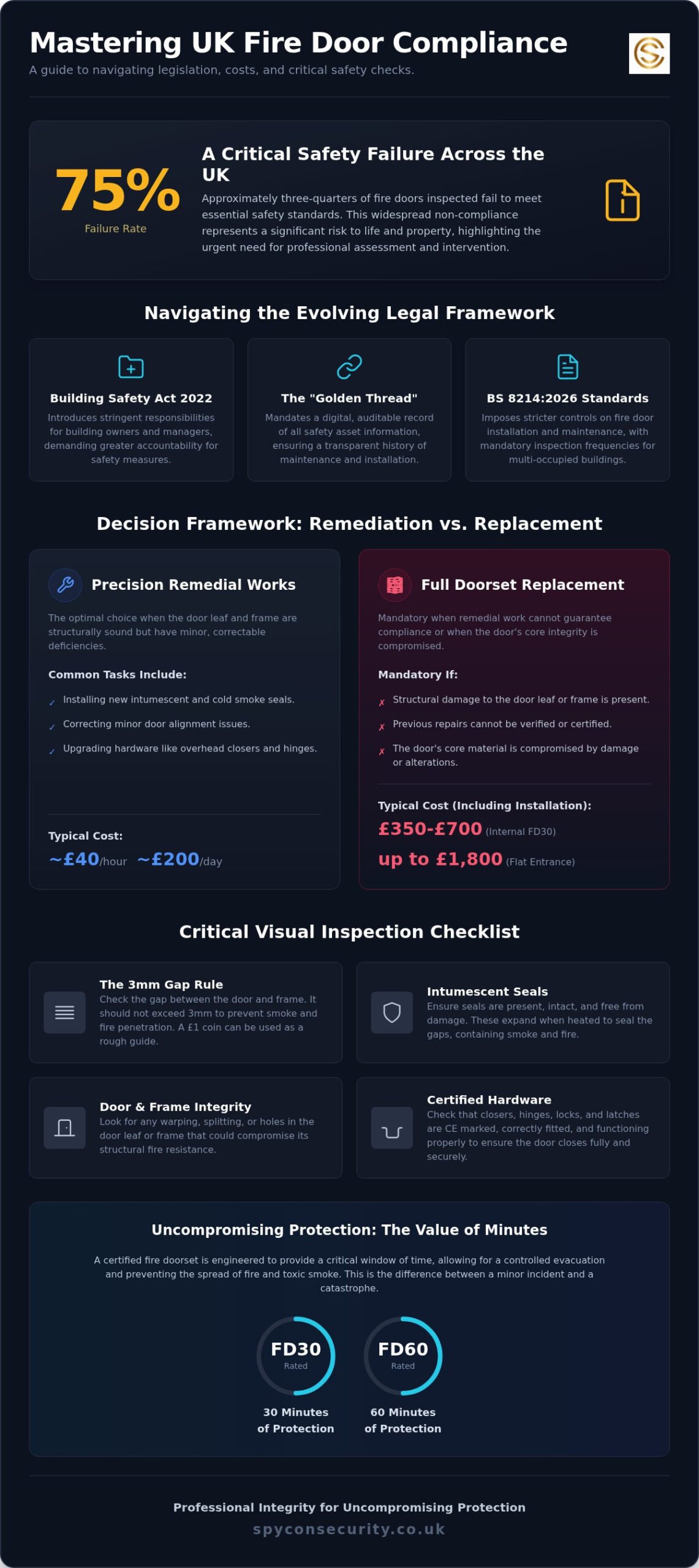
Approximately 75% of fire doors inspected across the United Kingdom fail to meet essential safety standards. This statistic is a stark reminder of the risks inherent in neglected infrastructure. You likely feel the weight of evolving legislation, from the Building Safety Act 2022 to the rigorous new BS 8214:2026 standards. It’s frustrating when compliance feels like a moving target that threatens your budget and operational flow.
This guide provides the clarity you need to master these complexities. We’ll outline how a professional fire door replacement service ensures your premises remain a verified safe haven. You’ll discover the precise criteria for choosing between remedial works and full installations. We’ll also preview the digital “Golden Thread” requirements and cost-effective strategies to protect your occupants without unnecessary downtime. Operational precision is your best defence against non-compliance fines and safety failures. This is about more than just hardware; it’s about uncompromising protection and professional integrity.
Key Takeaways
- Navigate the complexities of current UK fire safety legislation, including the mandatory inspection frequencies required for multi-occupied buildings under 2026 standards.
- Establish a strategic framework to determine whether precision remedial works are sufficient or if a professional fire door replacement service is necessary for full compliance.
- Master critical visual inspection techniques, such as the 3mm gap rule, to identify failures in smoke containment and structural integrity.
- Implement the “Golden Thread” of digital record-keeping to ensure an auditable, transparent history of all fire door maintenance and installation.
- Align your premises with the updated BS 8214:2026 standards to provide certified, uncompromising protection for all occupants and assets.
Understanding Fire Door Compliance and the Need for Professional Services
Fire doors are the frontline of passive fire protection. They aren’t just timber and steel; they’re engineered safety devices designed to save lives. Maintaining Fire Door Compliance is a continuous obligation under the Regulatory Reform (Fire Safety) Order 2005. The updated BS 8214:2026 standards now mandate even stricter controls over installation and maintenance across all materials. When a doorset is deemed non-compliant, a professional fire door replacement service is the only path to legal and operational certainty. With 75% of UK fire doors failing inspections, the need for expert intervention has never been more critical.
The Legal Obligations for Building Owners in 2026
The legislative landscape in 2026 demands absolute transparency. Under the Building Safety Act 2022, “Responsible Persons” must maintain a “Golden Thread” of information. This is a digital, auditable record of every safety asset within a building. You can’t rely on paper trails or verbal assurances anymore. Using non-certified installers for a fire door replacement service creates a dangerous break in this thread. It exposes duty holders to severe legal penalties and potential prosecution. Regular inspections now dictate remedial action with clinical precision. Every component must be verified, tested, and fit for its specific purpose to ensure the safety of all occupants.
Why Fire Door Integrity Cannot Be Compromised
Fire door integrity relies on the seamless interaction of the leaf, frame, and hardware. FD30 and FD60 doorsets are engineered to provide 30 or 60 minutes of protection against heat and toxic gases. These minutes are the difference between a controlled evacuation and a catastrophe. Common failure points often include damaged intumescent seals or excessive gaps that exceed the 3mm threshold. These issues are frequently identified during Spycon’s fire risk assessment services. Compromising on these technical specifications isn’t an option. High-stakes environments require meticulous attention to detail to ensure smoke containment remains absolute. A professional fire door replacement service ensures that every new installation meets these rigorous standards from day one.
Fire Door Remedial Works vs. Full Replacement: A Strategic Framework
Choosing between precision remediation and a full fire door replacement service is a critical decision for any building manager. This choice isn’t based on aesthetic preference but on a clinical assessment of structural integrity and legal compliance. Remedial works involve technical repairs to an existing doorset to restore its original fire-rating. It’s often the first line of defence for doors with minor deficiencies. However, if the repairs cannot be verified or if the door’s core is compromised, replacement becomes the only safe and legal path forward.
The financial implications are significant. Professional joinery labour for remedial tasks typically costs around £40 per hour, or a day rate of approximately £200. While this seems economical, it’s a false saving if the door fails a subsequent inspection. A standard internal FD30 replacement generally ranges from £350 to £700, including installation. For high-stakes flat entrance doors, costs can rise to £1,800 per unit. The Fire Safety (England) Regulations 2022 now mandate more frequent checks, making it harder to hide behind substandard repairs. Every decision must be documented to maintain the digital “Golden Thread” of safety information.
When Remediation is the Optimal Choice
Remediation is effective when the door leaf and frame remain structurally sound. It focuses on correcting minor alignment issues or replacing worn components. Common tasks include installing new intumescent and cold smoke seals or upgrading hardware like overhead closers and hinges. These works must be carried out by competent professionals to ensure the original certification remains valid. If you’re uncertain about your current inventory, a comprehensive fire strategy report can help prioritise these technical interventions.
Criteria for Full Doorset Replacement
There are clear triggers that make a full fire door replacement service mandatory. If a door leaf is warped, delaminated, or has holes larger than minor screw fixings, it’s beyond repair. Missing or unidentifiable certification labels are another non-negotiable factor; without proof of performance, the door is legally non-compliant. A 2026 report found that 65% of social housing fire doors failed safety standards, often due to these irreparable faults. Structural changes to a building’s layout also require bespoke doorsets that meet modern BS 8214:2026 criteria. In these high-stakes scenarios, compromising on safety is never an option.
Identifying Critical Faults: Signs Your Doors Require Attention
Vigilant maintenance is the bedrock of passive fire protection. Property managers must look beyond aesthetics to identify technical failures that compromise safety. The “3mm gap” rule is a non-negotiable standard; gaps between the door leaf and frame must not exceed this width to prevent smoke bypass. If you can fit a £1 coin into the gap, the doorset is likely non-compliant. Intumescent strips must be continuous and free from paint or physical damage. Self-closing devices must reliably return the door to the rebate from any angle. Adhering to ASDMA best practice guides ensures that these components work in unison during a fire event.
Common Failure Points in High-Traffic Commercial Areas
High-traffic environments, such as London commercial hubs, subject fire doors to extreme mechanical stress. Constant impact from trolleys or heavy footfall often leads to delamination of the door leaf. Over time, hinges may wear, causing the door to “drop” and rub against the floor or frame. This misalignment prevents the self-closer from functioning correctly. Propping doors open with extinguishers or wedges is a severe breach that damages the closer mechanism and compromises the entire fire compartment. When these mechanical failures occur, a professional fire door replacement service is often the most secure resolution. It is equally important to ensure that emergency escape routes are correctly specified; a compliant fire exit door installation must meet distinct technical requirements that differ from internal fire doors.
The Role of Professional Fire Door Surveys
While basic visual checks are useful, they are insufficient for legal compliance. A comprehensive fire door survey provides a technical audit that a DIY inspection cannot match. Professionals use calibrated gauges to measure tolerances and check for hidden defects, such as incorrect glazing or non-fire-rated hardware. These surveys inform a precise remedial strategy, identifying exactly where a fire door replacement service is required versus simple repairs. All findings must be documented in the building’s fire safety logbook to satisfy the “Golden Thread” requirements of the Building Safety Act 2022. This documentation provides the evidence-based proof of safety that insurers and regulatory bodies demand.
Executing a Professional Fire Door Replacement Service
A professional fire door replacement service is a technical operation that demands absolute precision. It begins with a meticulous site survey to assess the structural opening and the surrounding substrate. Once the survey is complete, we remove the non-compliant units without damaging the integrity of the wall. Preparing the aperture is a critical step; it ensures the new frame sits perfectly plumb and square. This foundation is essential for the door leaf to function as intended during a fire event. Every stage of the process must be documented to maintain the building’s digital safety record.
Selecting the Right Fire Rating: FD30 to FD120
Matching door performance to the building’s overarching fire strategy is a matter of life safety. The specific rating, be it FD30, FD60, or FD120, dictates the minutes of integrity the doorset provides. Material choices vary based on the environment. Timber is standard for internal corridors, whilst steel or composite options are often required for high-risk areas or external flat entrances. We consult fire strategy reports to ensure every doorset meets the exact specifications required by building control. This rigorous selection process prevents the installation of inadequate hardware that could fail under thermal stress. For premises that also require compliant emergency egress points, understanding the full scope of fire exit door installation standards under the 2026 compliance checklist is an essential part of any holistic fire strategy.
The Importance of Certified Installation
Certified installation is the only way to guarantee that a fire door replacement service delivers its promised protection. Every component must mirror the “as-tested” configuration used during the manufacturer’s original fire tests. This includes the precise application of fire-rated foam and mastic to seal the gap between the frame and the wall. Without these specialist materials, smoke and heat can bypass the doorset entirely. Post-installation testing is equally vital. We verify that self-closing mechanisms return the door to the rebate with sufficient force to overcome the latch. If you require a compliant and certified installation, you can book a professional fire door survey to begin the process.
The final phase involves the handover of compliance documentation. This includes the manufacturer’s certification and proof of professional installation. These records are essential for your fire safety logbook and insurance requirements. They provide the definitive evidence that your premises are protected by high-standard, verified safety assets. Professional execution removes the guesswork from fire safety, replacing uncertainty with certified reliability.
Spycon Security: Your Partner for UK Fire Door Compliance
Spycon Security Ltd. operates as a high-stakes guardian for commercial and residential assets across the United Kingdom. We provide end-to-end fire safety solutions that bridge the gap between technical consultancy and physical installation. Our nationwide reach extends from our London headquarters to major hubs in Birmingham, Manchester, and throughout Wales. This geographic breadth ensures that our elite fire door replacement service is available wherever your portfolio is located. We don’t just install hardware; we verify the safety of your entire infrastructure. Our team maintains the highest standards of professional integrity. We ensure every project meets the rigorous demands of 2026 compliance. Every doorset we commission is a testament to our commitment to duty and excellence.
Integrated Fire Safety Consultancy
Operational safety requires a holistic strategy that transcends simple maintenance. We integrate fire door lifecycle management directly into your wider fire policy plan to ensure no asset is overlooked. This integration is vital for maintaining the digital continuity required by current legislation. Competitor services often treat fire doors as isolated components. We do not. We support property managers beyond the initial installation by providing comprehensive fire safety training and drill services. This ensures your personnel are as prepared as your hardware. Peace of mind is delivered through meticulous documentation. Every survey, repair, and replacement is logged with absolute precision. This creates an unshakeable audit trail for regulators and insurers alike.
Why Choose a Specialist Guardian?
Selecting a partner for fire protection is a decision rooted in trust and proven expertise. Spycon Security Ltd. brings a disciplined, authoritative approach to site safety that general contractors cannot match. We specialise in high-stakes environments and complex commercial assets where failure is not an option. Our dual expertise in physical security and fire protection allows us to identify systemic risks that others miss, often identifying exactly where a fire door replacement service is the only viable path to safety. We operate with absolute precision. We ensure that your premises remain fully compliant and your occupants stay protected. Our installers are trained to maintain the highest technical proficiency across all FD-rated installations. Don’t leave your regulatory obligations to chance. Secure your premises with Spycon Security Ltd. today and experience the reassurance of professional excellence. We remain vigilant so you don’t have to.
Secure Your Compliance and Protect Your Personnel
Compliance in 2026 is no longer a matter of periodic visual checks; it’s a continuous commitment to the digital “Golden Thread.” You must move beyond surface-level repairs and embrace a strategic framework that prioritises structural integrity and certified hardware. Whether your premises require precision remedial work or a comprehensive fire door replacement service, the objective remains the same: uncompromising safety for every occupant. Maintaining high standards is your best defence against legal liability and operational failure.
Spycon Security provides the authoritative expertise required to navigate these high-stakes regulations. With our SIA Licensed expertise and London Building Control approved reports, we offer a level of rigour that general contractors cannot match. Our nationwide UK fire safety coverage ensures that your assets are protected by a partner who values professional integrity above all else. Request a Professional Fire Door Survey from Spycon Security to establish your baseline of safety today. You can achieve full regulatory peace of mind with a disciplined approach to maintenance. We’re ready to stand as your watchful guardian in an ever-evolving legislative landscape.
Frequently Asked Questions
What is the difference between fire door remedial works and replacement?
Fire door remedial works involve precise technical repairs to restore an existing doorset to its original fire-rating. This includes replacing damaged intumescent seals or adjusting hinges to correct alignment. Conversely, a fire door replacement service involves the complete removal of a non-compliant unit and the installation of a new, certified doorset. Remediation is only an option if the door leaf and frame remain structurally sound and the original certification is identifiable.
How often should fire doors be inspected in a commercial building?
Commercial fire doors should undergo a professional inspection at least every six months. High-traffic environments may require more frequent checks to mitigate mechanical wear. Under the Fire Safety (England) Regulations 2022, residential buildings over 11 metres in height mandate quarterly checks for doors in common parts and annual checks for flat entrance doors. Regular inspections are essential to maintain the “Golden Thread” of safety information required for legal compliance.
Can any carpenter carry out fire door remedial works?
No, fire door maintenance requires specific competency that exceeds general joinery. A general carpenter may not understand the “as-tested” configurations required to maintain a door’s fire-rating. Using non-certified personnel can void the manufacturer’s certification and expose the duty holder to significant legal risk. It is vital to use specialists who adhere to BS 8214:2026 standards and can provide the necessary documentation for your building’s fire safety logbook.
What are the main causes of fire door failure in the UK?
The primary causes of failure include excessive gaps between the leaf and frame, damaged intumescent strips, and faulty self-closing devices. Many doors also fail due to unauthorised hardware changes or the removal of certification labels. Misalignment caused by heavy footfall in commercial hubs often prevents the door from latching correctly. These technical deficiencies compromise the fire compartment, allowing smoke and toxic gases to bypass the doorset during an incident.
Are fire door surveys a legal requirement for landlords?
Yes, landlords and “Responsible Persons” must ensure fire doors are fit for purpose under the Regulatory Reform (Fire Safety) Order 2005. The Fire Safety Act 2021 clarified that flat entrance doors in multi-occupied residential buildings fall within this scope. Professional surveys provide the evidence-based audit required to demonstrate that safety obligations are being met. Failure to conduct these surveys can lead to prosecution and severe financial penalties if standards are breached.
How long does a professional fire door replacement service take?
A standard internal fire door replacement typically takes between three to five hours per unit. This timeframe includes the removal of the non-compliant set, preparation of the structural opening, and the precision installation of the new frame and leaf. More complex FD120 or bespoke installations may require additional time. Our teams work methodically to ensure that your premises remain secure and compliant whilst keeping operational downtime to an absolute minimum.
Is it possible to repair a fire door that has a gap larger than 4mm?
Gaps exceeding 4mm generally cannot be repaired through simple adjustment and usually necessitate a full fire door replacement service. The technical standard for smoke containment is a 3mm gap; anything beyond this threshold allows heat and smoke to bypass the protection. Whilst minor hinge adjustments can sometimes close small discrepancies, a gap larger than 4mm often indicates a warped door leaf or a structural failure that compromises the unit’s integrity.