


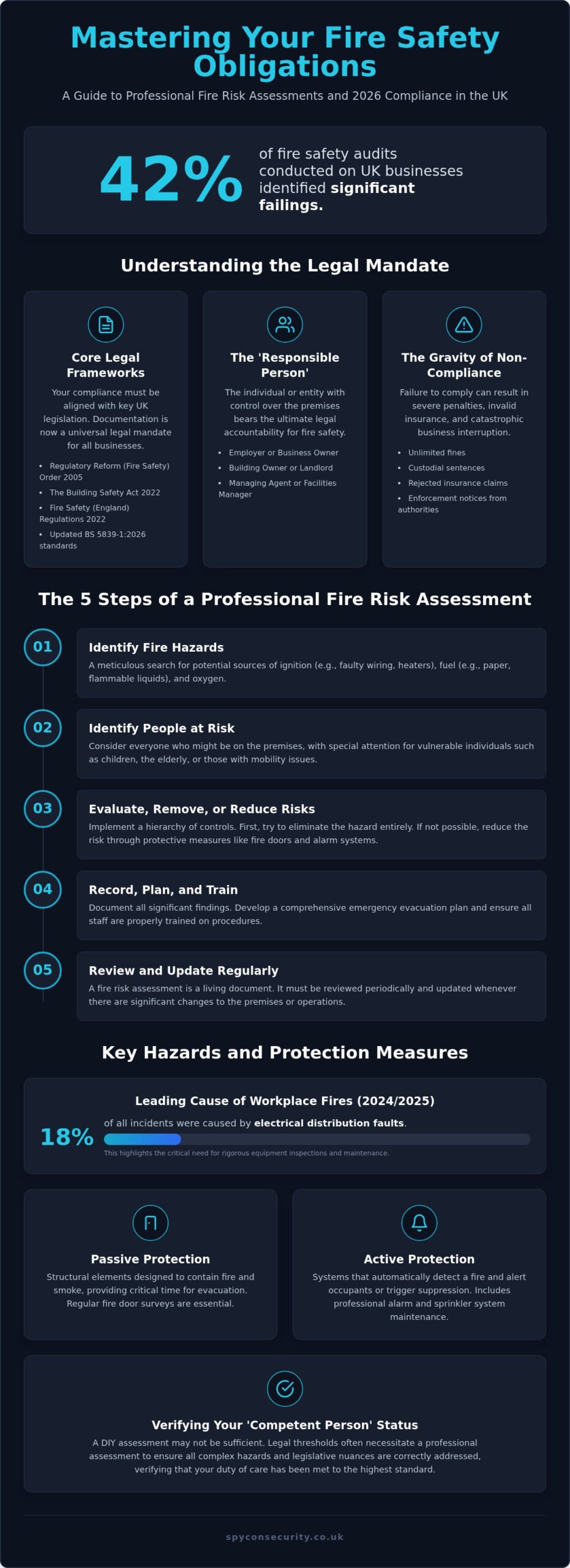
Recent data reveals that 42% of fire safety audits conducted on UK businesses identified significant failings. This statistic represents more than just a regulatory hurdle. It highlights a widespread vulnerability that puts lives and livelihoods at risk. For any designated “responsible person,” the weight of legal accountability is substantial. You likely feel the pressure to keep pace with the Fire Safety (Residential Evacuation Plans) (England) Regulations 2025 while ensuring your fire risk assessment meets the updated BS 5839-1:2026 standards. The fear of heavy fines or even custodial sentences for non-compliance is a rational response to such high stakes.
We understand that the complexity of modern legislation often leads to confusion. You might wonder if a DIY approach is sufficient or if your current protocols meet the rigorous demands of the Building Safety Act 2022. This article provides the clarity you require. By following our expert breakdown, you’ll master your legal obligations and secure your premises with a robust safety strategy. We’ll explore the latest 2026 legislative updates, define your specific duties, and demonstrate how professional verification delivers the uncompromising protection your staff and residents deserve.
Key Takeaways
- Align your safety protocols with the Regulatory Reform (Fire Safety) Order 2005 and the latest 2026 legislative requirements.
- Implement a systematic five-step methodology to identify hazards and protect vulnerable occupants with total precision.
- Understand the legal thresholds that necessitate a professional fire risk assessment to ensure your ‘competent person’ status is verified.
- Identify and mitigate sector-specific hazards, ranging from industrial storage risks to residential evacuation complexities.
- Transition from assessment findings to operational readiness through expert fire door surveys and professional alarm system maintenance.
Understanding the Legal Mandate for Fire Risk Assessments
A fire risk assessment is a methodical, systematic evaluation of your premises. It identifies potential fire hazards and determines the safety of everyone on-site. This process is not a casual walkthrough. It’s a detailed analysis of ignition sources, fuel loads, and structural vulnerabilities. The Regulatory Reform (Fire Safety) Order 2005 stands as the primary legislation governing these requirements across the United Kingdom. However, the 2026 compliance landscape has evolved significantly. Every business, regardless of its size or employee count, must now maintain a written record of its fire safety measures. The previous exemptions for small teams no longer apply. Documentation is now a universal legal mandate for all commercial entities.
Who is the ‘Responsible Person’ in London and Luton Firms?
The ‘Responsible Person’ bears the ultimate legal weight of fire safety. In London and Luton commercial properties, this role is typically filled by the employer, the building owner, or the managing agent. If you exert control over the premises, the law identifies you as the primary point of accountability. In shared office blocks or industrial estates, the situation becomes more complex. Multiple tenants must coordinate their safety efforts meticulously. You can’t operate in a vacuum. Each party must ensure their specific area is safe whilst contributing to the building’s overall evacuation strategy. Negligence is a high-stakes risk. The legal consequences are uncompromising. Authorities possess the power to issue enforcement notices, impose unlimited fines, or pursue custodial sentences for serious breaches of duty.
The Gravity of Compliance: Beyond the Paperwork
Compliance serves a purpose far beyond simply avoiding a fine. It’s the foundation of operational survival. Insurance providers almost universally require a valid fire risk assessment to validate your coverage. If a fire occurs and your records are found to be absent, incomplete, or outdated, your claim will likely be rejected. This leaves your business entirely exposed to the financial fallout of a disaster. The Fire and Rescue Service also maintains the authority to audit your records at any time. They look for evidence of a disciplined, professional approach to safety. By applying established Risk Assessment Principles, you demonstrate that your safety strategy is rooted in professional rigour rather than guesswork. Maintaining steady, grounded documentation provides the peace of mind that your staff, residents, and assets are protected by a system that meets the highest standards of the law.
The Five Steps of a Professional Fire Risk Assessment
A professional fire risk assessment follows a disciplined, five-step methodology. This structure ensures that no vulnerability is overlooked. It begins with identifying fire hazards. This involves a meticulous search for sources of ignition, fuel, and oxygen. Next, you must identify people at risk. Special attention is required for staff, visitors, and vulnerable individuals, such as those with limited mobility. The third step involves evaluating, removing, or reducing these risks. You must apply a hierarchy of prevention to eliminate hazards where possible. Fourth, you record your findings, develop a comprehensive emergency plan, and provide necessary staff training. Finally, you must review the assessment regularly. This ensures your safety strategy remains effective as your operations change.
Identifying Hazards with Operational Precision
Modern commercial environments present specific ignition risks that require constant vigilance. In the 2024/2025 period, electrical distribution faults were the leading cause of workplace fires, accounting for 18% of all incidents. This data underscores the need for rigorous equipment inspections. In warehouses, high-load storage and hazardous materials demand strict storage protocols to prevent rapid fire spread. A fire hazard is defined as any condition or behaviour that can start a fire or increase its intensity, such as the accumulation of grease and fat within a commercial kitchen’s extraction system.
Evaluating and Reducing Risk Factors
Once hazards are identified, you must implement a robust hierarchy of protection. This involves a balance between passive and active fire measures. Passive protection includes structural elements like fire doors that contain smoke and flames. Active protection involves systems like fire alarms or sprinklers that detect and suppress threats. Clear escape routes and functional emergency lighting are non-negotiable requirements for any building. For high-occupancy sites, you must prepare a detailed emergency evacuation plan that accounts for all possible scenarios. Adhering to Official Risk Assessment Guidance ensures your methodology aligns with international safety standards. If you’re unsure about the technical requirements for your premises, a professional fire risk assessment provides the expert verification needed for total peace of mind.
Competent Persons vs. Self-Assessment: Navigating Responsibility
A self-assessment is technically permissible for the simplest, lowest-risk premises. However, the definition of ‘low-risk’ is often narrower than many building owners realise. If your site involves multiple floors, complex escape routes, or public access, a DIY approach is a significant legal liability. The Regulatory Reform (Fire Safety) Order 2005 mandates that a ‘competent person’ must assist with fire safety duties. In a legal context, competence is defined by sufficient training, experience, and knowledge. It’s not a title one can simply adopt. It requires a deep understanding of fire dynamics and structural protection. Without this expertise, your fire risk assessment may fail to meet the necessary standard of rigour.
The dangers of an amateur assessment are documented. Statistics show that 42% of fire safety audits conducted by authorities identify failings. These deficiencies often stem from a lack of technical depth. An untrained individual might miss the significance of a non-compliant fire door or an incorrectly configured alarm interface. Professional assessors provide an uncompromising level of scrutiny. They identify hidden vulnerabilities that an internal manager, distracted by daily operations, might overlook. This professional verification is your primary defence against the financial and legal fallout of a fire incident.
Why Professional Expertise is Essential for London Property
London and Luton properties present unique challenges. Many firms operate out of heritage buildings or complex conversions. These structures don’t follow modern templates. They require a bespoke approach to safety. Ensuring every fire door and alarm system meets current British Standards requires specialised equipment and training. An external, unbiased audit removes the ‘familiarity bias’ that often plagues internal reviews. It provides a clear, objective record of your safety status. This level of detail is exactly what the Fire and Rescue Service expects during a formal inspection. When selecting an external auditor, understanding how to evaluate credentials and technical expertise is essential — our guide to choosing the best fire risk assessment company in London provides a methodical framework for making the right decision.
The Spycon Security Ltd. Approach: Professional Gravity in Consultancy
We approach consultancy with disciplined precision. Our assessors are trained to identify risks that remain invisible to the untrained eye. We don’t just provide a document; we provide expert verification. This process instils immediate confidence in your safety protocols. By integrating fire door surveys and fire strategy reports into our model, we ensure a seamless transition from assessment to action. We act as a seasoned partner. Our commitment to excellence ensures your premises remain compliant and your people remain protected. There’s no room for shortcuts when lives are at stake.
Sector-Specific Fire Safety: Offices, Warehouses, and Residential Blocks
Fire safety is not a one-size-fits-all discipline. A professional fire risk assessment must be meticulously calibrated to the specific hazards of your sector. Generic templates often fail to account for the unique variables of different building types. In modern office environments, the high density of electronic equipment creates a constant electrical load. Cluttered escape routes and propped-open fire doors remain the most common points of failure. Understanding the full scope of office fire door regulations UK is essential for facility managers who need to verify that every barrier meets the required FD30 or FD60 performance standard. Warehouses present a different set of challenges altogether. High-load storage configurations can lead to rapid fire development, whilst hazardous materials require specialised containment protocols that exceed standard safety measures. Residential blocks and Houses in Multiple Occupation (HMOs) introduce the most critical risk factor: sleeping occupants. These environments demand sophisticated detection systems and clear, unobstructed pathways to safety that function under high-stress conditions. Property owners managing these residential environments should also review the specific obligations outlined in a dedicated fire risk assessment for landlords to ensure full compliance with 2026 UK regulations.
Construction sites are particularly vulnerable to arson and hot-work accidents. Implementing manned guarding provides a physical layer of protection that technology alone cannot match. These professionals offer constant vigilance. They ensure that ignition sources are controlled and unauthorised access is prevented. For high-risk sites where the threat of arson or unauthorised occupation is elevated, deploying canine security units provides an additional sensory-driven deterrent that significantly enhances perimeter protection beyond what static guarding or cameras can achieve. This proactive approach significantly reduces the likelihood of a catastrophic fire during the most vulnerable stages of a build.
High-Rise and Commercial Density in London
London’s commercial landscape is defined by high-rise density and complex vertical escape routes. Managing an evacuation in these settings requires absolute precision. Fire door surveys are essential for London office compliance because they verify that critical compartmentation remains intact within high-traffic, multi-tenanted environments. Regular inspections ensure that these vital barriers haven’t been compromised by daily wear or unauthorised modifications. Without verified compartmentation, a fire can spread vertically with devastating speed, bypassing the very systems designed to contain it.
Integrating Fire Safety with Physical Security
Effective site protection bridges the gap between fire safety and physical security. 24/7 CCTV monitoring allows for the immediate detection of early smoke signatures or suspicious activity indicative of arson. On-site security guards play a vital role in assisting with fire drills. They ensure that evacuation procedures are executed without panic and that all personnel are accounted for at assembly points. This integrated approach is especially critical for protecting vacant properties in Luton from fire-related vandalism. By combining these disciplines, you create a resilient safety network that protects both your property and the people within it. If you need to verify your site’s readiness, you can book a professional fire risk assessment to ensure every vulnerability is addressed with expert precision.
Securing Compliance with Spycon Security: Beyond the Assessment
Completing a fire risk assessment is the diagnostic phase of your safety strategy. The resulting document identifies where your defences are compromised and where your legal liability is greatest. However, the true measure of safety lies in the remedial actions that follow. Transitioning from identifying a hazard to eliminating it requires technical precision. This is where professional consultancy becomes operational reality. For complex developments or high-occupancy buildings, we develop comprehensive fire strategy reports. These documents provide a high-level blueprint for safety. They coordinate detection, containment, and evacuation into a single, cohesive framework. This ensures that every architectural feature and safety system works in unison to protect life and property.
Our Technical Fire Solutions
We provide bespoke fire alarm system installation tailored to the specific geometry of your site. A high-ceilinged warehouse in Luton requires a different detection profile than a heritage office in Central London. Our engineers ensure that your systems meet the latest BS 5839-1 standards and remain in constant readiness through scheduled maintenance audits. Structural integrity is equally vital to your defence. We conduct detailed fire door surveys to verify that every barrier can withstand its required fire rating. If a door is found to be deficient, we provide professional fire door installation to restore your building’s compartmentation. Our service also includes fire extinguisher installation. We don’t just supply equipment. We provide the necessary training to ensure your staff can act with confidence and precision during an incident.
Your Partner in Vigilant Protection
Spycon Security is the preferred choice for London and Luton firms seeking an uncompromising level of protection. We operate with professional gravity and a commitment to unwavering reliability. Our approach is grounded in duty and professional integrity. We don’t allow for shortcuts because we understand the stakes of non-compliance. By integrating physical security with fire safety, we offer a level of site protection that generic consultants cannot match. We act as your watchful guardian. Our team ensures that your compliance is not just a box-ticking exercise but a robust shield against disaster. To secure your premises and meet your legal obligations with absolute confidence, Contact Spycon Security for a Professional Fire Risk Assessment.
Achieving Uncompromising Fire Safety Standards
Maintaining a secure environment requires more than just meeting the bare minimum of the law. It demands a culture of constant readiness and professional rigour. You now understand that a fire risk assessment is a live document that must evolve alongside 2026 legislative shifts. Relying on a ‘competent person’ ensures that your safety strategy is built on expert verification rather than guesswork. This approach protects your residents, your staff, and your legal standing from the severe consequences of negligence.
Spycon Security provides comprehensive fire safety consultancy across London and Luton. Our SIA licensed experts operate with professional gravity to identify every vulnerability on your site. We don’t just find problems; we provide the technical solutions needed to solve them. From fire door surveys to alarm maintenance, we act as your watchful guardian. Our commitment to excellence ensures your premises remain a bastion of safety and compliance. It’s time to replace uncertainty with certified expertise. Before engaging any provider, consult our 2026 buyer’s guide to selecting a qualified fire risk assessment company in London to ensure you verify credentials and technical competence with confidence.
Secure Your Premises with a Professional Fire Risk Assessment
Take the decisive step today to ensure your property is protected by a partner that values order and professional integrity above all else.
Frequently Asked Questions
How often should a fire risk assessment be reviewed for a London business?
Reviews should occur annually or immediately following any significant structural or operational changes. If you renovate your London office, change your floor layout, or significantly increase staff numbers, your existing documentation is no longer valid. Regular reviews ensure your safety protocols reflect the current reality of your premises and maintain constant readiness for an unannounced audit.
Is a fire risk assessment a legal requirement for small offices in Luton?
Yes, a fire risk assessment is a mandatory legal requirement for all businesses in Luton regardless of size. Following legislative updates in 2026, the previous exemption for businesses with fewer than five employees has been abolished. Every ‘responsible person’ must now maintain a written record of their fire safety measures to remain compliant with the law.
Can I carry out my own fire risk assessment if I am the business owner?
You may only perform your own assessment if you possess the specific training, knowledge, and experience to be deemed a ‘competent person’ under UK law. For most owners, the technical complexity of modern building regulations makes professional verification the safer choice. An amateur oversight can lead to severe legal liabilities and compromise the safety of everyone on-site.
What happens if a building fails a fire safety inspection by the Fire and Rescue Service?
Failure typically results in an enforcement notice detailing the specific remedial actions required within a set timeframe. Serious breaches can lead to a prohibition notice, which restricts or closes access to the building immediately. Extreme cases of negligence often result in criminal prosecution, leading to unlimited fines or custodial sentences for the responsible person.
Do I need a separate fire risk assessment for a vacant commercial property?
Vacant properties require a dedicated assessment to manage specific risks such as arson, vandalism, and the failure of dormant safety systems. Even without occupants, the building structure and neighbouring properties remain vulnerable. Maintaining a valid safety record is also a critical requirement for most commercial insurance policies to remain in effect.
What is included in a professional fire strategy report?
A fire strategy report is a high-level technical document that provides a blueprint for safety in complex developments. It includes detailed evacuation modelling, fire detection system specifications, and structural compartmentation analysis. These reports coordinate all safety features into a single, cohesive framework to ensure the building’s design supports safe egress during an emergency.
How much does a professional fire risk assessment cost in the UK?
The cost of a fire risk assessment depends on the size and complexity of the premises. Small offices or shops typically range from £200 to £450, whilst larger industrial units or residential blocks can range from £300 to over £800. High-rise buildings or complex care homes often require more intensive audits, with fees starting from £1,500 and rising based on technical requirements.
What are the specific fire safety requirements for high-rise residential buildings?
High-rise buildings must comply with the Building Safety Act 2022, which mandates regular inspections of external wall systems and flat entrance doors. Responsible persons must also create Personal Emergency Evacuation Plans (PEEPs) for residents who require assistance. New residential buildings over 18 metres now require second staircases and evacuation lifts to ensure resilient vertical escape routes for all occupants. Landlords managing such properties should consult a comprehensive fire risk assessment for landlords to understand their specific legal duties under the latest 2026 regulations.