


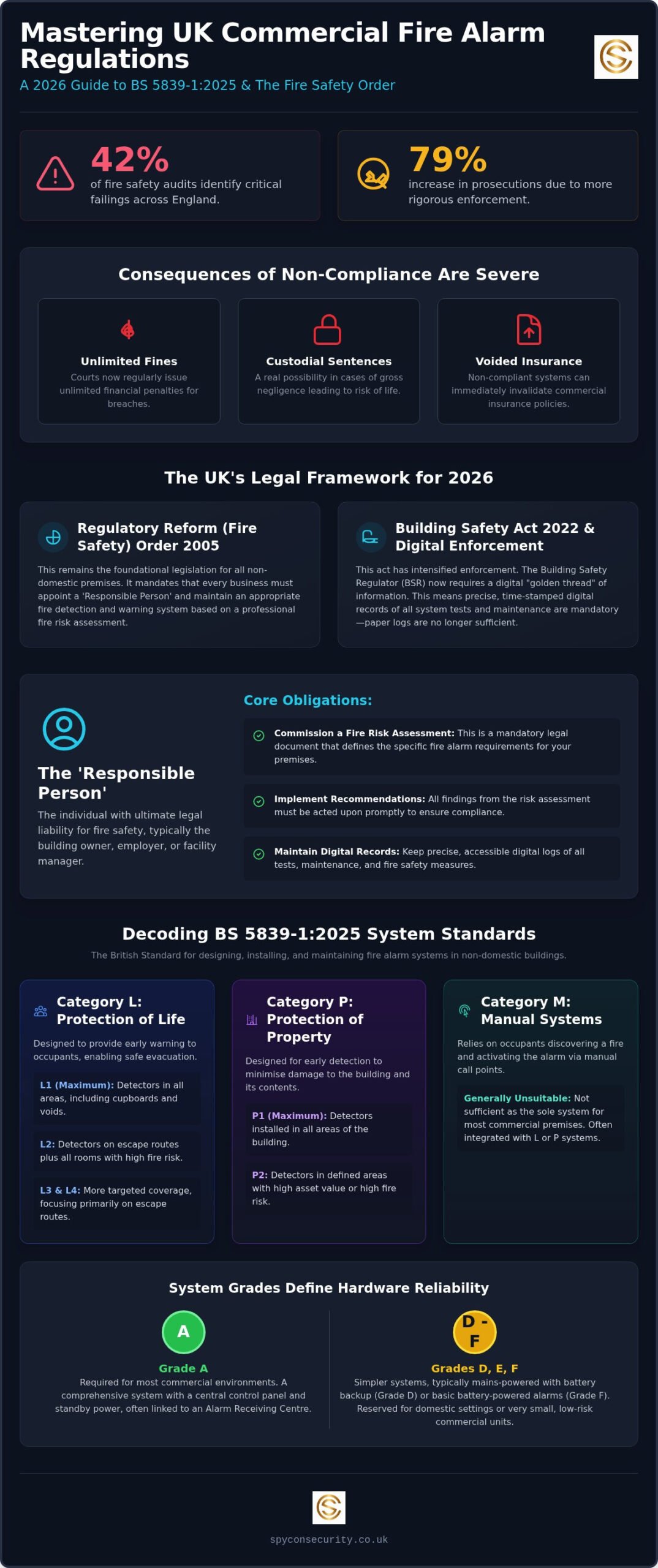
In the most recent reporting period, 42% of fire safety audits across England identified critical failings, resulting in a 79% increase in prosecutions. These statistics underscore the urgent need to master commercial fire alarm system regulations UK as enforcement becomes increasingly rigorous. You understand that fire safety isn’t merely a checkbox. It’s a fundamental pillar of your operational integrity and the protection of your workforce.
It’s understandable if you feel overwhelmed by the technical distinctions between L and P categories or the fear of heavy financial penalties for non-compliance. You deserve the peace of mind that comes from a system that works perfectly and satisfies every legal requirement. This 2026 guide simplifies the complexities of UK fire safety legislation. It ensures your premises align with the latest British Standards without the stress of trial and error.
We provide a clear roadmap to legal compliance by breaking down the BS 5839-1:2025 requirements. You’ll learn how to select a BAFE-validated provider and implement strategies that significantly reduce false alarms. This article prepares you to secure your assets with absolute precision and professional gravity.
Key Takeaways
- Identify your specific duties as a “Responsible Person” under the Regulatory Reform (Fire Safety) Order 2005 to avoid severe legal penalties.
- Align with the latest commercial fire alarm system regulations UK by adhering to the BS 5839-1:2025 standards for design and installation.
- Clarify the distinctions between Category L and P systems to ensure your detection coverage matches your building’s unique risk profile.
- Secure your insurance validity by ensuring every installation is finalised with a formal commissioning certificate from a competent professional.
- Streamline your path to Building Control approval by integrating professional fire strategy reports with certified alarm monitoring and maintenance.
The UK Legal Framework for Commercial Fire Alarms in 2026
The Regulatory Reform (Fire Safety) Order 2005 (RRO) remains the foundational legislation for non-domestic premises in England and Wales. It dictates that every business must maintain an appropriate fire detection and warning system. However, the interpretation of “appropriate” has become more stringent. As of 2026, compliance is no longer a static goal but a continuous operational requirement. Failure to adhere to commercial fire alarm system regulations UK carries severe penalties. Courts now regularly issue unlimited fines. In cases of gross negligence, custodial sentences are a real possibility. Beyond legal sanctions, non-compliance immediately voids commercial insurance policies, leaving your assets entirely unprotected. For a foundational fire alarm system overview, understanding the interplay between hardware and legal duty is essential. Professional verification is the only way to ensure your system meets these evolving standards.
The Building Safety Act and 2026 Enforcement
The Building Safety Act 2022 has fundamentally altered the enforcement landscape. The Building Safety Regulator (BSR) now oversees fire safety standards with increased rigour, particularly in high-risk or multi-occupied buildings. Enforcement is becoming data-driven. There’s a decisive shift towards digital record-keeping. Paper logs are no longer sufficient. You must maintain precise, time-stamped digital records of all system tests and maintenance activities. Local fire authorities in major hubs like London and Manchester have ramped up site inspections. They focus on the “golden thread” of information. This ensures that safety data is accurate and accessible throughout the building’s lifecycle. These authorities have the power to shut down non-compliant sites instantly.
The Role of the Responsible Person (RP)
The “Responsible Person” (RP) holds the ultimate legal liability for fire safety within an organisation. This is typically the employer, building owner, or facility manager. In multi-tenanted commercial buildings, responsibilities are often shared. This requires formalised co-operation between different parties to ensure no gaps in protection exist. Identifying the RP is the first step toward compliance. The second is commissioning a professional fire risk assessment. This document isn’t optional. It’s the legal instrument that defines the specific requirements for your fire alarm system. It accounts for building size, occupancy type, and specific fire hazards. Without a valid assessment, your commercial fire alarm system regulations UK strategy lacks a legal foundation. The RP must ensure that all recommendations are implemented promptly to maintain legal standing.
Understanding BS 5839-1: System Categories and Grades
Compliance with commercial fire alarm system regulations UK rests heavily on the application of BS 5839-1. This British Standard provides the framework for designing, installing, and maintaining systems in non-domestic premises. As of April 2025, the updated BS 5839-1:2025 has replaced previous versions, introducing stricter requirements for system integration and evacuation support. Failing to select the correct system category often leads to rejected Building Control applications and potential insurance disputes. This standard operates in tandem with the Regulatory Reform (Fire Safety) Order 2005 to ensure every occupant is sufficiently protected. Systems are classified by Grades (A through F) and Categories (L, P, and M).
Grades define the reliability and complexity of the hardware. Most commercial environments require Grade A. This involves a comprehensive system with a central control panel and standby power. Lower grades, such as D or F, are typically reserved for domestic settings or very small, low-risk commercial units. Selecting the wrong grade compromises the integrity of your fire safety strategy. It’s a mistake that can lead to system failure during a critical event.
Category L: Protection of Life
Category L systems focus on saving lives by providing early warnings to occupants. The specific sub-category you need depends on the complexity of your premises. L1 represents the highest level of protection. Detectors are installed in all areas of the building, including cupboards and roof spaces. L2 systems protect escape routes and rooms with a high fire risk, such as boiler centres or kitchens. L3 and L4 categories provide more targeted protection for hallways and stairs to ensure safe evacuation. L5 is a bespoke category designed for specific risks that a standard layout might miss. Professional guidance ensures you don’t over-specify or under-protect your site.
Category P and M: Property and Manual Systems
Category P systems are designed to protect the building and its assets, particularly whilst the premises are unoccupied. A P1 system covers the entire building to ensure the fire service is alerted as quickly as possible. P2 focuses on specific high-value areas, such as server rooms or archives. Category M systems are manual only. These rely on occupants to trigger “break glass” units. They’re only suitable for simple, low-risk buildings where a fire would be immediately obvious to everyone. A comprehensive fire strategy report is essential for determining which category is legally required for your organisation. If you’re unsure about your current classification, consulting a certified installer can prevent costly compliance errors.
Choosing the Right Fire Alarm Technology for Your Business
Selecting the correct hardware is an operational necessity. It ensures your commercial fire alarm system regulations UK strategy is both effective and compliant. Your choice depends on building size, occupancy, and the specific risks identified in your risk assessment. Under the Regulatory Reform (Fire Safety) Order 2005, the technology must be fit for purpose. It’s not enough to have an alarm; it must be the right alarm for your specific environment. Precise detection saves lives and protects assets.
Conventional vs. Addressable Systems
Conventional systems remain a viable choice for small, single-zone properties like independent retail units. They’re cost-effective for simple layouts. However, they only identify a general zone rather than a specific room. For larger complexes or multi-storey London high-rises, addressable systems are mandatory for operational efficiency. Each detector has a unique address. This allows the fire service to pinpoint the exact location of a fire instantly, significantly reducing search time. These systems also integrate seamlessly with fire doors and ventilation controls to contain smoke and heat. Whilst addressable systems have a higher initial cost, the reduction in false alarms and improved response times provide superior long-term value.
The Rise of Wireless Fire Detection
Wireless (radio) fire detection has seen a massive surge in adoption. It’s now the favourite choice for many Birmingham businesses operating in heritage or Grade II listed buildings. The primary advantage is the lack of cabling. This prevents damage to historic fabric and minimises operational downtime. In 2026, signal reliability and battery life have reached levels that rival wired alternatives. Hybrid systems are also common. They combine the robustness of a wired backbone with the flexibility of wireless extensions for hard-to-reach areas. Speed of installation is a decisive factor for businesses that cannot afford to close during an upgrade.
For specialist environments, standard detection is often insufficient. Aspirating smoke detection (ASD) provides high-sensitivity monitoring in data centres or warehouses with high ceilings. These systems actively draw air through a network of pipes to detect smoke at a molecular level. They provide the earliest possible warning, protecting high-value assets before a fire takes hold. Choosing the right technology is about precision. It’s about matching the detection speed to the potential risk. If you’re upgrading, professional fire alarm installation ensures your chosen technology is commissioned correctly and meets all current British Standards.
Installation and Maintenance: Your Ongoing Obligations
Compliance with commercial fire alarm system regulations UK doesn’t end when the last detector is fitted. It begins there. Installation must be executed by a “competent person” to satisfy BS 5839-1 standards. This isn’t a mere suggestion. It’s a legal necessity. A competent person is someone with the specific training and experience to verify that the system’s design meets the risk assessment’s requirements. Upon completion, you must receive a commissioning certificate. This document is the primary evidence your insurance provider will demand following any incident. Without it, your coverage is compromised. Precision is mandatory.
Weekly testing is a non-negotiable duty for the Responsible Person. You must trigger a different manual call point each week to confirm the control panel and sounders are operational. If your team lacks the knowledge to perform these checks, professional fire safety training provides the necessary competence. Neglect is the enemy of safety.
The 6-Month Service and Annual Certification
Professional servicing must occur at least every six months. During these periodic inspections, an engineer verifies battery health and cleans sensors to prevent malfunction. They also check for building alterations that might obstruct detection. Every test must be recorded in a Log Book. Whilst traditional paper logs exist, modern enforcement prefers digital records. These provide an immutable “golden thread” of safety data. Common reasons for system failure include:
- Battery depletion: Standby power must be capable of running the system during a total mains failure.
- Dirty detectors: Dust build-up leads to increased sensitivity and false triggers.
- Unauthorised alterations: New partitions or stored stock can create “blind spots” for smoke detectors.
Managing False Alarms (Unwanted Fire Signals)
False alarms are a significant drain on UK businesses. In the year ending March 2026, Fire and Rescue Services attended over 172,000 false alarms caused by equipment failure. These incidents lead to unnecessary evacuations and lost productivity. In dense city centres like Edinburgh or Glasgow, frequent false alarms can lead to financial penalties from local fire authorities. Adhering to commercial fire alarm system regulations UK requires a proactive approach to reducing these signals. Modern “multi-sensor” detectors solve this. They use sophisticated algorithms to distinguish between steam, dust, and actual smoke. Implementing these technologies reduces the risk of brigade call-outs. It maintains the urgency of real alarms amongst staff. To ensure your premises stay compliant and protected, book a professional fire alarm inspection and maintenance service today.
Integrated Protection: The Spycon Security Approach
Spycon Security Ltd. operates with the understanding that commercial fire alarm system regulations UK demand more than just hardware. Compliance is a continuous commitment to safety. We provide a seamless link between precision fire alarm installation and 24/7 monitoring. This unified strategy is the most cost-effective way to protect your assets and your people. It eliminates the dangerous gaps that often occur when fire and security services are managed by separate providers. Our approach ensures that every component of your safety infrastructure works in absolute harmony.
Bespoke Fire Alarm Installation in London and Beyond
Our process is methodical and thorough. We manage the full lifecycle of your system. This begins with a professional fire risk assessment and concludes with a final system handover and certification. Every installation adheres to the elite standards of BS 5839-1:2025. We maintain a strong local presence in the commercial sectors of London, Birmingham, Manchester, and Coventry. This regional expertise allows our teams to respond rapidly to local regulatory requirements. Our fire strategy reports are Building Control approved. They provide a frictionless path for new developments and major refurbishments, ensuring your project remains on schedule and fully compliant.
Combining Technology with Human Vigilance
Hardware alone is insufficient for high-risk environments. We bridge the gap between technology and human response through integrated vigilance. Our alarm systems link directly to our 24/7 CCTV monitoring services centres. When a sensor triggers, our operators can immediately verify the event through visual feeds. This prevents the financial and operational costs of false alarms whilst ensuring a priority response for genuine fires. For sites with complex evacuation needs or cladding concerns, our walking watch and fire marshal services provide a constant on-site presence. They act as a watchful guardian, ready to react with operational precision at a moment’s notice.
Preparation is the final pillar of our protective shield. We ensure your workforce is ready through fire safety training and drills. Manned guarding units on-site are trained to manage evacuations and liaise directly with emergency services. This disciplined approach to commercial fire alarm system regulations UK transforms a legal obligation into a superior defensive strategy. It provides the peace of mind that comes from knowing your business is protected by seasoned experts who value professional integrity above all else.
Securing Your Future Through Absolute Compliance
Adhering to commercial fire alarm system regulations UK is a continuous commitment to operational excellence. It’s not a one-time event. You’ve learned that compliance requires a synergy between advanced hardware, rigorous maintenance, and precise fire risk assessments. This disciplined approach is the only way to satisfy the high-stakes demands of the Building Safety Regulator and ensure your insurance remains valid. Precision in these areas protects your workforce and your long-term liability.
Spycon Security operates with professional gravity to shield your business from risk. We maintain SIA licensed and BAFE compliant standards across every installation. Our Building Control approved fire strategy reports provide a clear path for new developments in London, Birmingham, and Manchester. We don’t just install systems; we provide a watchful guardian for your assets. You deserve the peace of mind that comes from unwavering reliability and elite-level expertise.
Secure your premises with professional fire alarm installation from Spycon Security. Take the decisive step toward total protection today.
Frequently Asked Questions
Do I legally need a fire alarm for my small business in the UK?
Yes, nearly all UK businesses require an electronic fire alarm system to comply with the Regulatory Reform (Fire Safety) Order 2005. Whilst the law allows for simple shouted warnings in exceptionally small, open-plan environments, these are rare. Most commercial fire alarm system regulations UK mandates at least a manual system. A professional risk assessment will confirm your specific legal requirements. This ensures your safety strategy remains robust and protects your long-term liability.
How often must a commercial fire alarm be tested and serviced by law?
You must conduct a user test every week to ensure the system is operational. This involves triggering a manual call point and recording the result in your log book. Additionally, professional servicing by a competent engineer is required at least every six months. This periodic inspection verifies the health of batteries, sensors, and sounders. Adhering to these intervals is a non-negotiable legal duty under current British Standards and the Fire Safety Order.
What is the difference between an L1 and an L2 fire alarm system?
The primary difference lies in the extent of detection coverage. An L1 system provides maximum protection with detectors installed in all areas of the building, including cupboards and roof voids. An L2 system is more targeted, covering all escape routes and rooms identified as high-risk, such as boiler centres or kitchens. L1 is often required for residential care homes, whilst L2 is standard for many medium-sized commercial offices and industrial units.
Can I install my own commercial fire alarm system?
You cannot legally install a system unless you are classified as a competent person with sufficient training and experience. British Standards require that design, installation, and commissioning are verified to ensure life safety. Most insurers and local fire authorities demand certification from a professional provider, such as a BAFE-accredited installer. Attempting a DIY installation usually leads to non-compliance, system failure, and the immediate invalidation of your commercial property insurance.
What happens if my business fire alarm goes off and it is a false alarm?
False alarms cause significant operational disruption and can lead to financial penalties from local fire authorities. If the Fire and Rescue Service attends multiple unwanted fire signals, they may recover costs or eventually refuse to attend without visual verification. It’s essential to investigate the cause of every false trigger. Modern systems using multi-sensor technology can distinguish between genuine smoke and environmental factors like steam, reducing the frequency of these costly incidents. Pairing your fire alarm with professional 24/7 CCTV monitoring services allows operators to visually verify alerts before a brigade call-out, significantly reducing unnecessary responses.
What are the fire alarm requirements for HMOs and blocks of flats in 2026?
In 2026, HMOs and blocks of flats must meet stringent standards under the Building Safety Act 2022. Requirements typically include Grade A or Grade D systems depending on the building’s height and risk profile. You must provide detection in all communal areas and, in many cases, interlinked heat detectors within individual dwellings. Professional risk assessments are vital for these properties to ensure the system supports the specific evacuation strategy, whether it is stay put or simultaneous evacuation.
How much does a commercial fire alarm system installation cost?
Costs vary significantly based on the size of the premises and the category of system required. A simple installation for a small shop might start with a low entry cost for basic alarms. However, complex addressable systems for large industrial sites or multi-storey offices require a higher investment, often reaching several thousand pounds. You should seek a bespoke quote that accounts for your specific fire risk assessment to ensure your commercial fire alarm system regulations UK strategy is fully funded.
How do I get a fire alarm certificate for my commercial property?
You obtain a certificate by commissioning a professional service or installation from a competent person. After an engineer completes a periodic inspection or a new installation, they will issue a commissioning or service certificate. This document proves that your system meets BS 5839-1 standards. You must keep these certificates alongside your log book for inspection by fire authorities or insurance providers. Regular professional maintenance is the only way to keep your certification current.