

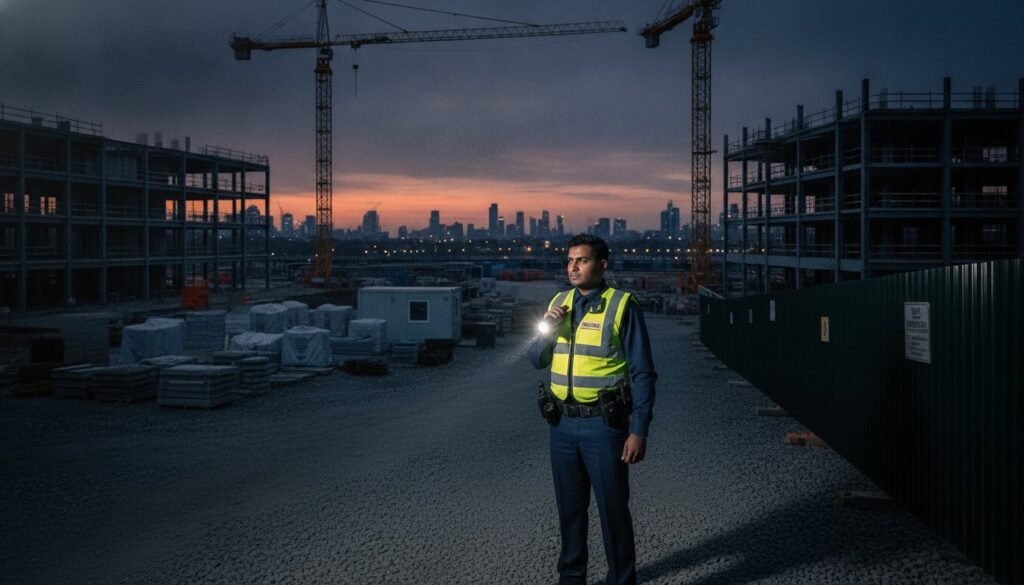
92% of UK construction companies have experienced theft, contributing to an industry loss exceeding £1 billion annually. For a site manager, these figures represent more than just lost assets; they signify stalled projects and escalating insurance premiums. Deploying professional construction site security guards is no longer an optional precaution. It’s a fundamental operational requirement. Vigilance must be constant. Protection must be absolute.
You understand that a secure site requires more than just a presence at the gate. It demands a disciplined approach to risk management that addresses both human and environmental threats. This guide provides a strategic framework for organising effective site protection. We’ll demonstrate how to deploy professional construction site security guards who are trained to handle modern criminal tactics whilst maintaining rigorous fire safety standards. You’ll learn to navigate complex insurance requirements, reduce the risk of project delays, and establish a site environment defined by order and professional integrity.
Key Takeaways
- Mitigate the severe financial and operational impact of organised crime by understanding the latest security trends in the UK construction sector.
- Ensure full legal compliance by verifying SIA licence credentials and mandatory first aid training for all on-site personnel.
- Determine the optimal balance between static manned guarding and specialised canine units based on your site’s specific vulnerabilities.
- Establish robust “Standard Operating Procedures” to maintain a disciplined and watchful presence that deters theft, vandalism, and arson.
- Learn how professional construction site security guards integrate fire marshal duties to protect project timelines and ensure full UK compliance.
The Growing Need for Construction Site Security Guards in the UK
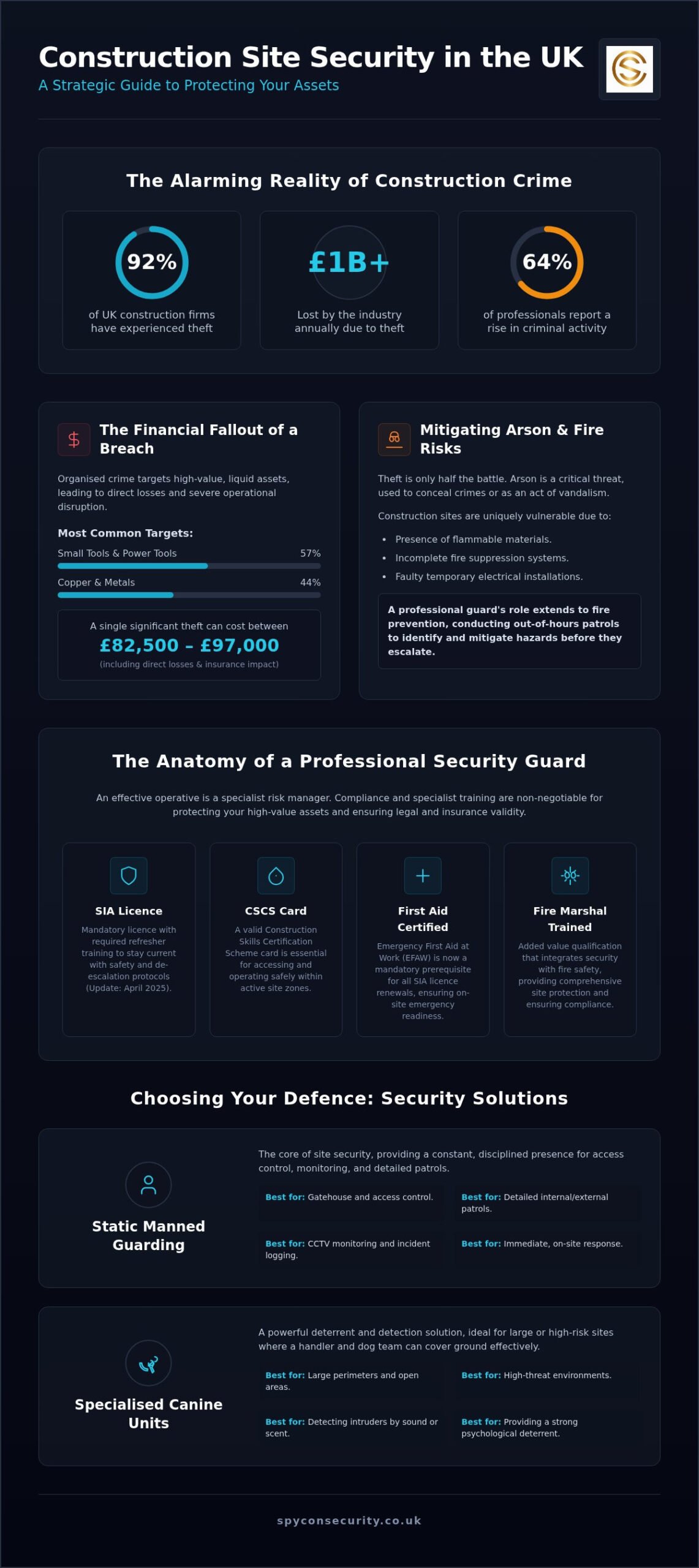
UK construction crime has evolved into a sophisticated programme risk. In 2026, 64% of industry professionals report a rise in criminal activity, with 92% of firms experiencing at least one theft incident. These aren’t isolated petty crimes; they’re organised operations targeting high-value assets. Maintaining Construction site safety requires a proactive stance against these threats. The presence of professional construction site security guards provides the first line of defence against intruders who view an unsecured perimeter as an invitation. Without a visible deterrent, a site is a target for professional gangs that can strip a location of its most valuable materials in a single night.
Financial Risks: Theft and Plant Machinery Loss
Criminals focus on liquidity. Small tools and power tools remain the primary targets, featuring in 57% of incidents, while copper theft affects 44% of sites. Loss of heavy machinery or fuel supplies creates immediate operational gaps. Beyond the replacement value, firms face hidden costs such as substantial insurance premium hikes and the expense of hiring temporary plant. A single significant theft event can cost a project between £82,500 and £97,000 when accounting for direct losses and insurance consequences. Contractors must account for the fact that the average daily cost of site downtime in 2026 can exceed tens of thousands of pounds when factoring in idle labour and liquidated damages.
Mitigating Arson and Fire Risks on Site
Theft is only half of the equation. Arson remains a critical threat, often used to mask evidence of theft or as an act of pure vandalism. Construction sites are uniquely vulnerable because of the presence of flammable materials and incomplete fire suppression systems. Professional construction site security guards play a vital role in fire prevention by identifying hazards during out-of-hours patrols. They monitor for smouldering materials, faulty temporary electrics, and signs of deliberate fire-starting. This vigilant oversight complements professional fire risk assessment services, ensuring that security and safety protocols operate in unison to protect the site’s integrity and project timeline.
What Defines a Professional Construction Security Guard?
A professional security operative is far more than a visible deterrent at a site entrance. They’re specialist risk managers who operate with absolute precision and discipline. Effective construction site security guards must possess a blend of physical presence, technical knowledge, and the ability to manage complex perimeters under pressure. They act as the primary point of contact for emergency services and the final line of defence for high-value plant machinery. Vigilance is their standard. Order is their objective.
SIA Licensing and Legal Compliance
Compliance is non-negotiable in the UK security sector. You should never deploy unlicensed personnel to protect your assets. As of April 2025, all security guards must complete mandatory refresher training to renew their Security Industry Authority (SIA) licence. This ensures they’re current with the latest safety protocols and conflict de-escalation techniques. Furthermore, a valid Emergency First Aid at Work (EFAW) certificate is now a mandatory prerequisite for all licence renewals.
There’s a distinct difference between basic guarding and professional manned guarding. High-risk sites require operatives who understand the legal framework of their authority, including the proper justification for the use of force. Hiring unlicensed staff isn’t just a security risk; it’s a legal liability that can invalidate your insurance policies and lead to severe penalties under UK health and safety laws. The same principle applies across all sectors — businesses seeking office security guards London firms rely on must equally ensure their provider meets SIA licensing standards and delivers verifiable compliance.
Specialist Training for Construction Environments
The construction environment presents unique hazards that require specific qualifications. Security personnel entering active zones must hold a valid CSCS card, demonstrating they understand site-specific safety protocols. This training is essential for navigating porous perimeters and identifying risks that could lead to project delays. The industry is currently undergoing a significant shift, with a major SIA qualification overhaul rolling out from Autumn 2026. This update focuses on advanced safety-critical skills, including counter-terrorism awareness and enhanced emergency response.
Professional construction site security guards often provide added value by holding fire marshal certifications. They’re trained to monitor for fire hazards during out-of-hours patrols, ensuring that smouldering materials or faulty electrics don’t escalate into a catastrophic loss. This dual-role capability is vital for meeting increasingly strict insurance requirements. Establishing a resilient perimeter starts with selecting highly trained security guards who understand the unique pressures of the UK construction industry. Their role involves meticulous reporting and constant communication, providing site managers with the peace of mind that every vulnerability is being actively managed.
Comparing Security Solutions: Static Guards vs. Canine Units
Selecting the correct deployment model for construction site security guards is a strategic decision that impacts both budget and operational efficacy. A one-size-fits-all approach often leaves vulnerabilities. Site managers must evaluate whether their primary risk is unauthorised access during working hours or large-scale theft under the cover of darkness. While technology provides oversight, physical presence remains the only way to intervene before a loss occurs. Discipline in selection leads to resilience in protection.
Static Guarding for Access and Asset Management
Static manned guarding is the foundation of site order. These operatives manage the “front of house,” ensuring that only authorised personnel and vehicles pass the perimeter. They’re responsible for:
- Verifying delivery manifests against incoming plant and materials to prevent inventory shrinkage.
- Maintaining accurate visitor logs to satisfy health and safety audits and UK compliance.
- Conducting methodical perimeter patrols using electronic clocking points to ensure constant vigilance.
This role is vital for preventing “walk-on” theft during active hours. It ensures that the site remains a controlled environment where every individual is accounted for. The presence of a professional guard at the gatehouse establishes a tone of authority that deters opportunistic crime from the moment a project begins.
Canine Units for High-Deterrence Patrols
For sites with extensive perimeters or high-value metal and fuel storage, canine security offers a superior level of protection. A single dog handler unit can effectively patrol an area that would require multiple static construction site security guards to cover. The psychological deterrent of a professional K9 unit is unparalleled. Most intruders will bypass a site if they believe a security dog is present. It’s a clear signal that the site is not an easy target.
Security dogs possess sensory capabilities that surpass any human or camera. Their ability to detect intruders through scent and sound in low-light conditions makes them ideal for large, porous sites where CCTV blind spots may exist. This is a highly efficient solution for high-risk projects. It combines the intelligence of a trained handler with the biological edge of a protection dog. While CCTV provides a record of events, a canine unit provides a proactive response that can neutralise a threat before assets are compromised. Precision in deployment ensures that high-value zones, such as copper storage areas, receive the highest level of vigilant oversight.
How to Organise Your Construction Site Security Strategy
Effective protection requires a methodical framework. It’s not enough to simply deploy construction site security guards and hope for the best. You must integrate them into a disciplined operational system that addresses specific site vulnerabilities. A successful strategy is a live document. It evolves with the project phases and responds to changing threat levels. Precision in planning leads to certainty in protection.
Step 1: Conduct a Site-Specific Risk Assessment
Before any operative sets foot on site, you must identify every potential entry point and blind spot. This involves a physical walk-through to inspect perimeter fencing, lighting, and gatehouse positioning. Analysing local crime data in cities like London or Birmingham is essential to understand the specific tactics used by regional criminal gangs. High-value asset zones, such as fuel stores and plant machinery compounds, should be situated in central, well-lit areas to maximise the effectiveness of surveillance and patrol visibility. This data-driven approach ensures that resources are allocated to the most vulnerable areas first, creating a layered defence that deters even the most determined intruders.
Step 2: Define Guard Responsibilities and Patrol Routes
Clarity is the foundation of discipline. Every guard must understand their specific duties through detailed Standard Operating Procedures (SOPs). Digital patrol tags should be installed at critical points around the perimeter. This ensures 100% site coverage and provides verifiable data that patrols are being conducted as scheduled. Guards should be trained in “Challenge and Response” protocols to handle unauthorised intruders with professional authority and legal justification. Incorporating fire safety checks into the nightly patrol routine adds a layer of protection against arson and accidental fire risks. This watchful oversight ensures that hazards are identified and neutralised before they can cause catastrophic project delays.
Step 3: Establish Communication and Reporting Lines
Accountability is maintained through rigorous reporting. Daily occurrence logs (DOLs) and incident reports provide a clear audit trail of all site activity. Utilising body-worn cameras ensures guard accountability and provides crucial evidence for police investigations if a breach occurs. For total oversight, integrate your physical guarding with 24/7 CCTV monitoring services. This combination allows for immediate verification of alarms and a coordinated response between on-site personnel and remote monitoring centres. Emergency contact procedures for site managers and emergency services must be clearly established and tested regularly. Regular monthly audits of these reports allow site managers to refine the strategy and maintain a secure environment. Organise your site security with professional manned guarding to ensure your project remains on schedule and within budget.
Spycon Security: Integrated Protection for the UK Construction Sector
Spycon Security Ltd. understands that protecting a construction site is an exercise in operational precision. We don’t just provide construction site security guards; we deploy disciplined professionals who act as a direct extension of your site management team. Our approach is grounded in the belief that security and safety are inseparable. We serve projects across the UK, from high-density urban developments in London and Birmingham to infrastructure works in Manchester and Leeds. Every deployment is managed with a level of professional gravity and unwavering reliability that ensures your assets remain secure.
The Spycon Advantage: Security Meets Fire Safety
A significant vulnerability for many contractors is the disconnect between physical security and fire prevention. Spycon bridges this gap by training our guards to handle fire marshal duties as a core part of their patrol routine. This integrated vigilance ensures the integrity of your fire strategy report is maintained throughout the project lifecycle. We identify risks like improperly stored combustible materials or faulty temporary wiring before they escalate into catastrophic incidents.
This dual-purpose oversight is specifically designed to satisfy increasingly strict insurance requirements. Insurers today demand verifiable proof of active risk management. Our construction site security guards provide this through meticulous daily occurrence logs and digital patrol verification. We don’t allow for shortcuts. By maintaining a highly organised and authoritative presence, we ensure your site remains compliant with UK health and safety laws whilst providing the peace of mind that comes from elite protection. Our commitment to SIA standards and continuous training means our personnel are always ready to face modern criminal threats with absolute precision. Ensuring your site holds a valid fire alarm installation certificate is an equally critical component of this compliance framework, providing insurers with the documented proof of professional fire safety standards they require.
Next Steps: Securing Your Project with Spycon
Every construction project has a unique risk profile. We don’t offer generic packages. Instead, we begin with a thorough site security and fire risk survey to identify your specific vulnerabilities. Whether you require a single operative for a site in Luton or a rapid-response team for a major development in Edinburgh, our solutions are fully scalable to your requirements.
Our teams operate with absolute transparency and professional integrity. We provide the watchful guardianship needed to keep your project on schedule and your budget intact. Contact our expert team today for a confidential consultation. Let us demonstrate how a disciplined, integrated security strategy can protect your assets, your people, and your professional reputation.
Establish a Resilient Perimeter for Project Success
Site protection is a discipline that requires unwavering reliability and professional gravity. By deploying elite construction site security guards, you address the sophisticated threats of modern crime whilst ensuring your project remains compliant with UK safety standards. Integrating physical guarding with fire safety duties provides a comprehensive shield against the financial and operational risks of theft and arson. This proactive stance satisfies strict insurance requirements and secures your project’s timeline.
Your site’s security shouldn’t be left to chance. A structured approach involving SIA licensed professionals ensures that every vulnerability is actively managed and every asset is protected. With a watchful guardian in place, you gain the peace of mind necessary to drive your project toward a successful completion.
Secure your site today with Spycon’s professional manned guarding. Our teams provide UK-wide coverage and operate as integrated fire safety experts to maintain order and professional integrity on every project.
Frequently Asked Questions
Do construction site security guards need an SIA licence?
Every operative must hold a valid Security Industry Authority (SIA) licence to work legally in the UK. This certification ensures they’ve passed rigorous background checks and completed standardised training. As of April 2025, mandatory refresher qualifications are required for all renewals. Hiring unlicensed personnel is a serious breach of compliance that can invalidate your insurance and lead to criminal prosecution. Always verify the licence status of your construction site security guards before deployment.
Can security guards also act as fire marshals on a construction site?
Professional guards can perform fire marshal duties if they’ve received specific fire safety training. This dual role is highly effective for out-of-hours protection. Operatives conduct regular patrols to identify fire hazards, such as smouldering materials or faulty electrics. Integrating these responsibilities ensures constant vigilance against arson and accidental fires. This approach satisfies strict insurance requirements and protects your site’s fire strategy report integrity during high-risk project phases.
What is the difference between static guarding and mobile patrols for construction?
Static guarding involves a permanent presence at a specific location, such as a gatehouse or asset store. It’s ideal for access control and managing delivery manifests. Mobile patrols involve operatives moving between multiple points or sites in a vehicle or on foot. While static guards provide constant oversight of a single point, mobile patrols offer a cost-effective deterrent for larger perimeters where a continuous presence isn’t required at every gate.
How many security guards do I need for my construction site?
The required number of construction site security guards depends on your specific site risk assessment. Factors include the total acreage, the number of entry points, and the value of on-site plant machinery. A small, contained site may only require a single static guard. Larger, porous developments often benefit from a combination of manned guarding and canine units. We recommend a professional survey to determine the optimal deployment level for your project’s unique vulnerabilities.
Are canine security units more effective than human guards alone?
Canine units offer a superior psychological deterrent and enhanced sensory capabilities. A single dog handler can often cover the same ground as multiple static guards due to the animal’s acute sense of smell and hearing. Dogs are particularly effective in low-light conditions where CCTV or human sight might fail. While human guards are essential for access control and reporting, canine units provide an uncompromising level of protection for high-value metal or fuel stores.
How do construction security guards help with insurance compliance?
Insurers often mandate professional security as a condition of coverage, especially for high-value projects. Guards provide verifiable proof of protection through daily occurrence logs and digital patrol tags. This disciplined oversight demonstrates that you’re actively mitigating risks of theft, vandalism, and arson. By meeting these “watchman” or “security” clauses, you don’t just ensure compliance; you may also negotiate lower premiums through a proven commitment to professional risk management.
What should be included in a construction site security risk assessment?
A comprehensive assessment must identify all perimeter vulnerabilities, blind spots in surveillance, and lighting gaps. It should analyse local crime trends in areas like Manchester or Birmingham to anticipate specific threats. The report must also categorise high-value asset zones and define “Challenge and Response” protocols. Including fire safety hazards is essential for a holistic strategy. This document serves as the operational blueprint for your security team, ensuring every risk is accounted for.
Can guards monitor CCTV systems whilst on patrol?
Modern security operatives can monitor CCTV feeds via mobile devices during their patrols. This allows for immediate verification of perimeter breaches or fire hazards identified by the system. However, for maximum efficacy, we recommend integrating on-site guarding with a dedicated fire alarm installation certificate-verified system and a 24/7 monitoring centre. This ensures that while the guard is physically patrolling one zone, a remote operative maintains constant oversight of the entire site, providing a seamless and layered defence.