


A fire alarm installation certificate is often the only barrier between a compliant operation and a criminal prosecution. In the event of a fire, your insurance provider will demand proof of meticulous verification and professional standards. Without this documentation, your personal liability is absolute. It is a high-stakes requirement that demands precision and unwavering adherence to UK standards.
We recognise that the distinction between installation and commissioning certificates often causes unnecessary confusion for property owners. Many managers fear failing a Fire Risk Assessment due to incomplete logbooks or misunderstood technical protocols. This guide provides the professional clarity required to master these essential requirements. You will learn to ensure your UK property remains legally compliant, fully insured, and professionally protected. We provide a definitive breakdown of the four critical stages of certification. This information grants you absolute peace of mind and a logbook that satisfies the most rigorous fire authorities during any inspection.
Key Takeaways
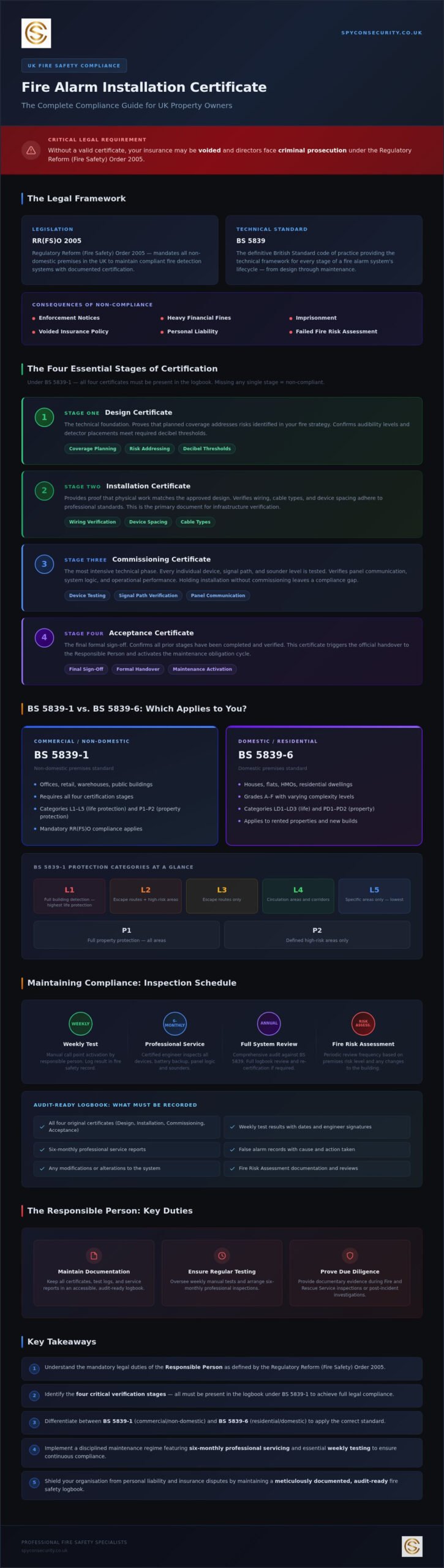
- Understand the mandatory legal duties of the Responsible Person as defined by the Regulatory Reform (Fire Safety) Order 2005.
- Identify the four critical verification stages required to secure a valid fire alarm installation certificate for your UK property.
- Differentiate between BS 5839-1 and BS 5839-6 to ensure your fire safety system adheres to the correct technical grade and category.
- Implement a disciplined maintenance regime featuring six-monthly professional servicing and essential weekly testing to ensure continuous compliance.
- Shield your organisation from personal liability and insurance disputes by maintaining a meticulously documented, audit-ready fire safety logbook.
What is Fire Alarm Certification and Why is it Mandatory?
Fire alarm certification is a formal declaration of safety. It serves as the primary verification that a detection system adheres to the rigorous BS 5839 standards. This documentation is not a mere administrative formality. It’s a mandatory requirement for every non-domestic premises across the United Kingdom. A valid fire alarm installation certificate confirms that the physical components, including wiring and device placement, align with the original design specifications. It’s the first line of defence in proving that your life safety systems are fit for purpose.
The distinction between different types of certification is critical for legal clarity. Whilst an installation certificate confirms the physical build, a commissioning certificate verifies the system’s operational logic and performance. Holding one without the other leaves a gap in your compliance record. Insurers view these documents as essential “condition precedents.” If a fire occurs and you cannot produce a valid fire alarm installation certificate, your policy coverage may be voided. This leaves the organisation and its directors exposed to significant financial and legal peril.
The Legal Framework: RR(FS)O and BS 5839
The Regulatory Reform (Fire Safety) Order 2005 (RR(FS)O) defines the legal landscape for UK fire safety. Under this legislation, the “Responsible Person” carries the absolute duty to ensure the premises are safe for all occupants. BS 5839 acts as the definitive code of practice that supports this law. It provides the technical framework for every stage of the system’s lifecycle. Failure to produce valid certification during an official audit by the Fire and Rescue Service can result in enforcement notices, heavy fines, or even imprisonment. These documents are vital components of your safety strategy, often highlighted during professional fire risk assessment services. Without them, you cannot prove that your system meets the minimum legal threshold for life protection.
Certification as a Risk Mitigation Tool
Professional certification serves as a robust shield for directors and property managers. It provides tangible evidence of due diligence and professional oversight. In the aftermath of an incident, investigators look for a clear paper trail of verification. A missing certificate suggests a lack of control and a failure in safety management. This documentation must align with the latest commercial fire alarm system regulations UK to ensure every sensor and sounder functions within precise legal parameters. The Fire and Rescue Service regards these certificates as the primary evidence of a compliant system. They offer the peace of mind that comes from knowing your liability is managed through meticulous, third-party verification.
The Four Essential Stages of Fire Alarm Certification
Fire safety compliance is a cumulative process. It isn’t a single document issued at the end of a project. Under BS 5839-1, a system only achieves full legal status when four distinct certificates are present in the logbook. Missing even one stage renders the entire system non-compliant. This chain of evidence is what fire authorities and insurance investigators scrutinise first. It’s your primary defence against claims of negligence. Each stage represents a specific layer of verification that protects the Responsible Person from liability.
Design and Installation Certificates
The Design Certificate is the technical foundation of your system. It proves that the planned coverage, such as L1 or L2 categories, accurately addresses the risks identified in your fire strategy. This document confirms that audibility levels and detector placements will meet the required decibel thresholds. Once the design is set, the fire alarm installation certificate provides proof that the physical work matches these plans. It verifies that the wiring, cable types, and device spacing adhere to the highest professional standards. Meticulous fire alarm installation is essential because it prevents the faults that lead to false alarms or system failures. Without a valid fire alarm installation certificate, you cannot prove the infrastructure of your life safety system is sound.
Commissioning and Acceptance: The Final Sign-Off
Commissioning is the most intensive technical phase. An engineer tests every individual device, signal path, and sounder level to ensure the system logic is flawless. They verify that the panel communicates correctly with every sensor in the building. However, the process remains legally incomplete without the Acceptance Certificate. This is where many property managers falter. You must sign this document to acknowledge the system is operational and that you’ve received the necessary training on how to use it. It’s the formal handover of responsibility. If you’ve inherited a building with a system of unknown origin, you’ll need a Verification Certificate. This retrospective audit confirms the system’s integrity when the original paperwork is missing. Securing professional fire strategy reports can help identify which certification gaps currently exist in your portfolio.
A compliant system is a documented system. Don’t assume your contractor has completed the job until all four certificates are safely inside your fire logbook. It’s the only way to ensure your property remains fully protected and legally beyond reproach.
BS 5839-1 vs. BS 5839-6: Which Certification Applies to You?
Selecting the wrong British Standard for your property is a costly error. It invalidates your compliance and leaves you vulnerable during a fire safety audit. UK regulations split fire alarm systems into two distinct parts. BS 5839-1 governs non-domestic premises, whilst BS 5839-6 covers domestic dwellings. Identifying which applies to your building is essential before you commission any work or request a fire alarm installation certificate. Professional precision at this stage prevents technical failures and legal disputes later.
Commercial and Public Buildings (BS 5839-1)
This standard applies to offices, shops, industrial units, and the communal areas of large residential blocks. It focuses on sophisticated detection and management. You must understand the Category system to ensure your system is fit for purpose. Category L (Life Safety) systems range from L1, providing total coverage, to L5, designed for specific fire risks. Category P (Property Protection) is often demanded by insurers to minimise building damage. For complex sites with mixed usage or high-occupancy levels, securing fire strategy reports is the only way to determine the correct category. A fire alarm installation certificate issued under Part 1 verifies that these complex technical requirements are met with absolute precision.
Domestic and Residential Certification (BS 5839-6)
Domestic certification uses a Grade system from A to F. Grade A systems are the most robust, featuring a central control panel and detectors, similar to commercial setups. These are often mandatory for large Houses in Multiple Occupation (HMOs) where the risk level is higher. Grade D1 and D2 systems involve mains-powered, interlinked alarms with battery backups. These are the standard for most rental properties. Grade F systems, which rely solely on batteries, are increasingly insufficient for modern compliance. The 2026 standards now demand more rigorous smoke alarm placement amongst residential units, particularly in escape routes and high-risk rooms. Landlords must ensure their Part 6 certificate reflects these latest safety thresholds. Mixed-use buildings, such as a ground-floor retail unit with flats above, require professional consultancy to integrate these two standards into a single, cohesive safety plan.
Maintaining Compliance: Inspection Intervals and Record Keeping
Compliance is a perpetual cycle of verification. It doesn’t end once the initial fire alarm installation certificate is filed away in your records. For commercial properties, the Regulatory Reform (Fire Safety) Order 2005 demands that systems are maintained in an efficient state and in good repair. This requires a disciplined approach to both professional inspections and internal testing. Any lapse in this regime creates a void in your legal protection. It exposes the Responsible Person to personal liability if the system fails during an incident.
The 6-Month Professional Service
A professional engineer must conduct a thorough service of your system at least every six months. This bi-annual inspection is far more technical than a routine user test. The engineer verifies battery standby capacity, examines detector sensitivity, and ensures sounder decibel levels remain audible throughout the premises. It’s vital to understand that a Service Certificate is distinct from the original fire alarm installation certificate. Whilst the installation document confirms the system was built correctly, the service certificate proves it remains operational. These inspections often reveal hidden faults that only specialised diagnostic equipment can detect. Coordinating these services alongside your fire risk assessments ensures a holistic approach to building safety. If a system fails this inspection, remedial works must be completed immediately to restore the safety of the site.
Weekly Testing and Logbook Management
The building owner carries a non-negotiable duty to perform a weekly user test. You should activate a different manual call point each week on a rotational basis. This ensures every device in the circuit functions correctly over time. The results, including the date, time, and specific call point location, must be recorded in the Fire Alarm Logbook. This book is your primary evidence during a Fire and Rescue Service audit. An incomplete logbook is often the first red flag for inspectors. It suggests a lack of management control. You must also record every false alarm and fault signal. Tracking these events helps identify patterns of “alarm fatigue” or equipment degradation before they lead to a total system failure. Meticulous record-keeping is the only way to demonstrate that you’ve fulfilled your legal obligations.
If your current logbook is incomplete or your servicing is overdue, you’re operating outside the legal threshold. Secure your property by booking a professional fire alarm system inspection today to restore your compliant status.
Professional Fire Safety Solutions with Spycon Security Ltd.
Spycon Security Ltd. operates with a commitment to professional gravity and operational precision. We understand that fire safety is not an area where shortcuts are permissible. Our team provides the technical expertise required to navigate the complex landscape of UK fire regulations. We ensure that every system we touch is backed by a valid fire alarm installation certificate, whilst providing the technical support needed for long-term maintenance. This document is the cornerstone of your legal defence and insurance validity. By choosing an elite partner, you move beyond basic compliance into a state of total property protection.
Expert Consultancy and Technical Installation
Our approach to fire alarm installation is bespoke and meticulous. We don’t believe in generic solutions for complex risks. Our consultants support property managers across major UK hubs, including Birmingham and Manchester, with detailed fire strategy reports. These reports are building-control approved and provide a clear roadmap for life safety. There is a significant operational advantage to using a single, disciplined provider for both physical security and fire safety. It ensures a seamless integration of CCTV monitoring and manned guarding with your fire detection protocols. For high-value commercial sites, pairing fire safety expertise with commercial property security guards London professionals creates a unified defence against arson, unauthorised access, and fire safety non-compliance. This unified strategy eliminates communication gaps and strengthens your overall security posture.
Securing Your Compliance for 2026
The regulatory environment is constantly evolving. Preparing for the 2026 standards requires a proactive stance and a deep understanding of BS 5839 amendments. We help you stay ahead of these changes by conducting comprehensive site surveys and retrospective audits. If your current fire alarm installation certificate is missing or outdated, our seasoned experts will identify the gaps and provide the necessary verification. We operate with absolute transparency and integrity. Our goal is to provide the peace of mind that comes from knowing your building is a fortress against fire risks.
A professional audit is the only certain way to guarantee compliance. Don’t leave your personal liability to chance or inadequate documentation. Ensure your organisation is protected by a watchful guardian that values order and excellence above all else. Secure your 2026 compliance and protect your assets with professional-grade fire safety solutions from Spycon Security Ltd.
Secure Your Property with Disciplined Fire Safety Standards
Maintaining a valid fire alarm installation certificate is a continuous commitment to life safety and legal integrity. It’s the only way to ensure your building remains fully insured and compliant with the Regulatory Reform (Fire Safety) Order 2005. You’ve learned that certification requires a meticulous four-stage verification process and a disciplined maintenance regime. These technical protocols prevent the failures that lead to catastrophic loss and personal liability. Precision in record-keeping is your primary shield during any official audit by the Fire and Rescue Service.
As SIA Licensed Security Experts, Spycon Security Ltd. provides comprehensive fire safety consultancy across London, Manchester, and Birmingham. We operate with the professional gravity required to protect high-risk sites and complex commercial portfolios. Our team ensures your systems meet every rigorous standard for 2026 and beyond. We provide the expertise needed to navigate mixed-use challenges and technical inspections with absolute confidence. Contact Spycon Security Ltd. for Professional Fire Alarm Certification and Compliance. Take control of your compliance today to ensure absolute peace of mind for the future of your property.
Frequently Asked Questions
Is a fire alarm certificate a legal requirement in the UK?
It is a non-negotiable legal requirement for non-domestic premises. The Regulatory Reform (Fire Safety) Order 2005 mandates that the Responsible Person maintains a safe environment. Holding a valid fire alarm installation certificate is the primary way to prove the system meets BS 5839 standards. Failure to produce this documentation during a Fire and Rescue Service inspection can lead to enforcement notices or prosecution. It serves as your definitive proof of professional due diligence.
How long does a fire alarm certificate last before it expires?
A professional installation certificate doesn’t have a fixed expiry date. However, its validity depends on a continuous chain of maintenance. Commercial systems must be professionally serviced at least every six months. Each service generates a new certificate that verifies the system remains operational. If you fail to maintain this six-monthly cycle, the original document no longer proves the current safety of the premises. Continuous verification is essential for insurance and legal compliance.
Who is authorised to issue a fire alarm commissioning certificate?
Only a competent person with the necessary technical training and experience is authorised to issue these documents. This typically refers to engineers who operate under third-party accredited schemes. These professionals possess the specialised equipment required to test system logic and sounder decibels. Relying on uncertified contractors or general electricians without specific fire safety qualifications puts your legal compliance and the safety of your occupants at significant risk. It is a matter of professional integrity.
What is the difference between a fire alarm certificate and a fire risk assessment?
The certificate is a technical document verifying that the detection hardware meets British Standards. In contrast, a fire risk assessment is a comprehensive audit of the entire building’s safety protocols. The risk assessment identifies potential hazards and specifies the required category of alarm system. Whilst the certificate proves the equipment works, the risk assessment confirms the equipment choice is appropriate for the specific risks present within your unique property environment.
Do I need a new certificate if I move a single fire detector?
Yes, any modification to the system layout requires a new certificate of modification. Even moving a single detector can alter the coverage and audibility levels of the entire circuit. A professional engineer must verify that the change doesn’t create blind spots or signal faults. This ensures the 2026 standards for detection placement are still met. Recording these minor works maintains the integrity of your fire logbook and prevents disputes with insurance providers.
Can I self-certify my own fire alarm system if I am a landlord?
Landlords cannot self-certify fire alarm systems unless they are professionally qualified as a competent person under UK law. For Grade A systems in HMOs or Part 1 systems in commercial units, third-party verification is mandatory. Self-certification lacks the professional gravity required by the Fire and Rescue Service. It leaves you personally liable for any system failures. Always engage a disciplined expert to ensure your documentation remains legally robust and your insurance policy stays valid.
What happens if my business does not have a valid fire alarm certificate?
Operating without a valid fire alarm installation certificate carries severe consequences. You face immediate enforcement action from fire authorities, which can include heavy fines or the closure of your premises. Perhaps more critically, your insurance provider will likely reject any claims following a fire. Without professional certification, you cannot prove that you’ve fulfilled your legal duty of care. This exposes directors to absolute personal liability and potential criminal prosecution for negligence.
What is an Acceptance Certificate and why must I sign it?
The Acceptance Certificate is the final document in the certification lifecycle. By signing it, the building owner or manager confirms the system has been handed over in good working order. It also verifies that you’ve received adequate training on how to operate the panel and manage false alarms. Signing this document is a formal acknowledgment of your ongoing responsibility. It completes the legal paper trail required to prove the system is fully operational.