


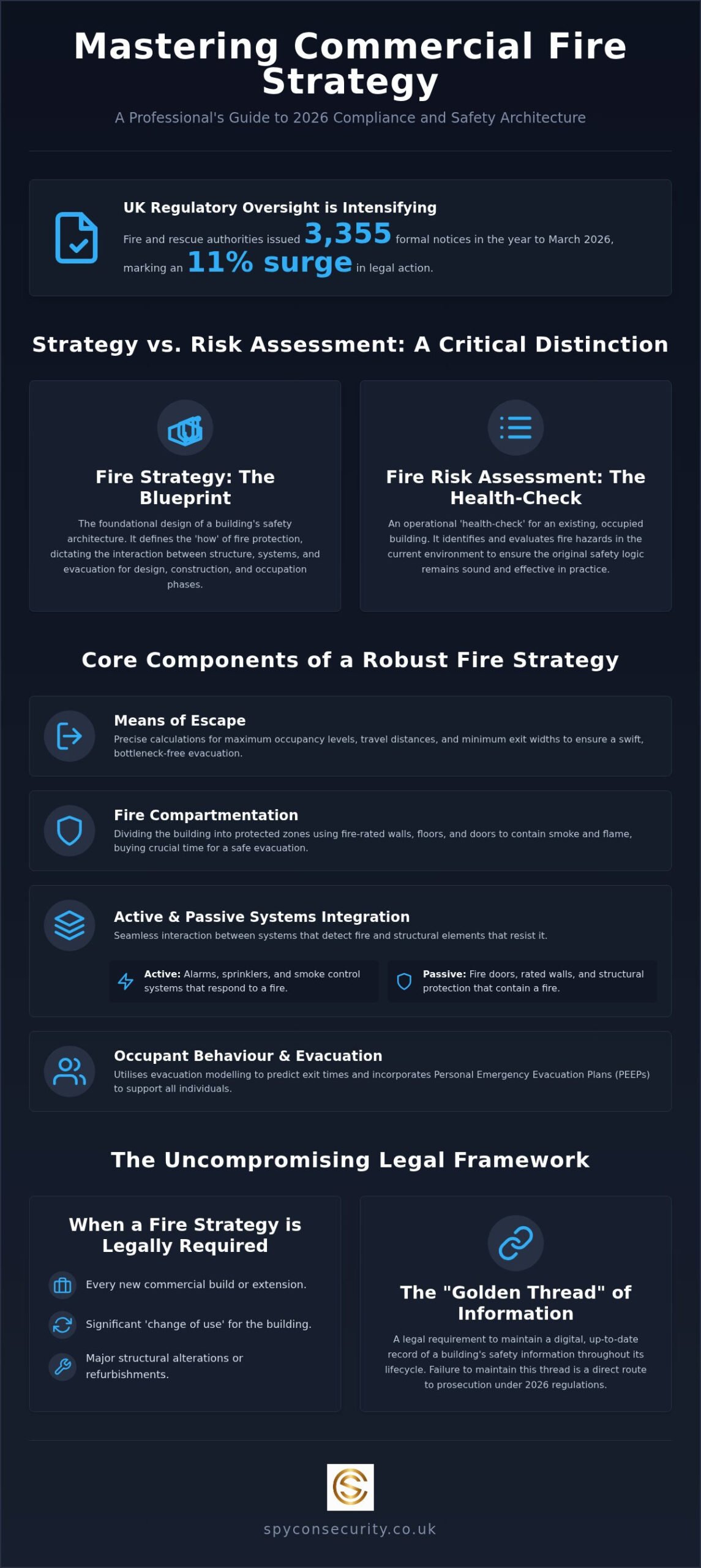
Fire and rescue authorities issued 3,355 formal enforcement notices in the year ending March 2026. This 11% surge in legal action signals a new era of uncompromising regulatory oversight. A comprehensive fire strategy for commercial buildings is no longer a mere recommendation; it’s the foundational requirement for legal operation. You understand that a single oversight can compromise an entire facility. You’re likely managing the friction between rigid fire exit requirements and the necessity of building security. High stakes. Zero margin for error.
This guide ensures you master these complexities to protect your assets and safeguard lives. You’ll gain a clear understanding of your legal obligations and how to produce approved documentation for building control and insurers. We’ll examine the “Golden Thread” of digital safety records, the updated BS 8214:2026 standards for fire doors, and tactical methods to keep your premises both secure and fire-safe. Precise compliance. Total professional confidence. This is the path to absolute peace of mind.
Key Takeaways
- Distinguish between a standard risk assessment and a comprehensive fire strategy for commercial buildings to ensure your safety blueprint meets legal standards.
- Master the technical requirements for occupancy levels, exit widths, and fire compartmentation to prevent the spread of smoke and flame.
- Navigate the 2026 legal implications of the Regulatory Reform (Fire Safety) Order to maintain unwavering compliance and avoid prosecution.
- Harmonise physical site security with fire safety protocols through the strategic deployment of fire marshals and “Walking Watch” services.
- Secure professional, approved documentation that satisfies the rigorous requirements of building control, insurers, and the Building Safety Regulator.
What is a Fire Strategy for Commercial Buildings?
A fire strategy for commercial buildings is the foundational blueprint of your facility’s safety architecture. It establishes the technical logic behind how a building behaves during an emergency. This isn’t just about placing extinguishers or signage. It’s a comprehensive framework. It dictates the interaction between structural design, active systems like alarms, and the human element of evacuation. By integrating fundamental Fire safety principles into the building’s DNA, you ensure protection that is proactive rather than reactive.
This document serves as the master plan during design, construction, and occupation phases. It provides the technical justification for your safety choices. It outlines how fire compartmentation will contain a blaze and defines the exact requirements for active systems. Without this blueprint, your building’s safety measures are merely a collection of isolated parts rather than a unified shield.
The Blueprint vs. The Health-Check
Many professionals confuse a strategy with a risk assessment. The distinction is critical for compliance. A strategy is the “how” of the building’s design intent. It defines how smoke is controlled and how occupants reach safety. Conversely, fire risk assessments serve as an operational “health-check” to identify hazards in a building that’s already in use. Insurers and building control bodies prioritise technical fire strategy reports for complex sites to verify that the original safety logic remains sound. This is especially vital in high-density hubs like London, where structural complexity increases risk.
When is a Formal Strategy Legally Required?
Legal triggers for a fire strategy for commercial buildings are clear and uncompromising. Under Building Regulations Part B, every new commercial build or extension requires a documented strategy to secure building control approval. You can’t rely on generic plans. If you’re undertaking a significant change of use or structural alterations, the law requires an updated strategy. The “Responsible Person” carries the weight of this duty. They must ensure the strategy reflects the building’s current layout and occupancy. In the 2026 regulatory environment, failing to maintain this “Golden Thread” of information is a direct route to prosecution. Precision in documentation isn’t optional. It’s a matter of legal survival.
Core Components of a Robust Fire Strategy
A robust fire strategy for commercial buildings functions as a cohesive ecosystem. It isn’t a static list of equipment. It’s a dynamic plan that integrates structural integrity with operational response. You must ensure that every component, from the thickness of a partition wall to the decibel level of a sounder, aligns with the building’s specific occupancy profile. This requires a meticulous approach to both active and passive protection measures to create a fail-safe environment.
Calculating means of escape requires technical precision. You must account for maximum occupancy levels and minimum exit widths to prevent bottlenecks during a crisis. This data is often derived from the UK Government Fire Safety Guidance. Simultaneously, fire compartmentation acts as your secondary line of defence. By using fire-rated walls and floors, you divide the building into protected zones. This contains smoke and flame, providing the vital time needed for a safe evacuation. Our team at Spycon Security maintains a commitment to professional integrity that ensures every component of your strategy is verified and rigorous.
Evacuation Modelling and Occupant Behaviour
Evacuation modelling is a tool for predicting safe exit times in high-occupancy buildings. It accounts for the diverse behaviours found in different commercial settings. An office environment, with its familiar layout, requires a different strategy than a high-ceilinged warehouse or a retail centre. Central to this is the inclusion of Personal Emergency Evacuation Plans (PEEPs). These are no longer optional considerations. Effective April 2026, duty holders must identify and support every individual who may require assistance during an emergency. Your strategy must reflect these specific human requirements to be truly effective.
Active and Passive Systems Integration
True protection relies on the seamless interaction between active and passive measures. Professional fire alarm installation provides the early warning necessary to initiate the strategy. These systems must adhere to BS 5839-1:2025 to ensure reliability. However, this alert must trigger a passive response. This includes the automatic closing of fire doors held on magnetic releases. Regular fire door surveys are essential to verify that these barriers remain functional and compliant with BS 8214:2026. If a door fails to seal, the compartmentation logic collapses. Passive protection also extends to fire-stopping. You must verify that every service penetration through a fire-rated wall is sealed with appropriate materials to prevent the invisible spread of toxic gases.
UK Regulatory Compliance: The Legal Framework in 2026
The regulatory landscape for fire safety has shifted significantly. As of 2026, authorities have moved away from occasional inspections toward a model of constant verification. The Regulatory Reform (Fire Safety) Order 2005 remains the primary legislation, but its enforcement is now more rigorous. Fire and rescue authorities issued 3,355 formal notices in the year ending March 2026. This 11% increase highlights a zero-tolerance approach to negligence. A robust fire strategy for commercial buildings is your primary defence against such enforcement actions.
Adherence to BS 9999 is essential. This code of practice provides a risk-based approach to fire safety in the design and management of buildings. It allows for more flexible design solutions compared to prescriptive codes, provided the safety logic is sound. However, the consequences of non-compliance are severe. You face unlimited fines, potential imprisonment, and the immediate voiding of insurance policies if a strategy is found lacking. By securing professional consultancy for your fire policy plan, you ensure your documentation withstands the scrutiny of the Fire and Rescue Service.
The Role of Building Control and Local Authorities
Navigating the approval process in major hubs like Birmingham or Manchester requires technical precision. The Building Safety Regulator, which became a standalone body on 27 January 2026, now oversees the safety and performance of all buildings. A “Building Control Approved” report is non-negotiable for project sign-off. You must also maintain the “Golden Thread” of fire safety information. This digital record must be accurate and accessible throughout the building’s lifecycle. It proves that safety was considered at every stage, from initial design to daily occupation. Following Fire Protection Association Best Practices ensures this thread remains unbroken and legally robust.
Insurance Requirements and Risk Mitigation
Insurers are increasingly demanding evidence of proactive risk management. A comprehensive fire strategy for commercial buildings can lead to lower insurance premiums by demonstrating a reduced risk profile. It provides stakeholders and investors with the assurance that assets are protected by more than just the minimum legal requirements. Professional fire strategies are often a prerequisite for securing commercial building insurance in the UK. Without a verified strategy, your business is exposed to both physical and financial ruin. Due diligence is not just a legal duty. It’s a fundamental pillar of commercial viability.
Integrating Fire Safety with Physical Site Security
Most businesses treat security and fire safety as separate silos. This is a strategic error. A cohesive fire strategy for commercial buildings requires these functions to operate in total unison. Physical security personnel are often the first responders to an incident. Their presence ensures that fire protocols are executed with clinical precision long before emergency services arrive. By breaking down these departmental barriers, you create a more resilient safety net for your property and personnel.
Tactical deployment of manned guarding provides constant, human oversight that technical systems cannot replicate. In high-risk environments or buildings with temporary compliance gaps, Walking Watch services act as a vital bridge. These marshals provide manual detection and immediate evacuation assistance whilst remedial works are completed. This synergy extends to 24/7 CCTV monitoring. It allows for the rapid identification of early smoke signatures or suspicious behaviour indicative of arson. Our team offers the expert oversight required to protect your assets from every angle. Contact our specialists to discuss your integrated safety requirements.
The Watchful Guardian: Guards as Fire Marshals
SIA-licensed guards provide an extra layer of detection during out-of-hours patrols. They identify hazards that automated systems might miss, such as blocked fire doors, accumulated waste, or electrical faults. Comprehensive fire safety training and drills ensure these personnel react with immediate efficiency during a crisis. On London construction sites, vigilant guarding has proven essential in preventing arson during vulnerable project phases. Their presence serves as both a deterrent and a life-saving asset during the most critical moments of an incident.
Managing Access Control and Evacuation
The “Security vs. Fire” conflict is a persistent challenge for building managers. You must ensure fire exits are secure from external intrusion yet remain easily operable from within. Security gates and turnstiles must be configured to fail-safe to an open position immediately upon a fire alarm trigger. Large commercial perimeters also benefit from canine security units. They maintain site integrity whilst ensuring fire routes remain clear of obstructions. During a site-wide evacuation, security teams coordinate directly with emergency services. They provide accurate headcounts and site-specific information to the Fire and Rescue Service. This level of organisation is a core component of a professional fire strategy for commercial buildings.
Professional Fire Strategy Reports with Spycon Security
Spycon Security delivers specialist consultancy tailored to your specific commercial sector. Whether you operate a high-rise office in London or a logistics hub in Glasgow, your fire strategy for commercial buildings must be technically precise and operationally viable. We bridge the gap between standard fire risk assessments and comprehensive technical strategy reports. Our national reach ensures that elite fire safety services are accessible from the South Coast to Edinburgh. We bring a unique perspective to the industry. We combine the discipline of elite security expertise with the technical rigour of fire safety standards. This dual-lens approach ensures that your safety measures never compromise your site’s security integrity.
Our consultants understand the nuances of different environments. Retail centres require complex evacuation logic. Industrial facilities demand robust compartmentation for hazardous materials. We treat every project as a unique mission. We don’t provide generic templates. We provide verified, building-specific solutions that protect your people and your commercial interests. Our reports are designed to be definitive. They provide the clear evidence of due diligence required by the Building Safety Regulator and your insurance providers.
Our Methodical Approach to Fire Consultancy
We operate with professional gravity and operational precision. Our consultancy methodology follows a strict three-stage protocol to ensure no detail is overlooked:
- Detailed Site Survey: Seasoned assessors conduct a thorough physical inspection of your premises. We review existing architectural plans and documentation to identify latent risks and structural vulnerabilities.
- Strategic Development: We produce a bespoke fire strategy plan. This document provides the technical justification for your fire safety systems and satisfies the requirements of all legal stakeholders.
- Lifecycle Verification: Compliance is an ongoing commitment. We provide continued support, including professional fire door surveys and fire alarm installation maintenance to ensure your strategy remains functional.
Securing Your Compliance Today
The 2026 regulatory environment allows no room for error. Achieving total compliance requires a partner that understands the high stakes of commercial property management. A unified approach eliminates the risk of conflicting safety and security protocols. You gain the peace of mind that comes from a single, dependable point of contact for all protection needs. Our commitment to professional integrity ensures your building remains a safe, secure, and legally compliant asset. Contact Spycon Security for a Professional Fire Strategy Report and take the first step toward master-level fire safety compliance.
Secure Your Future Compliance
The 2026 regulatory landscape demands a shift from passive compliance to active verification. A robust fire strategy for commercial buildings is your most effective tool for managing this transition. By establishing a technical blueprint, you move beyond basic risk assessments to a framework of total protection. Integrating these protocols with professional guarding ensures that your facility is prepared for any eventuality. You can’t afford to overlook the synergy between structural safety and physical site security.
Spycon Security provides the expertise required to navigate these complexities with absolute precision. Our Building Control Approved Fire Strategy Reports and SIA Licensed Security Experts offer a unified solution for property managers. With national UK coverage including London, Birmingham, and Manchester, we’re ready to secure your site today. Don’t leave your assets to chance in an era of uncompromising enforcement. Taking action now prevents the risk of future prosecution or insurance failure.
Request a Professional Fire Strategy Consultation to ensure your premises remain safe, secure, and fully compliant. Your commitment to professional integrity starts with a partner you can trust.
Frequently Asked Questions
What is the difference between a fire risk assessment and a fire strategy?
A fire strategy for commercial buildings serves as the fundamental blueprint of a building’s safety design whilst a fire risk assessment is an operational health check. The strategy defines technical logic like compartmentation and evacuation modelling during design or structural changes. Conversely, a risk assessment identifies immediate hazards and maintenance issues in an occupied premises. You need both to maintain the Golden Thread of safety information required by 2026 UK regulations.
Is a fire strategy report a legal requirement for all commercial buildings?
A formal strategy is mandatory for all new commercial developments, extensions, and significant structural alterations under Building Regulations Part B. While older buildings may rely on risk assessments, a documented fire strategy is increasingly essential to demonstrate due diligence under the Regulatory Reform (Fire Safety) Order. It provides the technical justification for your safety measures. Without it, you’ll likely struggle to secure building control approval or satisfy modern insurance requirements.
How often should a commercial fire strategy be reviewed or updated?
You should review your fire strategy whenever significant structural changes, occupancy shifts, or changes in building use occur. Even without physical alterations, a review every three years is considered best practice to align with evolving UK legislation. The 2026 updates to fire door standards and alarm protocols mean older strategies may now be obsolete. Keeping this document current ensures your safety logic remains valid and legally robust against local authority scrutiny.
Can a security guard also act as a fire marshal for my building?
Yes, SIA-licensed security personnel can fulfil fire marshal duties if they’ve received specific, accredited training. This dual role provides an extra layer of vigilant protection, especially during out-of-hours patrols. Trained guards identify risks like blocked exits or faulty fire doors that automated systems might miss. Combining manned guarding with fire marshal responsibilities creates a highly organised response team. This integrated approach is a hallmark of elite commercial safety management in the UK.
What happens if my commercial building is found to be non-compliant with fire regulations?
Non-compliance with fire regulations leads to severe legal and financial repercussions. Fire and rescue authorities can issue formal enforcement notices, which increased by 11% in the year ending March 2026. Failure to rectify these issues can result in unlimited fines or imprisonment for the “Responsible Person.” Additionally, most commercial insurance policies become void if you can’t produce a valid fire strategy or risk assessment. The cost of negligence far outweighs the investment in professional consultancy.
Who is responsible for commissioning a fire strategy report in a multi-tenanted office?
The “Responsible Person” is typically the landlord or managing agent for common areas and structural elements. However, individual tenants are responsible for fire safety within their demised premises. In multi-tenanted buildings, these parties must coordinate to ensure a cohesive fire strategy for commercial buildings. This cooperation is essential for managing shared evacuation routes and integrated alarm systems. Clear documentation must define these boundaries to satisfy the Building Safety Regulator and local fire authorities.
Does a fire strategy cover fire door installation and maintenance?
A comprehensive fire strategy dictates the technical specifications for fire door installation as part of the building’s compartmentation plan. It defines the required fire resistance ratings, such as FD30 or FD60, based on the building’s specific risks. While the strategy sets the standards, ongoing fire door surveys are necessary to verify that these barriers remain functional. Maintenance must adhere to BS 8214:2026 standards to ensure smoke and flame are effectively contained during an emergency.
How much does a professional fire strategy report cost for a UK business?
The cost of a professional fire strategy report depends on the building’s size, structural complexity, and intended use. A high-rise office in London or a large industrial site in Manchester requires more technical analysis than a small retail unit in Luton. You should view this as a long-term investment in asset protection and legal safety. We recommend requesting a bespoke quote based on your specific site requirements to ensure you receive a thorough, compliant technical document.