

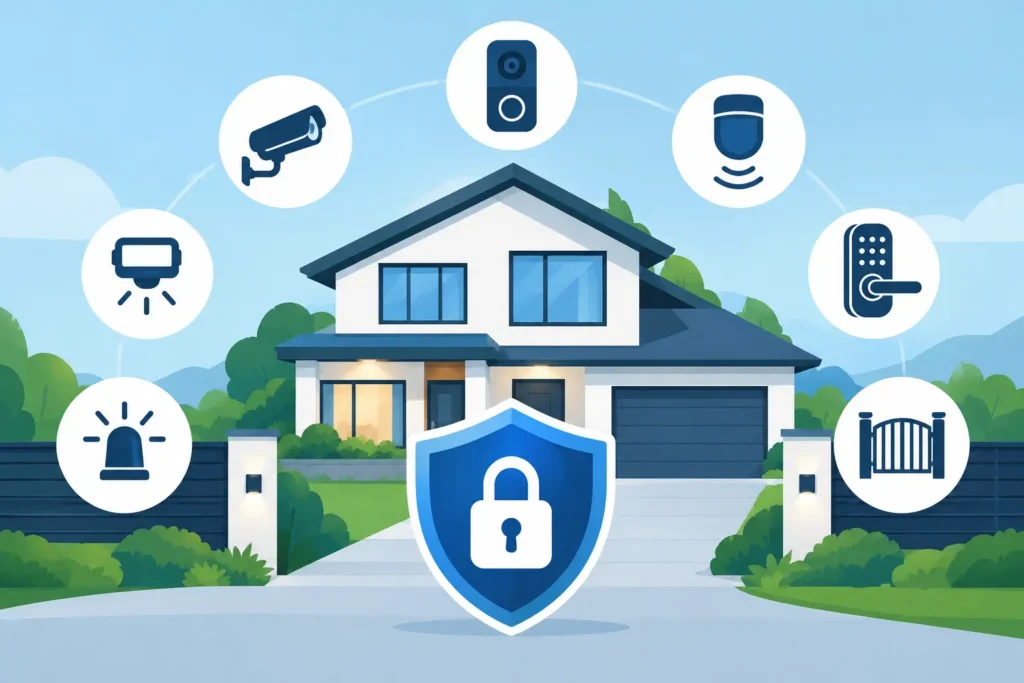
A security breach rarely begins with a dramatic forced entry. More often, it starts with an unsecured service gate, an unchallenged visitor, a blind spot in camera coverage, or an alarm that nobody is responsible for answering. The best property security measures close those ordinary gaps before they become theft, damage, unauthorized access, disruption, or a serious duty-of-care failure.
For facilities managers, property owners, construction leaders, and operations teams, effective protection is not a single product. It is a coordinated system of people, procedures, physical controls, and monitored technology. Each measure must work under real operating conditions, including shift changes, contractor access, deliveries, emergencies, and periods when the site is unoccupied.
1. Start With a Site-Specific Security Risk Assessment
Security should be designed around the risks a property actually faces, not around a generic equipment list. A distribution facility with valuable stock has different exposure from a residential building, vacant commercial unit, construction site, office campus, or public event venue.
A proper assessment examines entry and exit points, site boundaries, visibility, asset locations, visitor routes, existing systems, working patterns, local incident history, and emergency procedures. It should also identify where security and fire safety controls overlap. For example, access routes must remain controlled without obstructing emergency egress, and security staff need clear responsibilities during an evacuation.
The output should be a practical security plan that assigns ownership, sets response expectations, and identifies the measures that offer the greatest reduction in risk. This provides a defensible basis for procurement, insurer discussions, internal approval, and future review.
2. Control Access, Rather Than Simply Locking Doors
Doors, gates, barriers, and perimeter fencing are only effective when access is managed consistently. A locked entrance can still be defeated by tailgating, misplaced keys, shared codes, propped-open fire doors, or poor visitor procedures.
Access control should match the building’s use and risk level. Keypad entry may be suitable for a low-risk staff area, while card credentials, fobs, mobile credentials, or biometric controls can create better accountability in sensitive locations. High-risk sites may require layered entry, such as a gate, reception check-in, credential validation, and an escort policy for visitors.
Access permissions need regular review. Remove credentials promptly when staff leave, contractors complete work, or tenancy arrangements change. A system that records who entered a restricted area and when can be critical after an incident, but only if the records are retained and checked appropriately.
3. Use CCTV That Is Actively Monitored
Cameras can deter opportunistic crime and provide valuable evidence, but unmonitored footage is often reviewed only after damage or loss has occurred. That may support an investigation, yet it does not prevent the incident from escalating.
Monitored CCTV provides a more active control. Trained operators can identify suspicious behavior, verify an alarm activation, issue an audible warning where appropriate, and escalate to keyholders, on-site security personnel, or emergency services under an agreed response plan. Continuous coverage is particularly valuable for remote sites, vacant properties, out-of-hours operations, and large premises with multiple access points.
Camera placement matters as much as camera quantity. Coverage should focus on approaches to the site, entrances, loading areas, parking locations, high-value assets, perimeter weak points, and routes that could be used to leave the premises. Lighting, image quality, recording retention, signage, privacy requirements, and network resilience all need consideration.
4. Put Trained Security Personnel Where Presence Matters
Technology cannot inspect a damaged fence, challenge an unauthorized person, manage a crowd, conduct a welfare check, or make a judgment call during a developing incident. Manned guarding remains one of the strongest property security measures where visible presence and immediate intervention are required.
The right level of staffing depends on the threat, the hours of operation, and the nature of the property. A daytime corporate reception may require professional visitor management and access control. A construction site may need overnight patrols, gatehouse coverage, and rapid reporting of trespass or equipment theft. A residential development may need concierge-style security that combines a reassuring presence with disciplined incident procedures.
Security officers should be trained, properly briefed, and supported by clear post orders. Their responsibilities may include patrols, access checks, alarm response, incident reporting, contractor verification, keyholding coordination, and emergency support. On higher-risk sites, canine security can add a highly visible deterrent and increase the effectiveness of perimeter patrols.
5. Secure the Perimeter and Remove Easy Opportunity
A perimeter should make unauthorized entry difficult, visible, and time-consuming. This does not always mean installing the highest possible fence. The correct solution depends on the site layout, neighboring land, public access, planning constraints, and the likely threat.
Well-maintained fencing, locked gates, anti-climb measures, controlled vehicle access, secure storage compounds, and clear boundary signage create a first line of defense. Vegetation should not provide cover for intruders or obscure cameras and lighting. Damaged fencing, unsecured ladders, open bins, and stacked materials near a boundary can all create avoidable access opportunities.
For vacant or partially occupied properties, perimeter checks become especially important. Empty buildings can attract trespass, arson, vandalism, and illegal occupation. Physical security should be reviewed whenever occupancy, construction activity, or site use changes.
6. Connect Intruder Alarms to a Real Response Plan
An alarm is only as dependable as the response that follows it. If an activation produces uncertainty about who is called, who can access the site, and who is authorized to make decisions, valuable time is lost.
A documented alarm response plan should identify keyholders, escalation contacts, security personnel, monitoring arrangements, and procedures for false alarms, confirmed intrusion, utility failures, and police attendance. Keyholders must be available, understand their responsibilities, and avoid being placed in unnecessary risk. In many cases, a professional response service or security officer attendance is safer than expecting a lone employee to investigate an overnight alarm.
Test alarms and response procedures at planned intervals. Record faults, corrective actions, and test results. These records demonstrate that the control is being managed, rather than merely installed.
7. Treat Lighting and Maintenance as Security Controls
Poor lighting creates uncertainty for staff, visitors, cameras, and patrol officers. Appropriate illumination around entrances, walkways, parking areas, loading bays, and perimeter routes improves visibility and can discourage concealment or opportunistic access.
Lighting must be balanced carefully. Excessive glare can reduce camera effectiveness, disturb neighboring properties, or create shadows that conceal activity. Timed, dusk-to-dawn, or motion-activated lighting may suit different areas of the site. Emergency lighting should also be inspected and maintained as part of the wider life-safety strategy.
Routine maintenance is equally important. A security plan fails quickly when locks are damaged, door closers do not function, cameras are obstructed, alarms show unresolved faults, or access-control databases are out of date. Assign responsibility for inspections and ensure defects are logged through to completion.
8. Document Incidents, Test Procedures, and Review Performance
Security performance should be measurable. Incident reports, patrol records, access exceptions, alarm activations, maintenance logs, visitor data, and CCTV review findings can reveal recurring vulnerabilities long before a major incident occurs.
Good documentation also supports accountability. When an insurer, landlord, regulator, client, or senior leader asks what controls were in place, a verbal assurance is not enough. Clear records show what happened, who responded, what action was taken, and whether the issue was resolved.
Review the security plan after incidents, construction changes, tenant turnover, expansion, new operating hours, or changes in local risk. The best arrangements are not static. They adapt without compromising the standards that protect people, property, and operational continuity.
A property is most secure when every control has a clear purpose, a named owner, and a response that works at 2 a.m. as reliably as it does during normal business hours. That is the standard worth building toward.