

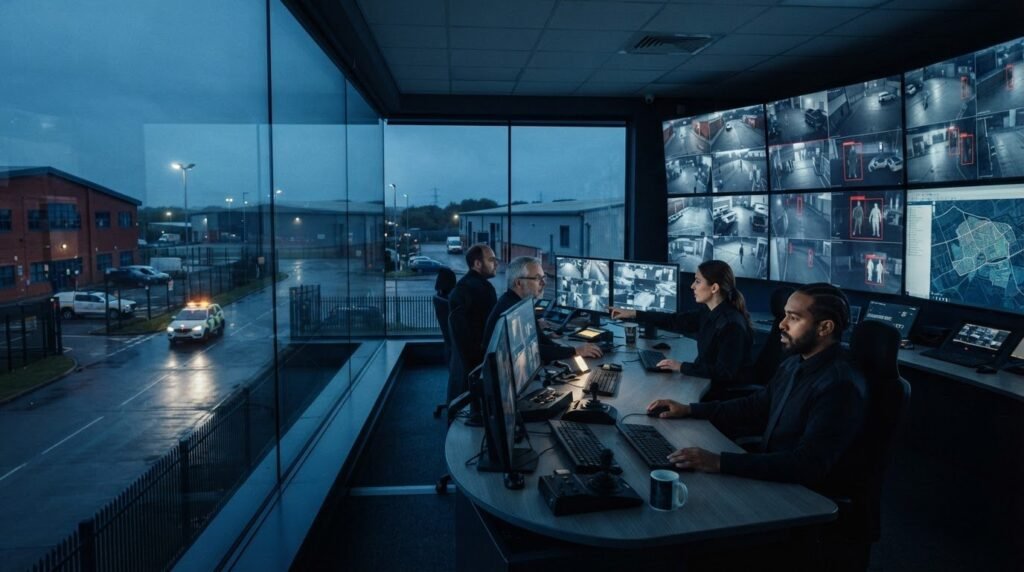
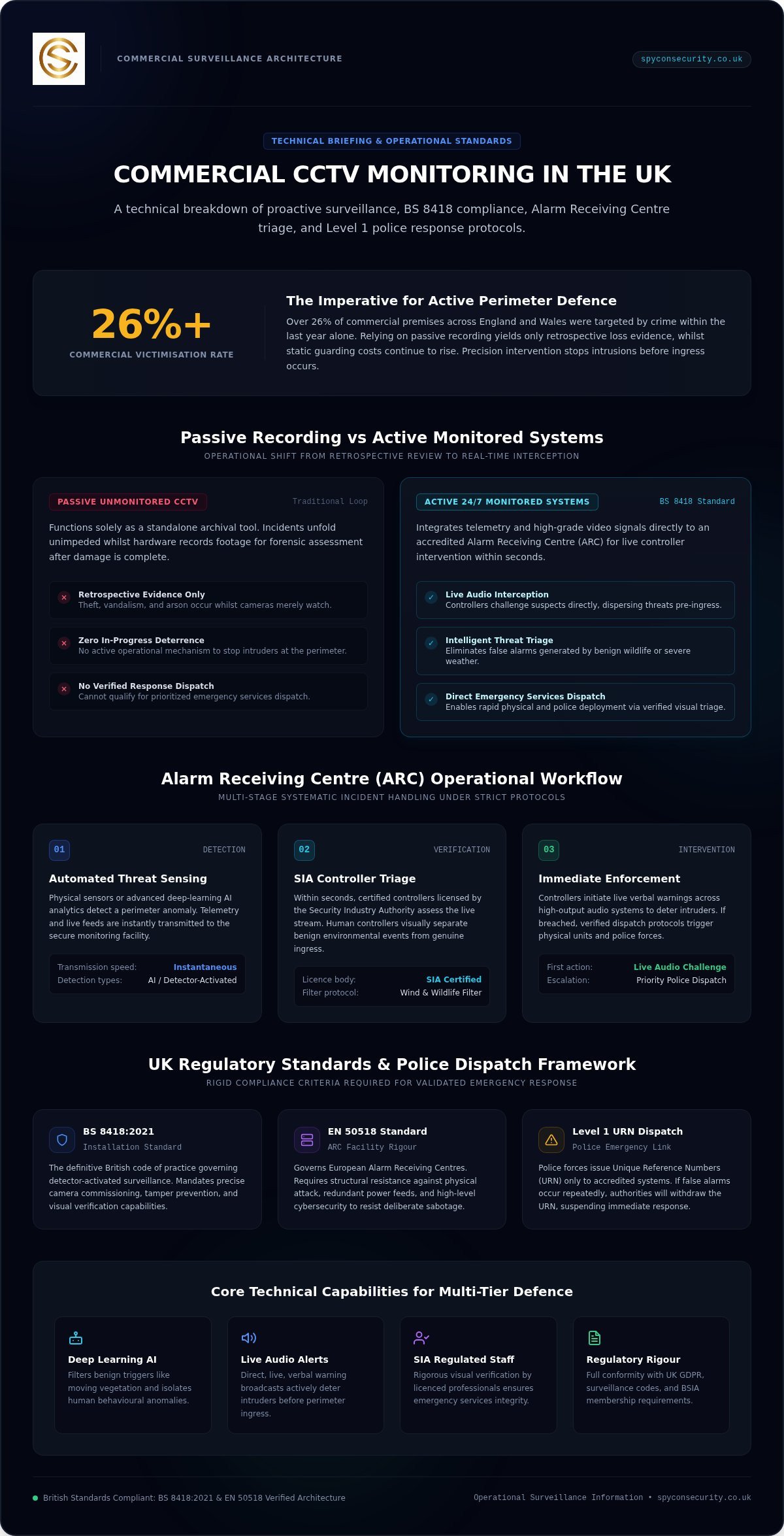
Over 26% of commercial premises in England and Wales were victims of crime in the last year. This reality demands more than passive recording. You understand the strain of rising costs for static guarding and the risk of police response suspension due to false alarms. It is a challenge that requires precision, not just presence. This guide provides the definitive roadmap for implementing CCTV monitoring services UK that actually perform.
We detail how accredited remote CCTV monitoring operates to protect your assets. The focus is on rigour. We cover the integration of rapid physical response with BS 8418 compliant technology. You will learn to secure immediate emergency dispatch through verified alarm protocols. We also address the complexities of GDPR and surveillance law. Our goal is peace of mind through technical excellence. Establish an impenetrable perimeter. Reduce overheads. Ensure total compliance. This is the standard for commercial security in 2026.
Key Takeaways
- Understand the operational shift from passive recording to proactive surveillance through accredited Alarm Receiving Centres.
- Identify the critical technical requirements of BS 8418 to ensure your site qualifies for immediate emergency services dispatch.
- Learn how advanced AI analytics and deep-learning technology enhance CCTV monitoring services UK by eliminating resource-draining false alarms.
- Apply a professional threat risk assessment framework to expose site vulnerabilities and deter criminal behaviour before ingress occurs.
- Discover how to design a multi-tier security posture that combines remote surveillance with physical intervention for maximum perimeter resilience.
What Are Professional CCTV Monitoring Services and How Do They Operate?
Professional CCTV monitoring is an active, round-the-clock remote security solution. It is not a passive recording loop. This service connects your site cameras directly to an accredited, off-site Alarm Receiving Centre (ARC). Expert controllers watch your perimeter when you cannot. It’s a disciplined approach to surveillance that ensures unwavering reliability and professional gravity.
The primary advantage of CCTV monitoring services UK is real-time intervention. Passive systems only record evidence for retrospective review. By then, the damage is done. Active monitoring intercepts criminal activity as it happens. It provides constant vigilance without the high overheads of multiple on-site static guards. It’s efficient. It’s precise. It’s a cost-effective hybrid that bridges the gap between technology and physical security.
The Operational Workflow of an Alarm Receiving Centre
The process begins the moment a sensor is triggered or AI analytics detect an anomaly. Video signals and telemetry transmit instantly to the ARC. This is a secure facility designed for high-stakes monitoring. Within seconds, a certified controller, licensed by the Security Industry Authority (SIA), assesses the live feed. They don’t guess; they verify.
A systematic triage process follows. Controllers are trained to separate verified criminal breaches from benign environmental triggers, such as wind or wildlife. This level of rigour is essential. It ensures that emergency services or physical response teams are only dispatched for genuine threats. Precision in triage maintains your site’s credibility with local authorities and prevents resource-draining false alarms.
Passive Video Recording vs. Active 24/7 Monitored Systems
Passive CCTV systems have significant limitations. They provide retrospective footage that helps in an investigation but does nothing to prevent the incident. Theft, vandalism, and arson occur whilst the cameras merely watch. Real-time intervention changes the dynamic. It stops the intruder at the perimeter before ingress occurs. You don’t just record the loss; you prevent it.
Integrating professional 24/7 CCTV monitoring services ensures comprehensive site protection. This active posture deters criminal behaviour through immediate audio challenges and rapid deployment of response units. It’s a proactive shield for commercial premises. Reliable. Grounded. Uncompromising.
UK Regulatory Frameworks and British Standards for Monitored CCTV
Rigour defines the UK security industry. Regulations aren’t suggestions; they’re operational necessities. High-quality CCTV monitoring services UK must adhere to strict British and European standards to guarantee performance. These frameworks ensure that every component, from the camera lens to the monitoring station’s backup power, meets a verified threshold of reliability. Compliance isn’t just about ticking boxes. It’s about ensuring your system functions exactly as intended during a high-stakes breach.
Understanding BS 8418 and EN 50518 Standards
BS 8418:2021 serves as the definitive code of practice for the design and installation of detector-activated surveillance. It dictates how systems should be commissioned to prevent tampering and ensure clear visual verification. Parallel to this, the European standard EN 50518 governs the Alarm Receiving Centre (ARC). This standard demands physical resistance against attack, redundant power supplies, and high-level cyber redundancy. Adherence to these BSIA membership criteria ensures that your security infrastructure is resilient against both environmental failure and deliberate sabotage.
Securing Level 1 Police Response via Unique Reference Numbers
A Unique Reference Number (URN) is the only way to guarantee a Level 1 police response for an alarm activation. Police forces in the UK don’t issue URNs to unaccredited systems. To maintain this status, your provider must follow strict verification protocols. An operator must visually confirm a threat before contacting emergency services. This human-in-the-loop requirement is vital. Operators must distinguish between environmental noise and genuine ingress within seconds. If a site generates excessive false alarms, the police will withdraw the URN. Total loss of emergency response is a risk no business should take. It pays to partner with an elite team who understands these stakes; you can learn more about our commitment to excellence on our about us page.
Surveillance Compliance: UK GDPR and Data Protection Laws
Legality extends beyond hardware. The UK GDPR and the Data Protection Act 2018 mandate how you handle recorded data. Clear signage is a legal requirement at every perimeter boundary. It must state who is responsible for the surveillance. Privacy masking is also essential. You cannot legally record public roadways or neighbouring residential premises without a specific, documented justification. Data retention must be proportionate. Typically, footage is held for 31 days unless required for an active investigation. Secure handling and encryption are non-negotiable to prevent data breaches. Meticulous documentation of these processes is the hallmark of a disciplined security partner.
Core Technologies: AI Analytics, Motion Sensors, and Live Audio Challenges
Precision in detection is the cornerstone of modern CCTV monitoring services UK. Elite security requires more than just a visual feed; it demands the intelligent filtering of environmental noise. By integrating advanced sensors with deep-learning algorithms, operators eliminate blind spots and resource-draining false alarms. This technological rigour ensures that every alert is a verified threat, not a passing animal or a gust of wind. It’s about constant readiness and absolute accuracy.
Thermal imaging adds another layer of resilience for hostile or unlit environments. In construction boundaries, industrial yards, and transport depots, visible light is often insufficient. Thermal cameras track heat signatures instead. They reveal intruders in total darkness or through heavy rain. This ensures your perimeter remains impenetrable regardless of the time of day or weather conditions.
Intelligent Video Analytics vs. Traditional Physical Detection
Legacy Passive Infrared (PIR) sensors are susceptible to weather and wildlife triggers. They lack context. In contrast, edge-based AI recognises specific human body shapes and vehicle profiles. It identifies loitering behaviour with absolute precision. Deep-learning video analytics offer superior environmental resistance compared to traditional infrared. Whilst implementation costs for AI are higher, the reduction in false dispatches makes it the superior choice for high-risk commercial sites. Accuracy is not a luxury; it’s a requirement.
- Detection Accuracy: AI distinguishes between human ingress and environmental movement.
- Environmental Resistance: Advanced analytics remain stable during heavy wind, rain, or snow.
- Operational Value: Reduced false alarms protect your site’s reputation with emergency services.
The Deterrent Power of Live Audio Warnings and Horn Speakers
Detection is only the first phase. Intervention is the second. Remote controllers use directional public-address audio to issue personalised, live verbal warnings. Hearing a live voice describe your clothing or actions is a powerful psychological deterrent. It removes the anonymity that criminals rely on. Industry data indicates that live audio challenges deter over 90% of trespassers before they attempt ingress.
The impact is immediate. Most intruders flee the moment they realise they’re being watched by a human operator in real time. For those who persist, the system integrates automated strobe lighting and siren triggers upon a verified perimeter breach. This creates a hostile environment for unauthorised individuals. It’s a proactive defense that deters criminal behaviour before property loss occurs. Reliable protection starts with decisive communication.
How to Choose a Commercial CCTV Monitoring Provider in the UK
Selecting a partner for CCTV monitoring services UK demands a decisive evaluation framework. It is a high-stakes decision where reliability is non-negotiable. You need a partner that values order and compliance above all else. A structured procurement process begins by conducting a thorough threat risk assessment to identify every vulnerability across your premises. Verify NSI Gold or SSAIB accreditation alongside BS 8418 operational compliance. Audit Service Level Agreements (SLAs) regarding alert verification and dispatch times. Finally, confirm the seamless operational escalation connecting remote controllers to physical security resources.
Assessing Facility Vulnerabilities and Threat Levels
Every commercial site presents unique risks. Evaluate your site boundary, storage yard layout, and blind corners carefully. Lighting limitations often dictate the need for thermal imaging or supplemental IR. High-risk environments, such as active building sites, often necessitate mobile solar surveillance towers to maintain coverage as the site evolves. Effective perimeter strategies often integrate these technologies with professional construction site security guards for comprehensive structural safeguarding. A disciplined assessment is the only way to deter criminal behaviour before ingress occurs.
Auditing ARC Technical Capability and Licensing Standards
A monitoring station is only as capable as its infrastructure and personnel. Confirm all remote monitoring station operators hold valid Security Industry Authority (SIA) licences. This ensures a baseline of professional training and background verification. Examine the provider’s server redundancy protocols and uninterruptible power supplies (UPS). Dual-path communications are essential to prevent system bypass. Insist on transparent incident reporting mechanisms and client portal access. Meticulous compliance logging is the hallmark of a seasoned expert who does not allow for shortcuts.
Bridging Surveillance with Physical Rapid Response Teams
Electronic surveillance provides the eyes; physical security provides the hands. Coordinated on-the-ground support is essential during high-stakes intrusions. Pairing monitoring with accredited manned guarding solutions creates a hybrid shield that technology alone cannot match. For vast compounds or high-value assets, consider canine security deployment. K9 units offer rapid search and apprehension capabilities that significantly increase the risk for intruders. This integrated posture ensures your perimeter remains resilient and your assets stay protected. To secure a partner rooted in duty and professional integrity, contact our expert team today.
Deploying Integrated Security: Protecting UK Commercial Sites
Integrated security is a deliberate, multi-tier posture. It combines electronic vigilance with elite physical protection. In the UK, commercial sites face diverse threats that a single solution cannot address. You must design a system where each layer supports the next. This ensures that even if one barrier is breached, the secondary response is already in motion. Deploying CCTV monitoring services UK within an integrated framework is the benchmark for modern commercial protection.
Tailoring Surveillance to High-Risk UK Commercial Sectors
Construction projects often face plant machinery theft and arson. Remote sites are particularly vulnerable outside standard operating hours. Logistics hubs require loading bay surveillance and vehicle registration capture to maintain perimeter integrity. For multi-tenant facilities, we recommend layered corporate security solutions. These systems manage high footfall whilst maintaining strict access protocols. Every sector has unique requirements. A seasoned expert identifies these nuances during the design phase to eliminate blind spots.
Operational Escalation and Collaborative Response Protocols
A verified alarm triggers a disciplined escalation protocol. It begins with an immediate assessment by the ARC controller. If a breach is confirmed, the controller initiates police dispatch and keyholder notification. Simultaneously, coordinated guard response units are deployed. These units secure the perimeter to prevent secondary breach attempts. Documentation is critical. We prepare evidence packs containing timestamped, high-definition footage. These packs are designed for use by the Crown Prosecution Service. Rigorous evidence collation ensures that criminal behaviour leads to successful prosecution and satisfies insurance reporting requirements.
Securing Your Premises with Spycon Security
Spycon Security Ltd. provides a consultative audit process to tailor your monitoring solution. We don’t believe in generic security. Our team assesses your specific site hazards to build a resilient shield. With regional coverage across London, Birmingham, and Manchester, we ensure rapid on-site intervention. Our CCTV monitoring services UK unite advanced technology with SIA-licensed personnel. We offer integrated workflows that pair surveillance with manned guarding and rapid canine security units. This hybrid approach is the benchmark for modern commercial protection. Contact our team today for a comprehensive appraisal of your physical and electronic security needs.
Securing Your Assets with Professional Vigilance
Establishing a resilient perimeter requires more than just hardware. It demands strict adherence to BS 8418 standards and the integration of AI-driven verification to secure police response. By moving from passive recording to active intervention, you eliminate the risk of property loss before it occurs. Choosing the right CCTV monitoring services UK ensures your site remains a hard target for criminal behaviour.
Spycon Security delivers this standard through a disciplined, multi-tier approach. Our SIA-licensed specialists provide round-the-clock physical and electronic protection across London, the Midlands, and the North. We offer a seamless tactical integration of 24/7 CCTV monitoring, manned guarding, and specialised canine patrol units. This hybrid strategy provides unwavering reliability for your commercial assets. It’s time to move beyond simple surveillance. Strengthen your perimeter with professional CCTV monitoring from Spycon Security. Secure your peace of mind with a partner rooted in duty and professional integrity.
Frequently Asked Questions
How quickly does a CCTV monitoring centre respond when an alarm triggers?
Response times are measured in seconds. Upon a sensor activation or AI analytical trip, the video feed transmits instantly to the accredited Alarm Receiving Centre. SIA-licensed controllers assess the situation immediately to differentiate between environmental noise and a genuine security breach. This rapid verification is essential for high-stakes environments in cities like London and Manchester. It ensures that any necessary escalation, such as a police dispatch or physical response, happens without human delay.
Can remote CCTV monitoring replace on-site manned security guards?
Remote surveillance offers a cost-effective alternative to round-the-clock static guarding. It provides constant vigilance over vast perimeters, such as logistics hubs in Birmingham or Nottingham. However, for high-risk assets, a hybrid approach is superior. Pairing CCTV monitoring services UK with on-site manned guarding or canine units ensures that detection is followed by immediate physical intervention. This integrated posture creates a more resilient shield than technology alone can provide for complex commercial sites.
What is required for remote CCTV monitoring to qualify for police response in the UK?
To guarantee a Level 1 police response, the system must be compliant with BS 8418. It must also be monitored by an approved Alarm Receiving Centre that holds a Unique Reference Number (URN) for the specific premises. Operators must visually verify the intruder before contacting emergency services. This rigour prevents resource-draining false alarms. Without these accreditations, police forces across the UK may not prioritise or even attend an unverified alarm activation.
How do remote operators tell the difference between real intruders and false alarms?
Operators use a combination of deep-learning AI analytics and professional visual verification. Modern edge-based technology distinguishes between human body shapes, vehicle profiles, and environmental triggers like wind or wildlife. When an alert reaches the monitoring station, a trained controller scrutinises the live feed to confirm the threat. This systematic triage ensures that response units are only deployed for genuine breaches. It maintains site credibility and protects your relationship with local emergency services.
Can my company use its existing analogue or IP cameras for remote monitoring?
Most existing IP cameras can be integrated into a remote monitoring workflow. Older analogue systems often require digital encoders to transmit signals to the Alarm Receiving Centre. However, the hardware must be capable of providing clear, high-definition footage for visual verification. If cameras lack modern analytics or infrared capabilities, they might not meet the strict requirements for BS 8418 compliance. A professional audit is necessary to determine if current infrastructure supports accredited surveillance protocols.
What happens if our site experiences a power outage or internet disconnection?
Resilient systems utilise uninterruptible power supplies (UPS) and dual-path communications to prevent system bypass. If the primary internet connection fails, the system automatically switches to a secondary cellular link, such as 4G or 5G. Battery backups ensure cameras and transmission equipment remain operational during power cuts. This redundancy is a core requirement of EN 50518 standards. It guarantees that sites in urban centres like Slough or Coventry remain protected even during infrastructure failures or deliberate sabotage.
Are commercial CCTV monitoring services compliant with UK GDPR regulations?
Compliance is mandatory under the UK GDPR and Data Protection Act 2018. Professional CCTV monitoring services UK incorporate privacy masking to avoid recording public roadways or residential areas. Clear, visible signage must be displayed at all perimeter boundaries to inform the public of the surveillance. Data retention is typically limited to 31 days unless required for an active investigation. Secure, encrypted storage ensures that digital evidence is handled with the professional gravity required by law.