

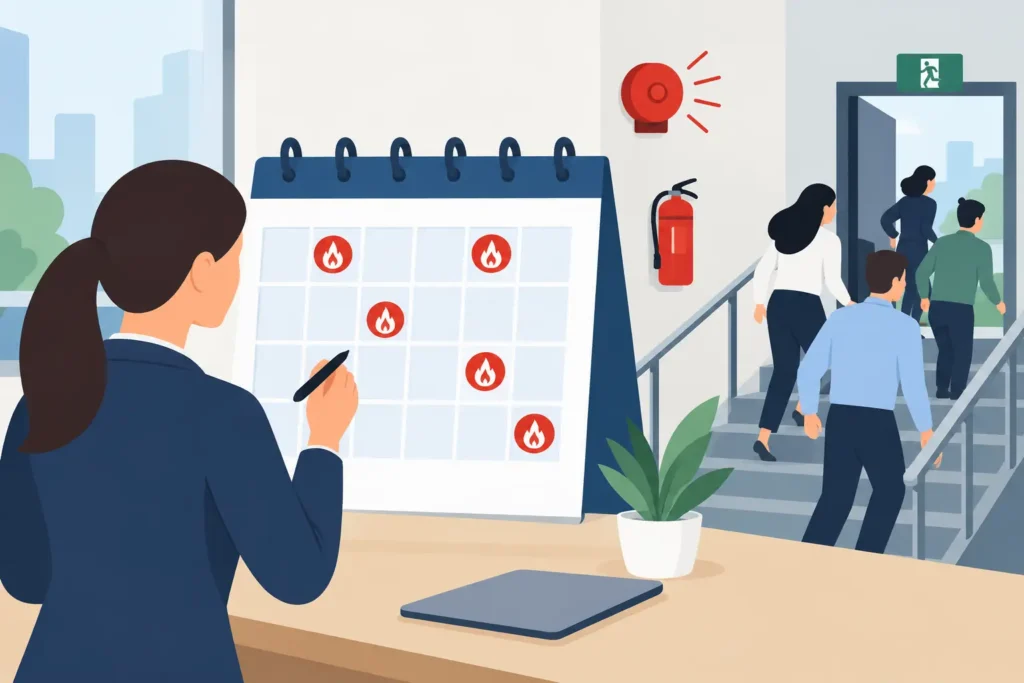
A fire alarm that sounds during normal operations tests far more than whether people can find an exit. The right fire drill frequency tests whether occupants recognize the signal, supervisors take control, routes remain usable, and the organization can account for people without confusion. For a facilities leader, that is the difference between a drill completed on paper and an evacuation process that holds up when it is questioned.
There is no single schedule that suits every property. The required cadence may be set by a local authority having jurisdiction, an adopted fire code, a lease, insurer requirements, licensing conditions, or internal policy. A high-occupancy venue, hospital, school, construction project, or residential property with staff-led procedures will not carry the same risk as a small, stable office suite. The objective is not to run the maximum possible number of drills. It is to maintain credible readiness, prove due diligence, and correct weaknesses before they become an emergency.
What Determines Fire Drill Frequency?
Start with the rules that apply to the specific building and occupancy. State and local fire codes, fire marshal requirements, and standards such as NFPA guidance may prescribe drill intervals for particular uses. These requirements can vary significantly by jurisdiction and building type, so copying a schedule from another site is a poor compliance strategy.
Where rules establish a minimum, treat that minimum as a floor, not an automatic answer. A risk assessment should consider how quickly conditions, occupants, and operations can change. A property undergoing construction or renovation may have altered exits, temporary partitions, changing contractor numbers, and impaired life-safety systems. A busy event venue may receive thousands of visitors who have never seen the building before. A distribution center may operate multiple shifts with different supervisory coverage.
The following conditions often justify more frequent drills or targeted evacuation exercises:
- High occupant turnover, including visitors, contractors, seasonal workers, students, or event attendees
- Shift work, lone working, or operations conducted outside standard business hours
- Complex layouts, multiple tenants, large floor plates, basements, or restricted egress routes
- Occupants who may need assisted evacuation, including people with mobility, sensory, or cognitive needs
- Recent changes to fire alarm systems, emergency lighting, fire doors, staffing, assembly areas, or site layouts
- Previous drill findings, alarm activations, near misses, or delays in accounting for occupants
A well-managed program can combine full evacuation drills with smaller, role-specific exercises. For example, a full-site drill may test evacuation and accountability, while a separate tabletop exercise tests decision-making by incident leaders. A drill with fire wardens can focus on sweep procedures, elevator controls, refuge areas, and communication. This approach avoids unnecessary disruption while ensuring that the people with critical duties are genuinely prepared.
Minimum Compliance Is Not the Same as Readiness
A calendar reminder does not create emergency capability. If a drill occurs at the same time, on the same day, through the same route every year, occupants begin to anticipate it. People may leave belongings behind only because they know it is a drill, skip their assigned exit, or gather casually at the assembly point. That behavior can hide serious issues.
Varying drill conditions produces more useful evidence. Run exercises across different shifts where practical. Test alternate exits, particularly after layout changes. Include a scenario in which a usual route is unavailable, but do not create hazards or obstruct egress during a live drill. The exercise must remain controlled, communicated appropriately, and consistent with local requirements.
There is a trade-off. Surprise drills can reveal authentic behavior, but poorly managed surprises may distress occupants, disrupt critical services, or create unnecessary risk. Healthcare settings, schools, secure facilities, and sites with vulnerable populations need carefully designed procedures. In these environments, a planned and staged exercise may deliver better safety outcomes than a disruptive unannounced evacuation.
How to Set a Defensible Fire Drill Schedule
A defensible schedule begins with documented authority. Confirm the applicable code requirements with the local fire authority or qualified fire safety professional, then record the required interval, responsible person, and scope of the drill. Include contractual, insurance, and client obligations in the review. If several requirements apply, follow the most stringent relevant requirement unless the authority directs otherwise.
Next, assess operational risk. Consider the building’s population, hours of use, evacuation complexity, and likely fire scenarios. Ask practical questions: Can every shift evacuate without relying on one manager? Are fire wardens available when needed? Can visitors receive instructions quickly? Does the assembly area remain safe if weather, traffic, or a secondary hazard affects it? Can the organization account for contractors and guests as well as employees?
Set a written annual plan rather than arranging drills ad hoc. The plan should identify the expected frequency, proposed windows, drill objectives, participants, observers, alarm notification arrangements, and the person authorized to begin and end the exercise. It should also define how the site will coordinate with monitoring centers, security teams, building management, and emergency services where required. A monitored alarm must never generate an avoidable emergency response because the drill was not properly managed.
For multi-tenant buildings, roles need particular clarity. The landlord or building manager may control common areas and the alarm system, while tenants remain responsible for their own employees, visitors, and internal evacuation leads. Coordination is essential, but responsibility should not become blurred. Every party should know who calls the monitoring provider, who communicates with occupants, who manages the assembly point, and how observations are reported.
Measure the Drill, Not Just the Evacuation Time
Evacuation time is useful, but it is not the only measure that matters. A very fast evacuation can still fail if occupants use unsafe routes, fire doors are wedged open, a visitor is left behind, or teams cannot confirm who is missing. The observation process should capture behavior and system performance, not just a stopwatch result.
Observers should look for whether the alarm was audible and visible throughout the building, whether wardens performed assigned checks, whether exits and stairwells were clear, and whether occupants moved promptly without returning for personal items. They should also check whether people used elevators contrary to procedure, whether accessible evacuation arrangements worked, and whether the assembly point remained orderly and away from responding vehicles.
Accountability is often the weak point. A reliable process must account for employees, contractors, visitors, and any known occupants who require assistance. Sign-in systems, visitor management, access-control data, and supervisor roll calls can all support this task, but technology does not replace ownership. Someone must be responsible for reconciling the information and escalating an unaccounted-for person immediately.
Records That Stand Up to Scrutiny
A drill record should be more than a date and signature. It should identify the property, date and time, drill type, alarm activation method, areas included, participating shifts, evacuation duration where measured, assembly point, and the person in charge. Record the observers, any equipment faults, occupancy concerns, communication issues, and whether emergency services or monitoring providers were notified.
Most importantly, log corrective actions. If an exit was blocked, a warden was absent, signage was unclear, or roll call took too long, assign an owner and target completion date. Review the action at the next safety meeting and confirm closure with evidence. Repeating the same finding across several drills is not evidence of a thorough program. It is evidence that the control has not been managed.
Documentation should sit alongside fire risk assessments, alarm inspection records, emergency lighting tests, extinguisher servicing, training records, and evacuation plans. Together, these records show a consistent life-safety system rather than isolated compliance tasks. They also provide the evidence insurers, regulators, clients, and investigators may request after an incident.
Keep Drills Connected to Daily Operations
The strongest fire drill program is supported by everyday discipline. Exit routes must stay clear. Fire doors must close and latch. New starters, contractors, and visitors need clear instructions. Fire wardens need current training and realistic coverage during absences. Security personnel can strengthen the process by controlling access, assisting with assembly-point management, supporting visitor accountability, and maintaining communication during an evacuation.
Spycon Security Ltd. approaches fire preparedness as an operational control, connecting trained personnel, life-safety systems, documented procedures, and site-specific oversight. That joined-up approach matters because an alarm system alone cannot direct people, verify an evacuation, or close the gaps found during a drill.
Review fire drill frequency whenever the site changes, not only when the annual calendar comes due. A new tenant, revised floor plan, expanded shift pattern, construction project, or incident finding can change the level of preparedness required. The most useful question is not, “When did we last conduct a drill?” It is, “Would this site evacuate safely and account for everyone if the alarm sounded right now?”