

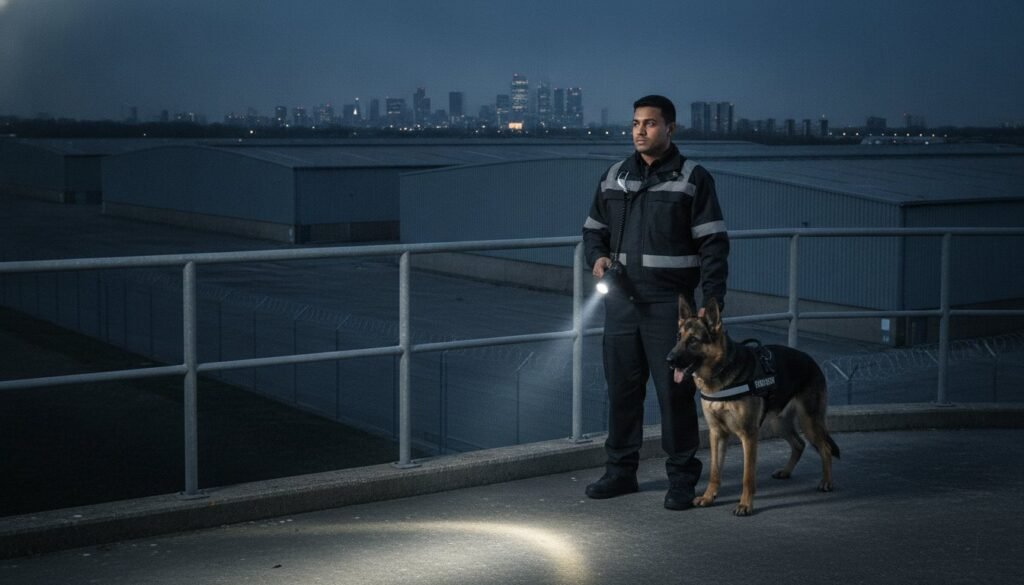
Can a standard security presence really protect a sprawling, vacant London site once the sun goes down? For many asset managers, the reality of persistent trespassing and the escalating costs of security breaches prove that traditional methods often fall short. This is precisely where specialist dog handlers London provide a level of operational precision that human guarding alone cannot replicate. You know that large, dark industrial sites present unique vulnerabilities. Human senses have limits. Intruders find the gaps. Risks escalate.
We understand that true peace of mind comes from total site control. This case study reveals how specialist canine units provide an uncompromising layer of security for London’s most complex and high-risk environments. You’ll discover how these elite teams achieve total site clearance and establish a formidable visual deterrent. We also outline the path to maintaining strict compliance with UK security standards whilst significantly reducing the risk of unauthorised access. It’s a disciplined approach. Elite protection. Total site security.
Key Takeaways
- Understand why the advanced sensory capabilities of canine units are vital for detecting intruders in complex urban environments.
- Identify the mandatory certifications, including SIA and NASDU, required for specialist dog handlers London to ensure professional compliance.
- Learn how a structured risk assessment and deployment strategy can effectively secure high-value vacant commercial assets.
- Discover the operational synergy between canine security and fire safety services for enhanced site protection.
- Gain a definitive checklist for vetting security firms to ensure they possess the local expertise and logistical capacity required in the capital.
What is a Specialist Dog Handler and Why are They Essential in London?
A specialist dog handler is not merely a security guard with a canine companion. These are elite operational units trained for high-stakes enforcement and detection in environments where human capability reaches its limit. In London, where commercial assets are often vast and complex, the need for this level of precision has grown significantly. Commercial landlords amongst the capital’s most prestigious boroughs now face sophisticated trespassing and squatting threats. Standard manned guarding remains a vital foundation. However, high-risk sites require the uncompromising presence of specialist dog handlers London to ensure absolute site integrity. This is security at its most disciplined.
The Sensory Advantage in Urban Security
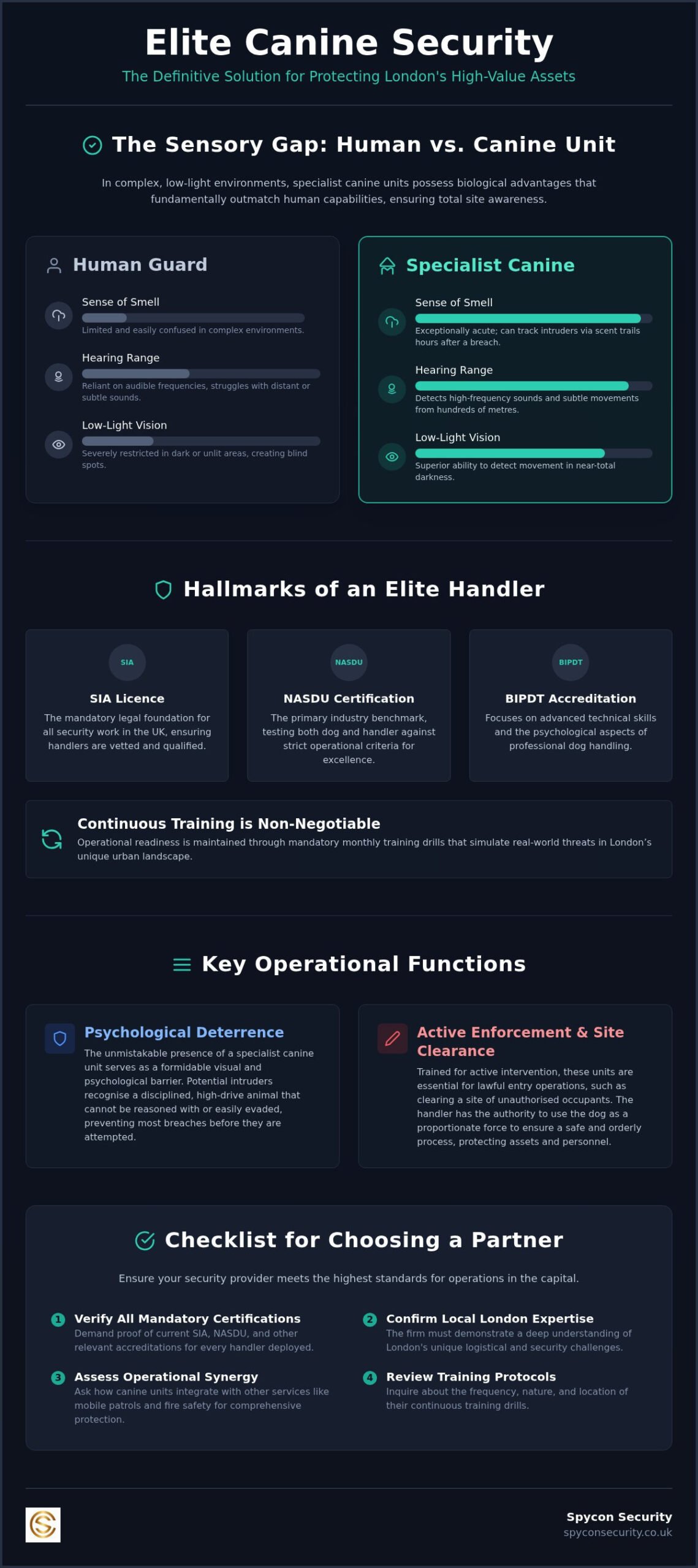
Dogs possess sensory capabilities that fundamentally outmatch human guards. A canine’s sense of smell is significantly more acute than a human’s, allowing them to track intruders through scent trails even hours after a breach has occurred. Their hearing is equally superior. They detect high-frequency sounds and subtle movements from hundreds of metres away, often before a human guard even suspects a presence. This is especially vital in low-light conditions where visual identification is limited.
In the dense industrial centres of London, these traits are critical. Large warehouses and dark construction sites create blind spots for CCTV and human patrols. A specialist dog can detect an intruder through solid barriers, within shipping containers, or hidden deep inside a vacant property. This biological advantage ensures that no corner of a high-value asset remains unmonitored. It’s about detection before contact. Reliable. Precise. Uncompromising.
Deterrence vs. Enforcement
There is a sharp distinction between a standard patrol dog and a specialist enforcement unit. While all canine units provide a visual deterrent, specialist handlers are trained for active intervention and site clearance. Their presence alone serves as a psychological barrier. Potential intruders recognise the risk of a disciplined, high-drive dog that cannot be bargained with or easily evaded. This visual deterrent often prevents a breach from occurring in the first place, saving landlords the significant costs of property damage and legal fees.
These units are essential during “lawful entry” operations. When landlords must reclaim a property or clear a site of unauthorised occupants, the canine unit provides the necessary leverage to ensure a safe and orderly process. A specialist dog handler possesses the legal authority to use their dog as a proportionate and reasonable force for protection and the prevention of crime during the eviction of trespassers. This level of authority, backed by rigorous training, is what makes them indispensable for high-stakes asset protection in the capital.
What Defines a Specialist Dog Handler in 2026?
Professional standards in the security industry are not static; they require constant verification and adherence to evolving protocols. In 2026, the definition of a specialist dog handler is rooted in rigorous accreditation and operational discipline. It’s no longer sufficient for a guard to simply possess a dog. High-stakes environments in the capital demand a level of expertise that can only be achieved through official recognition and continuous assessment. For specialist dog handlers London, the baseline for entry is an SIA licence, which provides the legal foundation for all security work in the UK. However, true specialism requires much more than a basic permit.
The National Association of Security Dog Users (NASDU) serves as the primary benchmark for canine excellence. NASDU certification ensures that both the handler and the dog have been tested against strict operational criteria, from tracking and searching to controlled protection. This is supplemented by the British Institute of Professional Dog Trainers (BIPDT), which focuses on the technical and psychological aspects of handler training. These bodies ensure that every unit deployed to a high-risk site is capable of maintaining professional gravity under intense pressure. Operational readiness is a constant state, maintained through monthly training drills that simulate real-world threats in London’s unique urban landscape.
Professional Accreditations and Compliance
There is a critical distinction between General Purpose (GP) dogs and detection units. GP dogs are the backbone of asset protection, trained to track intruders and provide a formidable physical presence. Detection dogs focus on specific substances, such as explosives or narcotics. Insurance providers frequently mandate these specific certifications for high-risk sites to mitigate liability. Without documented proof of NASDU or BIPDT compliance, a landlord’s insurance coverage may be compromised in the event of a security breach. Spycon maintains meticulous standards to ensure every deployment meets these strict insurance and legal requirements. For those requiring a comprehensive security strategy, integrating professional manned guarding alongside canine units offers the highest level of site integrity.
The Handler-Dog Bond: Operational Precision
The synergy between a handler and their dog is a professional partnership built on thousands of hours of shared training. This bond ensures that every response is controlled, disciplined, and proportionate. Specialist handlers use humane restraint techniques and prioritise canine welfare at all times. They’re trained to read their dog’s subtle signals, allowing them to identify threats long before they’re visible to the human eye. A specialist handler is a trained security professional first and foremost; the dog is a precision tool that extends their capabilities. It’s this combination of human intelligence and canine instinct that provides an uncompromising layer of protection for London’s most valuable assets.
Operational Case Study: High-Value Asset Protection in London
Consider a 4,500-square-metre commercial office complex in East London. The building sits vacant during a transition between commercial tenants. Intelligence indicates that local squatting collectives have identified the site as a primary target. This scenario is a common reality for many landlords in the capital. To secure the perimeter, specialist dog handlers London were deployed to provide a level of vigilance that technology and human guards alone could not sustain. The objective was clear: total asset preservation and the prevention of unauthorised occupancy.
Phase 1: The Tactical Risk Assessment
Before deployment, the team conducts a meticulous tactical survey. Handlers identify every vulnerable entry point, from basement ventilation shafts to roof access hatches. This assessment integrates seamlessly with existing manned guarding protocols to ensure no gaps exist in the security net. By mapping the site’s unique geography, handlers determine the most effective patrol routes for maximum coverage. Branded security vehicles are positioned at primary gates. They serve as a secondary visual deterrent, signalling a state of constant readiness to anyone observing the site.
Phase 2: Deployment and Incident Response
Operational success relies on disciplined nocturnal patrols. During a high-stakes deployment, a handler’s dog exhibited a “silent alert” behaviour near a side loading bay. This is a subtle physical change, such as a tensed posture or focused gaze, indicating the presence of an intruder before any sound is heard. The dog’s superior senses detected movement behind a heavy steel door that the handler could not yet perceive. This early detection allowed the handler to initiate a controlled sweep of the area immediately.
By identifying the breach at the point of entry, the team de-escalated the situation before the trespassers could establish a foothold within the building. The handler’s role is to manage the canine whilst maintaining site security through calm, authoritative communication. The handler maintains absolute professional gravity throughout the enforcement action, ensuring all protocols are followed with precision. It’s a controlled response to a high-pressure event.
The outcome was the successful preservation of the client’s asset. Zero breaches occurred during the six-month vacancy period. The landlord avoided the significant legal costs, property damage, and cleaning fees typically associated with squatting. This case study demonstrates that specialist dog handlers London are an essential component of a robust security strategy. They provide the precision enforcement tool required for London’s most complex environments. Reliable protection. Uncompromising standards. Total site integrity.
Synergy: Integrating Canine Units with Fire Safety
Asset protection requires a holistic view of risk. Whilst physical intrusion is a primary concern, fire represents an equally catastrophic threat to property value. In London, the integration of canine units with fire safety protocols creates a comprehensive shield for high-risk sites. Specialist dog handlers London are uniquely positioned to identify early-stage fire hazards that human guards might overlook. This dual-purpose vigilance ensures that a site is protected from both external threats and internal failures. It is a disciplined approach to total site integrity.
Arson remains a significant risk for vacant commercial properties in the capital. Intruders often use fire to mask evidence of theft or simply as an act of vandalism. A disciplined canine unit acts as a powerful deterrent against such behaviour. By maintaining a constant, watchful presence, handlers prevent the initial breach that often precedes an arson attempt. This proactive stance is essential for maintaining the long-term integrity of a client’s asset. Spycon operates as a unique provider capable of managing both fire risk and physical security with uncompromising standards.
Mitigating Arson Risks in London
Regular patrols by specialist dog handlers London are a proven method for reducing arson incidents in derelict or vacant buildings. Dogs can detect the presence of accelerants or the faint scent of smoke long before a fire becomes visible or triggers a standard alarm system. This rapid detection is critical in vacant buildings where fire can spread unchecked through voids and industrial ducting. Our teams work in synergy with fire risk assessment services to identify potential fuel sources and vulnerable areas. This methodical approach ensures that risks are mitigated before they escalate into a catastrophe. Precision. Readiness. Protection.
Canine Units and Fire Marshalling
The role of a dog handler extends into the realm of active fire marshalling, particularly in residential blocks or complex mixed-use developments. These units provide essential support for waking watch services. Whilst a dog monitors for security breaches, the handler ensures that fire safety standards are strictly maintained on the ground. This includes verifying that fire exits remain clear and that fire-fighting equipment is accessible and unobstructed. A dog’s ability to navigate dark or smoke-filled environments also provides an additional layer of safety during emergency evacuations.
Property managers gain significant peace of mind from this multi-disciplinary approach. It eliminates the need for multiple, disconnected security and fire safety teams. Instead, a single, elite unit manages the site with absolute professional gravity. This efficiency reduces operational costs whilst increasing the overall safety of the building’s occupants and the structure itself. To ensure your property meets all legal requirements whilst remaining secure, arrange a comprehensive fire risk assessment to protect your London asset.
Choosing the Right Specialist Dog Handlers in London
Selecting a security partner is a critical decision for any asset manager. In a city as complex as London, the margin for error is non-existent. When vetting specialist dog handlers London, you must look beyond surface-level promises. Rigorous verification of credentials is the only way to ensure operational integrity. You require a partner that understands the high-stakes nature of asset protection and operates with a corresponding level of professional gravity. Precision is not optional; it’s the baseline for every deployment.
London’s unique geography requires more than just a presence. Effective deployment depends on a deep understanding of borough-specific risks and the logistics of the capital’s transport network. A provider must demonstrate 24/7 availability and the capacity for rapid response. Threats to high-value assets don’t adhere to business hours; your security shouldn’t either. A disciplined unit remains in a state of constant readiness, prepared to intervene the moment a perimeter is challenged. This level of commitment is what separates elite units from standard guarding services. For operators managing large-scale logistics facilities, understanding how warehouse security services integrate canine units, manned guarding, and fire safety compliance is essential for building a truly comprehensive protection strategy.
The Vetting Checklist for London Firms
Before engaging a canine security provider, conduct a thorough audit of their operational standards. This process ensures that your site remains compliant with UK security regulations and insurance requirements. A reputable firm will provide this documentation without hesitation. Focus on the following criteria:
- Certification: Verify that all handlers hold valid SIA licenses and that both handler and dog are NASDU or BIPDT certified.
- Insurance: Ensure the firm carries comprehensive public liability insurance specifically tailored for canine security operations.
- Experience: Request evidence of successful deployments in similar urban environments, such as vacant commercial properties or high-density industrial centres.
- Accountability: Confirm the provider uses real-time incident logging and provides detailed reporting for every shift.
Why Spycon Security Ltd. is the Reliable Choice
Spycon Security Ltd. operates with a commitment to operational precision and professional integrity that is unmatched in the capital. We understand that your assets represent significant value and require uncompromising protection. By choosing Spycon, you benefit from a single point of contact for both physical security and fire protection. This unified approach eliminates the friction of managing multiple vendors and ensures a consistent, authoritative standard across every aspect of site safety. Our teams are trained to navigate the complexities of London’s high-risk environments with absolute discipline.
We invite you to secure your assets with a team that values duty above all else. Our specialist dog handlers London provide the formidable deterrent and precision enforcement tool your site demands. Don’t leave your property’s integrity to chance. Establish an uncompromising layer of security today. Contact Spycon Security for Specialist Canine Units and ensure your high-stakes environments are protected by the industry’s elite.
Establishing Uncompromising Site Integrity
Protecting high-value assets in the capital requires more than a passive presence; it demands a state of constant readiness and precision enforcement. We’ve explored how elite canine units bridge the gap between standard guarding and total site control. By integrating SIA Licensed Handlers and NASDU Certified Units, you ensure that your security strategy is both legally compliant and operationally formidable. This disciplined approach provides the sensory advantage and psychological deterrent necessary to secure London’s most complex environments.
True peace of mind is achieved through a multi-disciplinary strategy. Our integrated fire and security expertise allows for a holistic protection model that mitigates risks from both trespassers and potential fire hazards. The deployment of specialist dog handlers London remains the most effective method for maintaining absolute site integrity in high-stakes scenarios. It’s time to move beyond standard measures and adopt a professional standard that values duty and excellence above all else.
Secure your London assets with Spycon’s specialist dog handlers. We look forward to partnering with you to establish a secure and managed environment for your property.
Frequently Asked Questions
Can specialist dog handlers be deployed for residential security in London?
Yes, specialist dog handlers are frequently deployed to secure high-value residential estates and apartment blocks across the capital. Their presence is particularly effective in gated communities or residential developments where a heightened security profile is required. These units provide a visible deterrent that standard patrols cannot match, ensuring the safety of residents whilst maintaining strict control over communal areas and perimeters.
What are the legal requirements for security dogs in the UK?
The primary legal framework is the Guard Dogs Act 1975, which mandates that a dog must be under the control of a handler at all times. Warning signs must be clearly displayed at every entrance to the premises to alert the public. Additionally, every handler must hold a valid SIA licence to operate legally. Compliance with these regulations ensures that the deployment is lawful and that the client’s liability is managed through professional adherence to UK standards.
How much space does a canine unit need to be effective on a site?
Canine units are highly adaptable and don’t require a specific amount of space to remain effective. They excel in both confined urban environments, such as narrow alleyways or basement car parks, and vast industrial warehouses. A dog’s superior scenting and hearing capabilities allow it to monitor large areas from a single point. This makes them a cost-effective alternative to multiple human guards on expansive sites where visibility might be obstructed.
Are security dog handlers more effective than standard security guards?
Specialist dog handlers provide a higher level of detection and deterrence than standard security guards alone. A dog’s biological advantages, including acute hearing and scent, allow for the identification of threats long before they’re visible to a human. This sensory reach, combined with the psychological impact of a disciplined canine, creates a more formidable barrier against intruders. It’s a precision enforcement tool that human capability simply can’t replicate in high-stakes environments.
What happens if a security dog detects an intruder on my premises?
Upon detection, a trained dog will typically provide a “silent alert” or a controlled bark to notify the handler. The handler then takes immediate command of the situation, following established protocols to clear the site or detain the trespasser. Every action is disciplined and proportionate, ensuring that the intruder is managed safely whilst the property is secured. This process is documented through real-time incident logging to provide a clear audit trail for the client.
Can K9 units be used alongside CCTV monitoring services?
Yes, specialist dog handlers London are most effective when integrated with 24/7 CCTV monitoring. Whilst cameras provide visual coverage of a site, canine units offer a mobile response that can investigate blind spots or areas with limited visibility. This synergy ensures that any anomaly detected on screen is met with a rapid, physical investigation. It creates a layered security infrastructure where technology and biological instinct work in perfect unison to protect your asset.
What training do Spycon specialist dog handlers undergo?
All Spycon handlers are SIA licensed and undergo rigorous training to achieve NASDU or BIPDT certification. This training covers advanced obedience, search techniques, and controlled protection work. Beyond initial qualification, our units participate in regular monthly assessments to maintain operational readiness and professional gravity. This commitment to continuous development ensures that every handler and dog team deployed to your site meets the highest industry standards for discipline and expertise.
How quickly can a specialist dog handler be deployed to a London site?
Deployment times vary based on specific site requirements, but we prioritise rapid response for high-risk situations. In many cases, specialist dog handlers London can be positioned on-site within hours of a security breach or an urgent request. Our logistical network across the capital allows for efficient movement and constant readiness. This speed of deployment is vital for landlords facing immediate threats from squatters or unauthorised occupants in vacant properties.