

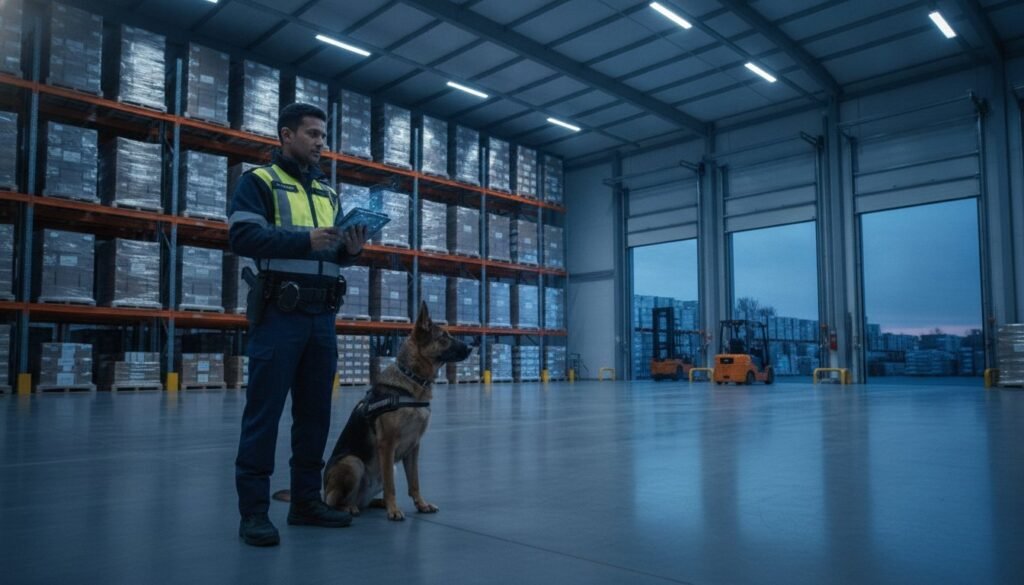
A single breach in your perimeter doesn’t just cost you inventory; it compromises the operational integrity of your entire UK supply chain. Managing large-scale logistics hubs across multiple regions is a relentless task, particularly when inventory shrinkage and external theft threaten your profit margins. You need a proactive shield that operates without interruption. High-calibre warehouse security services are the only way to ensure your facility remains a fortress against modern threats.
We recognise the difficulty of overseeing vast sites whilst staying ahead of strict fire safety regulations. It’s a significant burden. This guide will teach you how to organise a robust security strategy that integrates manned guarding, canine units, and fire safety compliance. You’ll learn how to secure 24/7 protection and potentially reduce insurance premiums through proven deterrence. We’ll outline the path to total compliance using specialist fire strategy reports. Constant vigilance. Absolute compliance. Total protection.
Key Takeaways
- Understand the necessity of an integrated security framework that unites physical guarding with rigorous fire safety protocols.
- Discover how professional warehouse security services employ specialist canine units to secure large perimeters with maximum operational efficiency.
- Learn the methodology for conducting comprehensive site risk assessments to identify and eliminate vulnerabilities in your access control.
- Ensure total regulatory compliance through Building Control approved fire strategy reports and meticulous fire door surveys.
- Recognise the importance of tailoring security deployment to the specific logistical demands of major UK hubs and port-side facilities.
Understanding the Modern Warehouse Security Landscape in the UK
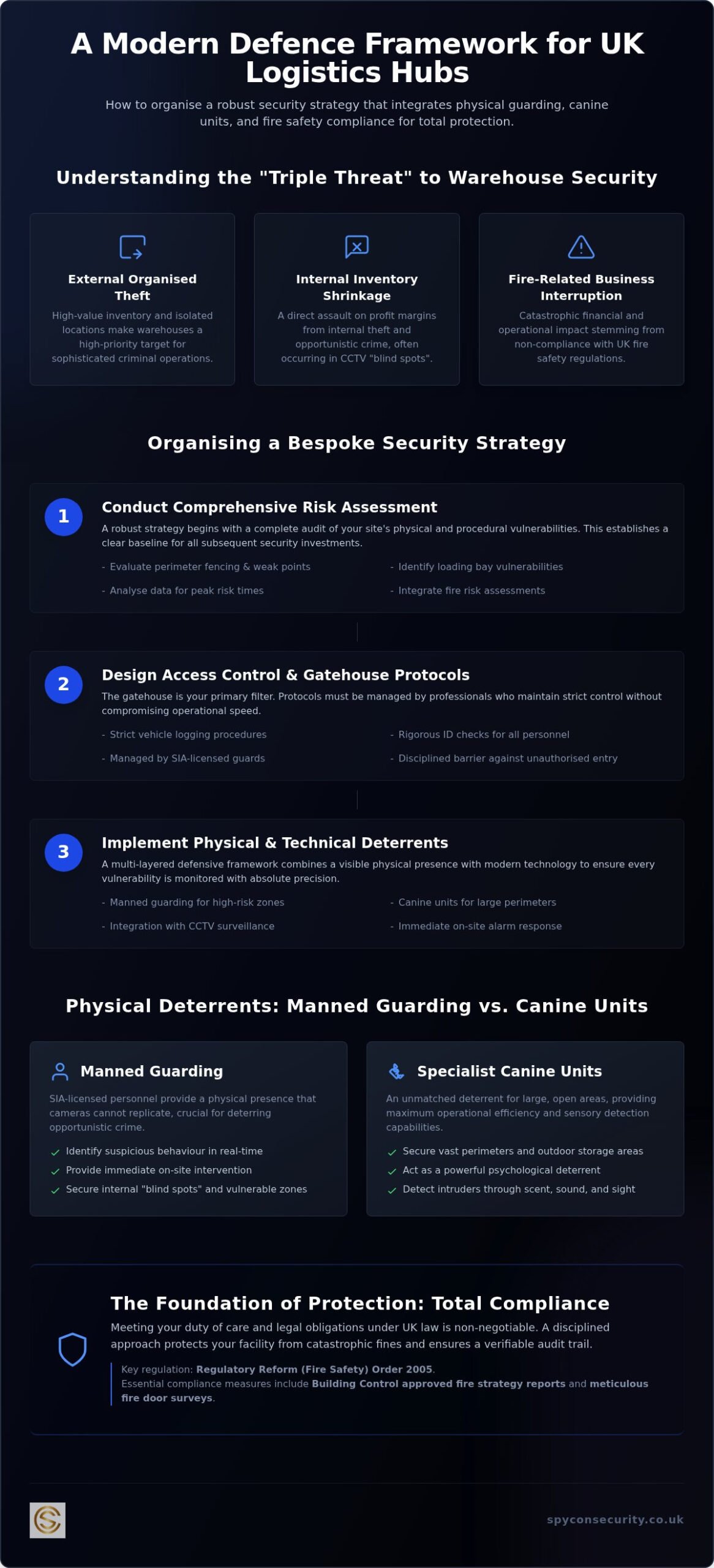
The UK logistics sector faces an increasingly sophisticated criminal environment. Modern warehouse security services are no longer just about locking gates; they are integrated systems of physical, technical, and fire safety measures designed to prevent total business loss. Warehouses remain high-priority targets due to the concentration of high-value inventory and their often isolated industrial locations. In 2026, operators must defend against a “Triple Threat”: external organised theft, internal inventory shrinkage, and fire-related business interruption. Professional warehouse security services represent a multi-layered defensive framework where SIA-licensed personnel coordinate physical deterrence, technological surveillance, and fire safety protocols to ensure total asset protection. This integrated approach ensures that every vulnerability, from the perimeter fence to the loading bay, is monitored with absolute precision.
The Rising Cost of Inventory Shrinkage
Shrinkage is a direct assault on your profit margins. Beyond the immediate loss of stock, high rates of theft lead to increased insurance premiums and operational delays that ripple through the supply chain. Traditional warehouse layouts often contain “blind spots” where CCTV alone cannot provide sufficient coverage, particularly in high-density racking areas. Professional manned guarding serves as a critical deterrent in these vulnerable zones. Guards provide a physical presence that cameras cannot replicate. They identify suspicious behaviour in real-time. They ensure that opportunistic crime, whether internal or external, is met with immediate intervention. This proactive stance is essential for maintaining the integrity of your inventory records and protecting your bottom line.
Regulatory Compliance and Duty of Care
Warehouse owners carry heavy legal obligations under UK law, including the Regulatory Reform (Fire Safety) Order 2005. Standard security measures frequently fail to address the specific risks of large-scale industrial sites, such as hazardous material storage or complex evacuation routes. You must maintain a clear, verifiable audit trail for all security patrols and safety checks. This documentation is vital for demonstrating due diligence during official inspections or insurance claims. A disciplined approach to security ensures you meet your duty of care to staff whilst protecting the facility from the catastrophic financial impact of non-compliance fines. Total oversight is the only acceptable standard for modern logistics hubs. Precision in reporting is as important as the physical protection itself.
How to Organise a Bespoke Warehouse Security Strategy
Developing a resilient defence for a logistics hub requires a methodological approach. Generic solutions fail because they ignore the specific layout and operational tempo of your site. Professional warehouse security services begin with a structured five-step implementation plan. This ensures that physical deterrence, technical surveillance, and fire compliance are perfectly aligned. A bespoke strategy addresses the unique flow of your facility, ensuring protection does not hinder productivity.
Conducting the Initial Risk Assessment
A robust strategy starts with a comprehensive audit of your site’s physical boundaries. This involves evaluating perimeter fencing for weak points and identifying loading bay vulnerabilities where cargo is most at risk. Analysts must examine historical data to predict peak risk times, such as night shifts or weekends, when staffing levels might be lower. This audit must also include fire risk assessment services to identify potential ignition sources amongst high-density storage. Identifying these gaps early prevents costly breaches. It establishes a clear baseline for all subsequent security investments.
Designing Access Control and Gatehouse Protocols
Gatehouses are your primary filter. They must be managed by professionals who understand the rhythm of a busy logistics hub whilst maintaining strict vehicle logging procedures. Rigorous ID checks for staff, contractors, and delivery drivers are mandatory. The objective is to manage the flow of goods-in and goods-out without compromising operational speed. SIA-licensed guards provide the necessary authority to enforce these protocols. They act as a disciplined barrier against unauthorised entry. Precision at the entry point is the foundation of internal site safety.
Once the physical and access barriers are set, you must integrate technical surveillance with physical response units. This ensures that any alarm trigger results in an immediate, on-site investigation. Establishing a fire safety baseline is the next critical phase. A professional fire strategy report provides the blueprint for compliance and total facility protection. Finally, regular auditing ensures your strategy evolves alongside emerging threats. Maintaining this level of operational precision is essential for long-term security. Securing a facility of this scale requires expert oversight; professional manned guarding ensures these protocols are followed without exception.
Implementing Physical Deterrents: Manned Guarding vs Canine Units
Physical deterrence remains the most effective method for preventing unauthorised access to UK logistics hubs. Whilst technical surveillance provides oversight, physical units provide the response necessary to neutralise threats. High-calibre warehouse security services typically employ a combination of manned guarding and canine units to create a layered defence. Manned guarding remains the gold standard for complex gatehouse management and internal asset protection. Conversely, canine security offers an unparalleled level of perimeter coverage. Spycon specialises in combining these two elements for maximum effect, ensuring that your facility is protected by both human intelligence and superior animal senses.
The Role of Specialist Dog Handlers
Large perimeters present significant challenges for traditional foot patrols. A single dog and handler team can effectively cover the same area as four static guards, making them a highly efficient choice for expansive logistics sites. Security dogs possess superior olfactory and auditory senses, allowing them to detect intruders long before they are visible to the human eye or standard CCTV. These units are particularly effective in low-visibility conditions or complex warehouse environments where shadows and racking create natural cover for criminals. The psychological impact of a K9 unit is also a powerful deterrent; most intruders will abandon an attempt rather than risk a confrontation with a trained security dog. Learn more about canine security for UK sites to understand how these specialist units operate under strict professional protocols.
Static Guarding for Loading Bays and Internal Assets
Internal security is just as critical as perimeter defence. Static guards provide a visible presence that discourages internal inventory shrinkage and ensures loading bay protocols are strictly followed. Beyond theft prevention, these personnel perform vital “walking watch” patrols. This involves identifying early signs of fire, water leaks, or equipment failure that could lead to significant business interruption. For facilities located in high-density areas, refer to manned guarding for London assets to see how urban logistics requirements differ from isolated rural sites. This dual-purpose role ensures that your facility is protected from both criminal activity and operational hazards. Constant movement. Expert observation. Immediate response. This is the standard required for total site safety.
Integrating Fire Safety and Surveillance for Total Compliance
A comprehensive warehouse security plan is fundamentally incomplete without a robust fire safety component. Whilst physical deterrence stops the intruder, fire safety compliance protects the business from total asset loss. A professional fire strategy report serves as the foundational document for this protection. It outlines the specific measures required to safeguard high-value inventory and personnel. Modern warehouse security services leverage 24/7 CCTV monitoring not only to detect unauthorised entry but also to serve as a critical early warning system for smoke or heat. Early detection is the difference between a minor incident and a catastrophic facility failure. All fire alarm systems must be maintained to UK national standards to ensure constant readiness.
Fire Door Surveys and Remedial Works
Fire doors are frequently the most overlooked element of warehouse safety. In large-scale logistics hubs, these doors are essential for compartmentation, preventing the rapid spread of fire through vast open spaces. UK law mandates regular inspections for high-occupancy industrial sites to ensure every door remains functional and compliant. Spycon manages the entire lifecycle of this protection, from conducting meticulous fire door surveys to the professional installation of compliant hardware. Maintaining these barriers is a matter of legal duty and operational survival. Neglect leads to heavy fines and increased risk. Precision in maintenance is non-negotiable.
Fire Alarm System Integration
Large open-plan facilities require more than basic alarm hardware. They need integrated monitoring solutions that account for the unique acoustics and layout of a warehouse. Professional fire alarm installation must be tailored to ensure maximum coverage across every square metre. Beyond the hardware, your on-site security team must be expertly trained in fire drill protocols and emergency response. This integration ensures that when an alarm sounds, the response is immediate and disciplined. Total compliance requires a partner that understands both physical protection and fire safety consultancy. Ensure your facility meets every regulatory standard by partnering with Spycon Security Ltd for an integrated safety audit.
Securing Your Logistics Hub: Local Deployment and National Standards
Effective warehouse security services must be adaptable to the specific geographical risks of the UK’s logistics network. A distribution hub in the Midlands faces different operational pressures than a port-side facility in Kent. Whilst national standards like SIA licensing provide a baseline of professional competence, they must be applied with deep local expertise to be truly effective. Spycon organises rapid response teams across its service areas to ensure that any breach is met with immediate, professional intervention. This geographical readiness is critical for maintaining the continuity of national supply chains. Precision in deployment is the hallmark of a resilient security strategy.
Regional Logistics Hotspots: London to the Midlands
Urban warehouses in London and Luton operate within high-traffic, high-risk environments where external theft attempts are frequent. These sites require a heightened level of vigilance and sophisticated access control to manage constant vehicle movements. In the Midlands, the “Golden Triangle” represents the highest density of distribution centres in the UK, necessitating large-scale perimeter protection and robust gatehouse management. For high-stakes urban assets, the deployment of specialist dog handlers in London provides a level of deterrence that static measures cannot achieve. Similarly, port-side facilities in Dover and Canterbury face unique challenges related to international transit and cargo security. These sites require guards trained in specific maritime and border-adjacent protocols to ensure total site integrity.
Ensuring Long-Term Security Resilience
A “set and forget” approach is a precursor to a security breach. Criminal tactics evolve. Site layouts change. Fire safety regulations are updated. Maintaining a resilient defence requires a commitment to constant improvement and rigorous testing. Periodic fire and security audits are essential to identify new vulnerabilities before they can be exploited by organised criminal elements. These reviews ensure that your warehouse security services remain aligned with both the latest threats and current UK compliance laws. Total protection is a continuous process of verification and refinement. It demands a partner that values long-term integrity over short-term convenience. Constant vigilance is the only path to peace of mind.
Precision. Vigilance. Compliance. These are the pillars of a secure logistics operation. Don’t wait for a breach to occur before evaluating your current defensive posture. Contact Spycon Security for a bespoke warehouse security assessment to ensure your facility remains a fortress against all threats.
Protect Your Logistics Operations With Uncompromising Precision
Securing a UK logistics hub requires more than a perimeter fence and a standard lock. It demands a disciplined integration of physical deterrence and regulatory compliance. You’ve seen how professional warehouse security services combine human intelligence with canine precision to eliminate site vulnerabilities. You understand that a Building Control approved fire strategy report is as vital as a manned guard at the gatehouse. These elements work together to create a fortress that is both resilient and compliant.
Maintaining this level of operational integrity is a continuous commitment to excellence. It’s about protecting your profit margins from shrinkage whilst ensuring your facility meets every legal obligation. With SIA licensed guards and 24/7 UK-wide surveillance, your assets remain under constant, expert protection. Total oversight is the only standard that guarantees peace of mind in an evolving threat landscape. High standards are not an option; they are a necessity.
Take the definitive step toward a resilient, compliant facility. Secure your facility with Spycon’s expert warehouse security services and ensure your operations remain uninterrupted. Your business deserves the highest level of professional protection.
Frequently Asked Questions
What are the most common security risks for UK warehouses in 2026?
The primary threats include organised cargo theft and internal inventory shrinkage. Criminal groups are increasingly targeting high-value goods like pharmaceuticals and electronics during both transit and storage. You must also account for business interruption caused by fire or arson. Vigilance against both physical breaches and technical surveillance gaps is essential for modern logistics hubs to maintain operational continuity.
Do I legally need SIA-licensed guards for my warehouse?
You are legally required to use SIA-licensed personnel if you are contracting security services from an external provider. The Private Security Industry Act 2001 mandates that individuals performing manned guarding or keyholding must hold a valid licence. Using unlicensed staff exposes your business to significant legal liability and potential criminal prosecution. Professional warehouse security services ensure all personnel meet these strict regulatory standards without exception.
How does canine security compare to traditional manned guarding in a warehouse setting?
Canine units offer superior perimeter coverage compared to static guards. A single dog and handler can monitor the same area as four traditional guards; this makes them highly efficient for large, isolated sites. Their heightened olfactory and auditory senses allow for earlier detection of intruders in low-visibility conditions. Whilst manned guards excel at gatehouse management, K9 units provide a more powerful psychological and physical deterrent for vast perimeters.
What is included in a warehouse fire strategy report?
A warehouse fire strategy report includes a detailed analysis of evacuation routes, fire compartmentation, and the placement of alarm systems. It provides a blueprint for Building Control approval and ensures compliance with the Regulatory Reform (Fire Safety) Order 2005. The report also assesses high-risk areas like forklift charging bays or chemical storage zones. This document is vital for protecting your facility from total asset loss and legal non-compliance.
Can professional security services help reduce my insurance premiums?
Professional security measures can lead to a reduction in insurance premiums. Insurers view SIA-licensed guarding and 24/7 monitoring as significant risk mitigators for high-value inventory. By providing a clear audit trail of security patrols and fire safety compliance, you demonstrate a proactive approach to asset protection. Many warehouse security services provide the necessary documentation to satisfy the rigorous requirements of industrial insurance providers.
How often should fire door surveys be conducted in an industrial facility?
Fire door surveys should be conducted at least every six months in busy industrial facilities. High-traffic environments lead to frequent wear and tear on door closers, hinges, and seals. Regular inspections are a legal necessity under the Fire Safety (England) Regulations 2022 for specific building types. Ensuring these barriers remain functional is critical for maintaining fire compartmentation and protecting your staff and inventory from rapid fire spread.
What are the benefits of 24/7 CCTV monitoring for remote warehouse sites?
Constant monitoring provides an immediate response to both intruders and early signs of fire. For remote sites, 24/7 CCTV serves as a watchful guardian when staff are not present. It allows for the rapid deployment of mobile units or emergency services, preventing minor incidents from escalating into total losses. This technical oversight complements physical guarding by providing total visibility across every square metre of your facility, day and night.
How do you secure a warehouse with multiple entry and exit points?
Securing multiple entry points requires centralised gatehouse management and integrated technical barriers. You must enforce strict vehicle logging and ID checks at every access point. Combining physical guards with electronic surveillance ensures that all movements are tracked and verified. Establishing a single point of entry policy for visitors whilst maintaining secure, monitored loading bays for logistics prevents unauthorised access without hindering your operational flow.