

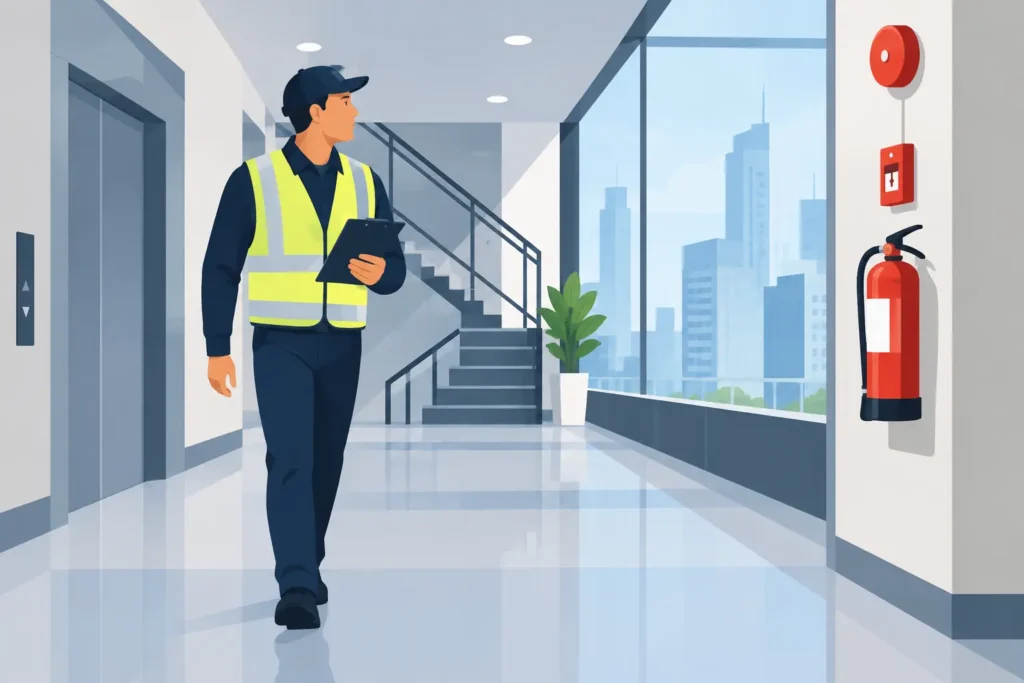
A fire alarm fault, incomplete remediation work, or an external wall concern can leave a building exposed long before a permanent solution is installed. Walking watch fire safety fills that gap with trained personnel on site, actively patrolling the premises, identifying signs of fire, and initiating a controlled response when seconds matter. It is not a substitute for a compliant fire strategy or a functioning alarm system. It is a temporary life-safety control that must be planned, staffed, managed, and documented to stand up to scrutiny.
For property managers, landlords, construction leaders, and facilities teams, the decision is not simply whether to place someone in a building overnight. The question is whether the arrangement provides credible coverage for the building’s actual risks, occupants, layout, and evacuation approach.
What Walking Watch Fire Safety Is Designed to Do
A walking watch is a continuous or scheduled physical patrol carried out by trained fire safety personnel. The watch is commonly introduced where a building’s normal fire precautions are compromised or where the fire risk assessment identifies a heightened short-term risk. Typical triggers include defective alarm coverage, evacuation concerns in higher-risk residential buildings, construction activity, impaired fire doors, or fire safety measures awaiting repair or replacement.
Patrol officers move through agreed routes and critical areas rather than remaining at a single point. They look for smoke, heat, burning smells, unsafe storage, blocked escape routes, damaged compartmentation, unauthorized hot work, and other conditions that could allow a fire to start or spread. If they identify an incident, they raise the alarm, contact emergency services where required, support the evacuation plan, and provide clear information to responding crews.
The value is active human detection. A monitored technical system may identify smoke in a covered zone, but it cannot check whether a stairwell is obstructed, whether contractors have left ignition sources unattended, or whether a fire door has been wedged open. A walking watch can do those things, provided its officers are briefed properly and the patrol plan reflects the site.
When a Walking Watch Is the Right Control
Walking watches are often associated with residential towers, but the principle applies more broadly. A temporary fire patrol may be appropriate in occupied apartment blocks, hotels, student housing, hospitals, mixed-use developments, warehouses, and construction sites. The need depends on the findings of a current fire risk assessment and on the controls already in place.
It may be justified when an alarm system is impaired, when planned works affect detection or escape arrangements, or when a building has a known risk requiring immediate management while remediation is underway. In some cases, additional patrols during specific periods are sufficient. In others, the risk profile requires 24/7 coverage, with officers positioned to inspect all relevant areas at a frequency set by the fire strategy.
That distinction matters. Overstaffing can create avoidable cost without improving safety. Understaffing creates a more serious problem: a control that exists on paper but cannot detect, communicate, and respond quickly enough in practice. The right level of cover follows a competent assessment of travel distances, building height, occupancy, sleeping risk, compartmentation, detection systems, and evacuation arrangements.
A temporary measure requires a permanent plan
A walking watch should have a defined purpose, review date, and exit plan. It can reduce risk while repairs, alarm upgrades, fire door replacements, or broader remediation are completed, but it should not become an unchallenged long-term workaround.
Decision-makers should ask what condition caused the watch to be introduced, who owns the corrective action, what milestones are in place, and what evidence will show that the watch can be reduced or removed safely. This keeps operational spending aligned with the actual route to compliance.
What Effective Patrol Coverage Looks Like
Reliable walking watch coverage starts before the first patrol. The provider needs a site-specific briefing that covers the building plan, fire alarm arrangements, escape routes, assembly points, resident or occupant needs, restricted areas, utility shut-offs, and contact details for responsible persons. Generic instructions are not enough for a complex site.
Patrol routes should be written, practical, and repeatable. They need to include common areas, corridors, stairs, plant rooms where appropriate, external access points, waste areas, construction interfaces, and locations with known fire hazards. Officers also need clear patrol intervals. A route that takes longer to complete than the agreed inspection frequency is not a workable control.
Good coverage also requires defined escalation. Personnel must know what to do if they find smoke, hear an alarm, discover a blocked exit, or identify a condition that needs immediate isolation. They should understand when to call the fire department, when to notify building management, and how to communicate with occupants without causing confusion or delay.
Personnel are not there merely to walk a route and complete a log. They are there to make informed observations, take proportionate action, and preserve an accurate record of what happened.
Documentation Is Part of the Fire Safety Control
When a building’s fire precautions are questioned by regulators, insurers, residents, or investigators after an incident, verbal assurance is not enough. The responsible party needs evidence of the decision-making process and the controls in operation.
Walking watch records should show patrol times, areas checked, observations made, hazards identified, corrective actions, and escalation details. Shift handovers should record outstanding issues, changes to access, contractor activity, and any defects affecting the patrol plan. Supervisory checks help confirm that the assigned coverage is being delivered as specified.
Documentation should connect with the wider fire safety file, including the current risk assessment, alarm testing records, emergency lighting checks, fire door inspections, incident reports, and remediation updates. This creates a defensible chain from identified risk to temporary control to permanent correction.
For multi-occupancy sites, communication records are equally valuable. Occupants need clear, accurate instructions about alarm signals, evacuation expectations, access restrictions, and any temporary procedures. Messages should be controlled by the responsible management team and consistent with the building’s fire strategy. A patrol officer cannot compensate for unclear resident communication or an evacuation plan that has never been tested.
Common Gaps That Undermine a Walking Watch
The most common failure is treating the service as generic security guarding. Fire safety patrols require a different brief, different reporting standards, and a direct connection to the building’s risk controls. An officer who has not been trained on the site’s fire arrangements may be present without being effective.
Another gap is relying on a fixed patrol schedule that becomes predictable. If a patrol is always completed at the same time and in the same sequence, conditions can change between rounds. The solution is not random patrols without discipline, but a structured plan with sufficient frequency, responsive checks after relevant events, and supervision.
Poor coordination with contractors is also a significant risk. Construction and maintenance works can introduce hot work, temporary electrical equipment, dust, open service risers, impaired detection, and changes to escape routes. The walking watch team must receive timely information about the work taking place and have authority to escalate unsafe conditions.
Finally, some sites fail to review the arrangement as conditions improve or deteriorate. If an alarm system is restored, patrol deployment may be reduced only after the relevant checks and approvals. If new defects are found or occupancy changes, the coverage may need to increase. Fire safety controls must follow the live risk, not last month’s assumptions.
Integrating Fire Safety and Protective Operations
For occupied, high-risk, or operationally sensitive sites, fire safety cannot sit apart from access control, contractor management, CCTV coverage, and incident response. A blocked emergency exit may be a fire safety issue, a security issue, or both. An unauthorized person entering a plant room can create a life-safety risk as well as an asset-protection concern.
Using one accountable provider for trained patrol personnel, control-room support, fire safety documentation, and wider site protection can remove handoff failures between separate contractors. Spycon Security Ltd. applies this joined-up approach so that frontline observations reach the people responsible for corrective action, while records remain available for management review.
The right walking watch is not judged by how many rounds appear on a timesheet. It is judged by whether the building has credible detection, clear escalation, capable people, and evidence that risk is being actively controlled until the permanent fire safety solution is in place.