

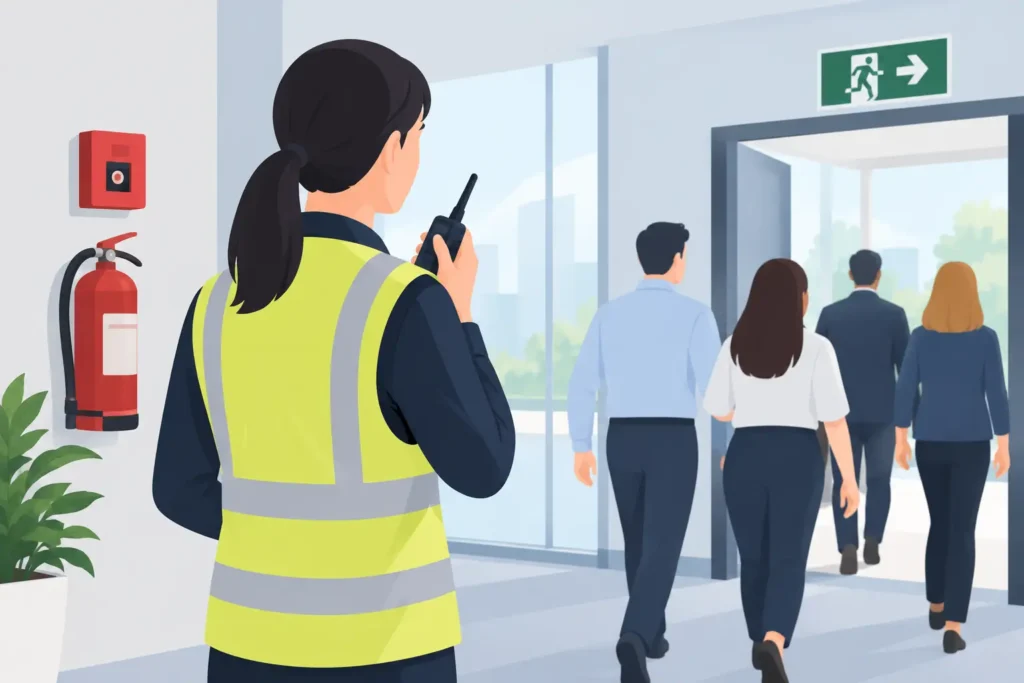
A fire alarm can raise the warning, but it cannot account for a visitor who does not know the exit route, a mobility-impaired employee waiting for assistance, or a contractor working behind a locked door. This is where trained people matter. The question, when are fire wardens required, is not answered simply by counting employees. It depends on the building, the people in it, the work being carried out, and the controls already in place.
For facilities managers, property managers, employers, and site leaders, the objective is clear: provide sufficient competent support to evacuate people safely, manage an incident in its early stages where appropriate, and demonstrate that the arrangement will hold up under scrutiny.
When Are Fire Wardens Required?
In many workplaces, fire wardens – also called fire marshals – are required when a fire risk assessment identifies the need for designated, trained people to support evacuation and fire-safety procedures. The exact legal duty varies by jurisdiction. In the United States, local fire codes, building codes, occupational-safety requirements, and the authority having jurisdiction may set specific requirements. In the United Kingdom, the responsible person must appoint competent persons to assist with preventive and protective measures where necessary.
The key point is that a job title is not usually the legal test. Adequacy is. If the risk assessment shows that occupants may need direction, sweep procedures, evacuation assistance, coordination with emergency services, or active monitoring of temporary hazards, designated fire wardens are normally the practical control.
A small, single-story office with a straightforward layout, a low occupancy, automatic detection, and a practiced evacuation plan may need fewer designated personnel than a large multi-tenant building. A warehouse, care setting, school, construction project, high-rise residential property, or venue with public attendance may require a much stronger on-site response arrangement.
The Risk Assessment Should Set the Requirement
A compliant fire-safety arrangement starts with a current, site-specific fire risk assessment. It should not assume that one warden is enough because that is what another location uses, or because a staffing chart happens to show an available supervisor.
The assessment should consider the building layout, escape routes, fire compartments, alarm coverage, occupancy levels, work patterns, and the presence of people who may need assistance. It should also consider whether staff are familiar with the premises. A corporate headquarters with permanent employees presents a different evacuation challenge from a visitor-heavy reception area, a retail unit, or a construction site with changing subcontractors.
Fire wardens become particularly necessary where there is a realistic risk that people will not self-evacuate promptly or safely. Common triggers include:
- Multiple floors, complex layouts, hidden rooms, or separate work zones
- Shift work, lone working, reduced overnight staffing, or frequent absences
- Visitors, contractors, members of the public, or occupants unfamiliar with escape routes
- People who need personal emergency evacuation plans or other assistance
- Higher fire risks, including hot work, flammable materials, commercial kitchens, battery charging, or construction activity
- Buildings with phased evacuation, simultaneous evacuation, or stay-put strategies that require clear site-specific procedures
A fire warden arrangement should never be used to cover deficiencies that need a technical solution. Blocked exits, failed emergency lighting, defective fire doors, or inadequate alarm coverage are not staffing issues. They must be corrected at source.
How Many Fire Wardens Do You Need?
There is rarely a universal ratio that applies to every premises. A commonly repeated number, such as one warden for every set number of employees, may be a useful starting point for internal planning, but it is not a substitute for a risk-based decision.
The right number depends on who is present at the busiest time, how far wardens must travel to check assigned areas, and whether they can carry out their duties without delaying their own escape. Consider every floor, department, tenant area, and shift. Then account for annual leave, sickness, meetings off-site, and staff turnover. A plan that works only when all named wardens are present is not dependable.
For example, a two-floor office may assign a trained warden to each floor, with deputies available for absences. A large distribution center may need coverage for warehouse aisles, loading areas, offices, welfare facilities, and night operations. A residential block may need trained fire marshals or a temporary fire-watch arrangement where building defects or alarm-system outages create a heightened risk.
The question is not whether the roster looks adequate on paper. It is whether enough competent people are available at the moment an alarm activates.
Coverage Must Match Operating Hours
Daytime coverage does not prove nighttime coverage. If a site runs 24/7, has weekend activity, or operates with a skeleton crew after normal business hours, the emergency plan must remain workable across every shift.
This may mean appointing and training additional deputies, changing responsibilities by shift, or using dedicated fire-watch personnel during higher-risk periods. For sites with continuous activity, control-room oversight, patrol records, and escalation procedures can also strengthen accountability.
What Fire Wardens Are Expected to Do
A fire warden is not expected to be a firefighter. Their role is to support the emergency plan without taking unnecessary personal risk. Duties should be written clearly and reflect the site risk assessment.
Before an incident, wardens may check that escape routes are unobstructed, fire doors are not wedged open, extinguishers remain accessible, and hazards are reported. They may also help communicate evacuation procedures to new staff, contractors, and visitors.
During an alarm, a warden may direct people toward safe exits, check assigned areas only where it is safe to do so, assist with roll calls, and report missing persons or relevant hazards to the incident lead or responding fire service. They should not re-enter a building, investigate smoke, or continue a sweep where conditions are unsafe.
After an event or drill, wardens should report failures: an exit that was locked, a door that did not close, an assembly point that was unsuitable, or a department that did not receive the alarm. These observations turn a drill into evidence for improvement.
Training, Drills, and Documentation Matter
Appointing names is not enough. Fire wardens need training that covers their practical responsibilities, the site evacuation plan, alarm signals, escape routes, assembly arrangements, and limitations of their role. Refresher training is necessary when staff change, layouts are altered, new risks are introduced, or drills identify gaps.
Training should be reinforced by realistic evacuation drills. A drill should test more than whether an alarm sounds. It should test communication, sweep assignments, visitor control, accessibility arrangements, roll-call accuracy, and the time needed to clear the premises.
Keep records of warden appointments, training, refresher dates, fire drills, issues identified, corrective actions, and updates to the fire risk assessment. These records demonstrate active management and give site leaders a reliable basis for decisions. They are especially valuable following an inspection, insurance review, enforcement visit, or incident.
Temporary Fire Wardens and Fire Watch Arrangements
There are times when normal arrangements are not enough. If a fire alarm system is impaired, fire doors are compromised, major construction work is taking place, or a building has been identified as having elevated risk, a temporary fire watch may be required by the relevant authority, insurer, or risk assessment.
This is not simply a matter of placing a person at reception. Effective fire-watch coverage needs defined patrol routes, frequencies, communications, escalation instructions, logbooks, and trained personnel who understand the premises. The arrangement must remain in place until the underlying control is restored or an alternative approved measure is implemented.
For construction and refurbishment projects, fire-warden duties should also be coordinated with permit-to-work controls, hot-work monitoring, material storage, changing escape routes, and contractor inductions. Conditions can change daily, so the fire plan must change with them.
Build a Fire-Warden Plan That Works Under Pressure
Start with the current risk assessment and walk the site as it operates, not as it appears on a drawing. Identify who is on-site during each shift, where people could become isolated, how visitors are accounted for, and what happens if a named warden is absent. Assign clear areas, nominate deputies, train them properly, and test the plan through drills.
Most importantly, review the arrangement whenever the building, occupancy, staffing, or risk profile changes. A fire warden is not a box to check. It is a defined life-safety responsibility that must work when people are under pressure and minutes matter.