

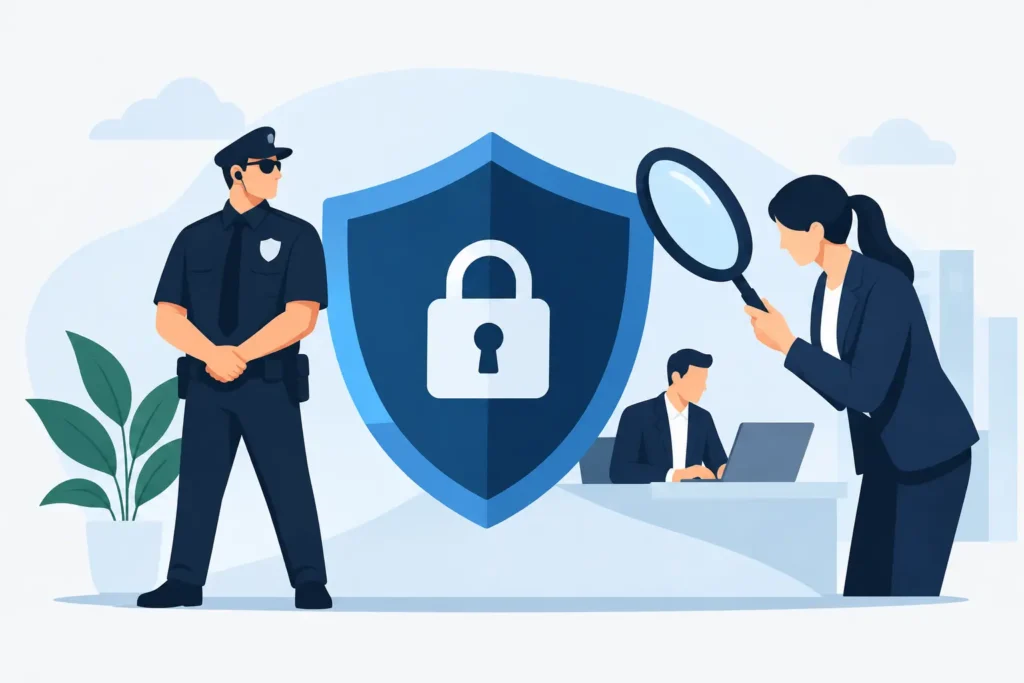
A vacant reception desk, an unsecured delivery entrance, or a fire panel alarm handled without a clear escalation path can quickly become more than an operational inconvenience. Security outsourcing gives organizations access to trained personnel, monitored systems, and defined response procedures without carrying the full burden of recruiting, supervising, and managing an in-house team.
For facilities managers, property owners, construction leaders, and operations teams, the decision is not simply whether to place a guard at a door. The real question is whether protection will hold up when an incident occurs, an insurer asks for evidence, or a regulator reviews the measures in place. A capable provider supplies visible protection and the records, supervision, and accountability behind it.
What Security Outsourcing Should Deliver
Security outsourcing means placing some or all security responsibilities with a specialist provider. That may include manned guarding, mobile patrols, canine units, event teams, access control, CCTV monitoring, alarm response, or control-room support. The right scope depends on the site, the threat profile, operating hours, and the level of public access.
The value is not limited to filling shifts. An outsourced security partner should bring established recruitment and vetting processes, trained officers, operational management, incident reporting, and cover for absence or changing risk. This gives the client a managed protective function rather than a collection of individuals working without consistent oversight.
For many organizations, security also overlaps with fire safety, property compliance, and business continuity. A warehouse may need gatehouse control, monitored cameras, emergency lighting checks, and a tested response to an out-of-hours alarm. A residential development may require concierge coverage, fire-door inspections, and documented escalation for vulnerable occupants. Splitting these responsibilities across disconnected vendors can create gaps precisely where accountability matters most.
Why Organizations Choose Security Outsourcing
The strongest case for outsourcing is control. It may appear counterintuitive at first: handing responsibility to a third party can feel less direct than hiring internally. In practice, a well-managed provider creates clearer lines of responsibility, measurable service expectations, and an escalation route when performance falls short.
Recruiting an in-house team requires more than posting vacancies. It involves screening, licensing where required, training, scheduling, payroll, relief coverage, supervision, disciplinary processes, and continuous competence management. Those demands increase sharply for 24/7 sites, multi-location estates, and operations with fluctuating staffing needs. A specialist provider is built to manage those requirements as part of its core operation.
Outsourcing also provides flexibility. A construction project may need gate security during active works, additional patrols during a high-value installation phase, and a different arrangement once the site is handed over. An event may need entry screening, queue management, backstage protection, and overnight security for a limited period. In each case, the service can be scaled around the actual risk rather than a permanent headcount.
There is also a practical compliance benefit. Security records, patrol logs, visitor information, incident reports, training evidence, and system maintenance documentation can demonstrate that reasonable controls were in place. Documentation does not prevent every incident, but it provides a defensible account of what was planned, delivered, and reviewed.
The Risks of Buying on Price Alone
Security is often procured under budget pressure, especially when the service is viewed as a basic guarding requirement. That approach can produce false savings. A low hourly rate may conceal weak supervision, poorly briefed staff, high turnover, inconsistent relief coverage, or reports that offer little useful evidence after an incident.
The consequences are operational as well as financial. An officer who does not understand site rules may allow unauthorized access, mishandle a visitor dispute, fail to identify a developing safety issue, or escalate too late. On a construction site, that can mean theft, trespass, vandalism, or unsafe access. In a residential or commercial building, it can affect occupants, reputation, and the ability to demonstrate duty of care.
Outsourcing does not remove the client’s responsibility to select and manage a provider. It changes the model. The client should define outcomes, verify credentials, agree reporting standards, and review performance. The provider should then take ownership of staffing, deployment, supervision, and response within that agreed framework.
How to Set the Right Scope
A useful security program begins with a site-specific assessment, not a generic staffing proposal. Consider what must be protected: people, equipment, information, stock, vehicles, access points, or the continuity of operations. Then consider when those risks are most likely to arise. A site may be quiet during business hours but exposed overnight, at weekends, or during deliveries.
The assessment should also examine the environment. Public-facing facilities need a different officer profile from industrial yards. A high-rise residential block requires different procedures from a logistics depot or a live construction project. Officers must understand the building, its occupants, its emergency arrangements, and the authority they have to intervene or escalate.
Technology should support the plan, not substitute for it. CCTV monitoring can provide continuous observation across large areas and create an evidential record. Access-control systems can restrict movement and identify entry attempts. Remote monitoring may be more cost-effective than a fixed officer for some lower-risk locations. But cameras cannot always challenge an intruder, direct an evacuation, manage a confrontation, or provide visible reassurance to staff and visitors.
The most effective arrangements often combine trained personnel with monitored technology. For example, a control room can identify an issue, follow an agreed escalation process, and direct a mobile response or on-site team. That combination gives organizations coverage beyond the limits of a single guard position.
Define the Response, Not Just the Presence
A contract should clearly describe what happens when something goes wrong. If an alarm activates, who verifies the cause? Who contacts emergency services? Who informs the client’s nominated manager? What information is recorded, and how quickly is the report issued?
These details are especially important for sites operating outside standard hours. A 24/7 service is only meaningful if calls are answered, incidents are assessed, and the right people are mobilized without uncertainty. The same principle applies to fire and life-safety events, where delayed or confused action can place people at risk.
What Good Provider Governance Looks Like
A professional provider does not treat deployment as the end of the job. It maintains active oversight through site instructions, shift briefings, supervisory visits, quality checks, incident review, and client communication. The client should know who manages the account, who is available after hours, and how concerns are escalated.
Reporting should be proportionate but useful. Daily activity records may be appropriate for high-risk sites, while periodic summaries can help property and operations leaders identify repeat issues, access weaknesses, or times of increased exposure. Reports should state facts clearly, record actions taken, and identify any recommendation that requires client approval.
Ask practical questions before appointing a provider. How are officers selected for the assignment? How is absence covered? Who audits performance? What training is relevant to the site? Can the provider support both protective staffing and safety compliance where those responsibilities meet? Clear answers reveal whether the service is designed around dependable delivery or simply shift fulfillment.
Integrating Security With Fire and Site Compliance
Security personnel are often the first people to notice a blocked exit, a damaged fire door, an unauthorized contractor, or an evacuation concern. They should not replace qualified fire-safety professionals, but they can play a critical role in identifying issues early and following established procedures.
This is where an integrated provider can reduce risk. Instead of separate teams working with incomplete information, security operations, fire-safety services, inspections, and documentation can be coordinated around one site plan. Spycon Security Ltd. applies this approach by connecting frontline security coverage with fire-safety capability and accountable service management.
Integration is not always necessary. A small office with limited access risk may only need a focused monitoring or access-control solution. But for multi-occupancy properties, construction projects, industrial assets, events, and sites with complex life-safety obligations, coordinated oversight can make responsibilities easier to manage and easier to evidence.
Make Outsourcing an Active Partnership
The best security outsourcing arrangements are reviewed as the site changes. New tenants, altered operating hours, construction phases, staffing reductions, seasonal demand, or a recent incident can all change the level of protection required. A service that was appropriate six months ago may no longer match the current exposure.
Set review points, examine incident trends, test communication routes, and confirm that instructions remain accurate. Protection should be visible where it needs to be, monitored when people are absent, and documented well enough to stand up to scrutiny. That is how outsourced security becomes more than a contracted service: it becomes a dependable part of operational control.